7 minutes
UChat
Posted by
7 Botpress Alternatives in 2026: Agent Builder or Customer Journey?
7 minutes
Posted by
UChat

UChat is a Botpress alternative when an AI Agent must operate inside a complete customer journey across channels, CRM, payments, live support and branded client workspaces. Voiceflow fits collaborative agent design, while Chatbase, Chatling, DocsBot AI, CustomGPT.ai and SiteGPT provide increasingly packaged routes to knowledge-grounded website agents.
Botpress remains a credible option when the agent itself is the engineering product and the team values visual development plus developer extensibility.
Bottom line: Decide how much of the surrounding customer operation you want the platform to provide, and how much your team intends to build.
Botpress Alternatives At A Glance
Alternative | Right for whom | Published model | Important tradeoff |
|---|---|---|---|
UChat | Automation teams and agencies | Free $0, Business $15 and Partner $199 monthly | Less centered on code-first agent engineering |
Voiceflow | Collaborative design and agency teams | Free trial, usage billing and business quotes; no flat public anchor | Flexible agent design; buyer still owns production architecture and runtime cost |
Chatbase | Teams launching hosted knowledge agents | Credit plans from Free to Pro | Less deterministic journey depth |
Chatling | Smaller website chatbot teams | Credit-tier plans | Narrower multichannel operations |
DocsBot AI | Documentation and support knowledge bots | Plans from Free to Business | Actions and lifecycle work need validation |
CustomGPT.ai | Business knowledge and retrieval use cases | Standard, Premium and Enterprise | Higher entry price for packaged knowledge |
SiteGPT | Website support and lead capture | Message and bot allowances | Website remains the center |
Why Teams Look For A Botpress Alternative
Botpress supports serious AI Agent development, but buyers may prefer a more collaborative design product, a faster hosted knowledge bot, a website-first package or a platform that already includes channel and customer-operation concepts.
Botpress currently publishes Pay-as-you-go at $0 plus AI spend, Plus at $79 monthly on annual billing, and Team at $445 monthly on annual billing. Monthly pricing is higher, and message events, bots, collaborators, storage and AI spend can add cost.
Botpress may be the more coherent choice when developers want the agent runtime, autonomous behavior and extensibility to remain the center of the product.
1. UChat: For AI Inside Customer Operations
UChat combines AI Agents with a visual Flow Builder, channel-specific messages, questions, conditions, functions, external requests and human handoff.
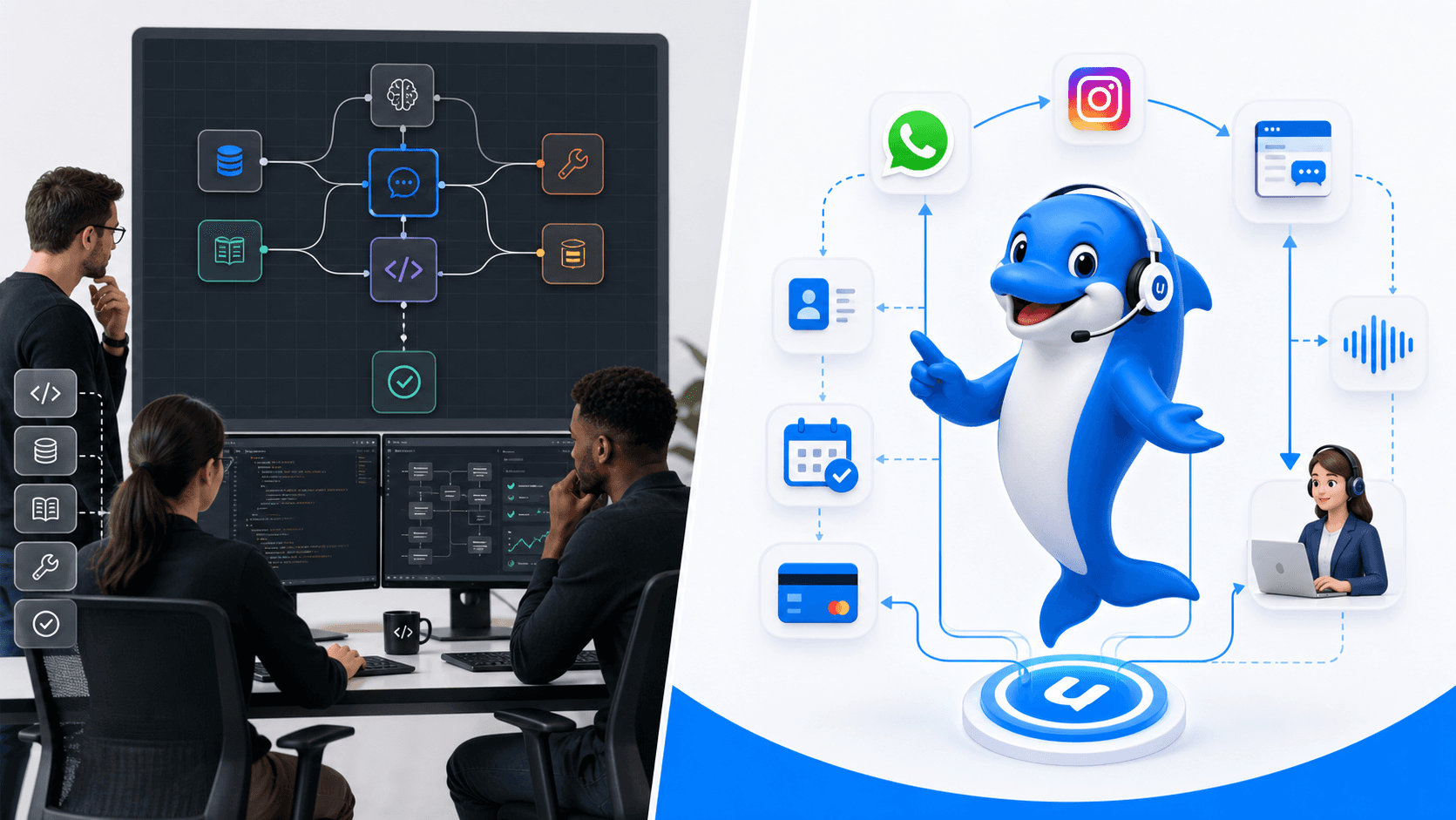
A journey can acquire a lead, collect structured details, let AI answer and choose an approved function, update a CRM board, take payment, create a ticket and continue follow-up. The platform supplies more of the operating vocabulary around the agent.
UChat Business is $15 monthly with one bot, 1,000 bot users, five members, unlimited automations and unlimited conversations. Partner is $199 monthly and adds branded domains, client workspaces, plans and billing. Provider and AI model charges may still apply. This makes UChat relevant for agencies selling automation, but a developer building a custom agent product may prefer Botpress or Voiceflow.
2. Voiceflow: For Collaborative Agent Design
Voiceflow supports teams designing, testing and handing off conversational agents with collaborative tooling and usage-based packaging. Its builder combines open-ended playbooks, deterministic workflows, a knowledge base, custom code and tools that can call APIs or native integrations such as Salesforce, HubSpot, Zendesk, Shopify and Twilio. It also addresses agency and multi-client delivery. Its public page offers a free trial and usage billing for agencies, while business pricing requires a request.
Its strongest evaluation is collaborative: let a designer, developer and client reviewer change the same agent, test a playbook and a fixed workflow, then approve a staged release. The tradeoff is that the buyer still needs to define the surrounding channels, service operation and runtime budget.
3. Chatbase: For Hosted Knowledge Agents
Chatbase publishes Free at 50 message credits, Hobby at $40 monthly for 700, Standard at $150 for 4,000 and Pro at $500 for 15,000, with add-ons available.
A team can use those tiers to prototype a knowledge-grounded agent without first assembling a development environment. Chatbase can train on documents, websites and databases, use prebuilt or custom actions, and create tickets in connected helpdesks for human escalation. That makes it more than a static FAQ bot, although the buyer still needs to prove the complete journey around those actions.
4. Chatling: For Accessible Website AI
Chatling publishes Free plus Starter, Growth and Scale plans. Monthly prices begin at $25, $75 and $295, with lower annual equivalents.
Chatling combines an AI knowledge base with live chat, CSAT, conversation summaries and integrations that include WhatsApp, Instagram, Telegram, Messenger, HubSpot and Zendesk. This gives a smaller support team a packaged route beyond a website widget; UChat becomes more relevant when deterministic business actions across those channels must share one maintained journey.
5. DocsBot AI: For Documentation-Led Support
DocsBot AI publishes Free, Personal at $49, Standard at $149 and Business at $499 monthly.
Documentation-led support is the cleanest fit. DocsBot can ingest sources ranging from websites and Confluence to helpdesks and code repositories, then extend answers with AI Actions through skills, APIs, MCP, webhooks and widget actions. The key test is whether its knowledge refresh and approved actions cover the support process without requiring a second orchestration layer.
6. CustomGPT.ai: For Business Knowledge Agents
CustomGPT.ai publishes Standard at $99 monthly or $89 on annual billing, Premium at $499 or $449, and Enterprise by quote.
CustomGPT.ai emphasizes broad source ingestion, source links in answers, public or private deployment and API access. It fits organizations that want a governed knowledge agent without managing the underlying indexing stack; the boundary to test is how many transactions and support operations must still be implemented through the API or another workflow system.
7. SiteGPT: For Website Support And Lead Capture
SiteGPT lists Starter, Growth and Scale at monthly equivalents of $39, $79 and $259 when billed annually.
It trains on website content, documents and a knowledge base, then adds lead-capture forms, automated follow-up, human handoff and integrations including Slack, Messenger and Zendesk. That is a clear fit for website support and lead capture; the limiting question is whether the customer journey later needs to originate and continue across more channels.
Decision Tree: Which Botpress Alternative Should You Choose?
Need AI inside cross-channel customer operations? Choose UChat.
Need collaborative conversation design? Choose Voiceflow.
Need a hosted knowledge agent? Choose Chatbase.
Need accessible website AI? Choose Chatling.
Need documentation-led support automation? Choose DocsBot AI.
Need a packaged business knowledge agent? Choose CustomGPT.ai.
Need website support and lead capture? Choose SiteGPT.
Need developer-led agent engineering? Keep Botpress.
How To Compare The Real Cost
Model messages, AI model usage, knowledge storage, bots or agents, team seats, integrations, human handoff, observability and implementation. Include the software needed around a narrow website bot.
An agent-builder bill and a customer-operation bill are not equivalent. Price the same production workflow, failure handling and monthly volume across every candidate.
Pricing was reviewed on official vendor pages on 31 August 2026. Recheck before purchase.
Frequently Asked Questions
Which Botpress alternative fits agencies?
UChat fits agencies that need full white-label client operations, while Voiceflow deserves consideration for collaborative agent design and client handoff.
Which option is fastest for a website knowledge bot?
Chatbase, Chatling, DocsBot AI, CustomGPT.ai and SiteGPT all offer packaged paths. Test the same source set, ten difficult questions and one escalation path.
Can UChat replace Botpress completely?
Not for every developer-led project. Validate autonomous tool selection, code workflows, testing, versioning, observability and custom integration requirements before migrating.
Try UChat For AI-Powered Customer Journeys
Start a 14-day UChat trial with Pro features and no credit card. Agencies can explore the Partner Plan or book a partner demo.
Sources
Editorial disclosure: This guide is published by UChat. Recommendations follow the use cases supported by the cited public evidence.
UChat is a Botpress alternative when an AI Agent must operate inside a complete customer journey across channels, CRM, payments, live support and branded client workspaces. Voiceflow fits collaborative agent design, while Chatbase, Chatling, DocsBot AI, CustomGPT.ai and SiteGPT provide increasingly packaged routes to knowledge-grounded website agents.
Botpress remains a credible option when the agent itself is the engineering product and the team values visual development plus developer extensibility.
Bottom line: Decide how much of the surrounding customer operation you want the platform to provide, and how much your team intends to build.
Botpress Alternatives At A Glance
Alternative | Right for whom | Published model | Important tradeoff |
|---|---|---|---|
UChat | Automation teams and agencies | Free $0, Business $15 and Partner $199 monthly | Less centered on code-first agent engineering |
Voiceflow | Collaborative design and agency teams | Free trial, usage billing and business quotes; no flat public anchor | Flexible agent design; buyer still owns production architecture and runtime cost |
Chatbase | Teams launching hosted knowledge agents | Credit plans from Free to Pro | Less deterministic journey depth |
Chatling | Smaller website chatbot teams | Credit-tier plans | Narrower multichannel operations |
DocsBot AI | Documentation and support knowledge bots | Plans from Free to Business | Actions and lifecycle work need validation |
CustomGPT.ai | Business knowledge and retrieval use cases | Standard, Premium and Enterprise | Higher entry price for packaged knowledge |
SiteGPT | Website support and lead capture | Message and bot allowances | Website remains the center |
Why Teams Look For A Botpress Alternative
Botpress supports serious AI Agent development, but buyers may prefer a more collaborative design product, a faster hosted knowledge bot, a website-first package or a platform that already includes channel and customer-operation concepts.
Botpress currently publishes Pay-as-you-go at $0 plus AI spend, Plus at $79 monthly on annual billing, and Team at $445 monthly on annual billing. Monthly pricing is higher, and message events, bots, collaborators, storage and AI spend can add cost.
Botpress may be the more coherent choice when developers want the agent runtime, autonomous behavior and extensibility to remain the center of the product.
1. UChat: For AI Inside Customer Operations
UChat combines AI Agents with a visual Flow Builder, channel-specific messages, questions, conditions, functions, external requests and human handoff.
A journey can acquire a lead, collect structured details, let AI answer and choose an approved function, update a CRM board, take payment, create a ticket and continue follow-up. The platform supplies more of the operating vocabulary around the agent.
UChat Business is $15 monthly with one bot, 1,000 bot users, five members, unlimited automations and unlimited conversations. Partner is $199 monthly and adds branded domains, client workspaces, plans and billing. Provider and AI model charges may still apply. This makes UChat relevant for agencies selling automation, but a developer building a custom agent product may prefer Botpress or Voiceflow.
2. Voiceflow: For Collaborative Agent Design
Voiceflow supports teams designing, testing and handing off conversational agents with collaborative tooling and usage-based packaging. Its builder combines open-ended playbooks, deterministic workflows, a knowledge base, custom code and tools that can call APIs or native integrations such as Salesforce, HubSpot, Zendesk, Shopify and Twilio. It also addresses agency and multi-client delivery. Its public page offers a free trial and usage billing for agencies, while business pricing requires a request.
Its strongest evaluation is collaborative: let a designer, developer and client reviewer change the same agent, test a playbook and a fixed workflow, then approve a staged release. The tradeoff is that the buyer still needs to define the surrounding channels, service operation and runtime budget.
3. Chatbase: For Hosted Knowledge Agents
Chatbase publishes Free at 50 message credits, Hobby at $40 monthly for 700, Standard at $150 for 4,000 and Pro at $500 for 15,000, with add-ons available.
A team can use those tiers to prototype a knowledge-grounded agent without first assembling a development environment. Chatbase can train on documents, websites and databases, use prebuilt or custom actions, and create tickets in connected helpdesks for human escalation. That makes it more than a static FAQ bot, although the buyer still needs to prove the complete journey around those actions.
4. Chatling: For Accessible Website AI
Chatling publishes Free plus Starter, Growth and Scale plans. Monthly prices begin at $25, $75 and $295, with lower annual equivalents.
Chatling combines an AI knowledge base with live chat, CSAT, conversation summaries and integrations that include WhatsApp, Instagram, Telegram, Messenger, HubSpot and Zendesk. This gives a smaller support team a packaged route beyond a website widget; UChat becomes more relevant when deterministic business actions across those channels must share one maintained journey.
5. DocsBot AI: For Documentation-Led Support
DocsBot AI publishes Free, Personal at $49, Standard at $149 and Business at $499 monthly.
Documentation-led support is the cleanest fit. DocsBot can ingest sources ranging from websites and Confluence to helpdesks and code repositories, then extend answers with AI Actions through skills, APIs, MCP, webhooks and widget actions. The key test is whether its knowledge refresh and approved actions cover the support process without requiring a second orchestration layer.
6. CustomGPT.ai: For Business Knowledge Agents
CustomGPT.ai publishes Standard at $99 monthly or $89 on annual billing, Premium at $499 or $449, and Enterprise by quote.
CustomGPT.ai emphasizes broad source ingestion, source links in answers, public or private deployment and API access. It fits organizations that want a governed knowledge agent without managing the underlying indexing stack; the boundary to test is how many transactions and support operations must still be implemented through the API or another workflow system.
7. SiteGPT: For Website Support And Lead Capture
SiteGPT lists Starter, Growth and Scale at monthly equivalents of $39, $79 and $259 when billed annually.
It trains on website content, documents and a knowledge base, then adds lead-capture forms, automated follow-up, human handoff and integrations including Slack, Messenger and Zendesk. That is a clear fit for website support and lead capture; the limiting question is whether the customer journey later needs to originate and continue across more channels.
Decision Tree: Which Botpress Alternative Should You Choose?
Need AI inside cross-channel customer operations? Choose UChat.
Need collaborative conversation design? Choose Voiceflow.
Need a hosted knowledge agent? Choose Chatbase.
Need accessible website AI? Choose Chatling.
Need documentation-led support automation? Choose DocsBot AI.
Need a packaged business knowledge agent? Choose CustomGPT.ai.
Need website support and lead capture? Choose SiteGPT.
Need developer-led agent engineering? Keep Botpress.
How To Compare The Real Cost
Model messages, AI model usage, knowledge storage, bots or agents, team seats, integrations, human handoff, observability and implementation. Include the software needed around a narrow website bot.
An agent-builder bill and a customer-operation bill are not equivalent. Price the same production workflow, failure handling and monthly volume across every candidate.
Pricing was reviewed on official vendor pages on 31 August 2026. Recheck before purchase.
Frequently Asked Questions
Which Botpress alternative fits agencies?
UChat fits agencies that need full white-label client operations, while Voiceflow deserves consideration for collaborative agent design and client handoff.
Which option is fastest for a website knowledge bot?
Chatbase, Chatling, DocsBot AI, CustomGPT.ai and SiteGPT all offer packaged paths. Test the same source set, ten difficult questions and one escalation path.
Can UChat replace Botpress completely?
Not for every developer-led project. Validate autonomous tool selection, code workflows, testing, versioning, observability and custom integration requirements before migrating.
Try UChat For AI-Powered Customer Journeys
Start a 14-day UChat trial with Pro features and no credit card. Agencies can explore the Partner Plan or book a partner demo.
Sources
Editorial disclosure: This guide is published by UChat. Recommendations follow the use cases supported by the cited public evidence.