8 minutes
UChat
Posted by
7 Rasa Alternatives in 2026: Code Control or Faster Delivery?
8 minutes
Posted by
UChat

Quick answer: UChat is a Rasa alternative when operations teams or agencies need a managed visual builder, ready customer channels and human support tools. Rasa remains the code-first choice for high-trust business logic and self-managed deployment; Dialogflow CX fits Google Cloud, while Copilot Studio fits Microsoft-centered organizations.
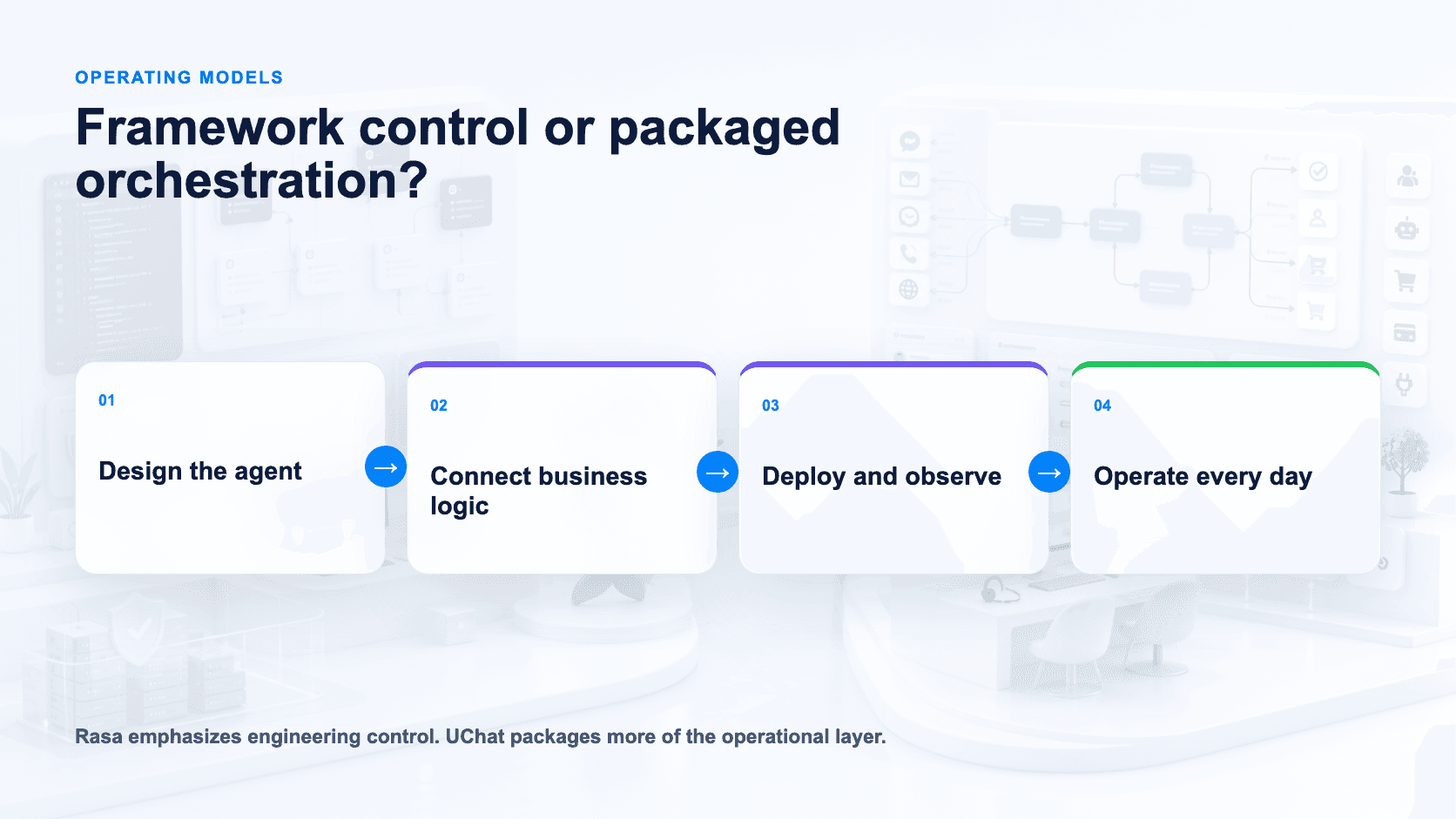
Rasa remains a good option when developers must own agent behavior in code, run the platform in controlled infrastructure and integrate it as a long-lived software system. A managed visual platform trades some of that ownership for faster delivery and simpler daily operation.
Bottom line: Choose who should own the agent after launch. Rasa optimizes for engineering control; managed visual platforms optimize for operational speed. Neither advantage is free.
Rasa Alternatives At A Glance
Alternative | Best fit | Operating model and control | Cost or implementation watchout | Evidence |
|---|---|---|---|---|
UChat | operations teams and agencies wanting managed visual delivery | AI Agents, a visual Flow Builder, channels, live chat and Partner features let non-developers launch and operate solutions. | It does not provide the same code-first ownership or self-managed posture Rasa emphasizes. | |
Dialogflow CX | Google Cloud teams building structured virtual agents | Flow-based conversation design, voice and Google Cloud integration suit developer-led deployments. | Usage pricing and surrounding operational components require careful architecture. | |
Botpress | technical teams wanting a visual AI-agent studio | Visual building, code extensions, knowledge and usage-based AI make it approachable without removing technical options. | Messages, AI spend, collaborators, storage and add-ons shape total cost. | |
Voiceflow | conversation-design teams prototyping chat and voice | Collaborative design, testing and deployment make it strong for teams iterating on conversational experiences. | Enterprise operations and runtime economics must be validated for the target scale. | |
Yellow.ai | large enterprises seeking managed omnichannel AI | Chat, voice, many channels and enterprise capabilities are packaged as a managed platform. | Enterprise pricing and implementation are sales-led. | |
Cognigy | enterprise contact centers | Conversational AI, voice and contact-center integration fit complex service environments. | Licensing, voice and implementation require a workload-specific commercial model. | |
Microsoft Copilot Studio | Microsoft-centered organizations | Power Platform connectors, governance and Microsoft 365 context reduce friction inside that ecosystem. | Copilot Credits and adjacent licensing make cost comparison less direct. |
Why Buyers Look For Rasa Alternatives
Rasa is built for developers creating high-trust conversational AI with explicit business logic and deployment control. Buyers look elsewhere when they want a browser-based visual builder, managed channels and human support tools, a Microsoft or Google ecosystem fit, or an agency-ready platform.
Rasa offers a free Developer Edition for one bot with a monthly conversation allowance. Rasa Pro and Rasa Studio add pro-code infrastructure and a no-code business interface, while enterprise deployment and support are sales-led. Include infrastructure and engineering ownership when comparing it with managed SaaS platforms.
UChat publishes Free at $0, Business at $15 and Partner at $199 as managed entry plans. A fair comparison adds UChat workspace limits, add-ons and messaging or AI-provider costs, then compares them with Rasa licensing, infrastructure, model usage, engineering, observability and ongoing platform ownership.
For a developer-platform decision, compare versioning, testability, prompt and policy control, deployment, monitoring, channel adapters and human operations around one high-value task. Treat undocumented parity as unknown and require an implementation proof.
Rasa vs UChat: Engineering Ownership Or Managed Operation?
Decision area | Rasa | UChat | What to prove |
|---|---|---|---|
Build model | Rasa documents CALM, business-logic Flows, code and prompt control for developer teams. | UChat combines a browser-based visual Flow Builder, AI Agents and callable actions. | Who can safely change the agent each week? |
Code and version ownership | Rasa fits software teams that want logic, extensions and delivery practices under engineering control. | UChat favors configuration in a managed product rather than source-code ownership of the runtime. | Require the versioning, review and rollback process you need. |
Deployment | Rasa documents self-managed and private-cloud paths, including Kubernetes deployment. | UChat is delivered as a managed SaaS platform; its public pages do not promise self-hosted deployment. | Verify residency, networking, backup and environment requirements. |
Testing and evaluation | Rasa's developer model supports engineering-led tests and evaluation around explicit business logic. | UChat supports visual testing and deterministic paths, but public material does not establish parity with a full code-based CI and evaluation stack. | Run regression, injection, correction and failure tests. |
Observability and security | Rasa makes infrastructure and operational controls part of the customer's architecture. | UChat reduces infrastructure ownership but also gives buyers less runtime control. | Define logs, alerts, access, retention and incident responsibilities. |
Channels and human work | Channel adapters and human-service integration are assembled for the target architecture. | UChat provides ready channel options, Live Chat, Boards and Tickets in the managed platform. | Compare adapter work, handoff context and daily operator usability. |
Agency delivery | Rasa can power deeply custom software but the agency owns more engineering. | UChat Partner adds white label, client workspaces, plans and billing. | Decide whether differentiation comes from custom code or repeatable packaged delivery. |
UChat's Managed Tradeoff In Practice
An operations team can build a multichannel UChat flow, ground an AI Agent in approved knowledge, call an API or integration, hand the conversation to Live Chat and track the next step in a Board or Ticket. The platform handles the product runtime while the team operates flow logic, credentials, knowledge, channel configuration and support processes.
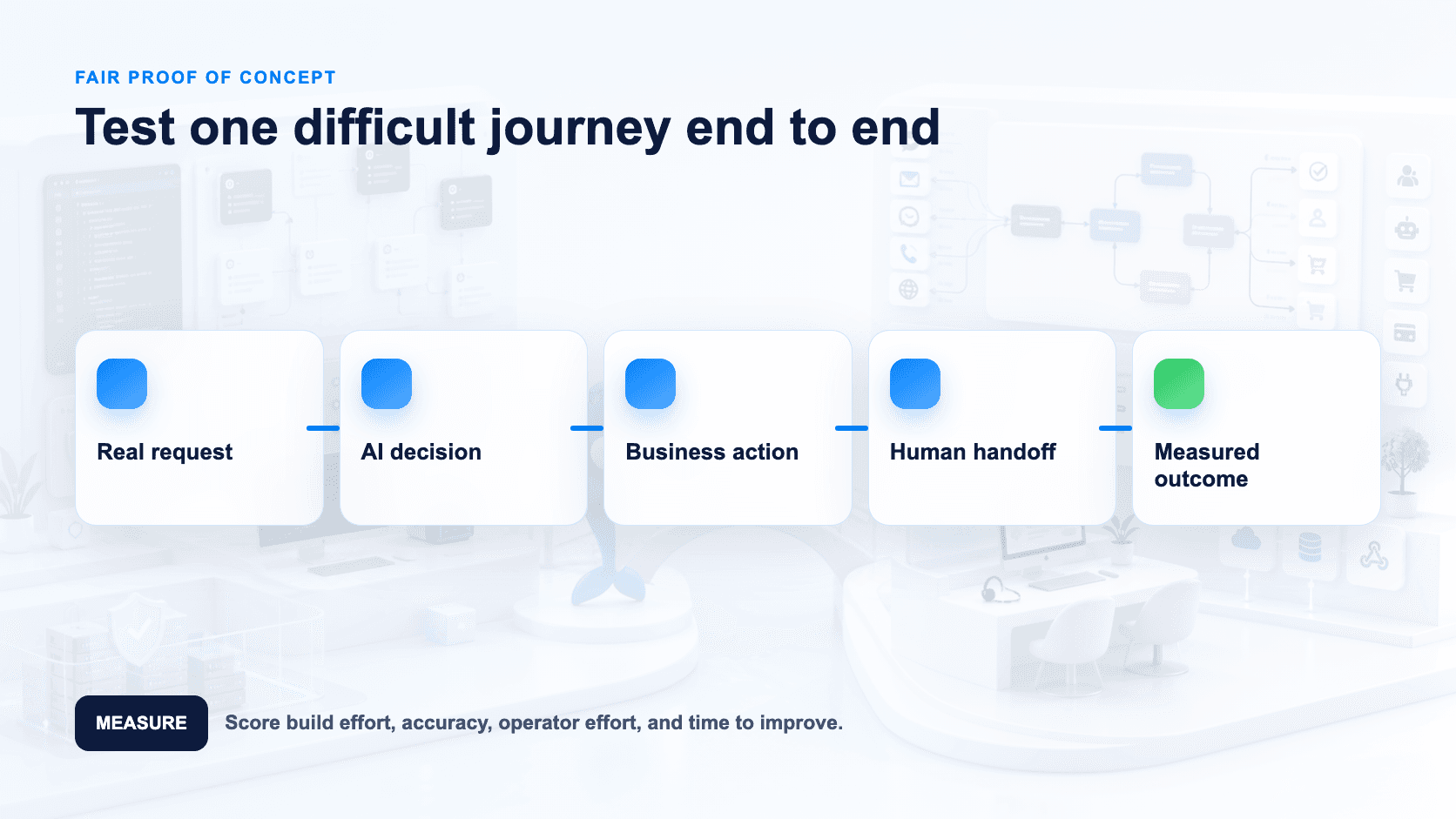
Compare both platforms with one versioned acceptance scenario:
Trigger the same authenticated task on the selected channel and pin the knowledge and model configuration used for the test.
Run success, invalid-input, prompt-injection, correction and external-API failure cases.
Record the expected deterministic route, callable action, retry rule and human-escalation state.
Verify what logs, alerts, access controls and rollback evidence each platform can provide.
Have the future operator change one rule and redeploy it; measure engineering effort and operational risk.
The tradeoff is real. UChat shortens the route to a working managed solution, especially for non-developers and agencies. It does not provide the same self-managed deployment, code ownership, infrastructure control or engineering test surface that makes Rasa attractive. Security, monitoring, rollback and environment needs should be verified as explicit acceptance criteria rather than inferred from either vendor's marketing.
1. UChat
Best fit: operations teams and agencies wanting managed visual delivery.
AI Agents, a visual Flow Builder, channels, live chat and Partner features let non-developers launch and operate solutions.
Tradeoff: It does not provide the same code-first ownership or self-managed posture Rasa emphasizes.
2. Dialogflow CX
Best fit: Google Cloud teams building structured virtual agents.
Flow-based conversation design, voice and Google Cloud integration suit developer-led deployments.
Tradeoff: Usage pricing and surrounding operational components require careful architecture.
3. Botpress
Best fit: technical teams wanting a visual AI-agent studio.
Visual building, code extensions, knowledge and usage-based AI make it approachable without removing technical options.
Tradeoff: Messages, AI spend, collaborators, storage and add-ons shape total cost.
4. Voiceflow
Best fit: conversation-design teams prototyping chat and voice.
Collaborative design, testing and deployment make it strong for teams iterating on conversational experiences.
Tradeoff: Enterprise operations and runtime economics must be validated for the target scale.
5. Yellow.ai
Best fit: large enterprises seeking managed omnichannel AI.
Chat, voice, many channels and enterprise capabilities are packaged as a managed platform.
Tradeoff: Enterprise pricing and implementation are sales-led.
6. Cognigy
Best fit: enterprise contact centers.
Conversational AI, voice and contact-center integration fit complex service environments.
Tradeoff: Licensing, voice and implementation require a workload-specific commercial model.
7. Microsoft Copilot Studio
Best fit: Microsoft-centered organizations.
Power Platform connectors, governance and Microsoft 365 context reduce friction inside that ecosystem.
Tradeoff: Copilot Credits and adjacent licensing make cost comparison less direct.
How To Choose The Right Rasa Alternative
Choose UChat when non-developers must build and operate multichannel workflows or an agency needs branded client delivery.
Choose Rasa when code ownership, self-managed deployment and explicit high-trust business logic are hard requirements.
Choose Dialogflow CX when Google Cloud and telephony architecture are already strategic.
Choose Copilot Studio when Microsoft governance and connectors matter more than platform neutrality.
Proof before migration: Implement one high-value task with business rules, API calls, corrections, prompt-injection tests, a human escalation and deployment monitoring. Measure engineering effort as carefully as answer quality.
Frequently Asked Questions
What is a practical Rasa alternative for non-developers?
UChat is a visual multichannel option in this shortlist. Voiceflow and Botpress also provide visual design surfaces, with different runtime and technical models.
Which alternative supports self-managed deployment?
Rasa explicitly supports self-managed deployment and should remain on the shortlist when that requirement is central.
Which option is best for agencies?
UChat Partner is purpose-built for custom branding, client workspaces, plans, billing and repeatable delivery.
How should we compare Rasa with SaaS pricing?
Add license, infrastructure, model usage, engineering, observability, upgrades and support. Compare that total with SaaS plans, usage and implementation.
Try UChat
Start a 14-day UChat trial with access to Pro features and no credit card required. Agencies evaluating branded client delivery can book a Partner Plan demo.
Sources
Pricing and packaging were reviewed on 2026-08-31. Verify current terms, limits, add-ons, taxes and implementation requirements before purchasing.
Quick answer: UChat is a Rasa alternative when operations teams or agencies need a managed visual builder, ready customer channels and human support tools. Rasa remains the code-first choice for high-trust business logic and self-managed deployment; Dialogflow CX fits Google Cloud, while Copilot Studio fits Microsoft-centered organizations.
Rasa remains a good option when developers must own agent behavior in code, run the platform in controlled infrastructure and integrate it as a long-lived software system. A managed visual platform trades some of that ownership for faster delivery and simpler daily operation.
Bottom line: Choose who should own the agent after launch. Rasa optimizes for engineering control; managed visual platforms optimize for operational speed. Neither advantage is free.
Rasa Alternatives At A Glance
Alternative | Best fit | Operating model and control | Cost or implementation watchout | Evidence |
|---|---|---|---|---|
UChat | operations teams and agencies wanting managed visual delivery | AI Agents, a visual Flow Builder, channels, live chat and Partner features let non-developers launch and operate solutions. | It does not provide the same code-first ownership or self-managed posture Rasa emphasizes. | |
Dialogflow CX | Google Cloud teams building structured virtual agents | Flow-based conversation design, voice and Google Cloud integration suit developer-led deployments. | Usage pricing and surrounding operational components require careful architecture. | |
Botpress | technical teams wanting a visual AI-agent studio | Visual building, code extensions, knowledge and usage-based AI make it approachable without removing technical options. | Messages, AI spend, collaborators, storage and add-ons shape total cost. | |
Voiceflow | conversation-design teams prototyping chat and voice | Collaborative design, testing and deployment make it strong for teams iterating on conversational experiences. | Enterprise operations and runtime economics must be validated for the target scale. | |
Yellow.ai | large enterprises seeking managed omnichannel AI | Chat, voice, many channels and enterprise capabilities are packaged as a managed platform. | Enterprise pricing and implementation are sales-led. | |
Cognigy | enterprise contact centers | Conversational AI, voice and contact-center integration fit complex service environments. | Licensing, voice and implementation require a workload-specific commercial model. | |
Microsoft Copilot Studio | Microsoft-centered organizations | Power Platform connectors, governance and Microsoft 365 context reduce friction inside that ecosystem. | Copilot Credits and adjacent licensing make cost comparison less direct. |
Why Buyers Look For Rasa Alternatives
Rasa is built for developers creating high-trust conversational AI with explicit business logic and deployment control. Buyers look elsewhere when they want a browser-based visual builder, managed channels and human support tools, a Microsoft or Google ecosystem fit, or an agency-ready platform.
Rasa offers a free Developer Edition for one bot with a monthly conversation allowance. Rasa Pro and Rasa Studio add pro-code infrastructure and a no-code business interface, while enterprise deployment and support are sales-led. Include infrastructure and engineering ownership when comparing it with managed SaaS platforms.
UChat publishes Free at $0, Business at $15 and Partner at $199 as managed entry plans. A fair comparison adds UChat workspace limits, add-ons and messaging or AI-provider costs, then compares them with Rasa licensing, infrastructure, model usage, engineering, observability and ongoing platform ownership.
For a developer-platform decision, compare versioning, testability, prompt and policy control, deployment, monitoring, channel adapters and human operations around one high-value task. Treat undocumented parity as unknown and require an implementation proof.
Rasa vs UChat: Engineering Ownership Or Managed Operation?
Decision area | Rasa | UChat | What to prove |
|---|---|---|---|
Build model | Rasa documents CALM, business-logic Flows, code and prompt control for developer teams. | UChat combines a browser-based visual Flow Builder, AI Agents and callable actions. | Who can safely change the agent each week? |
Code and version ownership | Rasa fits software teams that want logic, extensions and delivery practices under engineering control. | UChat favors configuration in a managed product rather than source-code ownership of the runtime. | Require the versioning, review and rollback process you need. |
Deployment | Rasa documents self-managed and private-cloud paths, including Kubernetes deployment. | UChat is delivered as a managed SaaS platform; its public pages do not promise self-hosted deployment. | Verify residency, networking, backup and environment requirements. |
Testing and evaluation | Rasa's developer model supports engineering-led tests and evaluation around explicit business logic. | UChat supports visual testing and deterministic paths, but public material does not establish parity with a full code-based CI and evaluation stack. | Run regression, injection, correction and failure tests. |
Observability and security | Rasa makes infrastructure and operational controls part of the customer's architecture. | UChat reduces infrastructure ownership but also gives buyers less runtime control. | Define logs, alerts, access, retention and incident responsibilities. |
Channels and human work | Channel adapters and human-service integration are assembled for the target architecture. | UChat provides ready channel options, Live Chat, Boards and Tickets in the managed platform. | Compare adapter work, handoff context and daily operator usability. |
Agency delivery | Rasa can power deeply custom software but the agency owns more engineering. | UChat Partner adds white label, client workspaces, plans and billing. | Decide whether differentiation comes from custom code or repeatable packaged delivery. |
UChat's Managed Tradeoff In Practice
An operations team can build a multichannel UChat flow, ground an AI Agent in approved knowledge, call an API or integration, hand the conversation to Live Chat and track the next step in a Board or Ticket. The platform handles the product runtime while the team operates flow logic, credentials, knowledge, channel configuration and support processes.
Compare both platforms with one versioned acceptance scenario:
Trigger the same authenticated task on the selected channel and pin the knowledge and model configuration used for the test.
Run success, invalid-input, prompt-injection, correction and external-API failure cases.
Record the expected deterministic route, callable action, retry rule and human-escalation state.
Verify what logs, alerts, access controls and rollback evidence each platform can provide.
Have the future operator change one rule and redeploy it; measure engineering effort and operational risk.
The tradeoff is real. UChat shortens the route to a working managed solution, especially for non-developers and agencies. It does not provide the same self-managed deployment, code ownership, infrastructure control or engineering test surface that makes Rasa attractive. Security, monitoring, rollback and environment needs should be verified as explicit acceptance criteria rather than inferred from either vendor's marketing.
1. UChat
Best fit: operations teams and agencies wanting managed visual delivery.
AI Agents, a visual Flow Builder, channels, live chat and Partner features let non-developers launch and operate solutions.
Tradeoff: It does not provide the same code-first ownership or self-managed posture Rasa emphasizes.
2. Dialogflow CX
Best fit: Google Cloud teams building structured virtual agents.
Flow-based conversation design, voice and Google Cloud integration suit developer-led deployments.
Tradeoff: Usage pricing and surrounding operational components require careful architecture.
3. Botpress
Best fit: technical teams wanting a visual AI-agent studio.
Visual building, code extensions, knowledge and usage-based AI make it approachable without removing technical options.
Tradeoff: Messages, AI spend, collaborators, storage and add-ons shape total cost.
4. Voiceflow
Best fit: conversation-design teams prototyping chat and voice.
Collaborative design, testing and deployment make it strong for teams iterating on conversational experiences.
Tradeoff: Enterprise operations and runtime economics must be validated for the target scale.
5. Yellow.ai
Best fit: large enterprises seeking managed omnichannel AI.
Chat, voice, many channels and enterprise capabilities are packaged as a managed platform.
Tradeoff: Enterprise pricing and implementation are sales-led.
6. Cognigy
Best fit: enterprise contact centers.
Conversational AI, voice and contact-center integration fit complex service environments.
Tradeoff: Licensing, voice and implementation require a workload-specific commercial model.
7. Microsoft Copilot Studio
Best fit: Microsoft-centered organizations.
Power Platform connectors, governance and Microsoft 365 context reduce friction inside that ecosystem.
Tradeoff: Copilot Credits and adjacent licensing make cost comparison less direct.
How To Choose The Right Rasa Alternative
Choose UChat when non-developers must build and operate multichannel workflows or an agency needs branded client delivery.
Choose Rasa when code ownership, self-managed deployment and explicit high-trust business logic are hard requirements.
Choose Dialogflow CX when Google Cloud and telephony architecture are already strategic.
Choose Copilot Studio when Microsoft governance and connectors matter more than platform neutrality.
Proof before migration: Implement one high-value task with business rules, API calls, corrections, prompt-injection tests, a human escalation and deployment monitoring. Measure engineering effort as carefully as answer quality.
Frequently Asked Questions
What is a practical Rasa alternative for non-developers?
UChat is a visual multichannel option in this shortlist. Voiceflow and Botpress also provide visual design surfaces, with different runtime and technical models.
Which alternative supports self-managed deployment?
Rasa explicitly supports self-managed deployment and should remain on the shortlist when that requirement is central.
Which option is best for agencies?
UChat Partner is purpose-built for custom branding, client workspaces, plans, billing and repeatable delivery.
How should we compare Rasa with SaaS pricing?
Add license, infrastructure, model usage, engineering, observability, upgrades and support. Compare that total with SaaS plans, usage and implementation.
Try UChat
Start a 14-day UChat trial with access to Pro features and no credit card required. Agencies evaluating branded client delivery can book a Partner Plan demo.
Sources
Pricing and packaging were reviewed on 2026-08-31. Verify current terms, limits, add-ons, taxes and implementation requirements before purchasing.