12 minutes
UChat
Posted by
UChat vs Chatwoot: Visual Automation or Open-Source Support Inbox?
12 minutes
Posted by
UChat

Quick Verdict
UChat and Chatwoot can both manage customer conversations across multiple channels, automate replies and bring human agents into the conversation. Their centers of gravity are different.
Choose Chatwoot for an open-source support inbox. Choose UChat when customer conversations need to become visible, multi-step business workflows across acquisition, sales, payments, CRM and support.
Chatwoot is compelling for a support team that values open source, self-hosting, control of its infrastructure and a conventional shared inbox. Captain adds an AI Agent and Copilot to that operating model.
UChat is built around automation design. Its Flow Builder combines channel triggers, AI Agents, deterministic rules, integrations, payments, CRM Boards, Tickets and human handoff. The Partner Plan also lets agencies deliver the platform under their own brand.
Table Of Contents
Scorecard
Recommendation By Use Case
Feature Comparison: Shared Inbox Versus Journey Builder
AI Agent And Human Assistance
Channels And Conversation Entry Points
Automation Integrations And APIs
Self-Hosting Security And Control
Reporting CRM And Support Operations
Pricing And Platform Resources
Agency And White-Label Delivery
When Chatwoot May Be A Better Fit
Decision Checklist
FAQ
Final Verdict And CTA
Scorecard
Decision area | Better starting fit | Why |
|---|---|---|
Open-source deployment | Chatwoot | Its codebase and self-hosted edition provide infrastructure control. |
Shared support inbox | Chatwoot | Inbox, assignments, teams, SLAs and reports are central to the product. |
AI support copilot | Chatwoot | Captain Copilot suggests responses, summarizes and translates inside the inbox. |
Visual customer journeys | UChat | AI, conditions, actions, APIs and channel nodes share one canvas. |
Social and acquisition automation | UChat | Comments, ads, messages and forms can trigger structured journeys. |
Reusable business operations | UChat | Function Flows isolate reusable logic across channels and bots. |
Built-in customer lifecycle | UChat | Boards, Tickets, Live Chat and automation connect acquisition through support. |
Full-white-label agency platform | UChat | Partners can brand, price, provision and manage client workspaces. |
Recommendation By Use Case
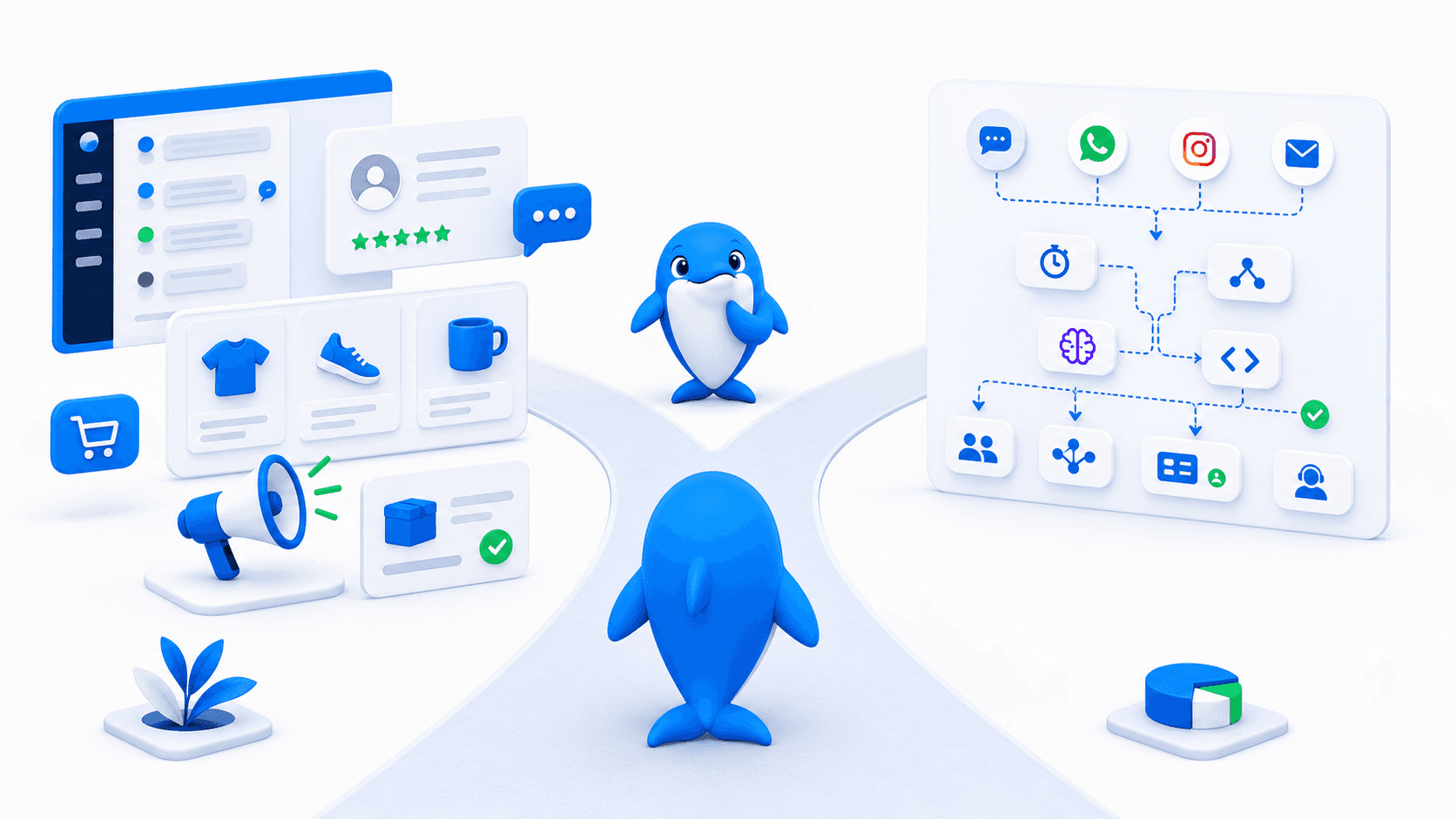
Chatwoot fits support-led operations. A team can consolidate website chat, email and messaging channels into one inbox, assign conversations, collaborate internally and measure support performance. Self-hosting is valuable when the organization wants to control the application and its data environment.
UChat fits automation-led operations. A lead can arrive from an Instagram comment, answer qualification questions, receive an AI recommendation, book or pay, enter a CRM stage, reach a human and continue through automated follow-up.
Choose Chatwoot when the primary job is to operate a support desk and open-source deployment matters. Choose UChat when the conversation is one part of a broader customer journey or when an agency wants to sell branded automation solutions.
Feature Comparison: Shared Inbox Versus Journey Builder
Chatwoot starts with the inbox. Conversations from supported channels appear in a shared workspace where agents can assign ownership, use private notes, apply labels, create teams and collaborate. This is a familiar operating model for customer support.
UChat includes Live Chat and Tickets, but its foundation is the Flow Builder. Teams design what should happen before, during and after a human conversation. Message nodes, questions, conditions, actions, delays, AI steps, APIs and channel-specific features form one journey.
The difference is the system's center. In Chatwoot, automation helps the support inbox run efficiently. In UChat, the inbox is one possible stage inside an automation system.
For a team replacing a conventional help desk, Chatwoot may feel more immediately familiar. For a team building lead capture, onboarding, commerce or service workflows, UChat exposes more of the surrounding journey directly.
AI Agent And Human Assistance
Chatwoot's Captain product combines two useful roles. Captain AI Agent handles customer questions using configured knowledge and automation. Captain Copilot assists human agents with suggested replies, summaries and translation. Cloud plans include monthly Captain credits, with the amount varying by plan.
UChat AI Agents use roles, instructions, business knowledge and callable functions. Supported model options include OpenAI, Claude, DeepSeek and xAI. AI steps can sit beside deterministic flow logic, so a team can let AI interpret intent while rules protect sensitive actions.
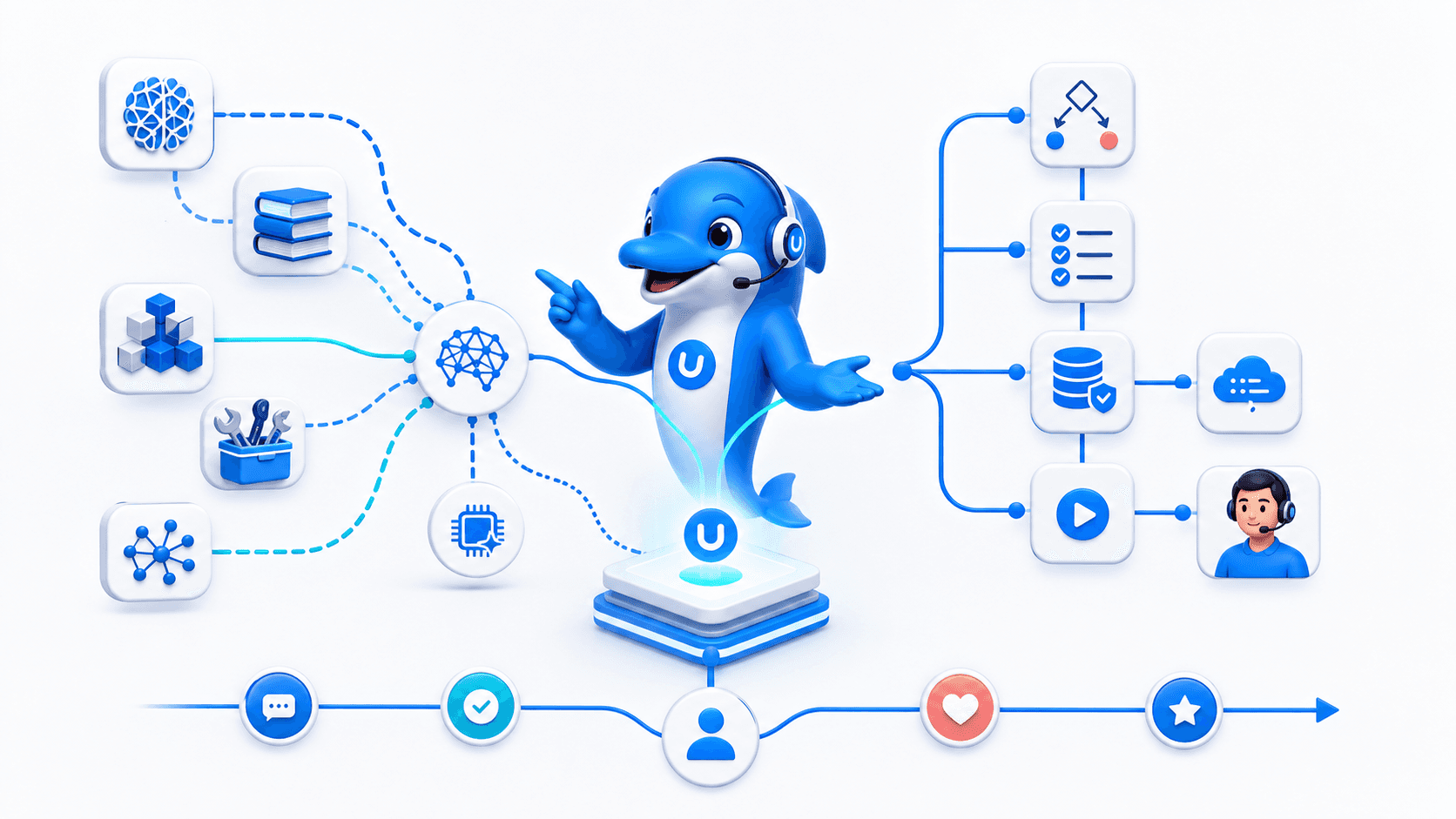
Function Flows can isolate a reusable operation such as checking an order, validating an appointment or calculating eligibility. The operation can return a verified result or a precise escalation reason without duplicating the logic in every channel flow.
For an inbox-centered support team, Captain is a natural extension of Chatwoot. UChat becomes more relevant when AI must participate in a larger, explicitly designed business process.
Test the action path, not only the answer. Include missing identity, unavailable APIs, conflicting records, restricted requests, duplicate submissions and human approval.
Channels And Conversation Entry Points
Chatwoot Cloud supports website live chat, email, WhatsApp, Facebook Messenger, Instagram, Telegram, LINE, SMS and API-created channels. Voice is included on higher cloud plans. Availability can vary by plan and provider configuration.
UChat supports Web Chat, Messenger, Instagram, WhatsApp, Telegram, SMS, WeChat, LINE, Viber, TikTok, RCS and other destinations. It also supports voice and phone automation through connected providers and real-time AI configurations.
The key distinction is not a raw channel count. UChat provides channel-specific triggers and actions for acquisition and automation. An Instagram comment, Messenger ad, WhatsApp template, web event or form can start a structured journey rather than simply open a support conversation.
UChat treats channel behavior as workflow input. Shared Omni Channel logic can be reused while destination-specific templates, comments, media and delivery rules remain explicit.
Chatwoot is strong when many channels need to converge on one human support operation. UChat is stronger when each channel needs to trigger and shape an automated customer journey.
Automation Integrations And APIs
Chatwoot provides automation rules, webhooks and application, platform and client APIs. A technical team can connect its inbox to other systems, create custom channels and extend a self-hosted deployment. Its open-source code offers an additional level of implementation freedom.
UChat exposes integrations as building blocks inside the customer journey. Native connections cover common AI, commerce, payment, calendar, storage, email and marketing systems. External requests and Zapier or Make can bridge additional services, while Mini Apps can package custom triggers and actions.
UChat gives non-developers more visible orchestration. A builder can see the condition, API request, payment step, CRM update and human transfer without moving all workflow logic into a separate integration service.
Developers still have options. APIs and webhooks can exchange data with backend systems, and Function Flows keep reusable operations separate from channel presentation.
Chatwoot offers more source-level control. UChat offers a more complete visual composition environment for customer-facing automation. The better choice depends on whether the team wants to own code and infrastructure or configure a managed automation platform.
Self-Hosting Security And Control
Chatwoot's open-source and self-hosted model is a genuine advantage. Organizations can run the platform in their chosen environment, control the deployment and integrate it with internal infrastructure. Chatwoot also publishes SOC 2 Type II and GDPR positioning, encryption controls, role-based access and, on relevant plans, SSO/SAML and audit logs.
Self-hosting is not free operational capacity. The organization becomes responsible for deployment architecture, upgrades, backups, monitoring, incident response, scaling and security maintenance. A self-hosted edition may reduce software lock-in while increasing engineering ownership.
UChat is a managed SaaS platform. Customers do not operate its application infrastructure, and UChat is not positioned as a self-hosted product. This reduces infrastructure work but does not meet a requirement to run the complete platform inside the customer's environment.
Treat deployment control as a requirement, not a slogan. If policy requires self-hosting, Chatwoot belongs on the shortlist. If the team wants to build and ship workflows without maintaining the underlying support application, UChat's managed model may be more practical.
Reporting CRM And Support Operations
Chatwoot focuses reporting on support operations. Teams can inspect conversation volume, agent activity, inbox performance and service metrics. Business and Enterprise plans add capabilities such as teams, automation rules, SLAs, custom roles or audit features according to current packaging.
UChat combines support operations with lightweight lifecycle management. Boards organize contacts into pipeline stages, Tickets track issues and Live Chat supports human handling. Flows can move records, assign work, notify staff and continue follow-up automatically.
Chatwoot is the cleaner fit when the main management question is, "How is our support desk performing?" UChat is the cleaner fit when the question is, "What should happen to this customer next?"
That does not make UChat a replacement for every mature help desk. Large support organizations may prefer Chatwoot or another service platform for workforce operations while using an automation layer elsewhere. Smaller businesses and agencies may value having conversations, workflow and CRM state closer together.
Pricing And Platform Resources
Chatwoot Cloud pricing reviewed on 6 August 2026:
Chatwoot plan | Monthly price per agent | Key allowance |
|---|---|---|
Hacker | $0 | Up to two agents, 500 conversations monthly, live chat only and no Captain. |
Startups | $19 | 300 Captain credits and supported channels except voice. |
Business | $39 | 500 Captain credits, voice, help center, teams and automation rules. |
Enterprise | $99 | 800 Captain credits, SSO/SAML and audit logs. |
Chatwoot offers a 15-day cloud trial without a credit card. Self-hosting changes the cost model: software access may be open source, but infrastructure, operations and engineering still have a cost.
UChat pricing reviewed on the same date:
UChat item | Monthly platform cost | Included capacity or unit |
|---|---|---|
Business | $15 | One bot, 1,000 bot users and five members. |
Extra bot | $10 | One additional bot. |
Extra member | $10 | One additional member. |
First 5,000 extra bot users | $5 per 1,000 | Added after the included 1,000. |
Later bot-user capacity | $20 per 5,000 | Charged in 5,000-user blocks. |
Partner Plan | $199 | White labeling and multi-client platform operations. |
UChat AI, voice and channel services can add provider charges. These models are not directly equivalent: Chatwoot Cloud prices primarily by agent and Captain credits, while UChat prices platform resources and bot-user capacity.
Model the complete operating cost. Include human seats, AI usage, channels, infrastructure, implementation, maintenance and the value of the workflows each platform replaces.
Agency And White-Label Delivery
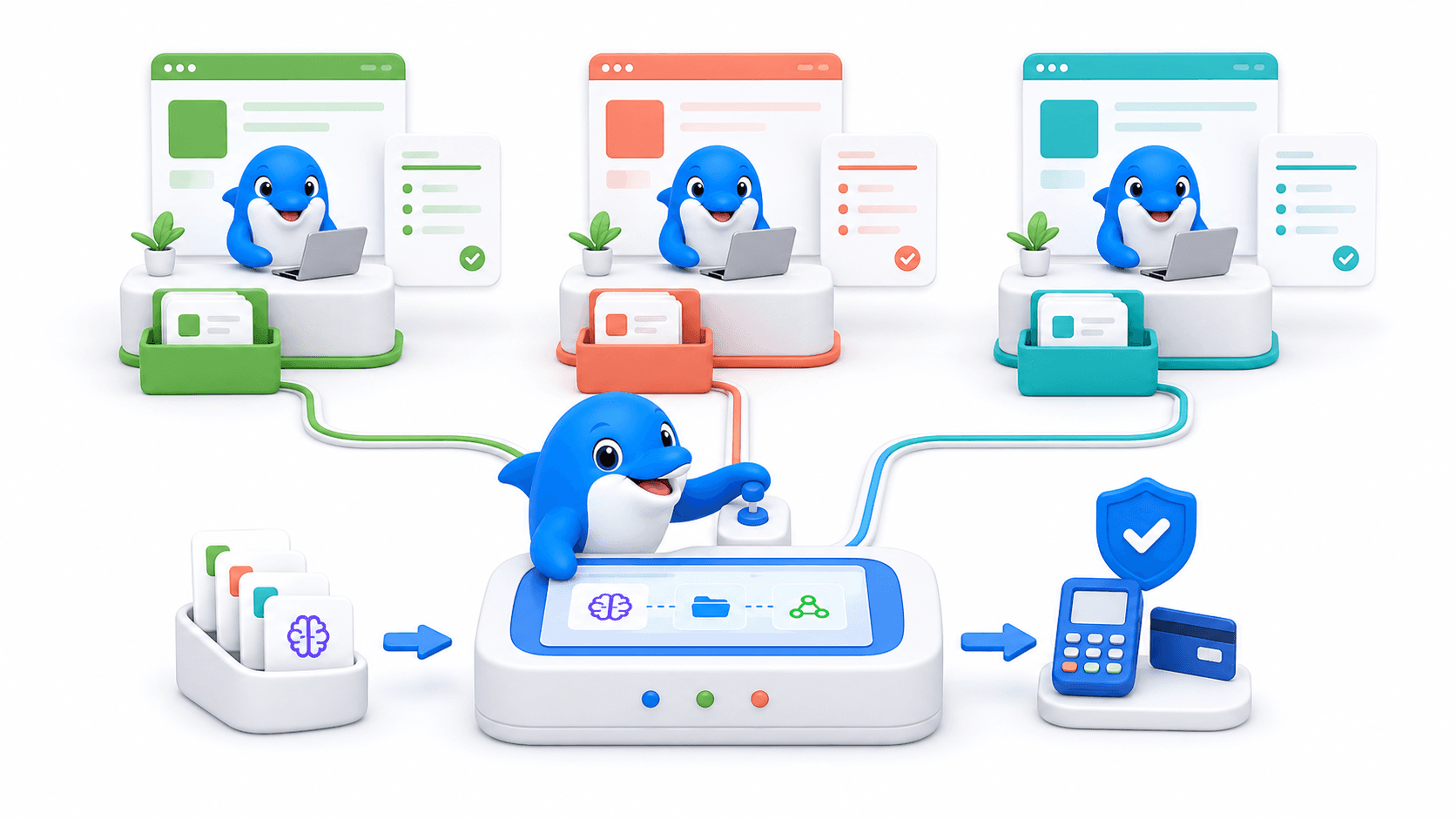
Chatwoot can be customized and self-hosted, which may suit a technical service provider building a managed support solution. Its Platform APIs also support account and user provisioning scenarios.
UChat Partner is designed more explicitly as a multi-client commercial platform. Partners can customize the domain, login, dashboard, navigation, support paths and marketplace; manage client workspaces; define plans and selling prices; connect billing; install templates; impersonate workspaces; and automate provisioning through Partner API.
The partner owns the client relationship and retail price. UChat deducts the relevant platform cost while the partner packages software, implementation and ongoing service under its own brand.
This makes UChat a stronger starting point for marketing agencies, automation consultants and vertical solution providers that want a ready-made white-label business model rather than a self-hosted support application they must productize themselves.
When Chatwoot May Be A Better Fit
Chatwoot may be better when:
open source or self-hosting is a firm requirement;
infrastructure and security operations are already available;
the shared inbox is the center of the customer-service workflow;
per-agent support packaging is easier to forecast;
Captain Copilot inside the support desk is the main AI requirement;
source-level customization matters more than a managed visual builder; or
a full-white-label multi-client commercial platform is unnecessary.
These are substantive reasons to choose Chatwoot. A fair comparison should not present self-hosting as automatically better or worse; it exchanges vendor-managed operations for customer-controlled operations.
Decision Checklist
Ask these questions before choosing:
Is the primary outcome a better support desk or a broader automated customer journey?
Must the complete platform run in infrastructure we control?
Do non-developers need to design API actions and business logic visually?
Are social comments, ads and channel-specific triggers important acquisition sources?
Do we need AI assistance for agents, autonomous customer actions or both?
Will CRM stages, payments, bookings and follow-up live inside the workflow?
Is pricing easier to model per support agent or by platform resources and bot users?
Are we deploying for one organization or reselling branded solutions to many clients?
Who will own upgrades, backups, monitoring and incident response if we self-host?
Can each platform demonstrate our hardest real workflow with failure and handoff paths?
Run the same proof of concept in both products. Use one real channel, one authenticated backend action, one exception, one human handoff and one measurable business outcome.
FAQ
Is Chatwoot free?
Chatwoot offers a free Hacker cloud plan with limits and an open-source self-hosted edition. A real self-hosted budget should include infrastructure, maintenance, monitoring, backups, upgrades and engineering time.
Can Chatwoot use AI?
Yes. Captain includes an AI Agent and Copilot capabilities such as response suggestions, summaries and translation. Cloud plans include different Captain credit allowances.
Can UChat replace a support inbox?
UChat includes Live Chat, assignments and Tickets, and it can automate work around them. A large support organization should still compare its workforce, SLA and reporting requirements with a dedicated help-desk product.
Is UChat self-hosted?
No. UChat is a managed platform. Choose Chatwoot when operating the complete application in your own environment is mandatory.
Which is better for an agency?
UChat has the clearer packaged agency model through custom branding, client workspaces, flexible plans, billing options, templates and Partner API. A technical agency may prefer Chatwoot when its service is specifically built around a customized self-hosted inbox.
Can I test UChat first?
Yes. UChat offers a 14-day trial with Pro features and no credit card required.
Final Verdict And CTA
Chatwoot is a credible open-source customer-support platform. Its shared inbox, self-hosting option, Captain AI and support operations make it a strong fit for teams that want infrastructure control and a familiar service-desk model.
UChat is the stronger fit when the business needs to design what happens around the conversation: acquisition triggers, qualification, AI reasoning, deterministic actions, payments, CRM movement, human handoff and follow-up. It is also purpose-built for agencies that want to sell a branded automation platform.
Start a 14-day UChat free trial with full Pro access and no credit card required.
Agencies can book a Partner Plan demo to explore white-label delivery, client workspaces, billing automation and Partner API operations.
Related comparisons: UChat vs Crisp, UChat vs Freshchat and UChat vs Zendesk AI.
Sources And Review Date
Product and pricing details were reviewed on 6 August 2026. Packaging can change. Primary sources: Chatwoot, Chatwoot pricing, Chatwoot self-hosted, Chatwoot Captain, Chatwoot developer docs, Chatwoot security, UChat, UChat Flow Builder, UChat channels, UChat CRM, UChat pricing, and UChat Partner.
Quick Verdict
UChat and Chatwoot can both manage customer conversations across multiple channels, automate replies and bring human agents into the conversation. Their centers of gravity are different.
Choose Chatwoot for an open-source support inbox. Choose UChat when customer conversations need to become visible, multi-step business workflows across acquisition, sales, payments, CRM and support.
Chatwoot is compelling for a support team that values open source, self-hosting, control of its infrastructure and a conventional shared inbox. Captain adds an AI Agent and Copilot to that operating model.
UChat is built around automation design. Its Flow Builder combines channel triggers, AI Agents, deterministic rules, integrations, payments, CRM Boards, Tickets and human handoff. The Partner Plan also lets agencies deliver the platform under their own brand.
Table Of Contents
Scorecard
Recommendation By Use Case
Feature Comparison: Shared Inbox Versus Journey Builder
AI Agent And Human Assistance
Channels And Conversation Entry Points
Automation Integrations And APIs
Self-Hosting Security And Control
Reporting CRM And Support Operations
Pricing And Platform Resources
Agency And White-Label Delivery
When Chatwoot May Be A Better Fit
Decision Checklist
FAQ
Final Verdict And CTA
Scorecard
Decision area | Better starting fit | Why |
|---|---|---|
Open-source deployment | Chatwoot | Its codebase and self-hosted edition provide infrastructure control. |
Shared support inbox | Chatwoot | Inbox, assignments, teams, SLAs and reports are central to the product. |
AI support copilot | Chatwoot | Captain Copilot suggests responses, summarizes and translates inside the inbox. |
Visual customer journeys | UChat | AI, conditions, actions, APIs and channel nodes share one canvas. |
Social and acquisition automation | UChat | Comments, ads, messages and forms can trigger structured journeys. |
Reusable business operations | UChat | Function Flows isolate reusable logic across channels and bots. |
Built-in customer lifecycle | UChat | Boards, Tickets, Live Chat and automation connect acquisition through support. |
Full-white-label agency platform | UChat | Partners can brand, price, provision and manage client workspaces. |
Recommendation By Use Case
Chatwoot fits support-led operations. A team can consolidate website chat, email and messaging channels into one inbox, assign conversations, collaborate internally and measure support performance. Self-hosting is valuable when the organization wants to control the application and its data environment.
UChat fits automation-led operations. A lead can arrive from an Instagram comment, answer qualification questions, receive an AI recommendation, book or pay, enter a CRM stage, reach a human and continue through automated follow-up.
Choose Chatwoot when the primary job is to operate a support desk and open-source deployment matters. Choose UChat when the conversation is one part of a broader customer journey or when an agency wants to sell branded automation solutions.
Feature Comparison: Shared Inbox Versus Journey Builder
Chatwoot starts with the inbox. Conversations from supported channels appear in a shared workspace where agents can assign ownership, use private notes, apply labels, create teams and collaborate. This is a familiar operating model for customer support.
UChat includes Live Chat and Tickets, but its foundation is the Flow Builder. Teams design what should happen before, during and after a human conversation. Message nodes, questions, conditions, actions, delays, AI steps, APIs and channel-specific features form one journey.
The difference is the system's center. In Chatwoot, automation helps the support inbox run efficiently. In UChat, the inbox is one possible stage inside an automation system.
For a team replacing a conventional help desk, Chatwoot may feel more immediately familiar. For a team building lead capture, onboarding, commerce or service workflows, UChat exposes more of the surrounding journey directly.
AI Agent And Human Assistance
Chatwoot's Captain product combines two useful roles. Captain AI Agent handles customer questions using configured knowledge and automation. Captain Copilot assists human agents with suggested replies, summaries and translation. Cloud plans include monthly Captain credits, with the amount varying by plan.
UChat AI Agents use roles, instructions, business knowledge and callable functions. Supported model options include OpenAI, Claude, DeepSeek and xAI. AI steps can sit beside deterministic flow logic, so a team can let AI interpret intent while rules protect sensitive actions.
Function Flows can isolate a reusable operation such as checking an order, validating an appointment or calculating eligibility. The operation can return a verified result or a precise escalation reason without duplicating the logic in every channel flow.
For an inbox-centered support team, Captain is a natural extension of Chatwoot. UChat becomes more relevant when AI must participate in a larger, explicitly designed business process.
Test the action path, not only the answer. Include missing identity, unavailable APIs, conflicting records, restricted requests, duplicate submissions and human approval.
Channels And Conversation Entry Points
Chatwoot Cloud supports website live chat, email, WhatsApp, Facebook Messenger, Instagram, Telegram, LINE, SMS and API-created channels. Voice is included on higher cloud plans. Availability can vary by plan and provider configuration.
UChat supports Web Chat, Messenger, Instagram, WhatsApp, Telegram, SMS, WeChat, LINE, Viber, TikTok, RCS and other destinations. It also supports voice and phone automation through connected providers and real-time AI configurations.
The key distinction is not a raw channel count. UChat provides channel-specific triggers and actions for acquisition and automation. An Instagram comment, Messenger ad, WhatsApp template, web event or form can start a structured journey rather than simply open a support conversation.
UChat treats channel behavior as workflow input. Shared Omni Channel logic can be reused while destination-specific templates, comments, media and delivery rules remain explicit.
Chatwoot is strong when many channels need to converge on one human support operation. UChat is stronger when each channel needs to trigger and shape an automated customer journey.
Automation Integrations And APIs
Chatwoot provides automation rules, webhooks and application, platform and client APIs. A technical team can connect its inbox to other systems, create custom channels and extend a self-hosted deployment. Its open-source code offers an additional level of implementation freedom.
UChat exposes integrations as building blocks inside the customer journey. Native connections cover common AI, commerce, payment, calendar, storage, email and marketing systems. External requests and Zapier or Make can bridge additional services, while Mini Apps can package custom triggers and actions.
UChat gives non-developers more visible orchestration. A builder can see the condition, API request, payment step, CRM update and human transfer without moving all workflow logic into a separate integration service.
Developers still have options. APIs and webhooks can exchange data with backend systems, and Function Flows keep reusable operations separate from channel presentation.
Chatwoot offers more source-level control. UChat offers a more complete visual composition environment for customer-facing automation. The better choice depends on whether the team wants to own code and infrastructure or configure a managed automation platform.
Self-Hosting Security And Control
Chatwoot's open-source and self-hosted model is a genuine advantage. Organizations can run the platform in their chosen environment, control the deployment and integrate it with internal infrastructure. Chatwoot also publishes SOC 2 Type II and GDPR positioning, encryption controls, role-based access and, on relevant plans, SSO/SAML and audit logs.
Self-hosting is not free operational capacity. The organization becomes responsible for deployment architecture, upgrades, backups, monitoring, incident response, scaling and security maintenance. A self-hosted edition may reduce software lock-in while increasing engineering ownership.
UChat is a managed SaaS platform. Customers do not operate its application infrastructure, and UChat is not positioned as a self-hosted product. This reduces infrastructure work but does not meet a requirement to run the complete platform inside the customer's environment.
Treat deployment control as a requirement, not a slogan. If policy requires self-hosting, Chatwoot belongs on the shortlist. If the team wants to build and ship workflows without maintaining the underlying support application, UChat's managed model may be more practical.
Reporting CRM And Support Operations
Chatwoot focuses reporting on support operations. Teams can inspect conversation volume, agent activity, inbox performance and service metrics. Business and Enterprise plans add capabilities such as teams, automation rules, SLAs, custom roles or audit features according to current packaging.
UChat combines support operations with lightweight lifecycle management. Boards organize contacts into pipeline stages, Tickets track issues and Live Chat supports human handling. Flows can move records, assign work, notify staff and continue follow-up automatically.
Chatwoot is the cleaner fit when the main management question is, "How is our support desk performing?" UChat is the cleaner fit when the question is, "What should happen to this customer next?"
That does not make UChat a replacement for every mature help desk. Large support organizations may prefer Chatwoot or another service platform for workforce operations while using an automation layer elsewhere. Smaller businesses and agencies may value having conversations, workflow and CRM state closer together.
Pricing And Platform Resources
Chatwoot Cloud pricing reviewed on 6 August 2026:
Chatwoot plan | Monthly price per agent | Key allowance |
|---|---|---|
Hacker | $0 | Up to two agents, 500 conversations monthly, live chat only and no Captain. |
Startups | $19 | 300 Captain credits and supported channels except voice. |
Business | $39 | 500 Captain credits, voice, help center, teams and automation rules. |
Enterprise | $99 | 800 Captain credits, SSO/SAML and audit logs. |
Chatwoot offers a 15-day cloud trial without a credit card. Self-hosting changes the cost model: software access may be open source, but infrastructure, operations and engineering still have a cost.
UChat pricing reviewed on the same date:
UChat item | Monthly platform cost | Included capacity or unit |
|---|---|---|
Business | $15 | One bot, 1,000 bot users and five members. |
Extra bot | $10 | One additional bot. |
Extra member | $10 | One additional member. |
First 5,000 extra bot users | $5 per 1,000 | Added after the included 1,000. |
Later bot-user capacity | $20 per 5,000 | Charged in 5,000-user blocks. |
Partner Plan | $199 | White labeling and multi-client platform operations. |
UChat AI, voice and channel services can add provider charges. These models are not directly equivalent: Chatwoot Cloud prices primarily by agent and Captain credits, while UChat prices platform resources and bot-user capacity.
Model the complete operating cost. Include human seats, AI usage, channels, infrastructure, implementation, maintenance and the value of the workflows each platform replaces.
Agency And White-Label Delivery
Chatwoot can be customized and self-hosted, which may suit a technical service provider building a managed support solution. Its Platform APIs also support account and user provisioning scenarios.
UChat Partner is designed more explicitly as a multi-client commercial platform. Partners can customize the domain, login, dashboard, navigation, support paths and marketplace; manage client workspaces; define plans and selling prices; connect billing; install templates; impersonate workspaces; and automate provisioning through Partner API.
The partner owns the client relationship and retail price. UChat deducts the relevant platform cost while the partner packages software, implementation and ongoing service under its own brand.
This makes UChat a stronger starting point for marketing agencies, automation consultants and vertical solution providers that want a ready-made white-label business model rather than a self-hosted support application they must productize themselves.
When Chatwoot May Be A Better Fit
Chatwoot may be better when:
open source or self-hosting is a firm requirement;
infrastructure and security operations are already available;
the shared inbox is the center of the customer-service workflow;
per-agent support packaging is easier to forecast;
Captain Copilot inside the support desk is the main AI requirement;
source-level customization matters more than a managed visual builder; or
a full-white-label multi-client commercial platform is unnecessary.
These are substantive reasons to choose Chatwoot. A fair comparison should not present self-hosting as automatically better or worse; it exchanges vendor-managed operations for customer-controlled operations.
Decision Checklist
Ask these questions before choosing:
Is the primary outcome a better support desk or a broader automated customer journey?
Must the complete platform run in infrastructure we control?
Do non-developers need to design API actions and business logic visually?
Are social comments, ads and channel-specific triggers important acquisition sources?
Do we need AI assistance for agents, autonomous customer actions or both?
Will CRM stages, payments, bookings and follow-up live inside the workflow?
Is pricing easier to model per support agent or by platform resources and bot users?
Are we deploying for one organization or reselling branded solutions to many clients?
Who will own upgrades, backups, monitoring and incident response if we self-host?
Can each platform demonstrate our hardest real workflow with failure and handoff paths?
Run the same proof of concept in both products. Use one real channel, one authenticated backend action, one exception, one human handoff and one measurable business outcome.
FAQ
Is Chatwoot free?
Chatwoot offers a free Hacker cloud plan with limits and an open-source self-hosted edition. A real self-hosted budget should include infrastructure, maintenance, monitoring, backups, upgrades and engineering time.
Can Chatwoot use AI?
Yes. Captain includes an AI Agent and Copilot capabilities such as response suggestions, summaries and translation. Cloud plans include different Captain credit allowances.
Can UChat replace a support inbox?
UChat includes Live Chat, assignments and Tickets, and it can automate work around them. A large support organization should still compare its workforce, SLA and reporting requirements with a dedicated help-desk product.
Is UChat self-hosted?
No. UChat is a managed platform. Choose Chatwoot when operating the complete application in your own environment is mandatory.
Which is better for an agency?
UChat has the clearer packaged agency model through custom branding, client workspaces, flexible plans, billing options, templates and Partner API. A technical agency may prefer Chatwoot when its service is specifically built around a customized self-hosted inbox.
Can I test UChat first?
Yes. UChat offers a 14-day trial with Pro features and no credit card required.
Final Verdict And CTA
Chatwoot is a credible open-source customer-support platform. Its shared inbox, self-hosting option, Captain AI and support operations make it a strong fit for teams that want infrastructure control and a familiar service-desk model.
UChat is the stronger fit when the business needs to design what happens around the conversation: acquisition triggers, qualification, AI reasoning, deterministic actions, payments, CRM movement, human handoff and follow-up. It is also purpose-built for agencies that want to sell a branded automation platform.
Start a 14-day UChat free trial with full Pro access and no credit card required.
Agencies can book a Partner Plan demo to explore white-label delivery, client workspaces, billing automation and Partner API operations.
Related comparisons: UChat vs Crisp, UChat vs Freshchat and UChat vs Zendesk AI.
Sources And Review Date
Product and pricing details were reviewed on 6 August 2026. Packaging can change. Primary sources: Chatwoot, Chatwoot pricing, Chatwoot self-hosted, Chatwoot Captain, Chatwoot developer docs, Chatwoot security, UChat, UChat Flow Builder, UChat channels, UChat CRM, UChat pricing, and UChat Partner.