12 minutes
UChat
Posted by
UChat vs Intercom: Which AI Customer Platform Fits Your Operating Model?
12 minutes
Posted by
UChat

Quick Verdict
UChat and Intercom overlap more than a simple chatbot-versus-helpdesk comparison suggests. Both combine AI, automation, customer channels, integrations, and human handoff.
The deciding factor is the operating center. Choose Intercom when Fin and a mature customer-service Helpdesk should lead. Choose UChat when visual workflows, business actions, flexible automation, or a branded client platform should lead.
Intercom is the stronger starting point for an established support organization that wants AI resolution, agent assistance, knowledge, quality controls, reporting, tickets, and team workflows in one service suite.
UChat is the stronger fit for builders, technical operators, and agencies that need a visual automation layer, multiple AI configuration paths, reusable channel logic, APIs and integrations, or a full-white-label client platform.
Table Of Contents
Scorecard
Recommendation By Use Case
Feature Comparison
AI Customer Service Suite Or Automation Platform
Fin And UChat AI Agents
Channels And Omnichannel Workflows
Human Handoff Helpdesk CRM And Tickets
Integrations APIs And Business Actions
Pricing And Total Cost
Agency And White-Label Delivery
When Intercom May Be A Better Fit
When UChat Is The Better Fit
FAQ
CTA: Test UChat
Scorecard
If this describes your business | Better starting point | Why |
|---|---|---|
A support organization wants AI resolution and human service in one mature operating layer | Intercom | Fin, Helpdesk, knowledge, workflows, tickets, reporting, QA, and agent assistance are designed around customer-service operations. |
A team wants AI inside detailed visual journeys and deterministic business logic | UChat | AI Agents can work beside Flow Builder, Function Flows, fields, conditions, external requests, integrations, and human transfer. |
A business needs voice, email, web chat, WhatsApp, Instagram, Messenger, SMS, Slack, or Discord | Both | Intercom and UChat both cover meaningful channel sets. Verify the exact trigger and message type rather than choosing by channel count. |
A small team wants a low-cost entry point for chatbot automation | UChat | UChat Business starts at $15/month; Intercom uses per-seat plans plus outcome and add-on charges. The usage models differ, so model total cost. |
An agency wants its own domain, branding, plans, prices, workspaces, and billing path | UChat Partner | These capabilities are part of UChat's agency operating model rather than simply an embedded AI endpoint. |
An enterprise support team prioritizes service QA, SLAs, security, and AI performance management | Intercom | Intercom Expert and Fin emphasize enterprise support controls, observability, testing, and service operations. |
Recommendation By Use Case
Imagine two teams starting the same Monday.
The first leads customer support for a growing software company. It wants Fin to resolve common and complex questions, a shared inbox for people, tickets for longer work, a help center, reporting, QA, and clear escalation. Intercom is the more natural operating center.
The second is an automation agency. It wants to build a lead-qualification and appointment workflow once, connect it to business systems, deploy it across messaging channels, package it as a template, and install it into separately branded client workspaces. UChat Partner is the more natural operating center.
A third team may simply want an affordable AI chatbot connected to WhatsApp, Instagram, web chat, or another channel. That team should compare the actual workflow and monthly usage before paying for a broader helpdesk suite.
Feature Comparison: Who Each Platform Is Built For
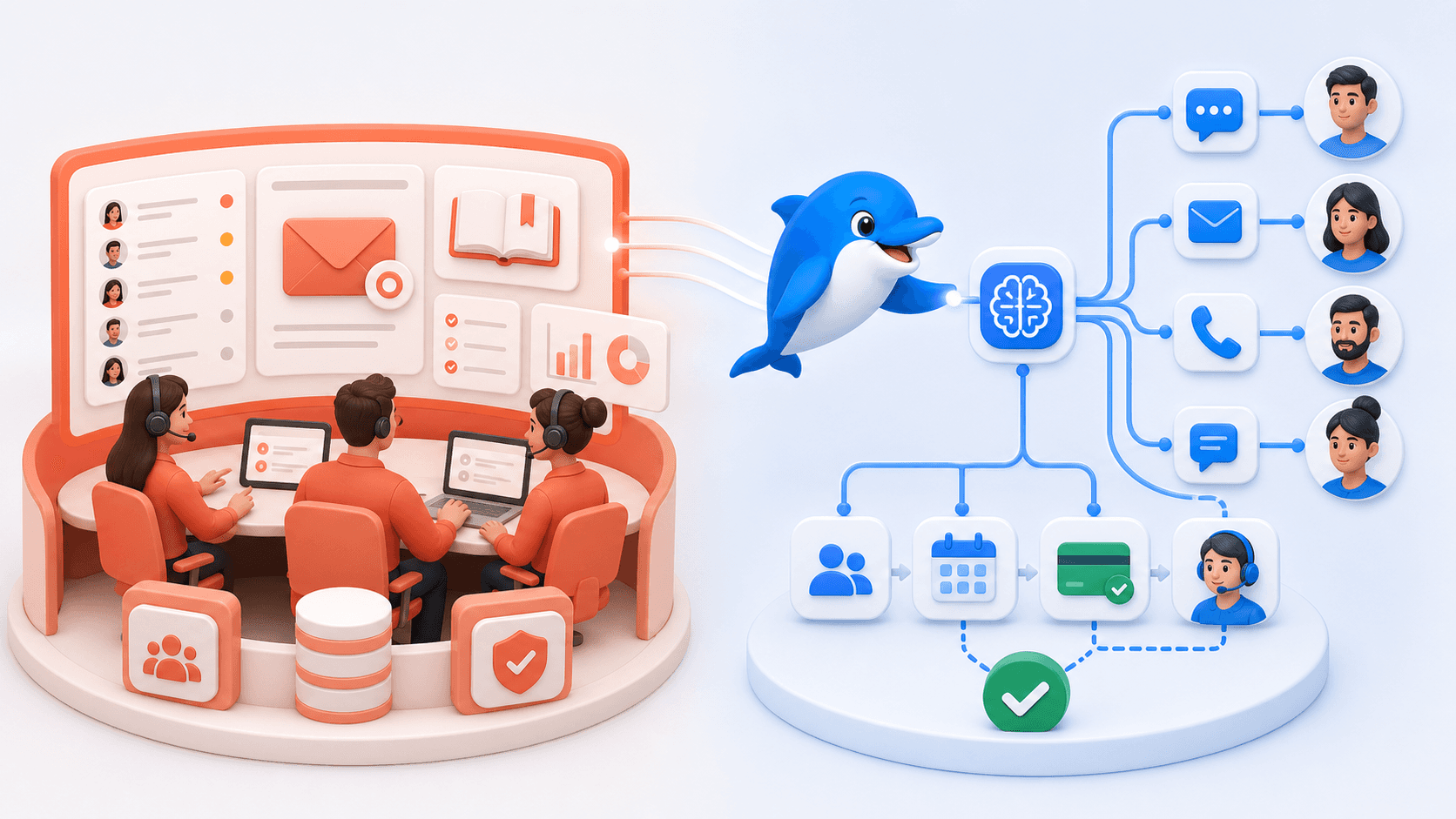
Intercom describes an AI-first customer-service platform. Fin works in front of customers, while Helpdesk gives human teams inboxes, tickets, knowledge, workflows, reporting, and AI assistance. The product is designed to improve resolution, service quality, and support-team efficiency.
UChat is a no-code AI Agent and chatbot automation platform. The center of the product is the system a builder creates: messages, questions, AI decisions, conditions, API requests, customer data, channel actions, ecommerce steps, tickets, and transfers.
Intercom starts with the customer-service operation. UChat starts with the automation architecture. That distinction affects the interface, pricing, implementation style, and buyer.
Dimension | Intercom | UChat |
|---|---|---|
Primary center | Fin and an integrated customer-service Helpdesk | AI Agents, visual flows, channels, and reusable automation |
Human work | Shared inbox, tickets, assignment, SLAs, reporting, QA | Live Chat, assignment, mobile handling, Boards, and Tickets |
AI model | Fin as a vertically integrated customer agent | Configurable AI Agents connected to providers, tools, functions, and flows |
Automation | Workflows, Fin Procedures, actions, APIs, and connectors | Flow Builder, Function Flows, AI Functions, external requests, webhooks, Mini Apps |
Agency model | Product and API paths for service teams and embedded support | Full-white-label Partner platform with client workspaces, plans, pricing, billing, and Partner API |
AI Customer Service Suite Or Automation Platform
Intercom's architecture is compelling when service is the job. Fin can answer across channels, use business context, take actions, and hand off with conversation history. Helpdesk then gives managers the controls to supervise people and AI together.
UChat's architecture is compelling when the workflow itself is the product. A builder can decide exactly when AI should reason, when a deterministic flow should take control, what data should be stored, which integration should run, and how the journey continues on another channel.
This is not a maturity contest. Intercom's tighter customer-service focus can reduce the amount of architecture a support team must design. UChat's broader construction surface can give a technical team or agency more freedom, but that freedom requires clearer solution design.
Fin And UChat AI Agents
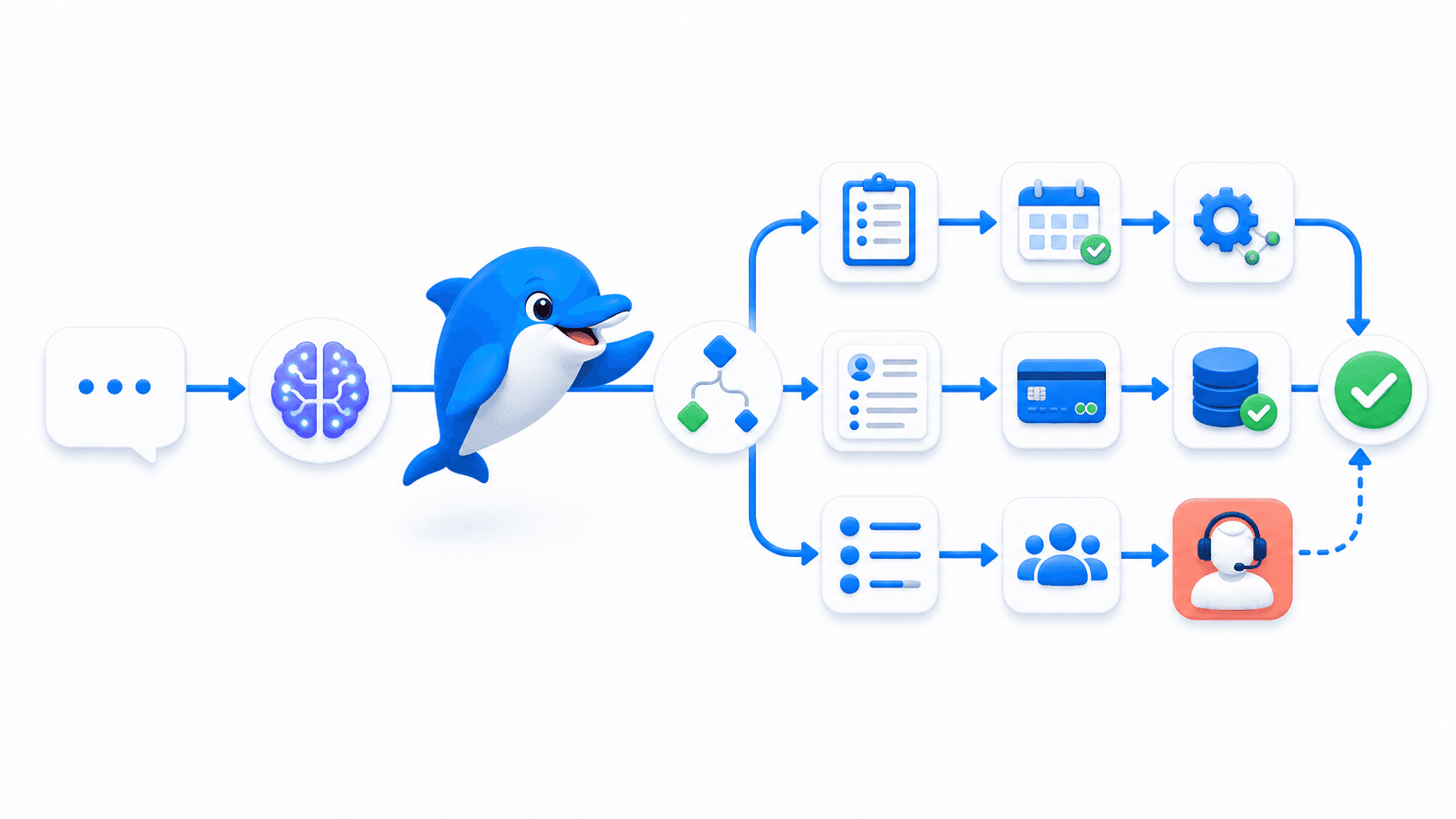
Fin is a serious AI customer-service product, not an FAQ widget. Intercom says Fin can resolve complex requests, read and write to third-party systems, work across voice and messaging channels, follow procedures, use knowledge and customer context, and transfer to human agents. Its testing, observability, recommendations, and service-specific models are meaningful strengths.
UChat AI Agents are designed to participate in a wider automation system. They can use business instructions and knowledge, call AI Functions and tools, work with Flow Builder, transfer to people, and operate across supported channels. A team can combine flexible AI behavior with deterministic conditions and actions.
Consider a booking journey:
A customer starts on Instagram, WhatsApp, or web chat.
An AI Agent answers service questions and identifies intent.
A flow collects structured details such as service, location, and preferred time.
An API or integration checks availability.
A confirmed booking triggers follow-up; an exception transfers to a person with context.
A Board or Ticket records work that still needs attention.
An agency packages the solution for installation into another client workspace.
Intercom can automate sophisticated service procedures. UChat's distinctive value is the way AI, channels, visual logic, integrations, and reusable agency delivery sit in the same builder-oriented system.
Channels And Omnichannel Workflows
Intercom's current Fin channel page lists Voice, Email, Messenger, WhatsApp, Instagram, Facebook Messenger, SMS, Slack, Discord, and the Fin Agent API. It also emphasizes consistent history and handoff context.
UChat supports a broad mix of web, social, messaging, voice, and SMS channels. Its Omni Channel approach is designed to reuse bot logic across supported destinations while still respecting each channel's restrictions.
Channel names alone should not decide the purchase. Test:
the exact entry triggers, comments, ads, templates, and message formats required;
how customer identity and history behave across channels;
whether a channel supports the intended AI, broadcast, payment, catalog, or handoff flow;
how provider fees and approval requirements affect WhatsApp, SMS, and voice;
whether the same automation can be packaged and reused.
Intercom is optimized for consistent cross-channel support. UChat is designed to turn those channels into parts of a larger programmable customer journey.
Human Handoff Helpdesk CRM And Tickets
Intercom has the clearer proposition for a dedicated support department. Its plans combine shared inbox and ticketing, help centers, multiple team inboxes, round-robin assignment, reporting, SLAs, security controls, and multibrand service options.
UChat provides Live Chat handoff, assignment, mobile handling, customer data, CRM-style Boards, and Tickets. These features keep people connected to the automation, but buyers should not assume they mirror every enterprise helpdesk workflow or report.
Choose Intercom when the detailed management of support queues, AI quality, service levels, knowledge, and agent performance is central. Choose UChat when human support is one stage inside a broader automation that also includes lead generation, ecommerce, booking, payments, data updates, and cross-channel follow-up.
Integrations APIs And Business Actions
Fin connects to helpdesks and business systems, can take actions through Procedures and APIs, and offers an Agent API for custom interfaces. Intercom therefore should not be described as a closed inbox.
UChat supports native integrations, external requests, JavaScript, APIs, webhooks, Zapier and Make paths, and Mini Apps. Function Flows can isolate reusable logic, while templates and partner tooling support repeated deployment.
For a technical evaluation, write down the actual actions:
retrieve an order or subscription;
book or reschedule an appointment;
update a CRM record;
create a ticket or pipeline item;
trigger a payment or checkout;
install the same integration for another client.
Then test authentication, data mapping, error handling, retries, limits, and plan requirements. A long integration directory is less important than whether the required transaction works reliably.
Pricing And Total Cost
Intercom's pricing combines seats, Fin outcomes, and optional usage or add-ons. On 2 August 2026, its public page displayed annual starting prices of $29, $85, and $132 per seat per month for Essential, Advanced, and Expert. The same page's structured pricing information listed monthly equivalents of $39, $99, and $139. Fin was listed at $0.99 per outcome.
Intercom plan | Annual starting price | Typical progression |
|---|---|---|
Essential | $29 per seat/month | Messenger, shared inbox, tickets, reports, and public help center |
Advanced | $85 per seat/month | Adds multiple team inboxes, workflow automation, assignment, and multilingual/private help center |
Expert | $132 per seat/month | Adds SLAs, SSO/identity, HIPAA support, and multibrand capabilities |
Fin | $0.99 per outcome | AI resolution usage; minimum commitments or other conditions may apply |
UChat Business starts at $15/month and includes one bot, 1,000 bot users, five members, and Pro features. UChat offers a 14-day free trial with no credit card. UChat Partner is $199/month before client workspace licenses and add-ons.
The meters are not directly interchangeable. Model total cost using:
paid agents or members;
Fin outcomes or AI/provider usage;
active contacts versus stored bot users;
bots, workspaces, and client licenses;
WhatsApp, SMS, voice, and email charges;
required workflows, APIs, security, reporting, and add-ons;
implementation and ongoing support.
For a support organization, Intercom's higher apparent entry price may be justified by replacing several service tools. For a small automation project or agency platform, UChat may provide a more economical and flexible starting point.
Agency And White-Label Delivery
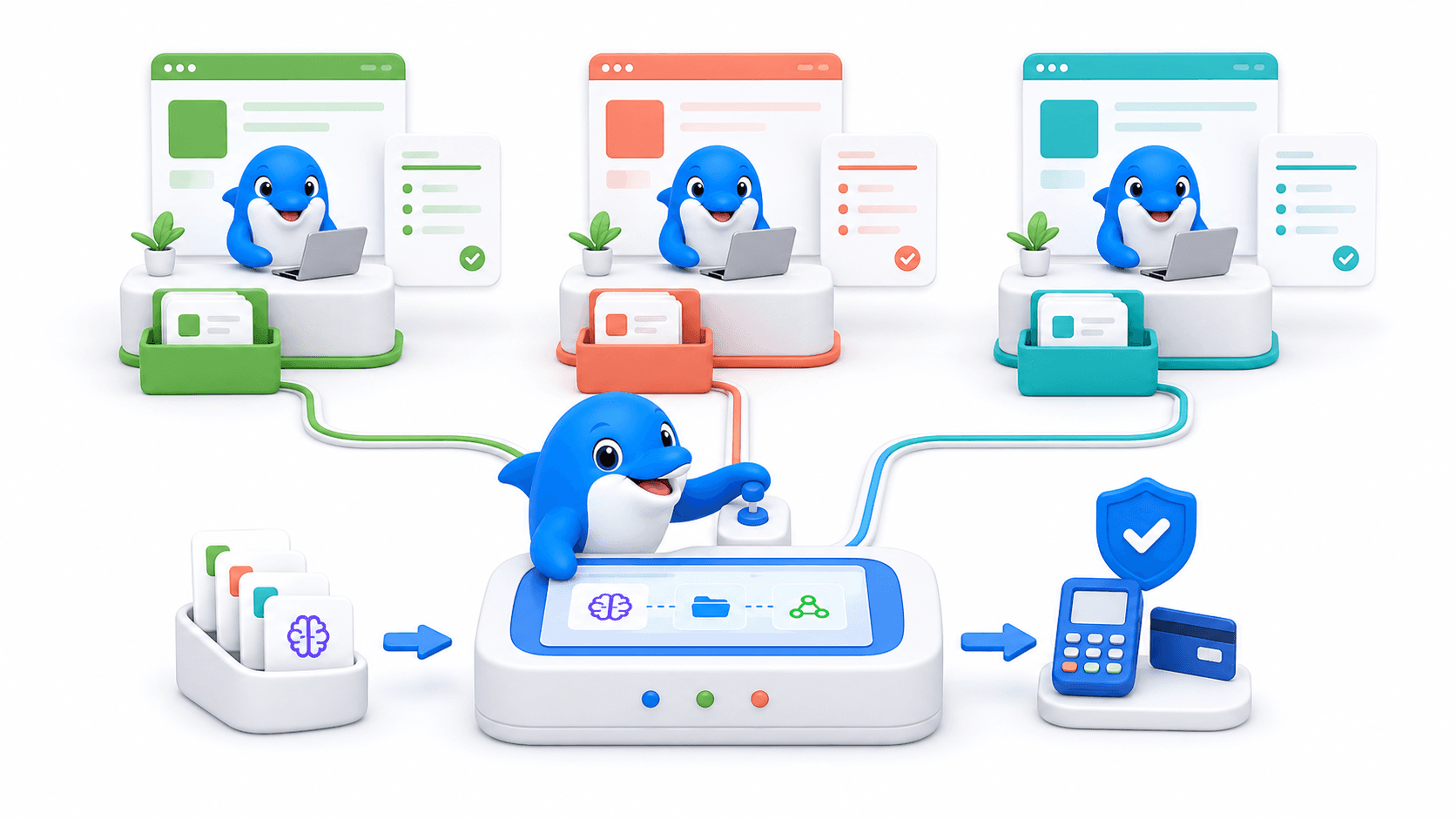
This is the clearest structural difference.
Fin's Agent API can power support inside a custom interface, and Intercom Expert supports multibrand service experiences. Those are valuable capabilities.
UChat Partner goes further into the commercial operating model for agencies. Partners can use their own domain and branding, configure client-facing plans and prices, manage workspaces, automate billing and onboarding, package templates, use Partner API endpoints, and keep the client relationship.
Embedding an AI agent is not the same as operating a branded multi-client platform. An agency that wants to sell managed automation, recurring platform access, templates, and integrations should compare that ownership model carefully.
When Intercom May Be A Better Fit
Intercom may be the better choice when:
customer service is the primary department and operating problem;
Fin resolution performance and service-specific AI controls matter most;
the team needs a mature inbox, tickets, knowledge, reporting, QA, and SLAs together;
support managers want one vendor and a prescriptive AI transformation path;
enterprise security, identity, data residency, and service governance are decisive.
Intercom deserves a serious trial in these situations. Choosing UChat only because its starting price is lower could leave the team rebuilding service operations it actually needed.
When UChat Is The Better Fit
UChat is usually the better fit when:
the workflow extends beyond support into acquisition, qualification, booking, ecommerce, payments, and follow-up;
builders want AI beside explicit visual logic and reusable functions;
the project needs flexible channel automation and custom integrations;
a smaller team wants a lower-cost entry point;
an agency wants its own brand, domain, client plans, prices, billing, workspaces, templates, and Partner API.
The strongest UChat case is not “Intercom without the cost.” It is a different operating model: build the automation, connect the business, and package the result as your own solution.
FAQ
Is UChat an Intercom helpdesk replacement?
Not in every case. UChat includes Live Chat, assignment, Boards, Tickets, customer data, and handoff, but Intercom is more deeply focused on enterprise customer-service operations, QA, reporting, knowledge, and SLAs. Compare the specific workflows rather than assuming feature equivalence.
Does Intercom support channels beyond web chat and email?
Yes. Fin's current official channel page lists voice, email, Messenger, WhatsApp, Instagram, Facebook Messenger, SMS, Slack, Discord, and an Agent API.
Can UChat combine AI with deterministic automation?
Yes. UChat AI Agents can work with Flow Builder, Function Flows, conditions, actions, fields, integrations, external requests, and human handoff.
Which is better for an agency?
UChat is generally the stronger fit when the agency wants to operate a white-label platform with its own domain, plans, pricing, billing path, client workspaces, templates, and API automation. Intercom can still suit an agency delivering customer-service implementation for clients.
Which platform is cheaper?
UChat has the lower public entry price, but the products meter different things. Compare seats, outcomes, AI usage, contacts or bot users, channels, workspaces, integrations, security, and implementation before estimating total cost.
Can I test UChat before deciding?
Yes. UChat offers a 14-day free trial with access to Pro features and no credit card requirement.
CTA: Test UChat Against Your Real Workflow
The fastest way to compare these platforms is to build one real journey: connect the required channel, let AI answer, call a business action, transfer an exception to a person, and measure what the team must maintain.
Start UChat's 14-day free trial with no credit card required.
If you want to sell automation under your own brand, book a UChat Partner demo.
Sources And Review Date
Product and pricing details were reviewed on 2 August 2026. Packaging can change. Primary sources: Intercom pricing, Fin, Intercom Helpdesk, Fin channels, Fin integrations, UChat, UChat pricing, and UChat Partner.
Quick Verdict
UChat and Intercom overlap more than a simple chatbot-versus-helpdesk comparison suggests. Both combine AI, automation, customer channels, integrations, and human handoff.
The deciding factor is the operating center. Choose Intercom when Fin and a mature customer-service Helpdesk should lead. Choose UChat when visual workflows, business actions, flexible automation, or a branded client platform should lead.
Intercom is the stronger starting point for an established support organization that wants AI resolution, agent assistance, knowledge, quality controls, reporting, tickets, and team workflows in one service suite.
UChat is the stronger fit for builders, technical operators, and agencies that need a visual automation layer, multiple AI configuration paths, reusable channel logic, APIs and integrations, or a full-white-label client platform.
Table Of Contents
Scorecard
Recommendation By Use Case
Feature Comparison
AI Customer Service Suite Or Automation Platform
Fin And UChat AI Agents
Channels And Omnichannel Workflows
Human Handoff Helpdesk CRM And Tickets
Integrations APIs And Business Actions
Pricing And Total Cost
Agency And White-Label Delivery
When Intercom May Be A Better Fit
When UChat Is The Better Fit
FAQ
CTA: Test UChat
Scorecard
If this describes your business | Better starting point | Why |
|---|---|---|
A support organization wants AI resolution and human service in one mature operating layer | Intercom | Fin, Helpdesk, knowledge, workflows, tickets, reporting, QA, and agent assistance are designed around customer-service operations. |
A team wants AI inside detailed visual journeys and deterministic business logic | UChat | AI Agents can work beside Flow Builder, Function Flows, fields, conditions, external requests, integrations, and human transfer. |
A business needs voice, email, web chat, WhatsApp, Instagram, Messenger, SMS, Slack, or Discord | Both | Intercom and UChat both cover meaningful channel sets. Verify the exact trigger and message type rather than choosing by channel count. |
A small team wants a low-cost entry point for chatbot automation | UChat | UChat Business starts at $15/month; Intercom uses per-seat plans plus outcome and add-on charges. The usage models differ, so model total cost. |
An agency wants its own domain, branding, plans, prices, workspaces, and billing path | UChat Partner | These capabilities are part of UChat's agency operating model rather than simply an embedded AI endpoint. |
An enterprise support team prioritizes service QA, SLAs, security, and AI performance management | Intercom | Intercom Expert and Fin emphasize enterprise support controls, observability, testing, and service operations. |
Recommendation By Use Case
Imagine two teams starting the same Monday.
The first leads customer support for a growing software company. It wants Fin to resolve common and complex questions, a shared inbox for people, tickets for longer work, a help center, reporting, QA, and clear escalation. Intercom is the more natural operating center.
The second is an automation agency. It wants to build a lead-qualification and appointment workflow once, connect it to business systems, deploy it across messaging channels, package it as a template, and install it into separately branded client workspaces. UChat Partner is the more natural operating center.
A third team may simply want an affordable AI chatbot connected to WhatsApp, Instagram, web chat, or another channel. That team should compare the actual workflow and monthly usage before paying for a broader helpdesk suite.
Feature Comparison: Who Each Platform Is Built For
Intercom describes an AI-first customer-service platform. Fin works in front of customers, while Helpdesk gives human teams inboxes, tickets, knowledge, workflows, reporting, and AI assistance. The product is designed to improve resolution, service quality, and support-team efficiency.
UChat is a no-code AI Agent and chatbot automation platform. The center of the product is the system a builder creates: messages, questions, AI decisions, conditions, API requests, customer data, channel actions, ecommerce steps, tickets, and transfers.
Intercom starts with the customer-service operation. UChat starts with the automation architecture. That distinction affects the interface, pricing, implementation style, and buyer.
Dimension | Intercom | UChat |
|---|---|---|
Primary center | Fin and an integrated customer-service Helpdesk | AI Agents, visual flows, channels, and reusable automation |
Human work | Shared inbox, tickets, assignment, SLAs, reporting, QA | Live Chat, assignment, mobile handling, Boards, and Tickets |
AI model | Fin as a vertically integrated customer agent | Configurable AI Agents connected to providers, tools, functions, and flows |
Automation | Workflows, Fin Procedures, actions, APIs, and connectors | Flow Builder, Function Flows, AI Functions, external requests, webhooks, Mini Apps |
Agency model | Product and API paths for service teams and embedded support | Full-white-label Partner platform with client workspaces, plans, pricing, billing, and Partner API |
AI Customer Service Suite Or Automation Platform
Intercom's architecture is compelling when service is the job. Fin can answer across channels, use business context, take actions, and hand off with conversation history. Helpdesk then gives managers the controls to supervise people and AI together.
UChat's architecture is compelling when the workflow itself is the product. A builder can decide exactly when AI should reason, when a deterministic flow should take control, what data should be stored, which integration should run, and how the journey continues on another channel.
This is not a maturity contest. Intercom's tighter customer-service focus can reduce the amount of architecture a support team must design. UChat's broader construction surface can give a technical team or agency more freedom, but that freedom requires clearer solution design.
Fin And UChat AI Agents
Fin is a serious AI customer-service product, not an FAQ widget. Intercom says Fin can resolve complex requests, read and write to third-party systems, work across voice and messaging channels, follow procedures, use knowledge and customer context, and transfer to human agents. Its testing, observability, recommendations, and service-specific models are meaningful strengths.
UChat AI Agents are designed to participate in a wider automation system. They can use business instructions and knowledge, call AI Functions and tools, work with Flow Builder, transfer to people, and operate across supported channels. A team can combine flexible AI behavior with deterministic conditions and actions.
Consider a booking journey:
A customer starts on Instagram, WhatsApp, or web chat.
An AI Agent answers service questions and identifies intent.
A flow collects structured details such as service, location, and preferred time.
An API or integration checks availability.
A confirmed booking triggers follow-up; an exception transfers to a person with context.
A Board or Ticket records work that still needs attention.
An agency packages the solution for installation into another client workspace.
Intercom can automate sophisticated service procedures. UChat's distinctive value is the way AI, channels, visual logic, integrations, and reusable agency delivery sit in the same builder-oriented system.
Channels And Omnichannel Workflows
Intercom's current Fin channel page lists Voice, Email, Messenger, WhatsApp, Instagram, Facebook Messenger, SMS, Slack, Discord, and the Fin Agent API. It also emphasizes consistent history and handoff context.
UChat supports a broad mix of web, social, messaging, voice, and SMS channels. Its Omni Channel approach is designed to reuse bot logic across supported destinations while still respecting each channel's restrictions.
Channel names alone should not decide the purchase. Test:
the exact entry triggers, comments, ads, templates, and message formats required;
how customer identity and history behave across channels;
whether a channel supports the intended AI, broadcast, payment, catalog, or handoff flow;
how provider fees and approval requirements affect WhatsApp, SMS, and voice;
whether the same automation can be packaged and reused.
Intercom is optimized for consistent cross-channel support. UChat is designed to turn those channels into parts of a larger programmable customer journey.
Human Handoff Helpdesk CRM And Tickets
Intercom has the clearer proposition for a dedicated support department. Its plans combine shared inbox and ticketing, help centers, multiple team inboxes, round-robin assignment, reporting, SLAs, security controls, and multibrand service options.
UChat provides Live Chat handoff, assignment, mobile handling, customer data, CRM-style Boards, and Tickets. These features keep people connected to the automation, but buyers should not assume they mirror every enterprise helpdesk workflow or report.
Choose Intercom when the detailed management of support queues, AI quality, service levels, knowledge, and agent performance is central. Choose UChat when human support is one stage inside a broader automation that also includes lead generation, ecommerce, booking, payments, data updates, and cross-channel follow-up.
Integrations APIs And Business Actions
Fin connects to helpdesks and business systems, can take actions through Procedures and APIs, and offers an Agent API for custom interfaces. Intercom therefore should not be described as a closed inbox.
UChat supports native integrations, external requests, JavaScript, APIs, webhooks, Zapier and Make paths, and Mini Apps. Function Flows can isolate reusable logic, while templates and partner tooling support repeated deployment.
For a technical evaluation, write down the actual actions:
retrieve an order or subscription;
book or reschedule an appointment;
update a CRM record;
create a ticket or pipeline item;
trigger a payment or checkout;
install the same integration for another client.
Then test authentication, data mapping, error handling, retries, limits, and plan requirements. A long integration directory is less important than whether the required transaction works reliably.
Pricing And Total Cost
Intercom's pricing combines seats, Fin outcomes, and optional usage or add-ons. On 2 August 2026, its public page displayed annual starting prices of $29, $85, and $132 per seat per month for Essential, Advanced, and Expert. The same page's structured pricing information listed monthly equivalents of $39, $99, and $139. Fin was listed at $0.99 per outcome.
Intercom plan | Annual starting price | Typical progression |
|---|---|---|
Essential | $29 per seat/month | Messenger, shared inbox, tickets, reports, and public help center |
Advanced | $85 per seat/month | Adds multiple team inboxes, workflow automation, assignment, and multilingual/private help center |
Expert | $132 per seat/month | Adds SLAs, SSO/identity, HIPAA support, and multibrand capabilities |
Fin | $0.99 per outcome | AI resolution usage; minimum commitments or other conditions may apply |
UChat Business starts at $15/month and includes one bot, 1,000 bot users, five members, and Pro features. UChat offers a 14-day free trial with no credit card. UChat Partner is $199/month before client workspace licenses and add-ons.
The meters are not directly interchangeable. Model total cost using:
paid agents or members;
Fin outcomes or AI/provider usage;
active contacts versus stored bot users;
bots, workspaces, and client licenses;
WhatsApp, SMS, voice, and email charges;
required workflows, APIs, security, reporting, and add-ons;
implementation and ongoing support.
For a support organization, Intercom's higher apparent entry price may be justified by replacing several service tools. For a small automation project or agency platform, UChat may provide a more economical and flexible starting point.
Agency And White-Label Delivery
This is the clearest structural difference.
Fin's Agent API can power support inside a custom interface, and Intercom Expert supports multibrand service experiences. Those are valuable capabilities.
UChat Partner goes further into the commercial operating model for agencies. Partners can use their own domain and branding, configure client-facing plans and prices, manage workspaces, automate billing and onboarding, package templates, use Partner API endpoints, and keep the client relationship.
Embedding an AI agent is not the same as operating a branded multi-client platform. An agency that wants to sell managed automation, recurring platform access, templates, and integrations should compare that ownership model carefully.
When Intercom May Be A Better Fit
Intercom may be the better choice when:
customer service is the primary department and operating problem;
Fin resolution performance and service-specific AI controls matter most;
the team needs a mature inbox, tickets, knowledge, reporting, QA, and SLAs together;
support managers want one vendor and a prescriptive AI transformation path;
enterprise security, identity, data residency, and service governance are decisive.
Intercom deserves a serious trial in these situations. Choosing UChat only because its starting price is lower could leave the team rebuilding service operations it actually needed.
When UChat Is The Better Fit
UChat is usually the better fit when:
the workflow extends beyond support into acquisition, qualification, booking, ecommerce, payments, and follow-up;
builders want AI beside explicit visual logic and reusable functions;
the project needs flexible channel automation and custom integrations;
a smaller team wants a lower-cost entry point;
an agency wants its own brand, domain, client plans, prices, billing, workspaces, templates, and Partner API.
The strongest UChat case is not “Intercom without the cost.” It is a different operating model: build the automation, connect the business, and package the result as your own solution.
FAQ
Is UChat an Intercom helpdesk replacement?
Not in every case. UChat includes Live Chat, assignment, Boards, Tickets, customer data, and handoff, but Intercom is more deeply focused on enterprise customer-service operations, QA, reporting, knowledge, and SLAs. Compare the specific workflows rather than assuming feature equivalence.
Does Intercom support channels beyond web chat and email?
Yes. Fin's current official channel page lists voice, email, Messenger, WhatsApp, Instagram, Facebook Messenger, SMS, Slack, Discord, and an Agent API.
Can UChat combine AI with deterministic automation?
Yes. UChat AI Agents can work with Flow Builder, Function Flows, conditions, actions, fields, integrations, external requests, and human handoff.
Which is better for an agency?
UChat is generally the stronger fit when the agency wants to operate a white-label platform with its own domain, plans, pricing, billing path, client workspaces, templates, and API automation. Intercom can still suit an agency delivering customer-service implementation for clients.
Which platform is cheaper?
UChat has the lower public entry price, but the products meter different things. Compare seats, outcomes, AI usage, contacts or bot users, channels, workspaces, integrations, security, and implementation before estimating total cost.
Can I test UChat before deciding?
Yes. UChat offers a 14-day free trial with access to Pro features and no credit card requirement.
CTA: Test UChat Against Your Real Workflow
The fastest way to compare these platforms is to build one real journey: connect the required channel, let AI answer, call a business action, transfer an exception to a person, and measure what the team must maintain.
Start UChat's 14-day free trial with no credit card required.
If you want to sell automation under your own brand, book a UChat Partner demo.
Sources And Review Date
Product and pricing details were reviewed on 2 August 2026. Packaging can change. Primary sources: Intercom pricing, Fin, Intercom Helpdesk, Fin channels, Fin integrations, UChat, UChat pricing, and UChat Partner.