8 minutes
UChat
Posted by
7 Yellow.ai Alternatives in 2026: Enterprise AI or Visual Automation?
8 minutes
Posted by
UChat
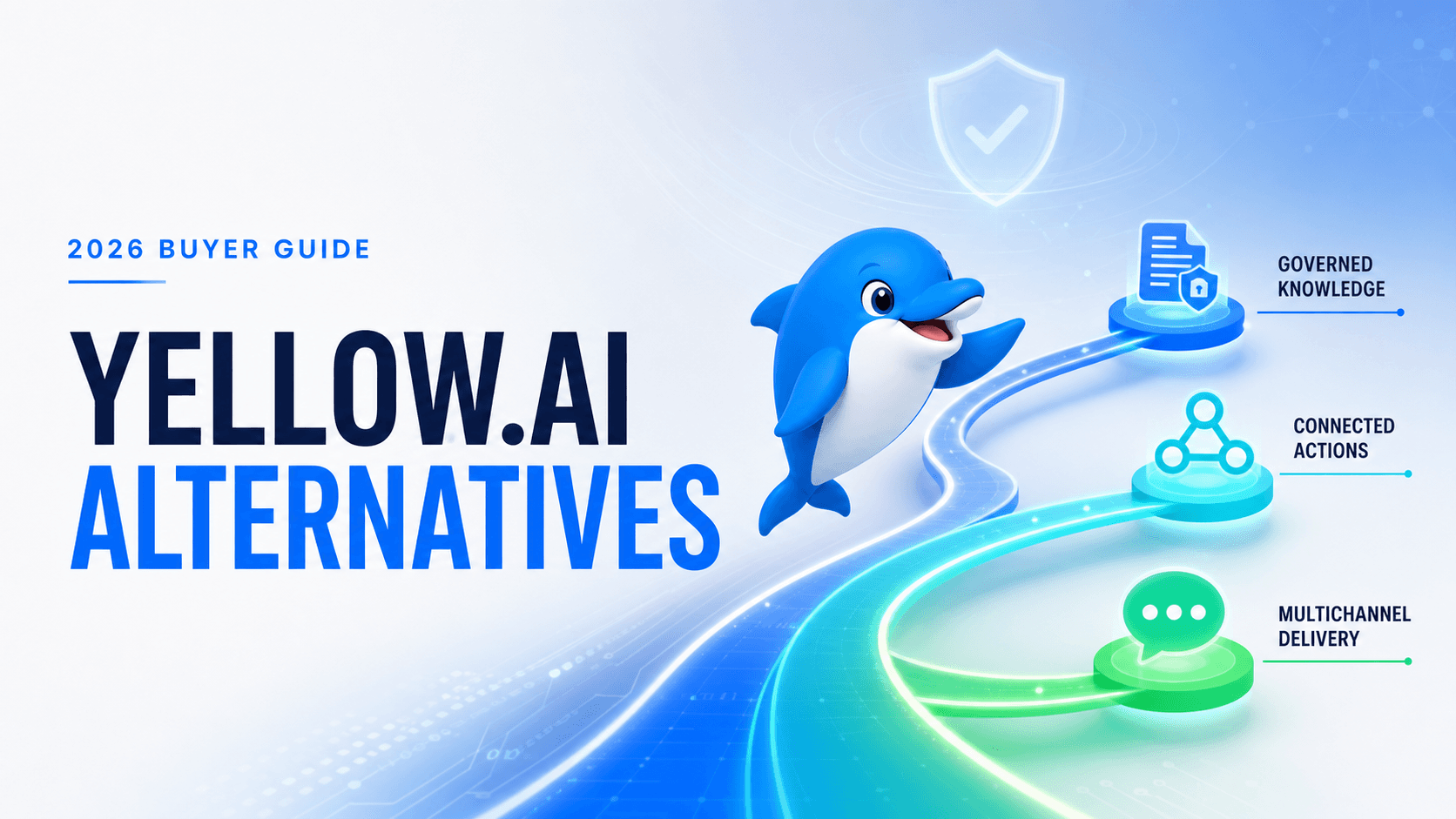
Quick answer: UChat is a Yellow.ai alternative for teams and agencies that want to launch visual multichannel automation without an enterprise implementation program. Cognigy and Ada fit large service organizations, Rasa fits engineering-led high-trust agents, and Microsoft Copilot Studio fits companies already standardized on Microsoft governance and connectors.
Yellow.ai remains a good option when enterprise chat, voice, global channels, governance and vendor-supported delivery belong in one program. UChat should only displace that model when the required workflows and controls can be proved at the intended scale.
Bottom line: Enterprise AI is an operating model, not a demo. Compare deployment ownership, voice and channel coverage, governance, resolution economics and who will maintain the agent after launch.
Yellow.ai Alternatives At A Glance
Alternative | Best fit | Operating model and control | Cost or implementation watchout | Evidence |
|---|---|---|---|---|
UChat | SMBs and agencies wanting visual multichannel delivery | AI Agents, visual flows, channels, live chat and Partner features reduce the operational distance from idea to client deployment. | It is not positioned as a substitute for every global enterprise deployment or governance requirement. | |
Ada | enterprise support teams prioritizing automated resolution | AI customer service and integrations center the buying case on support resolution. | Access is sales-led, so buyers need a workload-specific quote and proof of coverage. | |
Cognigy | large contact centers combining chat and voice | Enterprise conversational AI, voice and contact-center integration suit complex service environments. | Conversation, voice, knowledge and implementation costs need a full architecture model. | |
Rasa | engineering teams needing code and deployment control | CALM, business-logic Flows, on-premise options and developer control fit high-trust custom agents. | Production ownership requires more engineering and infrastructure responsibility. | |
Botpress | technical teams wanting a visual AI-agent builder | A visual studio, code extensibility and usage-based AI model create a flexible builder path. | AI spend, messages, storage, collaborators and add-ons shape the real bill. | |
Dialogflow CX | teams invested in Google Cloud | State-machine conversation design, telephony and Google Cloud integration suit developer-led virtual agents. | Cloud usage, implementation and surrounding operator tools must be assembled and priced. | |
Microsoft Copilot Studio | organizations standardized on Microsoft | Power Platform connectors, governance and Microsoft 365 context make it coherent inside that ecosystem. | Credit consumption and adjacent Microsoft licensing can make comparison less direct. |
Why Buyers Look For Yellow.ai Alternatives
Yellow.ai targets enterprise automation across chat, voice and many channels. Buyers look elsewhere when they need self-serve pricing, stronger developer ownership, an easier visual builder for a smaller team, or a white-label platform an agency can resell.
Yellow.ai publishes a free tier with one AI agent and a monthly session allowance, followed by per-resolution usage. Its Enterprise tier expands agents, sessions, channels, builders, integrations and governance through a sales-led plan. Confirm how resolutions, voice, implementation and support are priced for the proposed workload.
UChat publishes Free at $0, Business at $15 and Partner at $199 as entry plans. Its commercial model is easier to enter than a sales-led enterprise program, but buyers still need to estimate limits, add-ons, messaging or AI-provider charges, implementation and the support model required at scale.
For enterprise AI, ask every vendor to price the same monthly resolution and voice workload across the required countries, channels and environments. Then test identity, governed knowledge, backend action, escalation and audit evidence. Undocumented scale or governance claims stay unconfirmed until demonstrated.
Yellow.ai vs UChat: Enterprise Program Or Faster Delivery?
Decision area | Yellow.ai | UChat | What to prove |
|---|---|---|---|
Buyer and operating model | Yellow.ai positions itself as an enterprise Agentic AI platform with vendor-supported delivery. | UChat is a managed visual automation platform for operating teams and agencies. | Who designs, governs and maintains the agent after launch? |
Chat, voice and channels | Yellow.ai publishes enterprise access across 35+ chat, voice, email and SMS channels. | UChat documents web, social, messaging, SMS and voice-related workflows. | Validate each locale, number, provider, handoff and concurrency assumption. |
Agent building | Yellow.ai's platform documents natural-language building, multi-step workflows, RAG and multiple LLMs. | UChat combines AI Agents with deterministic Flow Builder steps and callable functions. | Test exceptions, approvals and backend actions, not only answer quality. |
Testing and observability | Yellow.ai documents traces, cross-channel tests, edge-case testing and resolution, sentiment and knowledge-gap analytics. | UChat public material establishes flow testing and operational tools, but not parity with every enterprise observability program. | Require production-shaped traces, alerts, evaluation and ownership. |
Security and governance | Yellow.ai publishes SOC 2, GDPR and ISO references and additional regulated-industry claims. | UChat's public product pages do not establish equivalent enterprise certification or private-deployment scope. | Procurement should verify identity, residency, audit, retention and certification directly. |
Integrations | Yellow.ai promotes 150+ enterprise integrations, including contact-center and CRM systems. | UChat supports native integrations, external requests, webhooks and Mini Apps. | Prove the exact authenticated action and failure path. |
Commercial model | Free entry and enterprise pricing use resolutions, usage and a sales-led scope. | Published entry pricing lowers the start barrier; capacity, providers, models and implementation still matter. | Price the same resolution, voice and support workload for one year. |
UChat's Credible Deployment Boundary
UChat can combine a supported channel, an AI Agent grounded in business knowledge, deterministic flow rules, an authenticated external action, human handoff, and lightweight Board or Ticket tracking. Agencies can place repeatable solutions in branded client workspaces and manage plans through Partner capabilities.
Use one production-shaped proof:
Authenticate a known customer on the selected channel and reject an invalid identity path.
Answer from a governed test knowledge set and record an unsupported-question branch.
Execute one authenticated backend action, including timeout, duplicate and permission-error handling.
Escalate with identity, transcript, action result and urgency to a named human queue.
Define the audit record, alert, retry owner and resolution metric before load testing the target volume.
That is a credible route for SMB and agency deployments where speed, visual control and multichannel delivery matter. It is not proof that UChat matches Yellow.ai on private deployment, global contact-center architecture, enterprise identity, auditability, regulated-industry controls or observability. Those requirements belong in a written proof plan and vendor review before purchase.
1. UChat
Best fit: SMBs and agencies wanting visual multichannel delivery.
AI Agents, visual flows, channels, live chat and Partner features reduce the operational distance from idea to client deployment.
Tradeoff: It is not positioned as a substitute for every global enterprise deployment or governance requirement.
2. Ada
Best fit: enterprise support teams prioritizing automated resolution.
AI customer service and integrations center the buying case on support resolution.
Tradeoff: Access is sales-led, so buyers need a workload-specific quote and proof of coverage.
3. Cognigy
Best fit: large contact centers combining chat and voice.
Enterprise conversational AI, voice and contact-center integration suit complex service environments.
Tradeoff: Conversation, voice, knowledge and implementation costs need a full architecture model.
4. Rasa
Best fit: engineering teams needing code and deployment control.
CALM, business-logic Flows, on-premise options and developer control fit high-trust custom agents.
Tradeoff: Production ownership requires more engineering and infrastructure responsibility.
5. Botpress
Best fit: technical teams wanting a visual AI-agent builder.
A visual studio, code extensibility and usage-based AI model create a flexible builder path.
Tradeoff: AI spend, messages, storage, collaborators and add-ons shape the real bill.
6. Dialogflow CX
Best fit: teams invested in Google Cloud.
State-machine conversation design, telephony and Google Cloud integration suit developer-led virtual agents.
Tradeoff: Cloud usage, implementation and surrounding operator tools must be assembled and priced.
7. Microsoft Copilot Studio
Best fit: organizations standardized on Microsoft.
Power Platform connectors, governance and Microsoft 365 context make it coherent inside that ecosystem.
Tradeoff: Credit consumption and adjacent Microsoft licensing can make comparison less direct.
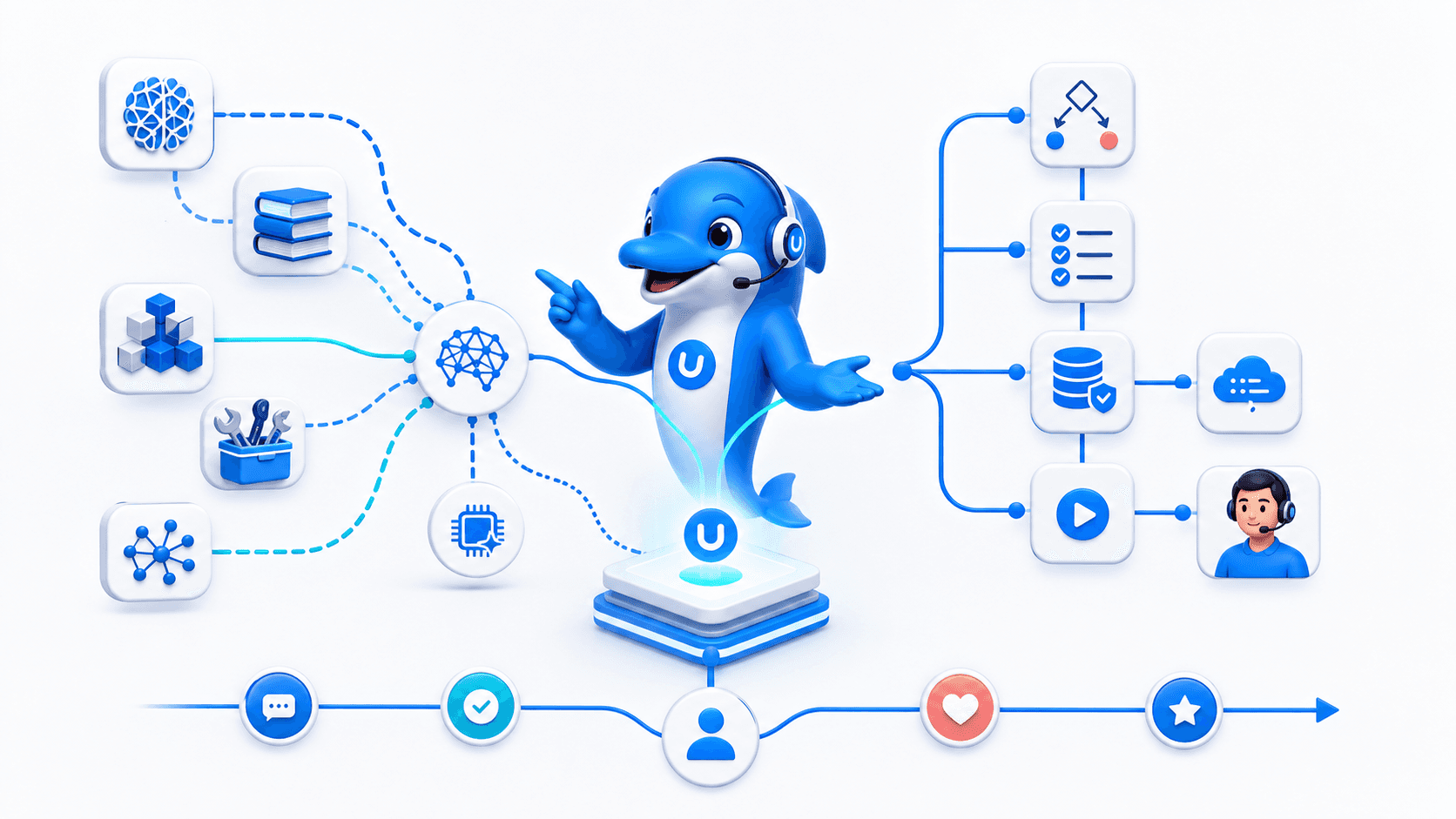
How To Choose The Right Yellow.ai Alternative
Choose UChat for visual cross-channel automation and white-label client delivery without an enterprise implementation program.
Choose Yellow.ai or Cognigy when global enterprise contact-center requirements drive the purchase.
Choose Rasa when code ownership, self-management and high-trust business logic matter most.
Choose Copilot Studio when Microsoft governance and connectors are decisive.
Proof before migration: Run a production-shaped scenario with authentication, a governed knowledge answer, backend action, escalation, voice or messaging channel, audit evidence and volume assumptions. Price the implementation and operating team as well as the software.
Frequently Asked Questions
Is UChat a direct Yellow.ai replacement?
Only for the workflows UChat can prove. UChat is a strong alternative for visual multichannel automation and agencies; large enterprise voice, governance and deployment requirements need a scoped proof.
Which alternative offers the most developer control?
Rasa is the clearest code-centric option in this shortlist. Botpress also combines visual building with code extensibility.
Which option is best for Microsoft organizations?
Copilot Studio is the more coherent choice when Power Platform, Microsoft 365 governance and tenant data are central.
How should enterprise buyers compare price?
Estimate resolutions or sessions, AI and voice usage, channels, connectors, implementation, environments, support, observability and internal engineering ownership.
Try UChat
Start a 14-day UChat trial with access to Pro features and no credit card required. Agencies evaluating branded client delivery can book a Partner Plan demo.
Sources
Pricing and packaging were reviewed on 2026-08-31. Verify current terms, limits, add-ons, taxes and implementation requirements before purchasing.
Quick answer: UChat is a Yellow.ai alternative for teams and agencies that want to launch visual multichannel automation without an enterprise implementation program. Cognigy and Ada fit large service organizations, Rasa fits engineering-led high-trust agents, and Microsoft Copilot Studio fits companies already standardized on Microsoft governance and connectors.
Yellow.ai remains a good option when enterprise chat, voice, global channels, governance and vendor-supported delivery belong in one program. UChat should only displace that model when the required workflows and controls can be proved at the intended scale.
Bottom line: Enterprise AI is an operating model, not a demo. Compare deployment ownership, voice and channel coverage, governance, resolution economics and who will maintain the agent after launch.
Yellow.ai Alternatives At A Glance
Alternative | Best fit | Operating model and control | Cost or implementation watchout | Evidence |
|---|---|---|---|---|
UChat | SMBs and agencies wanting visual multichannel delivery | AI Agents, visual flows, channels, live chat and Partner features reduce the operational distance from idea to client deployment. | It is not positioned as a substitute for every global enterprise deployment or governance requirement. | |
Ada | enterprise support teams prioritizing automated resolution | AI customer service and integrations center the buying case on support resolution. | Access is sales-led, so buyers need a workload-specific quote and proof of coverage. | |
Cognigy | large contact centers combining chat and voice | Enterprise conversational AI, voice and contact-center integration suit complex service environments. | Conversation, voice, knowledge and implementation costs need a full architecture model. | |
Rasa | engineering teams needing code and deployment control | CALM, business-logic Flows, on-premise options and developer control fit high-trust custom agents. | Production ownership requires more engineering and infrastructure responsibility. | |
Botpress | technical teams wanting a visual AI-agent builder | A visual studio, code extensibility and usage-based AI model create a flexible builder path. | AI spend, messages, storage, collaborators and add-ons shape the real bill. | |
Dialogflow CX | teams invested in Google Cloud | State-machine conversation design, telephony and Google Cloud integration suit developer-led virtual agents. | Cloud usage, implementation and surrounding operator tools must be assembled and priced. | |
Microsoft Copilot Studio | organizations standardized on Microsoft | Power Platform connectors, governance and Microsoft 365 context make it coherent inside that ecosystem. | Credit consumption and adjacent Microsoft licensing can make comparison less direct. |
Why Buyers Look For Yellow.ai Alternatives
Yellow.ai targets enterprise automation across chat, voice and many channels. Buyers look elsewhere when they need self-serve pricing, stronger developer ownership, an easier visual builder for a smaller team, or a white-label platform an agency can resell.
Yellow.ai publishes a free tier with one AI agent and a monthly session allowance, followed by per-resolution usage. Its Enterprise tier expands agents, sessions, channels, builders, integrations and governance through a sales-led plan. Confirm how resolutions, voice, implementation and support are priced for the proposed workload.
UChat publishes Free at $0, Business at $15 and Partner at $199 as entry plans. Its commercial model is easier to enter than a sales-led enterprise program, but buyers still need to estimate limits, add-ons, messaging or AI-provider charges, implementation and the support model required at scale.
For enterprise AI, ask every vendor to price the same monthly resolution and voice workload across the required countries, channels and environments. Then test identity, governed knowledge, backend action, escalation and audit evidence. Undocumented scale or governance claims stay unconfirmed until demonstrated.
Yellow.ai vs UChat: Enterprise Program Or Faster Delivery?
Decision area | Yellow.ai | UChat | What to prove |
|---|---|---|---|
Buyer and operating model | Yellow.ai positions itself as an enterprise Agentic AI platform with vendor-supported delivery. | UChat is a managed visual automation platform for operating teams and agencies. | Who designs, governs and maintains the agent after launch? |
Chat, voice and channels | Yellow.ai publishes enterprise access across 35+ chat, voice, email and SMS channels. | UChat documents web, social, messaging, SMS and voice-related workflows. | Validate each locale, number, provider, handoff and concurrency assumption. |
Agent building | Yellow.ai's platform documents natural-language building, multi-step workflows, RAG and multiple LLMs. | UChat combines AI Agents with deterministic Flow Builder steps and callable functions. | Test exceptions, approvals and backend actions, not only answer quality. |
Testing and observability | Yellow.ai documents traces, cross-channel tests, edge-case testing and resolution, sentiment and knowledge-gap analytics. | UChat public material establishes flow testing and operational tools, but not parity with every enterprise observability program. | Require production-shaped traces, alerts, evaluation and ownership. |
Security and governance | Yellow.ai publishes SOC 2, GDPR and ISO references and additional regulated-industry claims. | UChat's public product pages do not establish equivalent enterprise certification or private-deployment scope. | Procurement should verify identity, residency, audit, retention and certification directly. |
Integrations | Yellow.ai promotes 150+ enterprise integrations, including contact-center and CRM systems. | UChat supports native integrations, external requests, webhooks and Mini Apps. | Prove the exact authenticated action and failure path. |
Commercial model | Free entry and enterprise pricing use resolutions, usage and a sales-led scope. | Published entry pricing lowers the start barrier; capacity, providers, models and implementation still matter. | Price the same resolution, voice and support workload for one year. |
UChat's Credible Deployment Boundary
UChat can combine a supported channel, an AI Agent grounded in business knowledge, deterministic flow rules, an authenticated external action, human handoff, and lightweight Board or Ticket tracking. Agencies can place repeatable solutions in branded client workspaces and manage plans through Partner capabilities.
Use one production-shaped proof:
Authenticate a known customer on the selected channel and reject an invalid identity path.
Answer from a governed test knowledge set and record an unsupported-question branch.
Execute one authenticated backend action, including timeout, duplicate and permission-error handling.
Escalate with identity, transcript, action result and urgency to a named human queue.
Define the audit record, alert, retry owner and resolution metric before load testing the target volume.
That is a credible route for SMB and agency deployments where speed, visual control and multichannel delivery matter. It is not proof that UChat matches Yellow.ai on private deployment, global contact-center architecture, enterprise identity, auditability, regulated-industry controls or observability. Those requirements belong in a written proof plan and vendor review before purchase.
1. UChat
Best fit: SMBs and agencies wanting visual multichannel delivery.
AI Agents, visual flows, channels, live chat and Partner features reduce the operational distance from idea to client deployment.
Tradeoff: It is not positioned as a substitute for every global enterprise deployment or governance requirement.
2. Ada
Best fit: enterprise support teams prioritizing automated resolution.
AI customer service and integrations center the buying case on support resolution.
Tradeoff: Access is sales-led, so buyers need a workload-specific quote and proof of coverage.
3. Cognigy
Best fit: large contact centers combining chat and voice.
Enterprise conversational AI, voice and contact-center integration suit complex service environments.
Tradeoff: Conversation, voice, knowledge and implementation costs need a full architecture model.
4. Rasa
Best fit: engineering teams needing code and deployment control.
CALM, business-logic Flows, on-premise options and developer control fit high-trust custom agents.
Tradeoff: Production ownership requires more engineering and infrastructure responsibility.
5. Botpress
Best fit: technical teams wanting a visual AI-agent builder.
A visual studio, code extensibility and usage-based AI model create a flexible builder path.
Tradeoff: AI spend, messages, storage, collaborators and add-ons shape the real bill.
6. Dialogflow CX
Best fit: teams invested in Google Cloud.
State-machine conversation design, telephony and Google Cloud integration suit developer-led virtual agents.
Tradeoff: Cloud usage, implementation and surrounding operator tools must be assembled and priced.
7. Microsoft Copilot Studio
Best fit: organizations standardized on Microsoft.
Power Platform connectors, governance and Microsoft 365 context make it coherent inside that ecosystem.
Tradeoff: Credit consumption and adjacent Microsoft licensing can make comparison less direct.
How To Choose The Right Yellow.ai Alternative
Choose UChat for visual cross-channel automation and white-label client delivery without an enterprise implementation program.
Choose Yellow.ai or Cognigy when global enterprise contact-center requirements drive the purchase.
Choose Rasa when code ownership, self-management and high-trust business logic matter most.
Choose Copilot Studio when Microsoft governance and connectors are decisive.
Proof before migration: Run a production-shaped scenario with authentication, a governed knowledge answer, backend action, escalation, voice or messaging channel, audit evidence and volume assumptions. Price the implementation and operating team as well as the software.
Frequently Asked Questions
Is UChat a direct Yellow.ai replacement?
Only for the workflows UChat can prove. UChat is a strong alternative for visual multichannel automation and agencies; large enterprise voice, governance and deployment requirements need a scoped proof.
Which alternative offers the most developer control?
Rasa is the clearest code-centric option in this shortlist. Botpress also combines visual building with code extensibility.
Which option is best for Microsoft organizations?
Copilot Studio is the more coherent choice when Power Platform, Microsoft 365 governance and tenant data are central.
How should enterprise buyers compare price?
Estimate resolutions or sessions, AI and voice usage, channels, connectors, implementation, environments, support, observability and internal engineering ownership.
Try UChat
Start a 14-day UChat trial with access to Pro features and no credit card required. Agencies evaluating branded client delivery can book a Partner Plan demo.
Sources
Pricing and packaging were reviewed on 2026-08-31. Verify current terms, limits, add-ons, taxes and implementation requirements before purchasing.