12 minutes
UChat
Posted by
UChat vs JivoChat: Live Chat Inbox or Automation Platform?
12 minutes
Posted by
UChat

Quick verdict: JivoChat wins when you need a shared team inbox live in minutes — clear per-agent pricing, phone/email/chat unified, and a shared-inbox-first operating model. UChat wins when the goal is building automated, multichannel conversations (bots, AI agents, ticketing) rather than just staffing a chat window, while UChat publishes a $15 Business entry price. Because the billing units and included allowances differ, compare written totals rather than headline numbers.
Table Of Contents
Quick Verdict And Scorecard
Recommendation By Use Case
Feature Comparison
AI Agent Design And Control
Channels And Entry Points
Workflow Integrations And APIs
Human Handoff And Operations
When JivoChat May Be A Better Fit
Pricing And Total Cost
Agency And Multi-Client Delivery
Run A Fair Proof Of Concept
Decision Checklist
FAQ
Final Verdict And CTA
Quick Verdict And Scorecard
Category | JivoChat | UChat |
|---|---|---|
Entry pricing | Free plan; paid tiers Basic $28, Professional $42 and Enterprise $56 per agent/month when billed annually [S1] | Free plan; Business $15; Partner $199 — listed entry prices, billing period not stated here [S2] |
Live chat | Core product — live chat plus social/messenger/phone/email inbox in one view [S1] | Live Chat included as one channel among several [S7] |
Channel coverage | WhatsApp, Instagram, Telegram, plus phone and email [S1] | Web, social, and messaging channels, including Voice and SMS [S5] |
Automation / flow building | Not specified in [S1] | Visual Flow Builder for scripted, multi-step automation [S6] |
AI capabilities | Add-on AI assistant $13/agent/month; AI Agent add-on $69/agent/month [S1] | AI Agents with configurable knowledge, functions, and model choice; verify plan inclusion [S4] |
Ticketing / pipeline tracking | Not specified in [S1] | Boards/Tickets for structured lead and support tracking [S8] |
Reseller / white-label | Not specified in [S1] | White label, custom domain, and client-billing plans built in [S3] |
Integrations & extensibility | 50+ integrations, API access [S1] | Integrations, APIs, webhooks, and Mini Apps [S9] |
JivoChat's edge is a single shared inbox that already merges live chat, phone, and email with social/messenger channels [S1], and pricing that's a clearly listed per-agent rate at every tier — easy to budget as headcount grows. For a support desk that just wants agents answering fast, that's real simplicity.
UChat's edge is that automation is native to the product architecture. JivoChat lists its AI assistant and AI Agent as separately priced offerings [S1]; UChat documents AI Agents with knowledge sources, custom functions and model selection alongside Flow Builder [S4][S6]. Confirm UChat plan availability and usage allowances in the current pricing proposal. UChat also lists white-label and client-billing options on its Partner plan [S3], which JivoChat's published tiers don't mention — relevant for agencies reselling chat services rather than running their own desk.
Recommendation By Use Case
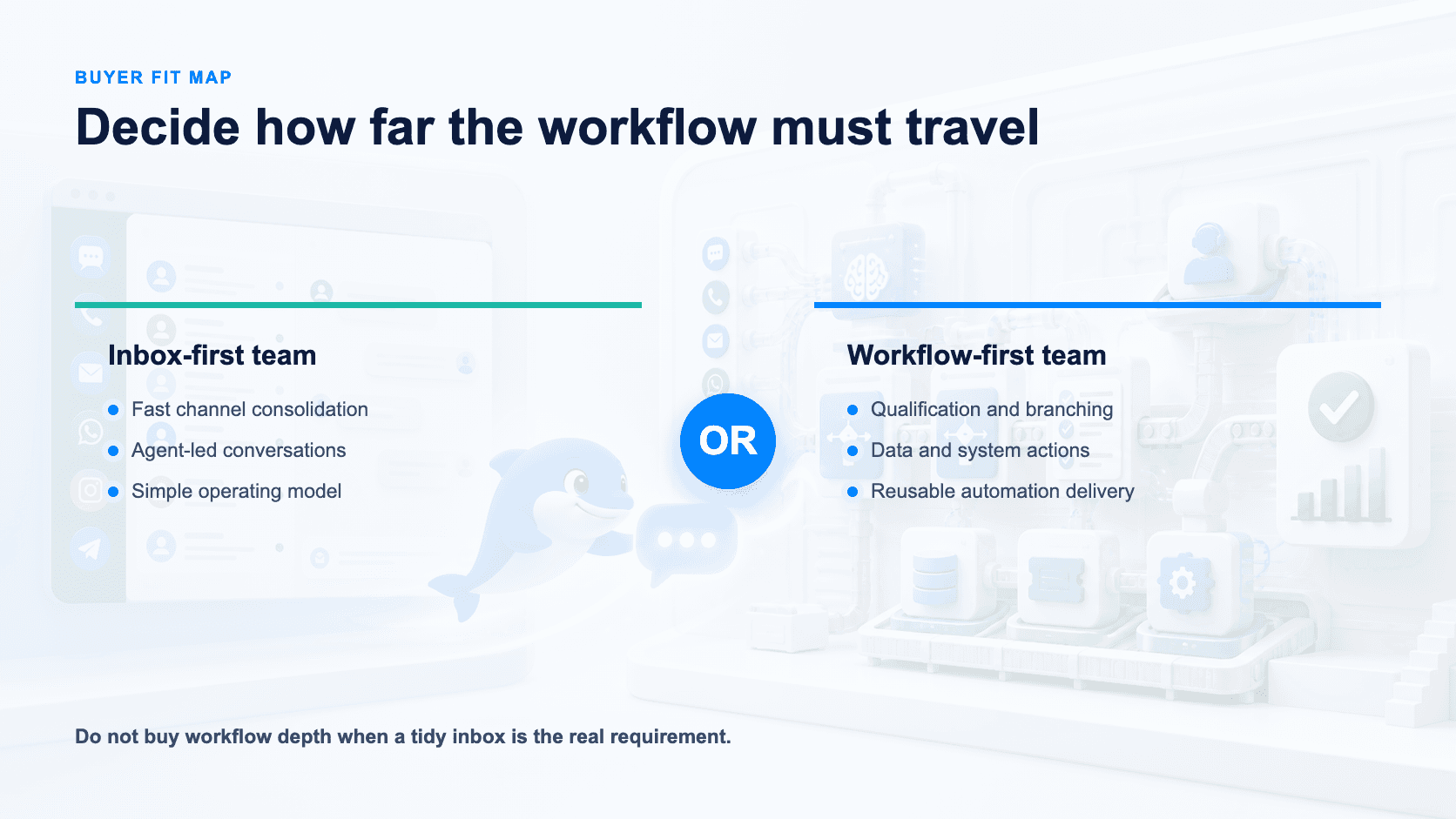
Fast-launch shared inbox, agent-heavy team. If the priority is getting a support team onto one screen — chat, social DMs, phone, and email — with minimal setup, JivoChat's unified inbox and clearly listed per-agent pricing [S1] gets there quickest. Its AI add-ons let you layer in assistance later without re-platforming.
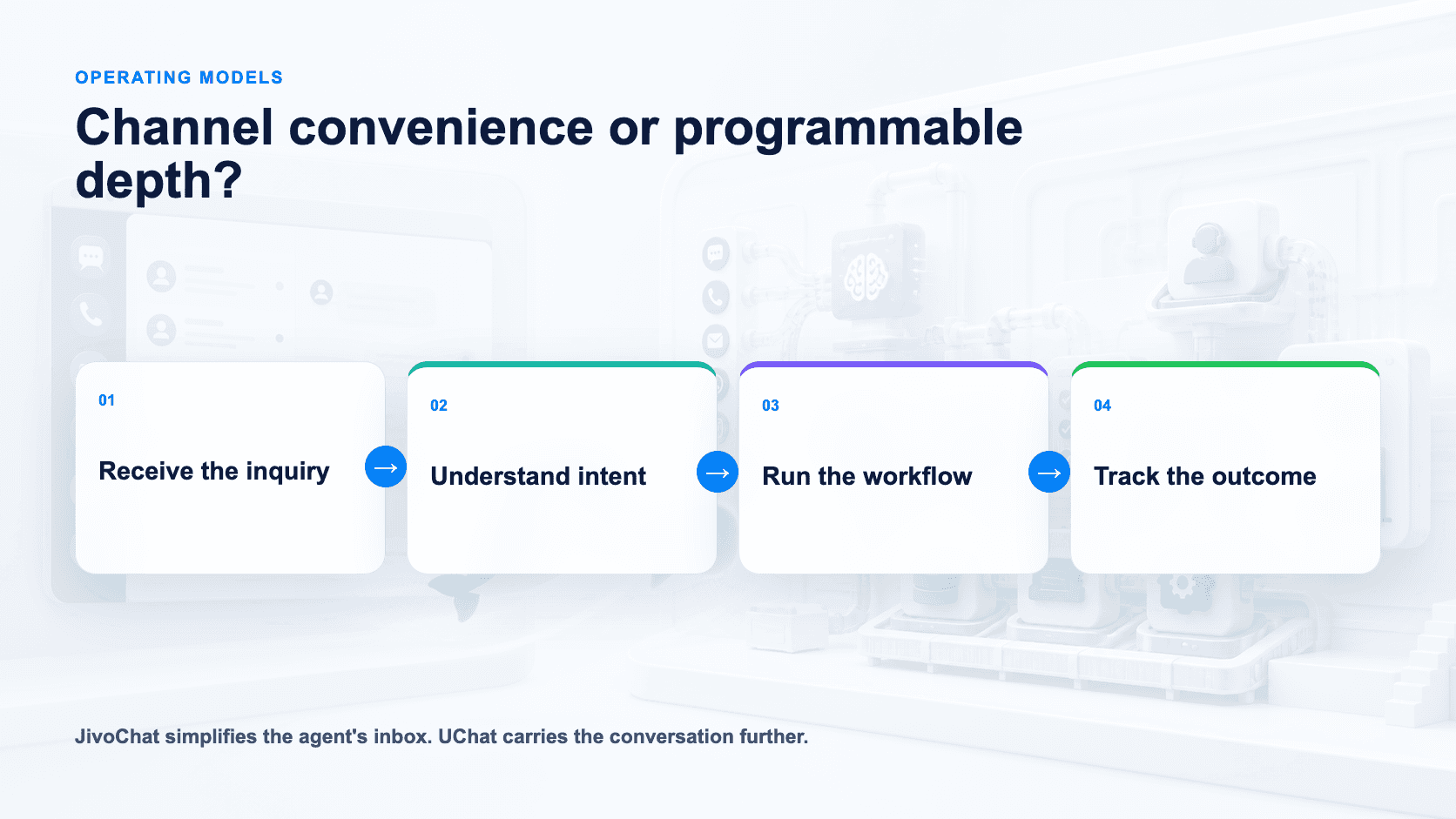
Automation-first, bot-driven engagement. If the goal is building multi-step flows — qualifying leads, routing tickets, running AI Agents against a knowledge base before a human ever joins — UChat's Flow Builder [S6], native AI Agents [S4], and Boards/Tickets [S8] are purpose-built for that, and the Business plan's low listed entry price [S2] makes it cheap to start experimenting.
Budget-conscious small teams. UChat lists a $15 Business entry price, while JivoChat lists Basic at $28 per agent/month when billed annually [S1][S2]. These are not equivalent units. Request written totals using the same seats, usage, channels and AI assumptions before deciding.
Agencies and resellers. UChat's white-label, custom-domain, and client-billing options on the Partner plan [S3] serve agencies managing multiple client accounts under one roof — a use case not addressed in JivoChat's published feature set [S1].
Unified inbox including phone. If you specifically want phone calls landing in the exact same queue view as chat and social replies, JivoChat's inbox is built for that [S1]. UChat also carries Voice and SMS as official channels [S5], but those typically route through Flows or AI Agents rather than a single merged human queue — a different operating model, not a missing feature.
Feature Comparison
JivoChat [S1] centers on a shared live-chat inbox: social, messenger, phone, email, WhatsApp, Instagram, and Telegram all land in one agent view, with 50+ integrations and an API. Pricing is per-agent and annual — Free, Basic $28, Professional $42 and Enterprise $56 per agent/month when billed annually — with WhatsApp, an AI assistant, and a separate AI Agent tier sold as add-ons.
UChat [S2] takes a broader approach: Free, Business, and Partner tiers listed at $0, $15, and $199, with automation, AI and channel breadth presented as platform capabilities. Confirm exact availability by plan. UChat also includes Live Chat [S7] and Boards/Tickets [S8] for teams that still want a manual queue.
AI Agent Design And Control
JivoChat offers an "AI assistant" at $13/agent/month and a separate, higher-tier "AI Agent" at $69/agent/month [S1]. The naming split suggests two capability levels, but the material here doesn't specify what each configures — knowledge sources, custom functions, or model selection for either tier aren't detailed.
UChat's AI Agents [S4] are described with more structural depth: agents can be built around a defined knowledge base, can call custom functions, and let the builder choose among multiple underlying models rather than being locked to one. That combination points to agents meant to handle real task logic — looking up data, taking actions, adapting to different reasoning needs — rather than only answering FAQ-style questions.
Channels And Entry Points
JivoChat's channel list is concrete and inbox-focused [S1]: live chat on your site, WhatsApp, Instagram, Telegram, phone, and email, unified into one shared inbox, extended further by 50+ integrations.
UChat [S5] supports web, social, and messaging channels — including Voice and SMS as official channels — and pairs that coverage with Live Chat [S7] as one entry point among several; flows, bots, and AI Agents [S4] can also serve as entry points, not just a live queue.
Workflow Integrations And APIs
JivoChat provides an API and cites 50+ integrations [S1], positioning itself to slot into an existing stack of tools a support team already uses, without requiring the team to rebuild processes around JivoChat itself.
UChat [S9] offers integrations, APIs, and webhooks, plus Mini Apps — a mechanism for extending functionality inside the UChat environment itself rather than only connecting outward. Combined with the Flow Builder [S6], workflow logic (branching, conditions, data handoffs) can live natively in UChat and trigger external systems via webhook or API, rather than living entirely in a third-party tool that JivoChat merely connects to.
Teams whose workflow engine lives elsewhere may prefer JivoChat's integration count and API, while teams that want automation logic built into the chat platform itself will find UChat's Flow Builder, webhooks, API, and Mini Apps [S6][S9] more self-contained. Neither vendor's material here names specific integration partners or webhook payload formats, so confirm must-have third-party support directly before committing.
Human Handoff And Operations
JivoChat is built around a single shared inbox pulling together live chat, social and messenger channels, phone, and email, with WhatsApp, Instagram, and Telegram included as standard [S1]. For a team that wants agents picking up conversations from one screen as fast as possible, this is a deploy-and-go setup — no flow to design before a human can respond.
UChat's operating model puts automation in front of the human layer. The visual Flow Builder [S6] and AI Agents [S4] are designed to resolve or triage conversations before a person gets involved. Live Chat [S7] and Boards/Tickets [S8] give UChat teams a place to hand off and track cases that do need a human, but the default path is automation-first, with human handoff a deliberate escalation rather than the primary structure.
When JivoChat May Be A Better Fit
JivoChat suits teams whose main goal is a fast, agent-centric shared inbox rather than a bot-building platform, with channel needs mapping cleanly onto its fixed set — live chat, social/messenger, phone, email, WhatsApp, Instagram, Telegram [S1]. Because AI in JivoChat is an optional add-on rather than a core mechanism, it's also a reasonable fit for teams that want humans to stay the primary responders and treat AI as a supplement, not the front line.
Pricing And Total Cost
UChat's published pricing is plan-based rather than per-agent: Free, Business, and Partner, listed at $0, $15, and $199 [S2]. Nothing in the available facts indicates these multiply by agent seat count the way JivoChat's do, which is worth noting — but channel, automation, and AI usage limits within each tier aren't detailed here either.
Treat every headline price as a starting point. Normalize seats, AI usage, channels, add-ons, providers and taxes in a written 12-month comparison.
Agency And Multi-Client Delivery
UChat is explicitly built for agencies and resellers: white labeling, custom domains, client-specific plans, and client billing are part of the platform [S3]. Combined with the Partner tier [S2], this points to a workflow where an agency manages multiple end clients under its own brand from a single UChat account.
The JivoChat facts provided don't mention white-labeling, client sub-accounts, or reseller billing — that's unaddressed in the available information, not confirmed absent. What is clear is that JivoChat's pricing is per-agent at every tier, including add-ons [S1]; an agency managing many client teams under that model would be paying per-agent costs multiplied across every client, whereas UChat's plan- and client-based structure [S2][S3] is the more purpose-built option for agencies managing multiple client bot deployments from one workspace.
Run A Fair Proof Of Concept
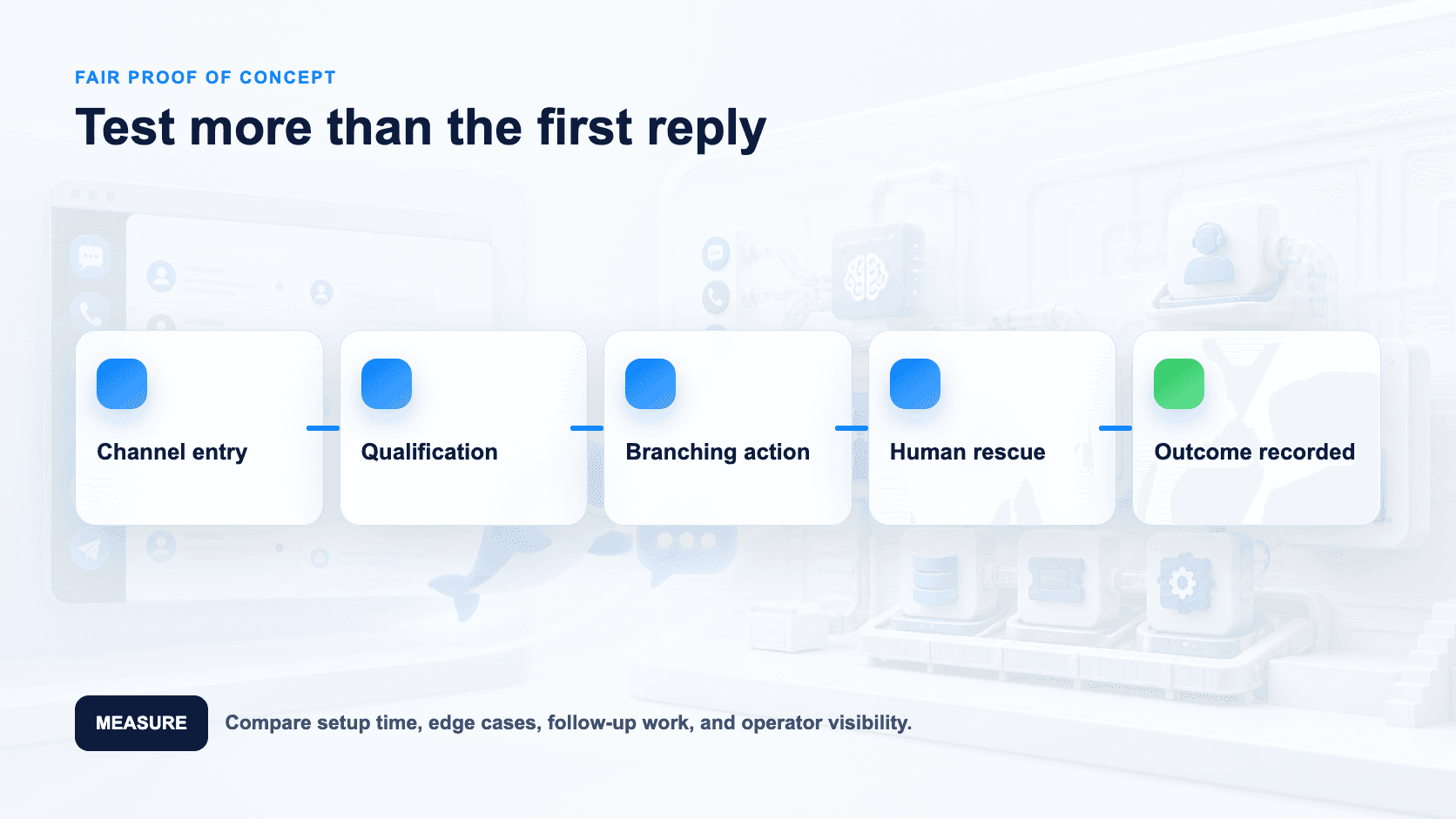
Don't judge either platform from a pricing page — run both against the same week of real conversations. JivoChat's strength is a shared inbox agents can open on day one [S1]; staff it and start replying. Time that setup against UChat's Live Chat plus Flow Builder [S6][S7]: build one automated intake flow that qualifies a lead before a human sees it, route the result into Boards/Tickets [S8], and connect the same channel mix, including Voice or SMS if you use them [S5].
The real difference between these platforms shows up in time and effort, not price — track agent hours per 100 conversations, and the share of volume that never needed a human at all.
Decision Checklist
Which channels do you actually run today? JivoChat covers live chat, phone, email, WhatsApp, Instagram, and Telegram plus 50+ integrations [S1]; confirm UChat's channel set, including Voice and SMS [S5], matches your list.
Do you need pre-human automation, or just a fast place for humans to reply? JivoChat is inbox-first [S1]; UChat's Flow Builder [S6] automates the path before a human is involved.
Is AI core to the workflow or a bolt-on? JivoChat prices AI separately — assistant $13/agent/month, AI Agent $69/agent/month [S1] — while UChat documents AI Agents with knowledge and model/function configuration; confirm availability and allowances for the selected plan [S4].
What's total cost at your agent count? JivoChat's paid tiers are $28, $42, or $56 per agent/month when billed annually [S1]; UChat lists Free, Business $15, and Partner $199 entry prices [S2]. Use the pricing checklist above to normalize the written totals.
Do you resell or manage chat for clients? UChat offers white label, custom domain, and client billing plans [S3]; white-labeling isn't mentioned in the JivoChat facts here.
How do you want work tracked after a chat ends? UChat has Boards/Tickets built in [S8]; ticket handling beyond the shared inbox isn't described for JivoChat.
What's your integration surface? JivoChat lists an API and 50+ integrations [S1]; UChat lists integrations, APIs, webhooks, and Mini Apps [S9].
How fast do agents need to go live? If the goal is "reply from every channel by Friday," JivoChat's inbox setup [S1] is the shorter path.
How much of your funnel should run without a human? The more volume that needs qualifying, routing, or FAQ handling first, the more UChat's Flow Builder and AI Agents [S6][S4] matter.
Do you need to choose the AI model? UChat lets you configure knowledge, functions, and model choice [S4]; JivoChat lists separately priced AI offerings; confirm model controls during evaluation [S1].
FAQ
Is JivoChat cheaper for a small team?
JivoChat lists Basic at $28 per agent/month when billed annually [S1]; UChat lists a $15 Business entry price [S2]. The units differ, so compare a written 12-month total for your actual team rather than declaring a cheaper winner.
Does JivoChat include AI, or is it extra?
Extra: an AI assistant at $13/agent/month and a full AI Agent at $69/agent/month, on top of the base plan [S1]. UChat documents AI Agents with knowledge, model and function configuration; confirm plan availability and usage allowances [S4].
Can I white-label either platform for clients?
UChat explicitly offers white label, custom domain, and client billing [S3]. White-labeling isn't mentioned in the JivoChat facts here, so treat it as unconfirmed rather than absent.
Which channels does each platform actually cover?
JivoChat: live chat, phone, email, WhatsApp, Instagram, Telegram, plus 50+ integrations [S1]. UChat: web, social, and messaging channels — including Voice and SMS — alongside its own integrations, APIs, webhooks, and Mini Apps [S5][S9].
Do I need a developer to build automation?
UChat's visual Flow Builder [S6] is built for no-code automation. These facts don't describe JivoChat's automation tooling beyond the shared inbox [S1], so don't assume parity.
Final Verdict And CTA
Choose JivoChat if the job is "stand up a shared inbox across phone, email, and social this week" — that's its clearest strength [S1]. Choose UChat if the job is "automate the funnel before a human gets involved, then hand off cleanly" — Flow Builder, AI Agents, Live Chat, and Boards/Tickets [S6][S4][S7][S8] form a connected automation and handoff stack, and white label plus client billing [S3] matter if you resell chat services.
Run your own proof of concept: start a free UChat trial or book a partner demo to see white label and client billing firsthand. See also UChat vs ManyChat, UChat vs Chatfuel, and UChat vs Landbot.
Sources reviewed 12 August 2026.
Quick verdict: JivoChat wins when you need a shared team inbox live in minutes — clear per-agent pricing, phone/email/chat unified, and a shared-inbox-first operating model. UChat wins when the goal is building automated, multichannel conversations (bots, AI agents, ticketing) rather than just staffing a chat window, while UChat publishes a $15 Business entry price. Because the billing units and included allowances differ, compare written totals rather than headline numbers.
Table Of Contents
Quick Verdict And Scorecard
Recommendation By Use Case
Feature Comparison
AI Agent Design And Control
Channels And Entry Points
Workflow Integrations And APIs
Human Handoff And Operations
When JivoChat May Be A Better Fit
Pricing And Total Cost
Agency And Multi-Client Delivery
Run A Fair Proof Of Concept
Decision Checklist
FAQ
Final Verdict And CTA
Quick Verdict And Scorecard
Category | JivoChat | UChat |
|---|---|---|
Entry pricing | Free plan; paid tiers Basic $28, Professional $42 and Enterprise $56 per agent/month when billed annually [S1] | Free plan; Business $15; Partner $199 — listed entry prices, billing period not stated here [S2] |
Live chat | Core product — live chat plus social/messenger/phone/email inbox in one view [S1] | Live Chat included as one channel among several [S7] |
Channel coverage | WhatsApp, Instagram, Telegram, plus phone and email [S1] | Web, social, and messaging channels, including Voice and SMS [S5] |
Automation / flow building | Not specified in [S1] | Visual Flow Builder for scripted, multi-step automation [S6] |
AI capabilities | Add-on AI assistant $13/agent/month; AI Agent add-on $69/agent/month [S1] | AI Agents with configurable knowledge, functions, and model choice; verify plan inclusion [S4] |
Ticketing / pipeline tracking | Not specified in [S1] | Boards/Tickets for structured lead and support tracking [S8] |
Reseller / white-label | Not specified in [S1] | White label, custom domain, and client-billing plans built in [S3] |
Integrations & extensibility | 50+ integrations, API access [S1] | Integrations, APIs, webhooks, and Mini Apps [S9] |
JivoChat's edge is a single shared inbox that already merges live chat, phone, and email with social/messenger channels [S1], and pricing that's a clearly listed per-agent rate at every tier — easy to budget as headcount grows. For a support desk that just wants agents answering fast, that's real simplicity.
UChat's edge is that automation is native to the product architecture. JivoChat lists its AI assistant and AI Agent as separately priced offerings [S1]; UChat documents AI Agents with knowledge sources, custom functions and model selection alongside Flow Builder [S4][S6]. Confirm UChat plan availability and usage allowances in the current pricing proposal. UChat also lists white-label and client-billing options on its Partner plan [S3], which JivoChat's published tiers don't mention — relevant for agencies reselling chat services rather than running their own desk.
Recommendation By Use Case
Fast-launch shared inbox, agent-heavy team. If the priority is getting a support team onto one screen — chat, social DMs, phone, and email — with minimal setup, JivoChat's unified inbox and clearly listed per-agent pricing [S1] gets there quickest. Its AI add-ons let you layer in assistance later without re-platforming.
Automation-first, bot-driven engagement. If the goal is building multi-step flows — qualifying leads, routing tickets, running AI Agents against a knowledge base before a human ever joins — UChat's Flow Builder [S6], native AI Agents [S4], and Boards/Tickets [S8] are purpose-built for that, and the Business plan's low listed entry price [S2] makes it cheap to start experimenting.
Budget-conscious small teams. UChat lists a $15 Business entry price, while JivoChat lists Basic at $28 per agent/month when billed annually [S1][S2]. These are not equivalent units. Request written totals using the same seats, usage, channels and AI assumptions before deciding.
Agencies and resellers. UChat's white-label, custom-domain, and client-billing options on the Partner plan [S3] serve agencies managing multiple client accounts under one roof — a use case not addressed in JivoChat's published feature set [S1].
Unified inbox including phone. If you specifically want phone calls landing in the exact same queue view as chat and social replies, JivoChat's inbox is built for that [S1]. UChat also carries Voice and SMS as official channels [S5], but those typically route through Flows or AI Agents rather than a single merged human queue — a different operating model, not a missing feature.
Feature Comparison
JivoChat [S1] centers on a shared live-chat inbox: social, messenger, phone, email, WhatsApp, Instagram, and Telegram all land in one agent view, with 50+ integrations and an API. Pricing is per-agent and annual — Free, Basic $28, Professional $42 and Enterprise $56 per agent/month when billed annually — with WhatsApp, an AI assistant, and a separate AI Agent tier sold as add-ons.
UChat [S2] takes a broader approach: Free, Business, and Partner tiers listed at $0, $15, and $199, with automation, AI and channel breadth presented as platform capabilities. Confirm exact availability by plan. UChat also includes Live Chat [S7] and Boards/Tickets [S8] for teams that still want a manual queue.
AI Agent Design And Control
JivoChat offers an "AI assistant" at $13/agent/month and a separate, higher-tier "AI Agent" at $69/agent/month [S1]. The naming split suggests two capability levels, but the material here doesn't specify what each configures — knowledge sources, custom functions, or model selection for either tier aren't detailed.
UChat's AI Agents [S4] are described with more structural depth: agents can be built around a defined knowledge base, can call custom functions, and let the builder choose among multiple underlying models rather than being locked to one. That combination points to agents meant to handle real task logic — looking up data, taking actions, adapting to different reasoning needs — rather than only answering FAQ-style questions.
Channels And Entry Points
JivoChat's channel list is concrete and inbox-focused [S1]: live chat on your site, WhatsApp, Instagram, Telegram, phone, and email, unified into one shared inbox, extended further by 50+ integrations.
UChat [S5] supports web, social, and messaging channels — including Voice and SMS as official channels — and pairs that coverage with Live Chat [S7] as one entry point among several; flows, bots, and AI Agents [S4] can also serve as entry points, not just a live queue.
Workflow Integrations And APIs
JivoChat provides an API and cites 50+ integrations [S1], positioning itself to slot into an existing stack of tools a support team already uses, without requiring the team to rebuild processes around JivoChat itself.
UChat [S9] offers integrations, APIs, and webhooks, plus Mini Apps — a mechanism for extending functionality inside the UChat environment itself rather than only connecting outward. Combined with the Flow Builder [S6], workflow logic (branching, conditions, data handoffs) can live natively in UChat and trigger external systems via webhook or API, rather than living entirely in a third-party tool that JivoChat merely connects to.
Teams whose workflow engine lives elsewhere may prefer JivoChat's integration count and API, while teams that want automation logic built into the chat platform itself will find UChat's Flow Builder, webhooks, API, and Mini Apps [S6][S9] more self-contained. Neither vendor's material here names specific integration partners or webhook payload formats, so confirm must-have third-party support directly before committing.
Human Handoff And Operations
JivoChat is built around a single shared inbox pulling together live chat, social and messenger channels, phone, and email, with WhatsApp, Instagram, and Telegram included as standard [S1]. For a team that wants agents picking up conversations from one screen as fast as possible, this is a deploy-and-go setup — no flow to design before a human can respond.
UChat's operating model puts automation in front of the human layer. The visual Flow Builder [S6] and AI Agents [S4] are designed to resolve or triage conversations before a person gets involved. Live Chat [S7] and Boards/Tickets [S8] give UChat teams a place to hand off and track cases that do need a human, but the default path is automation-first, with human handoff a deliberate escalation rather than the primary structure.
When JivoChat May Be A Better Fit
JivoChat suits teams whose main goal is a fast, agent-centric shared inbox rather than a bot-building platform, with channel needs mapping cleanly onto its fixed set — live chat, social/messenger, phone, email, WhatsApp, Instagram, Telegram [S1]. Because AI in JivoChat is an optional add-on rather than a core mechanism, it's also a reasonable fit for teams that want humans to stay the primary responders and treat AI as a supplement, not the front line.
Pricing And Total Cost
UChat's published pricing is plan-based rather than per-agent: Free, Business, and Partner, listed at $0, $15, and $199 [S2]. Nothing in the available facts indicates these multiply by agent seat count the way JivoChat's do, which is worth noting — but channel, automation, and AI usage limits within each tier aren't detailed here either.
Treat every headline price as a starting point. Normalize seats, AI usage, channels, add-ons, providers and taxes in a written 12-month comparison.
Agency And Multi-Client Delivery
UChat is explicitly built for agencies and resellers: white labeling, custom domains, client-specific plans, and client billing are part of the platform [S3]. Combined with the Partner tier [S2], this points to a workflow where an agency manages multiple end clients under its own brand from a single UChat account.
The JivoChat facts provided don't mention white-labeling, client sub-accounts, or reseller billing — that's unaddressed in the available information, not confirmed absent. What is clear is that JivoChat's pricing is per-agent at every tier, including add-ons [S1]; an agency managing many client teams under that model would be paying per-agent costs multiplied across every client, whereas UChat's plan- and client-based structure [S2][S3] is the more purpose-built option for agencies managing multiple client bot deployments from one workspace.
Run A Fair Proof Of Concept
Don't judge either platform from a pricing page — run both against the same week of real conversations. JivoChat's strength is a shared inbox agents can open on day one [S1]; staff it and start replying. Time that setup against UChat's Live Chat plus Flow Builder [S6][S7]: build one automated intake flow that qualifies a lead before a human sees it, route the result into Boards/Tickets [S8], and connect the same channel mix, including Voice or SMS if you use them [S5].
The real difference between these platforms shows up in time and effort, not price — track agent hours per 100 conversations, and the share of volume that never needed a human at all.
Decision Checklist
Which channels do you actually run today? JivoChat covers live chat, phone, email, WhatsApp, Instagram, and Telegram plus 50+ integrations [S1]; confirm UChat's channel set, including Voice and SMS [S5], matches your list.
Do you need pre-human automation, or just a fast place for humans to reply? JivoChat is inbox-first [S1]; UChat's Flow Builder [S6] automates the path before a human is involved.
Is AI core to the workflow or a bolt-on? JivoChat prices AI separately — assistant $13/agent/month, AI Agent $69/agent/month [S1] — while UChat documents AI Agents with knowledge and model/function configuration; confirm availability and allowances for the selected plan [S4].
What's total cost at your agent count? JivoChat's paid tiers are $28, $42, or $56 per agent/month when billed annually [S1]; UChat lists Free, Business $15, and Partner $199 entry prices [S2]. Use the pricing checklist above to normalize the written totals.
Do you resell or manage chat for clients? UChat offers white label, custom domain, and client billing plans [S3]; white-labeling isn't mentioned in the JivoChat facts here.
How do you want work tracked after a chat ends? UChat has Boards/Tickets built in [S8]; ticket handling beyond the shared inbox isn't described for JivoChat.
What's your integration surface? JivoChat lists an API and 50+ integrations [S1]; UChat lists integrations, APIs, webhooks, and Mini Apps [S9].
How fast do agents need to go live? If the goal is "reply from every channel by Friday," JivoChat's inbox setup [S1] is the shorter path.
How much of your funnel should run without a human? The more volume that needs qualifying, routing, or FAQ handling first, the more UChat's Flow Builder and AI Agents [S6][S4] matter.
Do you need to choose the AI model? UChat lets you configure knowledge, functions, and model choice [S4]; JivoChat lists separately priced AI offerings; confirm model controls during evaluation [S1].
FAQ
Is JivoChat cheaper for a small team?
JivoChat lists Basic at $28 per agent/month when billed annually [S1]; UChat lists a $15 Business entry price [S2]. The units differ, so compare a written 12-month total for your actual team rather than declaring a cheaper winner.
Does JivoChat include AI, or is it extra?
Extra: an AI assistant at $13/agent/month and a full AI Agent at $69/agent/month, on top of the base plan [S1]. UChat documents AI Agents with knowledge, model and function configuration; confirm plan availability and usage allowances [S4].
Can I white-label either platform for clients?
UChat explicitly offers white label, custom domain, and client billing [S3]. White-labeling isn't mentioned in the JivoChat facts here, so treat it as unconfirmed rather than absent.
Which channels does each platform actually cover?
JivoChat: live chat, phone, email, WhatsApp, Instagram, Telegram, plus 50+ integrations [S1]. UChat: web, social, and messaging channels — including Voice and SMS — alongside its own integrations, APIs, webhooks, and Mini Apps [S5][S9].
Do I need a developer to build automation?
UChat's visual Flow Builder [S6] is built for no-code automation. These facts don't describe JivoChat's automation tooling beyond the shared inbox [S1], so don't assume parity.
Final Verdict And CTA
Choose JivoChat if the job is "stand up a shared inbox across phone, email, and social this week" — that's its clearest strength [S1]. Choose UChat if the job is "automate the funnel before a human gets involved, then hand off cleanly" — Flow Builder, AI Agents, Live Chat, and Boards/Tickets [S6][S4][S7][S8] form a connected automation and handoff stack, and white label plus client billing [S3] matter if you resell chat services.
Run your own proof of concept: start a free UChat trial or book a partner demo to see white label and client billing firsthand. See also UChat vs ManyChat, UChat vs Chatfuel, and UChat vs Landbot.
Sources reviewed 12 August 2026.