11 minutes
UChat
Posted by
UChat vs Jotform AI Agents: Which Platform Fits?
11 minutes
Posted by
UChat

Quick verdict: Choose Jotform AI Agents when forms, submissions, appointments and structured data collection already sit at the center of the customer journey. Choose UChat when conversations must move across more channel families, combine AI with deterministic flow logic, continue into CRM or Ticket stages, or become a white-label service sold by an agency [S1][S3]–[S9].
Table Of Contents
Quick Verdict And Scorecard
Recommendation By Use Case
Feature Comparison
Forms, Knowledge And AI Actions
Channels And Journey Design
Human Handoff And Lifecycle Work
Pricing And Total Cost
Agency And White-Label Delivery
When Jotform May Be A Better Fit
Run A Fair Proof Of Concept
Decision Checklist
FAQ
Final Verdict And CTA
Quick Verdict And Scorecard
Dimension | Jotform AI Agents | UChat | Starting edge |
|---|---|---|---|
Operating center | Forms, submissions and structured intake [S1] | Multichannel conversation journeys [S10] | Depends on where the customer process begins |
AI design | Knowledge-driven Agents with channel-specific surfaces and actions [S1] | Configurable AI Agents, functions and model choice [S4] | Both are credible; test the required outcome |
Structured data | Deep connection to Jotform forms and data collection [S1] | Questions, custom fields, CRM and integrations [S6][S8][S9] | Jotform for form-native processes |
Channels | Chatbot, phone, voice, WhatsApp, Messenger, SMS, Instagram, app and more [S1] | Web, social, messaging, voice and SMS families [S5] | Map exact required channels in both |
Journey control | Agent instructions, tools and form-linked actions [S1] | Visual Flow Builder plus AI and deterministic actions [S4][S6] | UChat for explicit multi-step orchestration |
Human work | Mobile takeover and notifications [S1] | Live Chat, CRM Boards and Tickets [S7][S8] | UChat for broader post-chat lifecycle |
Agency model | Enterprise domains and account controls require scope confirmation [S1] | White label, client plans, billing and Partner API [S3] | UChat for documented platform resale |
How We Compared
We reviewed Jotform's current AI Agents overview, pricing, customer-service, channel and Enterprise pages. We compared them with UChat's official pricing, Partner, AI Agent, Channels, Flow Builder, Live Chat, CRM and Integrations pages. Evidence was captured on 13 August 2026, so plan limits and packaging should still be confirmed before purchase [S1]–[S12].
Recommendation By Use Case
Team already running lead forms, applications, registrations or approvals in Jotform: Start with Jotform AI Agents [S1].
Business wanting an Agent to collect structured information, book an appointment and pass data into an existing Jotform process: Start with Jotform [S1].
Team coordinating Instagram, Messenger, WhatsApp, Web Chat, SMS or voice journeys with shared automation logic: Start with UChat [S5][S6].
Operation that must combine probabilistic AI decisions with visible conditions, branches and recovery steps: Start with UChat [S4][S6][S9].
Support team that needs conversations to continue through a Board or Ticket lifecycle: Start with UChat [S7][S8].
Agency selling a platform under its own domain, plans and pricing: Start with UChat Partner [S3].
Feature Comparison
Capability | Jotform AI Agents | UChat |
|---|---|---|
Starting point | Build from scratch, template or existing form [S1] | Start from an AI Agent, Flow or reusable template [S4][S6] |
Knowledge | Websites, documents, FAQs and uploaded business sources [S1] | Instructions, knowledge sources and model choices [S4] |
Actions | Appointments, emails, information capture and API-connected tasks [S1] | AI functions, integrations, APIs, webhooks and Mini Apps [S4][S9] |
Data capture | Form-native structured collection [S1] | Question steps, fields, CRM and external systems [S6][S8][S9] |
Human takeover | Mobile takeover and push notifications [S1] | Live Chat handoff [S7] |
Lifecycle | Jotform submissions and connected processes [S1] | CRM Boards and Tickets [S8] |
Client resale | Confirm the complete multi-client delivery model [S1] | White label, domains, client plans and billing [S3] |
Forms, Knowledge And AI Actions
Jotform's strongest advantage is not merely that it “has forms.” Its AI Agents are connected to an established data-collection environment. A team can create an Agent from an existing form, use it to gather information conversationally, and continue into appointment, email or submission workflows [S1]. That is valuable when the business record is the destination of the conversation.
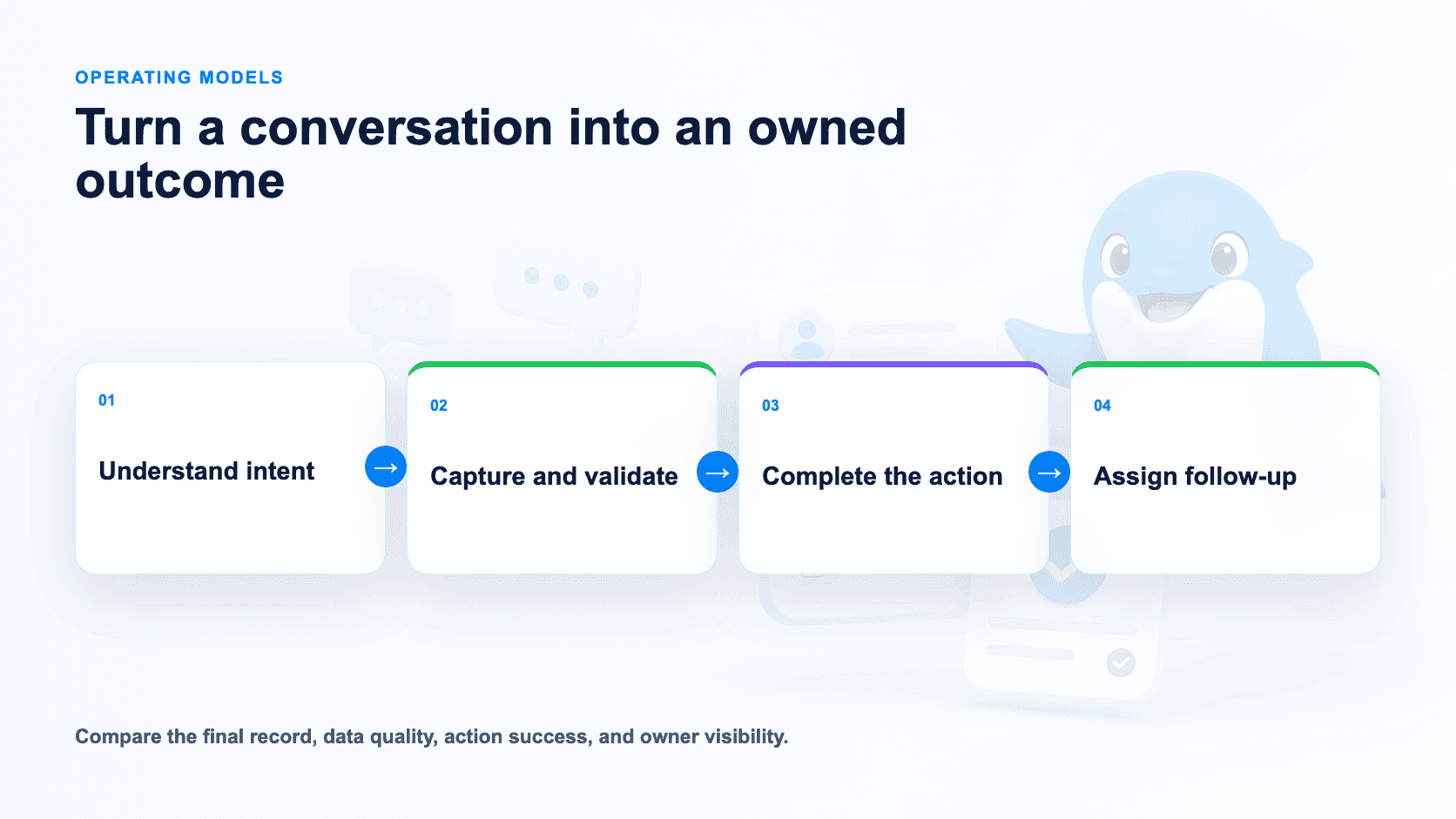
UChat can also ask questions, store fields and call external systems. Its distinction is architectural: an AI Agent can sit beside a visual Flow Builder, functions, conditions, APIs, webhooks and Mini Apps [S4][S6][S9]. The team can let AI interpret an open question, then move into deterministic steps for consent, validation, payment, routing or recovery.
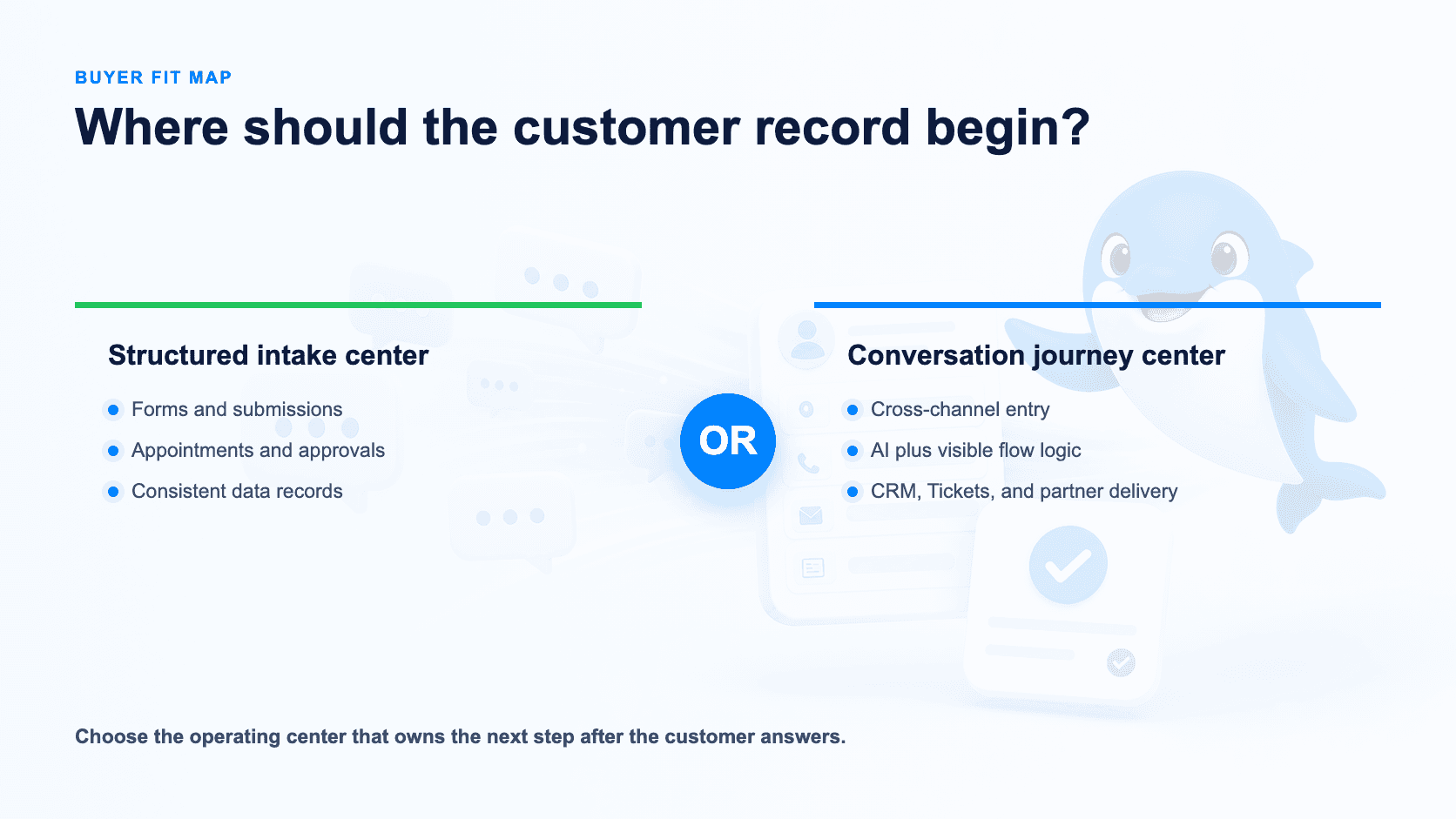
The choice is therefore not forms versus chatbots. It is where the operating center should live. If every successful interaction should become a Jotform submission, Jotform offers a coherent path. If a submission is only one step inside a longer social, messaging or service journey, UChat may provide a more useful orchestration layer.
Ask one practical question: after the customer provides the information, what must happen next, and which team needs to see or change that next step?
Knowledge quality also requires more than uploading documents. Test conflicting sources, expired policy, incomplete customer information and an unsupported request. A fluent answer is not a reliable workflow unless the Agent can identify uncertainty and choose a safe next action.
Channels And Journey Design
Jotform now documents a broad set of AI Agent surfaces: standalone and embedded chatbot experiences, phone and voice, SMS, WhatsApp, Messenger, Instagram, Agent App, kiosk, Shopify, Gmail, Salesforce and other specialized routes [S1]. Buyers should not evaluate it as a web-form product with a chatbot attached.
UChat documents coverage across web, social, messaging, voice and SMS families [S5]. Its Omni Channel and Flow Builder model is useful when the same business logic must be adapted across customer entry points [S5][S6]. A lead might arrive from an Instagram comment, continue in Messenger or WhatsApp, invoke an AI function, enter a Board stage and create a Ticket for an exception.
Channel lists alone do not decide the purchase. Verify the trigger, message type, template rule, identity model and human handoff on every required channel. A logo in an integration directory does not prove that the exact journey works.
UChat has the stronger starting case when channel orchestration is the product. Jotform has the stronger case when each channel should guide the customer into a consistent structured intake.
Human Handoff And Lifecycle Work
Jotform documents mobile human takeover with push notifications, allowing a person to step into an Agent conversation [S1]. That is a meaningful operational feature, especially for small teams that want to supervise customer interactions while away from a desk.
UChat Live Chat handles conversation takeover, while CRM Boards and Tickets provide separate ways to track work after the immediate chat [S7][S8]. This matters when “talk to a person” is not the end of the process. A sales opportunity may need pipeline movement; a service exception may need ownership, status and follow-up.
During evaluation, run an operator shift. Measure alert quality, context available at takeover, assignment, notes, status handling and the number of clicks required to resume automation. The Agent demo shows the customer experience; the shift test reveals the support experience.
Pricing And Total Cost
Jotform offers a free Starter plan, followed by Bronze, Silver, Gold and custom Enterprise tiers [S1]. The AI Agent environment is governed by several resources, including active Agents, monthly conversations, sessions, voice minutes, SMS messages and knowledge-base characters [S1]. Exact prices and allowances should be checked in the account and current checkout because the public crawler view does not expose a dependable complete price table.
UChat lists Free at $0, Business at $15 and Partner at $199 as entry prices [S2]. The total can also include workspace limits, members, bot users, add-ons, AI provider usage and channel-provider charges.
Model the same workload in both products:
Number of active customer experiences or Agents.
Monthly conversations and peak sessions.
Voice minutes and outbound messages.
Knowledge size and refresh frequency.
Human operators and lifecycle work.
External integrations and implementation time.
Do not compare one Jotform subscription number with one UChat plan number and call it finished. The resource units and surrounding products differ. The right comparison is the cost of one completed, maintained business outcome.
Agency And White-Label Delivery
Jotform Enterprise documents multiuser capabilities, custom domains, SSO and higher-control account features [S1]. Those can be valuable in a client implementation. An agency should still confirm client isolation, branded login, plan packaging, reusable assets, operator permissions and billing ownership for its exact resale model.
UChat Partner publicly documents full white-label customization, custom domains, client workspace management, plan controls, billing and Partner API automation [S3]. The partner can choose client-facing prices and keep the client relationship while UChat charges the relevant platform cost.
That makes UChat the clearer fit when the agency intends to sell its own automation platform, rather than deliver individual projects in another vendor's account. Jotform may be the cleaner implementation component when the agency's offer is centered on forms, registrations and data processes.
When Jotform May Be A Better Fit
Jotform may be better when the organization already depends on Jotform forms, approvals, signatures, payments or submissions. Reusing that data model can reduce integration work and give the Agent an obvious destination [S1].
It may also be better for a contained process such as event registration, application intake, patient pre-screening or appointment qualification. The Agent can make a structured experience feel conversational without requiring the team to design a larger automation architecture.
Finally, a procurement team seeking Jotform Enterprise controls may prefer one consolidated vendor relationship for forms and Agents. Confirm the exact compliance and governance requirements in the Enterprise scope rather than inferring them from a marketing page.
Run A Fair Proof Of Concept
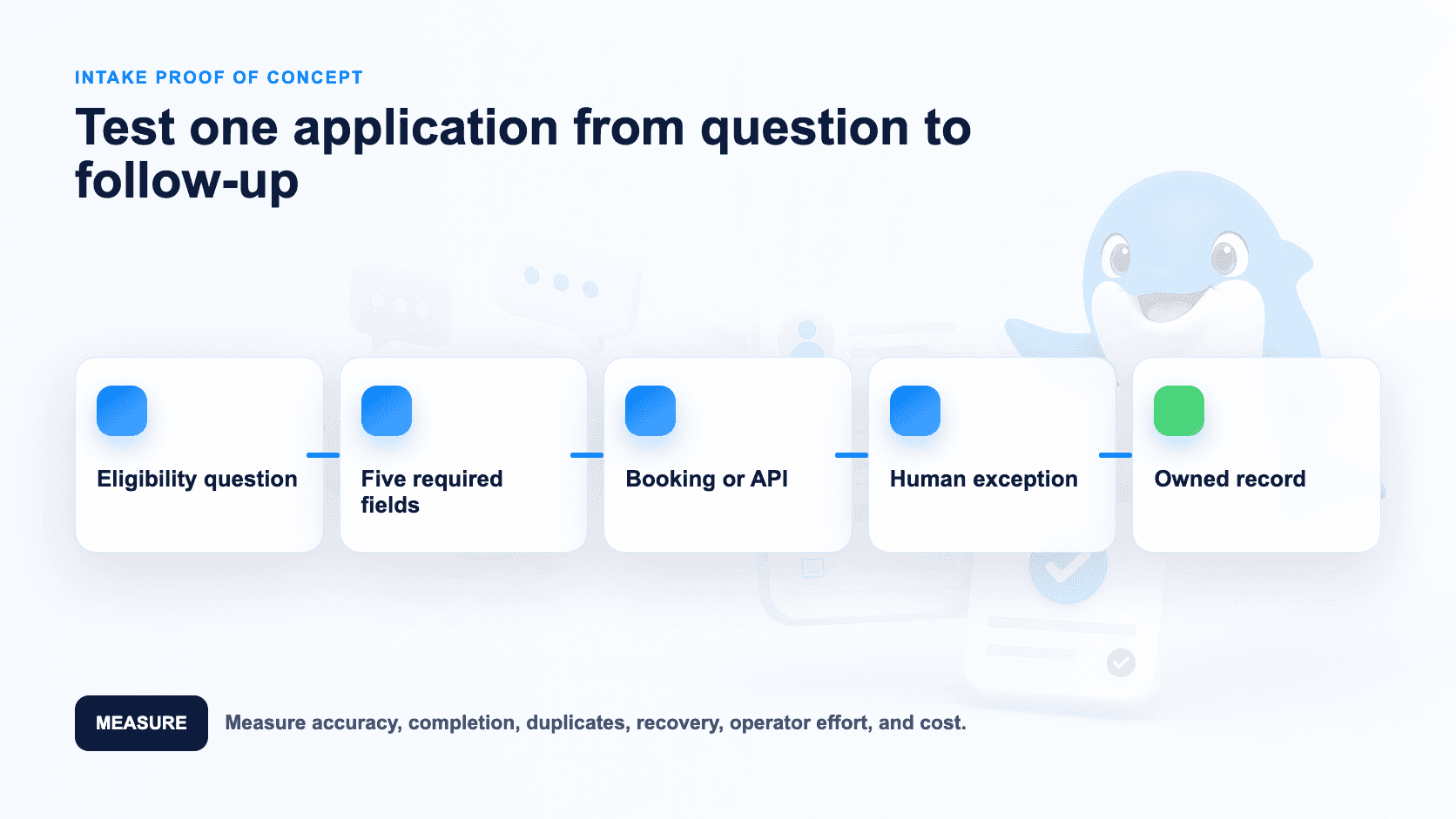
Do not begin with a generic support FAQ. Use a process in which structured data actually matters: for example, a service application that must establish eligibility, collect contact and project details, book a consultation and create an owned follow-up record.
Trace the same intake-to-outcome process in both products:
A visitor asks an ambiguous eligibility question.
The Agent uses only approved knowledge.
It captures five required fields and validates one.
It books an appointment or calls a test API.
A failed action produces a useful recovery path.
A human takes over with the collected context.
The result enters the system where the team will manage it.
The Jotform implementation should end in a usable form submission and connected process. The UChat implementation should prove that the same record can be collected inside a wider channel journey and handed into the system that owns follow-up. Measure answer accuracy, field completion, duplicate data, action success, operator effort, maintenance time and full monthly cost. Update one policy source and repeat the test.
Decision Checklist
Is a form submission the final record or one step in a larger journey?
Which channel-specific triggers and message types are required [S1][S5]?
Where should validation and deterministic logic live [S1][S6]?
Which Agent action must be proven with a real system [S1][S4][S9]?
How will a human see collected context and resume the process [S1][S7]?
Does work need Board or Ticket stages after the chat [S8]?
What do the Agent, conversation, session, voice and knowledge meters cost at peak?
Can the actual owner safely update the process?
Does an agency need a fully branded client platform [S3]?
Which prototype completed the outcome with fewer manual repairs?
FAQ
Does Jotform AI Agents work beyond website chat? Yes. Jotform documents phone, voice, SMS, WhatsApp, Messenger, Instagram, app, kiosk and other Agent surfaces [S1].
Can UChat collect structured information? Yes. UChat's Flow Builder can ask questions and work with fields, integrations, CRM Boards and Tickets [S6][S8][S9].
Which is better for forms? Jotform has the clearer form-native operating model [S1]. UChat may be preferable when form capture is embedded in a larger multichannel journey.
Which is better for agencies? UChat documents a complete white-label Partner model with client plans and billing [S3]. Jotform can still be a strong project component, particularly for structured intake.
Which is cheaper? That depends on Agents, conversations, sessions, voice, knowledge, workspace limits, members and implementation. Model the same completed process [S1][S2].
Final Verdict And CTA
Choose Jotform AI Agents when structured intake and the Jotform data ecosystem define the process [S1]. Choose UChat when you need multichannel journey orchestration, visible flow control, downstream lifecycle work or a branded platform for clients [S3]–[S9].
The shortest honest test is to build one complete intake, not another chatbot greeting. A 14-day UChat trial includes Pro access without a credit card [S11]. Agencies evaluating client delivery can book a Partner Plan demo [S12].
Related comparisons: UChat vs Landbot · UChat vs Typebot · UChat vs Voiceflow
Explore UChat's official pages for pricing, AI Agents, channels, Flow Builder, Live Chat, CRM, integrations and the Partner program.
Sources reviewed 13 August 2026.
Quick verdict: Choose Jotform AI Agents when forms, submissions, appointments and structured data collection already sit at the center of the customer journey. Choose UChat when conversations must move across more channel families, combine AI with deterministic flow logic, continue into CRM or Ticket stages, or become a white-label service sold by an agency [S1][S3]–[S9].
Table Of Contents
Quick Verdict And Scorecard
Recommendation By Use Case
Feature Comparison
Forms, Knowledge And AI Actions
Channels And Journey Design
Human Handoff And Lifecycle Work
Pricing And Total Cost
Agency And White-Label Delivery
When Jotform May Be A Better Fit
Run A Fair Proof Of Concept
Decision Checklist
FAQ
Final Verdict And CTA
Quick Verdict And Scorecard
Dimension | Jotform AI Agents | UChat | Starting edge |
|---|---|---|---|
Operating center | Forms, submissions and structured intake [S1] | Multichannel conversation journeys [S10] | Depends on where the customer process begins |
AI design | Knowledge-driven Agents with channel-specific surfaces and actions [S1] | Configurable AI Agents, functions and model choice [S4] | Both are credible; test the required outcome |
Structured data | Deep connection to Jotform forms and data collection [S1] | Questions, custom fields, CRM and integrations [S6][S8][S9] | Jotform for form-native processes |
Channels | Chatbot, phone, voice, WhatsApp, Messenger, SMS, Instagram, app and more [S1] | Web, social, messaging, voice and SMS families [S5] | Map exact required channels in both |
Journey control | Agent instructions, tools and form-linked actions [S1] | Visual Flow Builder plus AI and deterministic actions [S4][S6] | UChat for explicit multi-step orchestration |
Human work | Mobile takeover and notifications [S1] | Live Chat, CRM Boards and Tickets [S7][S8] | UChat for broader post-chat lifecycle |
Agency model | Enterprise domains and account controls require scope confirmation [S1] | White label, client plans, billing and Partner API [S3] | UChat for documented platform resale |
How We Compared
We reviewed Jotform's current AI Agents overview, pricing, customer-service, channel and Enterprise pages. We compared them with UChat's official pricing, Partner, AI Agent, Channels, Flow Builder, Live Chat, CRM and Integrations pages. Evidence was captured on 13 August 2026, so plan limits and packaging should still be confirmed before purchase [S1]–[S12].
Recommendation By Use Case
Team already running lead forms, applications, registrations or approvals in Jotform: Start with Jotform AI Agents [S1].
Business wanting an Agent to collect structured information, book an appointment and pass data into an existing Jotform process: Start with Jotform [S1].
Team coordinating Instagram, Messenger, WhatsApp, Web Chat, SMS or voice journeys with shared automation logic: Start with UChat [S5][S6].
Operation that must combine probabilistic AI decisions with visible conditions, branches and recovery steps: Start with UChat [S4][S6][S9].
Support team that needs conversations to continue through a Board or Ticket lifecycle: Start with UChat [S7][S8].
Agency selling a platform under its own domain, plans and pricing: Start with UChat Partner [S3].
Feature Comparison
Capability | Jotform AI Agents | UChat |
|---|---|---|
Starting point | Build from scratch, template or existing form [S1] | Start from an AI Agent, Flow or reusable template [S4][S6] |
Knowledge | Websites, documents, FAQs and uploaded business sources [S1] | Instructions, knowledge sources and model choices [S4] |
Actions | Appointments, emails, information capture and API-connected tasks [S1] | AI functions, integrations, APIs, webhooks and Mini Apps [S4][S9] |
Data capture | Form-native structured collection [S1] | Question steps, fields, CRM and external systems [S6][S8][S9] |
Human takeover | Mobile takeover and push notifications [S1] | Live Chat handoff [S7] |
Lifecycle | Jotform submissions and connected processes [S1] | CRM Boards and Tickets [S8] |
Client resale | Confirm the complete multi-client delivery model [S1] | White label, domains, client plans and billing [S3] |
Forms, Knowledge And AI Actions
Jotform's strongest advantage is not merely that it “has forms.” Its AI Agents are connected to an established data-collection environment. A team can create an Agent from an existing form, use it to gather information conversationally, and continue into appointment, email or submission workflows [S1]. That is valuable when the business record is the destination of the conversation.
UChat can also ask questions, store fields and call external systems. Its distinction is architectural: an AI Agent can sit beside a visual Flow Builder, functions, conditions, APIs, webhooks and Mini Apps [S4][S6][S9]. The team can let AI interpret an open question, then move into deterministic steps for consent, validation, payment, routing or recovery.
The choice is therefore not forms versus chatbots. It is where the operating center should live. If every successful interaction should become a Jotform submission, Jotform offers a coherent path. If a submission is only one step inside a longer social, messaging or service journey, UChat may provide a more useful orchestration layer.
Ask one practical question: after the customer provides the information, what must happen next, and which team needs to see or change that next step?
Knowledge quality also requires more than uploading documents. Test conflicting sources, expired policy, incomplete customer information and an unsupported request. A fluent answer is not a reliable workflow unless the Agent can identify uncertainty and choose a safe next action.
Channels And Journey Design
Jotform now documents a broad set of AI Agent surfaces: standalone and embedded chatbot experiences, phone and voice, SMS, WhatsApp, Messenger, Instagram, Agent App, kiosk, Shopify, Gmail, Salesforce and other specialized routes [S1]. Buyers should not evaluate it as a web-form product with a chatbot attached.
UChat documents coverage across web, social, messaging, voice and SMS families [S5]. Its Omni Channel and Flow Builder model is useful when the same business logic must be adapted across customer entry points [S5][S6]. A lead might arrive from an Instagram comment, continue in Messenger or WhatsApp, invoke an AI function, enter a Board stage and create a Ticket for an exception.
Channel lists alone do not decide the purchase. Verify the trigger, message type, template rule, identity model and human handoff on every required channel. A logo in an integration directory does not prove that the exact journey works.
UChat has the stronger starting case when channel orchestration is the product. Jotform has the stronger case when each channel should guide the customer into a consistent structured intake.
Human Handoff And Lifecycle Work
Jotform documents mobile human takeover with push notifications, allowing a person to step into an Agent conversation [S1]. That is a meaningful operational feature, especially for small teams that want to supervise customer interactions while away from a desk.
UChat Live Chat handles conversation takeover, while CRM Boards and Tickets provide separate ways to track work after the immediate chat [S7][S8]. This matters when “talk to a person” is not the end of the process. A sales opportunity may need pipeline movement; a service exception may need ownership, status and follow-up.
During evaluation, run an operator shift. Measure alert quality, context available at takeover, assignment, notes, status handling and the number of clicks required to resume automation. The Agent demo shows the customer experience; the shift test reveals the support experience.
Pricing And Total Cost
Jotform offers a free Starter plan, followed by Bronze, Silver, Gold and custom Enterprise tiers [S1]. The AI Agent environment is governed by several resources, including active Agents, monthly conversations, sessions, voice minutes, SMS messages and knowledge-base characters [S1]. Exact prices and allowances should be checked in the account and current checkout because the public crawler view does not expose a dependable complete price table.
UChat lists Free at $0, Business at $15 and Partner at $199 as entry prices [S2]. The total can also include workspace limits, members, bot users, add-ons, AI provider usage and channel-provider charges.
Model the same workload in both products:
Number of active customer experiences or Agents.
Monthly conversations and peak sessions.
Voice minutes and outbound messages.
Knowledge size and refresh frequency.
Human operators and lifecycle work.
External integrations and implementation time.
Do not compare one Jotform subscription number with one UChat plan number and call it finished. The resource units and surrounding products differ. The right comparison is the cost of one completed, maintained business outcome.
Agency And White-Label Delivery
Jotform Enterprise documents multiuser capabilities, custom domains, SSO and higher-control account features [S1]. Those can be valuable in a client implementation. An agency should still confirm client isolation, branded login, plan packaging, reusable assets, operator permissions and billing ownership for its exact resale model.
UChat Partner publicly documents full white-label customization, custom domains, client workspace management, plan controls, billing and Partner API automation [S3]. The partner can choose client-facing prices and keep the client relationship while UChat charges the relevant platform cost.
That makes UChat the clearer fit when the agency intends to sell its own automation platform, rather than deliver individual projects in another vendor's account. Jotform may be the cleaner implementation component when the agency's offer is centered on forms, registrations and data processes.
When Jotform May Be A Better Fit
Jotform may be better when the organization already depends on Jotform forms, approvals, signatures, payments or submissions. Reusing that data model can reduce integration work and give the Agent an obvious destination [S1].
It may also be better for a contained process such as event registration, application intake, patient pre-screening or appointment qualification. The Agent can make a structured experience feel conversational without requiring the team to design a larger automation architecture.
Finally, a procurement team seeking Jotform Enterprise controls may prefer one consolidated vendor relationship for forms and Agents. Confirm the exact compliance and governance requirements in the Enterprise scope rather than inferring them from a marketing page.
Run A Fair Proof Of Concept
Do not begin with a generic support FAQ. Use a process in which structured data actually matters: for example, a service application that must establish eligibility, collect contact and project details, book a consultation and create an owned follow-up record.
Trace the same intake-to-outcome process in both products:
A visitor asks an ambiguous eligibility question.
The Agent uses only approved knowledge.
It captures five required fields and validates one.
It books an appointment or calls a test API.
A failed action produces a useful recovery path.
A human takes over with the collected context.
The result enters the system where the team will manage it.
The Jotform implementation should end in a usable form submission and connected process. The UChat implementation should prove that the same record can be collected inside a wider channel journey and handed into the system that owns follow-up. Measure answer accuracy, field completion, duplicate data, action success, operator effort, maintenance time and full monthly cost. Update one policy source and repeat the test.
Decision Checklist
Is a form submission the final record or one step in a larger journey?
Which channel-specific triggers and message types are required [S1][S5]?
Where should validation and deterministic logic live [S1][S6]?
Which Agent action must be proven with a real system [S1][S4][S9]?
How will a human see collected context and resume the process [S1][S7]?
Does work need Board or Ticket stages after the chat [S8]?
What do the Agent, conversation, session, voice and knowledge meters cost at peak?
Can the actual owner safely update the process?
Does an agency need a fully branded client platform [S3]?
Which prototype completed the outcome with fewer manual repairs?
FAQ
Does Jotform AI Agents work beyond website chat? Yes. Jotform documents phone, voice, SMS, WhatsApp, Messenger, Instagram, app, kiosk and other Agent surfaces [S1].
Can UChat collect structured information? Yes. UChat's Flow Builder can ask questions and work with fields, integrations, CRM Boards and Tickets [S6][S8][S9].
Which is better for forms? Jotform has the clearer form-native operating model [S1]. UChat may be preferable when form capture is embedded in a larger multichannel journey.
Which is better for agencies? UChat documents a complete white-label Partner model with client plans and billing [S3]. Jotform can still be a strong project component, particularly for structured intake.
Which is cheaper? That depends on Agents, conversations, sessions, voice, knowledge, workspace limits, members and implementation. Model the same completed process [S1][S2].
Final Verdict And CTA
Choose Jotform AI Agents when structured intake and the Jotform data ecosystem define the process [S1]. Choose UChat when you need multichannel journey orchestration, visible flow control, downstream lifecycle work or a branded platform for clients [S3]–[S9].
The shortest honest test is to build one complete intake, not another chatbot greeting. A 14-day UChat trial includes Pro access without a credit card [S11]. Agencies evaluating client delivery can book a Partner Plan demo [S12].
Related comparisons: UChat vs Landbot · UChat vs Typebot · UChat vs Voiceflow
Explore UChat's official pages for pricing, AI Agents, channels, Flow Builder, Live Chat, CRM, integrations and the Partner program.
Sources reviewed 13 August 2026.