14 minutes
UChat
Posted by
UChat vs Voiceflow: Which AI Agent Platform Fits Your Customer Journey?
14 minutes
Posted by
UChat
Quick Verdict
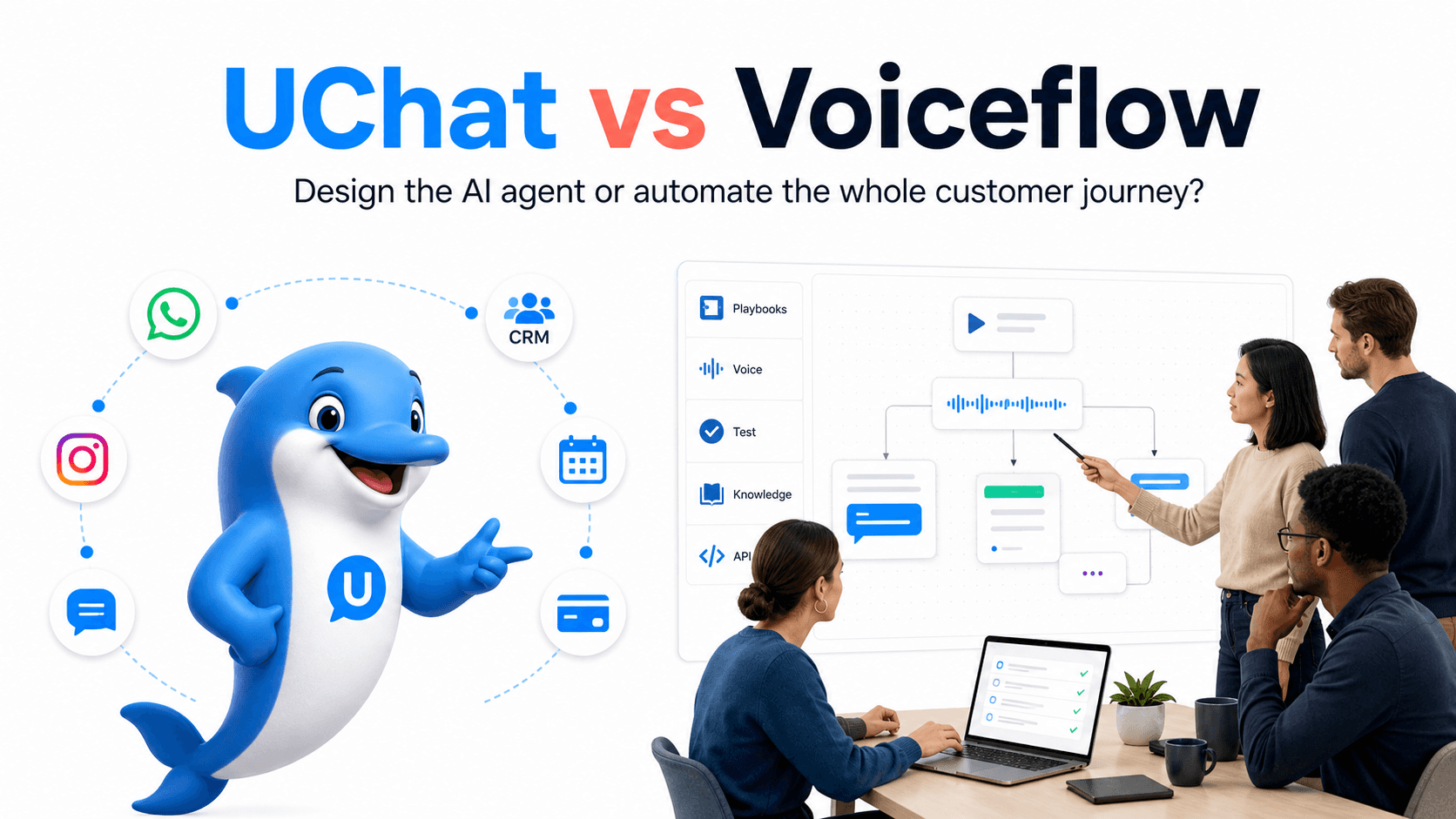
UChat and Voiceflow both combine AI reasoning with visual workflows, knowledge, tools and API actions. Both can build production chat and voice Agents. The decision is less about whether either platform supports AI and more about which operating layer your team needs.
Choose Voiceflow when designing, testing and operating the Agent experience is the main job. Choose UChat when that Agent must run inside a broader customer journey across native channels, CRM, ecommerce, payments, support and branded client workspaces.
Voiceflow is a strong choice for conversation designers, product teams and developers. Its agentic framework, playbooks, deterministic workflows, API and MCP tools, environments, evaluations and Conversations API create a serious Agent development lifecycle.
UChat is the stronger fit for automation operators and agencies that want AI Agents to work alongside channel-specific triggers, reusable flows, live chat, CRM Boards, Tickets, commerce actions and a full-white-label client platform.
Table Of Contents
Scorecard
Recommendation By Use Case
Feature Comparison: Agent Design And Frameworks
Knowledge, Tools And Business Actions
Testing, Environments And Analytics
Channels And Deployment
Human Support, CRM And Tickets
Integrations, Ecommerce And Payments
Pricing And Usage Models
Agency And White-Label Delivery
When Voiceflow May Be A Better Fit
Decision Checklist
FAQ
Final Verdict And CTA
Scorecard
Decision area | Better starting fit | Why |
|---|---|---|
Conversation design and Agent prototyping | Voiceflow | Its visual design model, playbooks and testing workflow are particularly strong for dedicated Agent teams. |
Agent evaluation and production lifecycle | Voiceflow | Environments, traffic splits, transcripts, evaluations, tests and analytics support disciplined releases. |
Deterministic customer automation | UChat | Visual flows connect channel messages, conditions, data capture, actions, APIs and AI across a full journey. |
Native messaging-channel operations | UChat | UChat provides more channel-specific triggers, message types and deployment paths inside the platform. |
Custom chat and voice interfaces | Voiceflow | Native web chat and telephony combine with the Conversations API for custom delivery. |
Ecommerce, payments, CRM and follow-up | UChat | These operations sit directly inside the customer automation environment. |
API, MCP and custom function tools | Voiceflow | Its tool framework is broad, explicit and developer-friendly. |
Human handoff within the customer lifecycle | UChat | Live Chat, assignment, mobile handling, CRM Boards and Tickets share the same customer context. |
Agency tools for multiple clients | Depends | Voiceflow has multi-client management and handoff tools; UChat Partner provides broader platform-level branding, plans, billing and workspace operations. |
Transparent entry pricing | UChat | UChat publishes its entry plan; Voiceflow currently directs current plan and credit pricing to its in-product billing area. |
Recommendation By Use Case

Voiceflow will feel natural to a team whose core discipline is conversation design. It supports agentic playbooks, deterministic workflows, model choice, knowledge, tools, testing and measurement without forcing everything into code.
UChat becomes more useful when a growth, sales, ecommerce or support team needs the Agent to participate in a larger operational journey: acquire a lead, qualify intent, collect structured data, book, take payment, transfer to a person and continue follow-up across channels.
UChat Partner is designed for agencies that want to sell the resulting system under their own domain and brand, control plans and client-facing prices, manage separate workspaces and automate account operations.
The shortest distinction is this: Voiceflow focuses on the Agent experience; UChat focuses on the customer journey that surrounds it.
Feature Comparison: Agent Design And Frameworks
Voiceflow now supports two framework styles.
Its recommended agentic framework uses a global prompt, playbooks, tools and reasoning to route conversations. Playbooks describe goals and let the Agent decide how to reach them. Deterministic workflows remain available wherever identity checks, compliance steps or fixed business logic need explicit control.
Voiceflow also provides a conversation-flow framework in which builders define every branch and transition manually. This makes the platform relevant to both modern Agent design and traditional flow-based conversation architecture.
UChat follows a similarly pragmatic idea: AI should reason where flexibility creates value, while flows should control steps that need predictable execution. AI Agents can use business knowledge and functions, then hand execution back to normal flows or function-oriented logic.
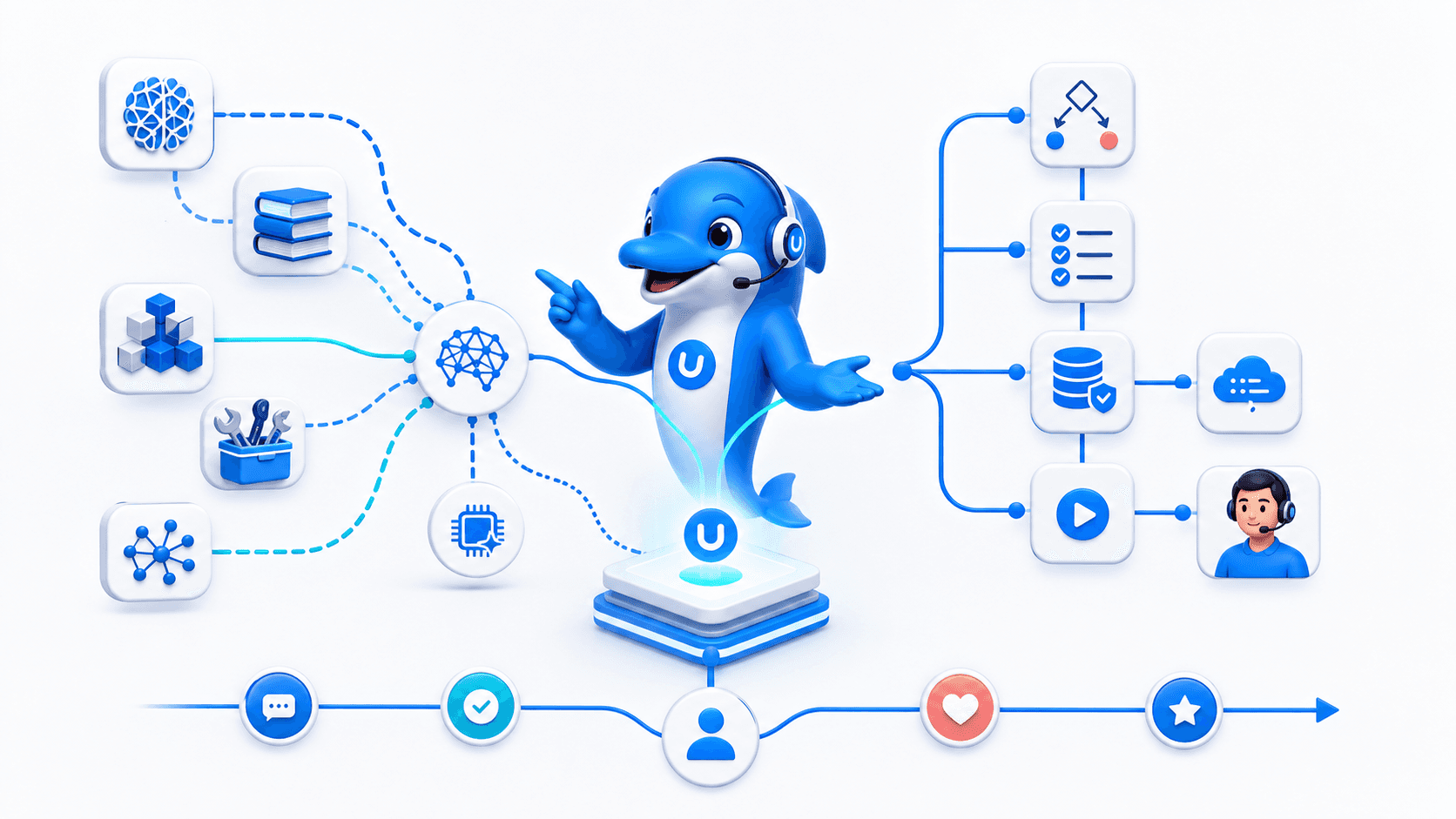
A UChat implementation can collect required fields before an Agent runs, let the Agent interpret intent and choose a function, validate the result, route by condition and continue through messages, APIs, tags, sequences, payments or human transfer.
The platforms overlap substantially. The practical difference is the vocabulary around the canvas:
Voiceflow organizes work around Agent behavior, playbooks, tools, environments and evaluation.
UChat organizes work around Agents, channel events, messages, customer data and business automation.
Neither model is universally better. Choose the one your team can debug, govern and maintain after the first demo.
Knowledge, Tools And Business Actions
Voiceflow Knowledge Base supports business content and structured data, while its tool system can connect prebuilt integrations, REST APIs, MCP servers, JavaScript functions and system tools. A playbook can choose a tool autonomously; a workflow can execute the same API or function at a fixed point.
That distinction is valuable. It lets teams use AI when intent is ambiguous and deterministic execution when the action must always happen.
UChat AI Agents also use business knowledge and functions. The broader UChat flow environment can then continue with operational actions that are common in customer automation.
For example, a UChat journey can:
detect whether the lead came from Instagram, WhatsApp or Web Chat;
capture contact and qualification data into user fields;
use an AI Agent to answer product questions and identify intent;
call an availability, CRM or ecommerce API;
book an appointment or collect payment;
move the contact to the correct CRM Board stage;
open a Ticket or transfer to Live Chat when confidence is low; and
send reminders and follow-up on the most appropriate channel.
Voiceflow can build many of these actions using integrations and APIs. UChat's advantage is that more of the surrounding customer-operation layer already exists as native automation primitives.
Tool calling is only one step. Buyers should compare how the platform stores customer context, handles channel behavior, recovers from failure and continues the journey after a tool returns.
Testing, Environments And Analytics
This is one of Voiceflow's clearest strengths.
Voiceflow provides draft and published environments, traffic splitting, transcripts, call recordings, logs, analytics, evaluations and tests. Teams can inspect behavior, measure resolution or custom criteria, and test changes before sending all traffic to a new version. Its CLI and APIs extend that lifecycle into developer workflows.
These capabilities matter most when an Agent is maintained like a software product, rather than treated as a one-time chatbot build.
UChat provides testing and operational visibility through its builder, conversation history, logs, workspace audit data, live chat and related platform tools. Agencies can also impersonate client workspaces for troubleshooting. However, a team whose selection is driven primarily by formal Agent evaluations, environment traffic splitting and test automation may prefer Voiceflow's dedicated lifecycle.
UChat's counterweight is operational visibility across the whole customer journey. Teams can inspect the flow, contact fields, CRM stage, ticket state, channel conversation and downstream action in one customer automation environment.
Channels And Deployment
Voiceflow offers native web chat and telephony. Its phone capabilities support inbound and outbound calling through supported providers, while custom interfaces and additional channels can connect through the Conversations API. This is flexible for teams willing to own interface or integration work.
UChat offers a broader portfolio of native customer channels. Depending on the use case, builders can work with Web Chat, Messenger, Instagram, WhatsApp, Telegram, SMS, voice, Slack, WeChat, LINE, Viber, RCS, TikTok and other supported channels.
The distinction is not simply a channel count.
Native channel support can include triggers, message types, templates, delivery events and account-connection workflows that are specific to that network. API delivery provides more freedom, but the implementation team owns more of the channel adapter.
The value depends on where your customers actually communicate. Voiceflow may be ideal for a branded web or voice experience. UChat becomes more attractive when several messaging ecosystems are part of the commercial solution.
Human Support, CRM And Tickets
Voiceflow can connect Agents to live-agent platforms through integrations and tools. Its integration materials include systems such as Zendesk, and call forwarding can transfer voice conversations to people or external lines.
That modular approach works well when a company already has a helpdesk and wants the Agent layer to connect with it.
UChat includes Live Chat as part of the platform. Conversations can be transferred and assigned, team members can work from mobile, and the same customer can retain custom fields, move across CRM-style Boards and create or update Tickets.
Voiceflow fits a composable support stack. UChat fits a more consolidated customer-journey stack.
The right choice depends on existing systems. A mature Zendesk operation may value Voiceflow's Agent design layer. A smaller business or agency may prefer fewer separate tools and a shared customer record inside UChat.
Integrations, Ecommerce And Payments
Voiceflow provides production-grade tools for systems such as Zendesk, Salesforce, Shopify, HubSpot, Gmail and Airtable, plus REST API, MCP and JavaScript function paths. Its asynchronous API patterns can preload data or fire background actions without making the customer wait.
UChat combines integrations with native customer-journey elements. Builders can work with Shopify, WooCommerce, Stripe, PayPal, Calendly, Google Sheets, Gmail, Zapier, Make, external APIs and reusable Mini Apps.
For a product team, Voiceflow's flexible tool layer can be the better engineering foundation. For a marketing or automation team, UChat can shorten the distance from a conversation to a packaged business outcome such as payment, booking, CRM movement and follow-up.
Pricing And Usage Models
The two platforms expose different commercial units.
Voiceflow documentation says a bill consists of a plan fee, optional editor seats and phone numbers, and shared credit-based usage. It lists four plans:
Voiceflow plan | Intended use | Publicly documented packaging |
|---|---|---|
Free | Trying Voiceflow | Limited features and a one-time credit grant that does not renew. |
Pro | Individual builders | All LLM models and a higher Agent limit than Free. |
Business | Growing teams | Fallback models, priority support and business-level collaboration or branding capabilities. |
Enterprise | Large or regulated organizations | Unlimited product usage, SSO, private cloud hosting and custom credit allotments. |
On 2 August 2026, Voiceflow's public pricing page did not display fixed self-serve amounts. Its documentation directs users to Plans and Billing inside the Voiceflow dashboard for current plan, add-on and credit-bundle pricing. The public page emphasizes usage-based billing for agencies and request-pricing engagement for businesses.
Credits are consumed by production actions such as LLM responses and phone calls. Paid credits reset by billing cycle and are shared across workspaces; the Free grant does not renew. Model choice, voice usage and orchestration can change consumption.
UChat's Business plan starts at $15 per month and is organized around bots, bot users and members, with add-ons available as usage grows. UChat also offers a 14-day trial with Pro features and no credit card requirement.
UChat Partner is $199 per month and includes a partner workspace with five bots, 10,000 bot users and five members. Default client-workspace cost examples are $10 for Business, $30 for Business Light and $100 for Business Large per month. Partners control the client-facing selling price and can request customized plan limits.
Model the whole implementation: Agent usage, models, voice minutes, channels, team members, client workspaces, external providers and service-delivery effort. A low headline fee can still produce a high operating cost if the architecture requires several additional systems.
Agency And White-Label Delivery
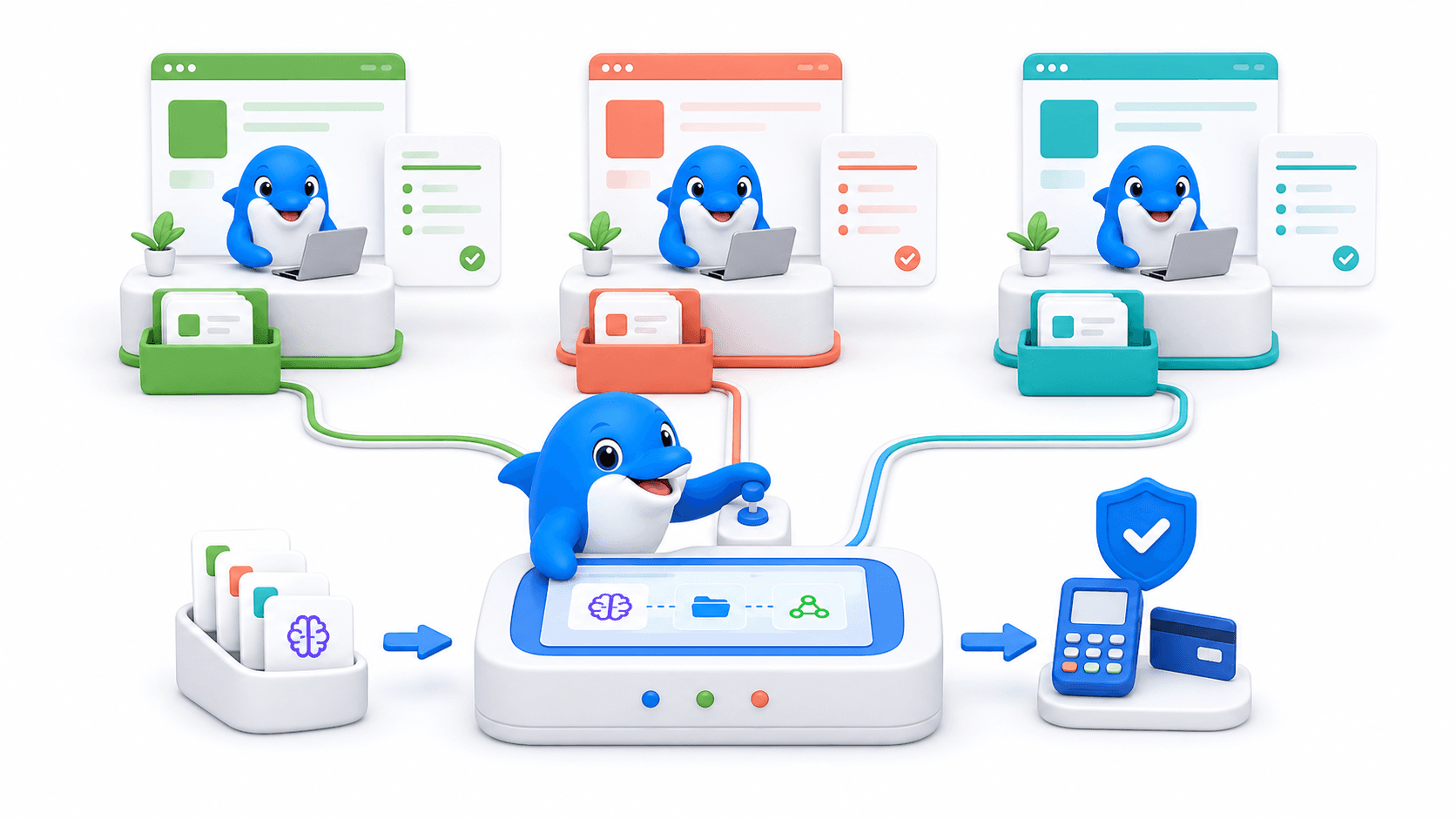
Voiceflow now speaks directly to agencies and partners. Its public pricing page describes multi-client workspace management, transparent usage-based billing, white-labeling, client handoff tools and access to major model providers. That makes it a credible agency platform, not only an internal enterprise builder.
UChat Partner uses a different commercial model. The partner can brand the login page, dashboard, domain, navigation and client experience; manage separate workspaces; define client-facing plans and prices; connect billing; install templates; impersonate workspaces for support; and automate account operations through the Partner API.
This difference should be tested in a demo rather than reduced to a checkbox. Ask both vendors:
What exact surfaces retain vendor branding?
Does the client log into the vendor platform or the agency's branded platform?
Can the agency define plans and selling prices?
Who bills the client?
Can onboarding, upgrades, cancellations and template installation be automated?
How are separate client environments supported and audited?
Voiceflow may be a strong choice for an agency delivering bespoke Agent projects and handing them to client teams. UChat Partner is usually the closer match for an agency selling an ongoing branded automation platform and managed service.
When Voiceflow May Be A Better Fit
Voiceflow may be the better choice when:
conversation design is a dedicated team discipline;
Agent evaluations, tests and environment traffic splitting are selection-critical;
the primary experience is custom web chat or voice;
developers want strong API, MCP, function and CLI tooling;
the company already has CRM and helpdesk systems to integrate; or
the agency delivers bespoke Agent projects rather than a branded SaaS platform.
In these cases, UChat's additional native channels, CRM, ticketing, commerce and partner operations may be more platform surface than the team needs.
Decision Checklist
Voiceflow is likely the better starting point when most of these are true:
the Agent experience is the product;
conversation designers and developers own the roadmap;
formal testing and evaluation are central;
web and voice are the primary interfaces;
custom APIs or interfaces are expected; and
existing enterprise systems remain the operational source of truth.
UChat is likely the better starting point when most of these are true:
the Agent is one part of a marketing, sales, service or commerce journey;
native social and messaging-channel behavior matters;
deterministic flows and AI must coexist visibly;
CRM, tickets, booking, payments and follow-up belong in the same platform;
operations teams maintain the solution; or
an agency wants a fully branded platform with client pricing and billing control.
FAQ
Is Voiceflow only for prototyping?
No. Voiceflow provides environments, traffic splitting, transcripts, evaluations, tests, analytics, APIs and production chat and voice deployment. It should be evaluated as a production Agent platform.
Can both platforms combine AI and deterministic flows?
Yes. Voiceflow combines agentic playbooks with workflows. UChat combines AI Agents and functions with visual flows and explicit customer-journey actions.
Which platform supports more channels?
Voiceflow supports native web chat and telephony and can reach custom interfaces or channels through its Conversations API. UChat provides a broader set of native messaging and voice channel integrations. Compare the exact trigger and message behavior required, not only the channel name.
Does Voiceflow support APIs and MCP?
Yes. Voiceflow supports REST API tools, MCP tools and JavaScript functions. UChat supports functions, external requests, APIs, integrations and reusable Mini Apps.
Which platform is better for voice Agents?
Voiceflow has a strong dedicated voice lifecycle, including phone providers, inbound and outbound calling, call forwarding, recordings and evaluation. UChat supports voice and AI calling within its broader omnichannel automation model. Test latency, provider, transfer and operational requirements directly.
Which platform is better for an agency?
Voiceflow offers multi-client management, usage billing, white-labeling and client handoff tools. UChat Partner is designed for broader platform branding, custom client plans and prices, billing automation, workspace support and Partner API operations.
Can I test UChat before deciding?
Yes. UChat offers a 14-day free trial with access to Pro features and no credit card required.
Final Verdict And CTA
Voiceflow is a serious AI Agent design and operations platform. Its agentic framework, deterministic workflows, tool system, chat and voice deployment, environments and evaluations make it an excellent option for conversation-design and product teams.
UChat is the stronger fit when the Agent must become part of a broader customer operating system. It connects AI with native channel automation, CRM, tickets, ecommerce, payments, human support and full-white-label agency delivery.
Choose Voiceflow to design and operate the Agent experience. Choose UChat to automate the customer journey around it.
Start a 14-day UChat free trial with full access to Pro features and no credit card required.
Agencies can book a Partner Plan demo to explore full-white-label delivery, client workspaces, billing automation and Partner API operations.
Related comparisons: UChat vs Botpress and UChat vs Tidio.
Sources And Review Date
Product and pricing details were reviewed on 2 August 2026. Packaging can change. Primary sources: Voiceflow, Voiceflow pricing, Voiceflow documentation, frameworks, tools, knowledge, deployment, measurement, billing, UChat, UChat AI Agent, UChat channels, UChat Flow Builder, UChat Live Chat, UChat CRM, UChat pricing, and UChat Partner.
Quick Verdict
UChat and Voiceflow both combine AI reasoning with visual workflows, knowledge, tools and API actions. Both can build production chat and voice Agents. The decision is less about whether either platform supports AI and more about which operating layer your team needs.
Choose Voiceflow when designing, testing and operating the Agent experience is the main job. Choose UChat when that Agent must run inside a broader customer journey across native channels, CRM, ecommerce, payments, support and branded client workspaces.
Voiceflow is a strong choice for conversation designers, product teams and developers. Its agentic framework, playbooks, deterministic workflows, API and MCP tools, environments, evaluations and Conversations API create a serious Agent development lifecycle.
UChat is the stronger fit for automation operators and agencies that want AI Agents to work alongside channel-specific triggers, reusable flows, live chat, CRM Boards, Tickets, commerce actions and a full-white-label client platform.
Table Of Contents
Scorecard
Recommendation By Use Case
Feature Comparison: Agent Design And Frameworks
Knowledge, Tools And Business Actions
Testing, Environments And Analytics
Channels And Deployment
Human Support, CRM And Tickets
Integrations, Ecommerce And Payments
Pricing And Usage Models
Agency And White-Label Delivery
When Voiceflow May Be A Better Fit
Decision Checklist
FAQ
Final Verdict And CTA
Scorecard
Decision area | Better starting fit | Why |
|---|---|---|
Conversation design and Agent prototyping | Voiceflow | Its visual design model, playbooks and testing workflow are particularly strong for dedicated Agent teams. |
Agent evaluation and production lifecycle | Voiceflow | Environments, traffic splits, transcripts, evaluations, tests and analytics support disciplined releases. |
Deterministic customer automation | UChat | Visual flows connect channel messages, conditions, data capture, actions, APIs and AI across a full journey. |
Native messaging-channel operations | UChat | UChat provides more channel-specific triggers, message types and deployment paths inside the platform. |
Custom chat and voice interfaces | Voiceflow | Native web chat and telephony combine with the Conversations API for custom delivery. |
Ecommerce, payments, CRM and follow-up | UChat | These operations sit directly inside the customer automation environment. |
API, MCP and custom function tools | Voiceflow | Its tool framework is broad, explicit and developer-friendly. |
Human handoff within the customer lifecycle | UChat | Live Chat, assignment, mobile handling, CRM Boards and Tickets share the same customer context. |
Agency tools for multiple clients | Depends | Voiceflow has multi-client management and handoff tools; UChat Partner provides broader platform-level branding, plans, billing and workspace operations. |
Transparent entry pricing | UChat | UChat publishes its entry plan; Voiceflow currently directs current plan and credit pricing to its in-product billing area. |
Recommendation By Use Case
Voiceflow will feel natural to a team whose core discipline is conversation design. It supports agentic playbooks, deterministic workflows, model choice, knowledge, tools, testing and measurement without forcing everything into code.
UChat becomes more useful when a growth, sales, ecommerce or support team needs the Agent to participate in a larger operational journey: acquire a lead, qualify intent, collect structured data, book, take payment, transfer to a person and continue follow-up across channels.
UChat Partner is designed for agencies that want to sell the resulting system under their own domain and brand, control plans and client-facing prices, manage separate workspaces and automate account operations.
The shortest distinction is this: Voiceflow focuses on the Agent experience; UChat focuses on the customer journey that surrounds it.
Feature Comparison: Agent Design And Frameworks
Voiceflow now supports two framework styles.
Its recommended agentic framework uses a global prompt, playbooks, tools and reasoning to route conversations. Playbooks describe goals and let the Agent decide how to reach them. Deterministic workflows remain available wherever identity checks, compliance steps or fixed business logic need explicit control.
Voiceflow also provides a conversation-flow framework in which builders define every branch and transition manually. This makes the platform relevant to both modern Agent design and traditional flow-based conversation architecture.
UChat follows a similarly pragmatic idea: AI should reason where flexibility creates value, while flows should control steps that need predictable execution. AI Agents can use business knowledge and functions, then hand execution back to normal flows or function-oriented logic.
A UChat implementation can collect required fields before an Agent runs, let the Agent interpret intent and choose a function, validate the result, route by condition and continue through messages, APIs, tags, sequences, payments or human transfer.
The platforms overlap substantially. The practical difference is the vocabulary around the canvas:
Voiceflow organizes work around Agent behavior, playbooks, tools, environments and evaluation.
UChat organizes work around Agents, channel events, messages, customer data and business automation.
Neither model is universally better. Choose the one your team can debug, govern and maintain after the first demo.
Knowledge, Tools And Business Actions
Voiceflow Knowledge Base supports business content and structured data, while its tool system can connect prebuilt integrations, REST APIs, MCP servers, JavaScript functions and system tools. A playbook can choose a tool autonomously; a workflow can execute the same API or function at a fixed point.
That distinction is valuable. It lets teams use AI when intent is ambiguous and deterministic execution when the action must always happen.
UChat AI Agents also use business knowledge and functions. The broader UChat flow environment can then continue with operational actions that are common in customer automation.
For example, a UChat journey can:
detect whether the lead came from Instagram, WhatsApp or Web Chat;
capture contact and qualification data into user fields;
use an AI Agent to answer product questions and identify intent;
call an availability, CRM or ecommerce API;
book an appointment or collect payment;
move the contact to the correct CRM Board stage;
open a Ticket or transfer to Live Chat when confidence is low; and
send reminders and follow-up on the most appropriate channel.
Voiceflow can build many of these actions using integrations and APIs. UChat's advantage is that more of the surrounding customer-operation layer already exists as native automation primitives.
Tool calling is only one step. Buyers should compare how the platform stores customer context, handles channel behavior, recovers from failure and continues the journey after a tool returns.
Testing, Environments And Analytics
This is one of Voiceflow's clearest strengths.
Voiceflow provides draft and published environments, traffic splitting, transcripts, call recordings, logs, analytics, evaluations and tests. Teams can inspect behavior, measure resolution or custom criteria, and test changes before sending all traffic to a new version. Its CLI and APIs extend that lifecycle into developer workflows.
These capabilities matter most when an Agent is maintained like a software product, rather than treated as a one-time chatbot build.
UChat provides testing and operational visibility through its builder, conversation history, logs, workspace audit data, live chat and related platform tools. Agencies can also impersonate client workspaces for troubleshooting. However, a team whose selection is driven primarily by formal Agent evaluations, environment traffic splitting and test automation may prefer Voiceflow's dedicated lifecycle.
UChat's counterweight is operational visibility across the whole customer journey. Teams can inspect the flow, contact fields, CRM stage, ticket state, channel conversation and downstream action in one customer automation environment.
Channels And Deployment
Voiceflow offers native web chat and telephony. Its phone capabilities support inbound and outbound calling through supported providers, while custom interfaces and additional channels can connect through the Conversations API. This is flexible for teams willing to own interface or integration work.
UChat offers a broader portfolio of native customer channels. Depending on the use case, builders can work with Web Chat, Messenger, Instagram, WhatsApp, Telegram, SMS, voice, Slack, WeChat, LINE, Viber, RCS, TikTok and other supported channels.
The distinction is not simply a channel count.
Native channel support can include triggers, message types, templates, delivery events and account-connection workflows that are specific to that network. API delivery provides more freedom, but the implementation team owns more of the channel adapter.
The value depends on where your customers actually communicate. Voiceflow may be ideal for a branded web or voice experience. UChat becomes more attractive when several messaging ecosystems are part of the commercial solution.
Human Support, CRM And Tickets
Voiceflow can connect Agents to live-agent platforms through integrations and tools. Its integration materials include systems such as Zendesk, and call forwarding can transfer voice conversations to people or external lines.
That modular approach works well when a company already has a helpdesk and wants the Agent layer to connect with it.
UChat includes Live Chat as part of the platform. Conversations can be transferred and assigned, team members can work from mobile, and the same customer can retain custom fields, move across CRM-style Boards and create or update Tickets.
Voiceflow fits a composable support stack. UChat fits a more consolidated customer-journey stack.
The right choice depends on existing systems. A mature Zendesk operation may value Voiceflow's Agent design layer. A smaller business or agency may prefer fewer separate tools and a shared customer record inside UChat.
Integrations, Ecommerce And Payments
Voiceflow provides production-grade tools for systems such as Zendesk, Salesforce, Shopify, HubSpot, Gmail and Airtable, plus REST API, MCP and JavaScript function paths. Its asynchronous API patterns can preload data or fire background actions without making the customer wait.
UChat combines integrations with native customer-journey elements. Builders can work with Shopify, WooCommerce, Stripe, PayPal, Calendly, Google Sheets, Gmail, Zapier, Make, external APIs and reusable Mini Apps.
For a product team, Voiceflow's flexible tool layer can be the better engineering foundation. For a marketing or automation team, UChat can shorten the distance from a conversation to a packaged business outcome such as payment, booking, CRM movement and follow-up.
Pricing And Usage Models
The two platforms expose different commercial units.
Voiceflow documentation says a bill consists of a plan fee, optional editor seats and phone numbers, and shared credit-based usage. It lists four plans:
Voiceflow plan | Intended use | Publicly documented packaging |
|---|---|---|
Free | Trying Voiceflow | Limited features and a one-time credit grant that does not renew. |
Pro | Individual builders | All LLM models and a higher Agent limit than Free. |
Business | Growing teams | Fallback models, priority support and business-level collaboration or branding capabilities. |
Enterprise | Large or regulated organizations | Unlimited product usage, SSO, private cloud hosting and custom credit allotments. |
On 2 August 2026, Voiceflow's public pricing page did not display fixed self-serve amounts. Its documentation directs users to Plans and Billing inside the Voiceflow dashboard for current plan, add-on and credit-bundle pricing. The public page emphasizes usage-based billing for agencies and request-pricing engagement for businesses.
Credits are consumed by production actions such as LLM responses and phone calls. Paid credits reset by billing cycle and are shared across workspaces; the Free grant does not renew. Model choice, voice usage and orchestration can change consumption.
UChat's Business plan starts at $15 per month and is organized around bots, bot users and members, with add-ons available as usage grows. UChat also offers a 14-day trial with Pro features and no credit card requirement.
UChat Partner is $199 per month and includes a partner workspace with five bots, 10,000 bot users and five members. Default client-workspace cost examples are $10 for Business, $30 for Business Light and $100 for Business Large per month. Partners control the client-facing selling price and can request customized plan limits.
Model the whole implementation: Agent usage, models, voice minutes, channels, team members, client workspaces, external providers and service-delivery effort. A low headline fee can still produce a high operating cost if the architecture requires several additional systems.
Agency And White-Label Delivery
Voiceflow now speaks directly to agencies and partners. Its public pricing page describes multi-client workspace management, transparent usage-based billing, white-labeling, client handoff tools and access to major model providers. That makes it a credible agency platform, not only an internal enterprise builder.
UChat Partner uses a different commercial model. The partner can brand the login page, dashboard, domain, navigation and client experience; manage separate workspaces; define client-facing plans and prices; connect billing; install templates; impersonate workspaces for support; and automate account operations through the Partner API.
This difference should be tested in a demo rather than reduced to a checkbox. Ask both vendors:
What exact surfaces retain vendor branding?
Does the client log into the vendor platform or the agency's branded platform?
Can the agency define plans and selling prices?
Who bills the client?
Can onboarding, upgrades, cancellations and template installation be automated?
How are separate client environments supported and audited?
Voiceflow may be a strong choice for an agency delivering bespoke Agent projects and handing them to client teams. UChat Partner is usually the closer match for an agency selling an ongoing branded automation platform and managed service.
When Voiceflow May Be A Better Fit
Voiceflow may be the better choice when:
conversation design is a dedicated team discipline;
Agent evaluations, tests and environment traffic splitting are selection-critical;
the primary experience is custom web chat or voice;
developers want strong API, MCP, function and CLI tooling;
the company already has CRM and helpdesk systems to integrate; or
the agency delivers bespoke Agent projects rather than a branded SaaS platform.
In these cases, UChat's additional native channels, CRM, ticketing, commerce and partner operations may be more platform surface than the team needs.
Decision Checklist
Voiceflow is likely the better starting point when most of these are true:
the Agent experience is the product;
conversation designers and developers own the roadmap;
formal testing and evaluation are central;
web and voice are the primary interfaces;
custom APIs or interfaces are expected; and
existing enterprise systems remain the operational source of truth.
UChat is likely the better starting point when most of these are true:
the Agent is one part of a marketing, sales, service or commerce journey;
native social and messaging-channel behavior matters;
deterministic flows and AI must coexist visibly;
CRM, tickets, booking, payments and follow-up belong in the same platform;
operations teams maintain the solution; or
an agency wants a fully branded platform with client pricing and billing control.
FAQ
Is Voiceflow only for prototyping?
No. Voiceflow provides environments, traffic splitting, transcripts, evaluations, tests, analytics, APIs and production chat and voice deployment. It should be evaluated as a production Agent platform.
Can both platforms combine AI and deterministic flows?
Yes. Voiceflow combines agentic playbooks with workflows. UChat combines AI Agents and functions with visual flows and explicit customer-journey actions.
Which platform supports more channels?
Voiceflow supports native web chat and telephony and can reach custom interfaces or channels through its Conversations API. UChat provides a broader set of native messaging and voice channel integrations. Compare the exact trigger and message behavior required, not only the channel name.
Does Voiceflow support APIs and MCP?
Yes. Voiceflow supports REST API tools, MCP tools and JavaScript functions. UChat supports functions, external requests, APIs, integrations and reusable Mini Apps.
Which platform is better for voice Agents?
Voiceflow has a strong dedicated voice lifecycle, including phone providers, inbound and outbound calling, call forwarding, recordings and evaluation. UChat supports voice and AI calling within its broader omnichannel automation model. Test latency, provider, transfer and operational requirements directly.
Which platform is better for an agency?
Voiceflow offers multi-client management, usage billing, white-labeling and client handoff tools. UChat Partner is designed for broader platform branding, custom client plans and prices, billing automation, workspace support and Partner API operations.
Can I test UChat before deciding?
Yes. UChat offers a 14-day free trial with access to Pro features and no credit card required.
Final Verdict And CTA
Voiceflow is a serious AI Agent design and operations platform. Its agentic framework, deterministic workflows, tool system, chat and voice deployment, environments and evaluations make it an excellent option for conversation-design and product teams.
UChat is the stronger fit when the Agent must become part of a broader customer operating system. It connects AI with native channel automation, CRM, tickets, ecommerce, payments, human support and full-white-label agency delivery.
Choose Voiceflow to design and operate the Agent experience. Choose UChat to automate the customer journey around it.
Start a 14-day UChat free trial with full access to Pro features and no credit card required.
Agencies can book a Partner Plan demo to explore full-white-label delivery, client workspaces, billing automation and Partner API operations.
Related comparisons: UChat vs Botpress and UChat vs Tidio.
Sources And Review Date
Product and pricing details were reviewed on 2 August 2026. Packaging can change. Primary sources: Voiceflow, Voiceflow pricing, Voiceflow documentation, frameworks, tools, knowledge, deployment, measurement, billing, UChat, UChat AI Agent, UChat channels, UChat Flow Builder, UChat Live Chat, UChat CRM, UChat pricing, and UChat Partner.