10 minutes
UChat
Posted by
UChat vs Re:amaze: Automation Platform or Ecommerce Helpdesk?
10 minutes
Posted by
UChat

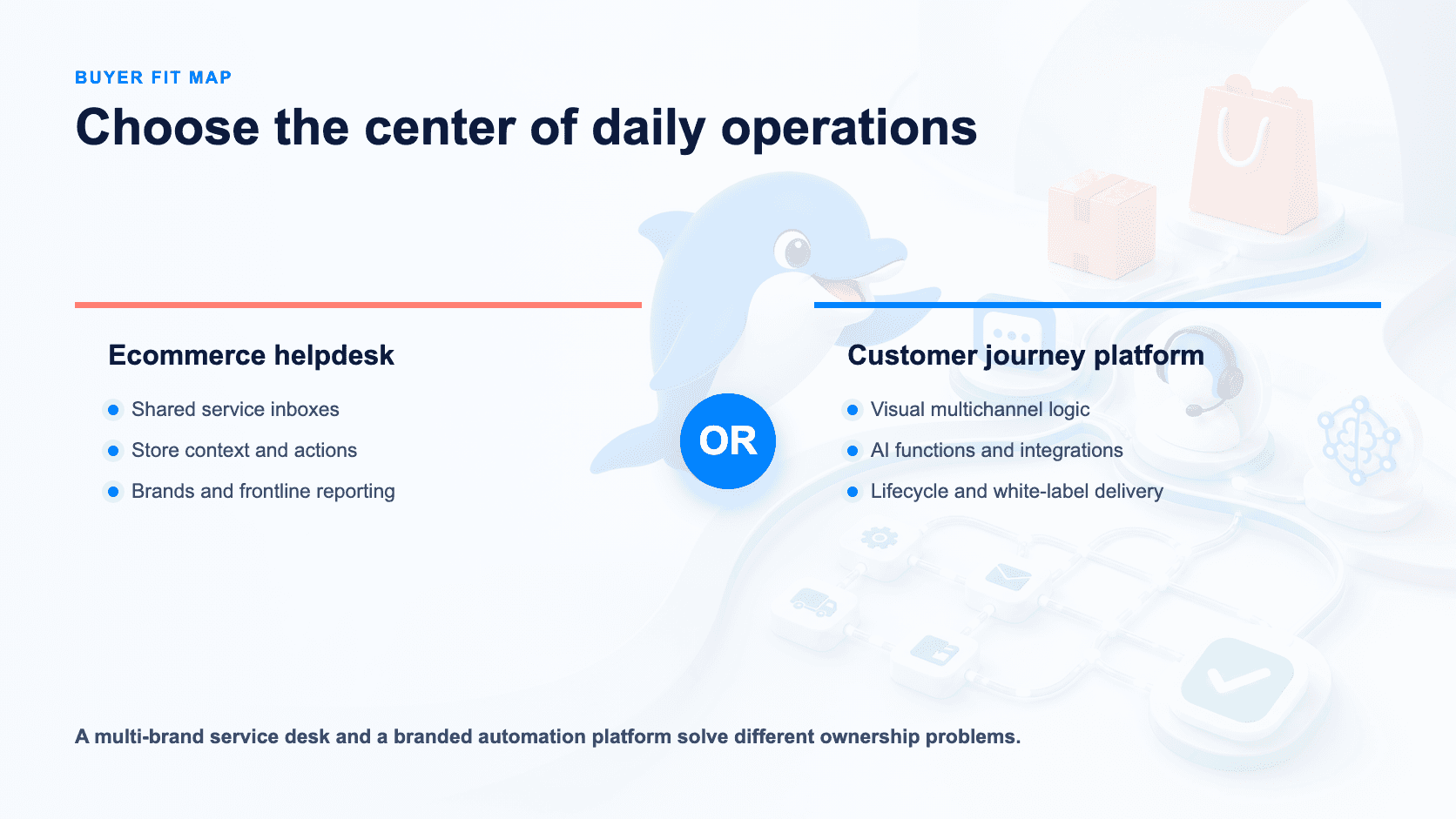
Quick verdict: Choose Re:amaze when the center of gravity is an ecommerce customer-service desk: shared inboxes, store context, multiple brands, frontline reporting and AI inside that operation. Choose UChat when the center of gravity is the customer journey: visual multichannel automation, configurable AI functions, business actions, lifecycle tools or white-label client delivery [S1][S3]–[S9].
Table Of Contents
Quick Verdict And Scorecard
Recommendation By Use Case
Feature Comparison
Ecommerce Service And Operator Workflow
AI Agent And Automation Design
Channels, Integrations And Lifecycle
Pricing And Total Cost
Agency And Multi-Client Delivery
When Re:amaze May Be A Better Fit
Run A Fair Proof Of Concept
Decision Checklist
FAQ
Final Verdict And CTA
Quick Verdict And Scorecard
Dimension | Re:amaze | UChat | Starting edge |
|---|---|---|---|
Core model | Ecommerce helpdesk, live chat and AI Agent [S1] | Multichannel visual automation platform [S10] | Re:amaze for service operations; UChat for journey orchestration |
Operator work | Inboxes, brands, reporting, workforce features and channels by plan [S1] | Live Chat, CRM Boards and Tickets [S7][S8] | Re:amaze for a mature helpdesk surface |
AI | FAQ, templates, context and URL knowledge across Chat, Email and SMS [S1] | Knowledge, instructions, model choice and AI functions [S4] | Depends on answer-versus-action depth |
Ecommerce | Store integrations and operator-side commerce actions [S1] | Ecommerce integrations inside configurable flows [S9] | Re:amaze for helpdesk commerce; test automation actions in both |
Channels | Email, chat, social, SMS, voice, video and push by plan [S1] | Web, social, messaging, voice and SMS families [S5] | Different breadth and operating model |
Pricing | Flat Starter or per-user tiers plus AI usage [S1] | Free $0, Business $15 and Partner $199 listed entry prices [S2] | Model seats, conversations and AI workload |
Agency delivery | Multiple brands on eligible plans [S1] | White label, custom domains, client plans and billing [S3] | UChat for branded resale |
How We Compared
We reviewed Re:amaze's current homepage, pricing, AI documentation and integration directory. We compared them with UChat's public pricing, Partner, AI Agent, Channels, Flow Builder, Live Chat, CRM and Integrations pages. The result distinguishes an operator-centered helpdesk from a broader automation platform rather than pretending the products are identical [S1]–[S10].
Recommendation By Use Case
Shopify or ecommerce team wanting support agents to handle conversations and store actions from one workspace: Start with Re:amaze [S1].
Support organization managing multiple consumer brands, teams, shifts, CSAT and detailed service operations: Re:amaze deserves the first proof of concept [S1].
Business automating acquisition and service across social, messaging, web, voice and SMS: Start with UChat [S5][S6].
Team that needs AI functions, visual branches, APIs, webhooks and lifecycle stages beyond the inbox: Start with UChat [S4][S6][S8][S9].
Agency selling clients access to a platform carrying the agency's brand: Start with UChat Partner [S3].
Small support team needing unlimited users and predictable conversation volume: Examine Re:amaze Starter carefully [S1].
Feature Comparison
Capability | Re:amaze | UChat |
|---|---|---|
Service workspace | Shared inboxes, live chat, social, FAQ and reporting [S1] | Live Chat with CRM Boards and Tickets [S7][S8] |
AI knowledge | FAQ, response templates, custom context and URLs [S1] | Knowledge, instructions, model choice and functions [S4] |
Automation | Workflows, macros, templates, bots and proactive Cues [S1] | Visual Flow Builder plus integrations and actions [S6][S9] |
Ecommerce | Shopify and other commerce integrations [S1] | Ecommerce integrations in broader flows [S9] |
Brand model | Multiple brands on Pro and above [S1] | White-label client platform on Partner [S3] |
Channels | Email, chat, social, SMS, voice, video and push by plan [S1] | Web, social, messaging, voice and SMS [S5] |
Extensibility | Integration directory and platform connections [S1] | APIs, webhooks, integrations and Mini Apps [S9] |
Ecommerce Service And Operator Workflow
Re:amaze begins with the support team. Its plans document unlimited inboxes, live chat, social channels, FAQ, workflow tools, templates, reporting and an AI Agent [S1]. Higher tiers add multiple brands, site visitors, advanced reporting, SMS, voice, workforce controls, CSAT and video capabilities [S1].
Its ecommerce integrations are especially relevant because operators can work with store context while serving the customer [S1]. For a team measured on queue health, response quality and order resolution, that concentration is valuable.
UChat begins with the journey. It documents Live Chat for human intervention, then CRM Boards and Tickets for lifecycle work [S7][S8]. Its ecommerce connections sit inside a wider integration and flow architecture [S6][S9]. That can be useful when an order question is only one step in acquisition, qualification, payment, follow-up or re-engagement.
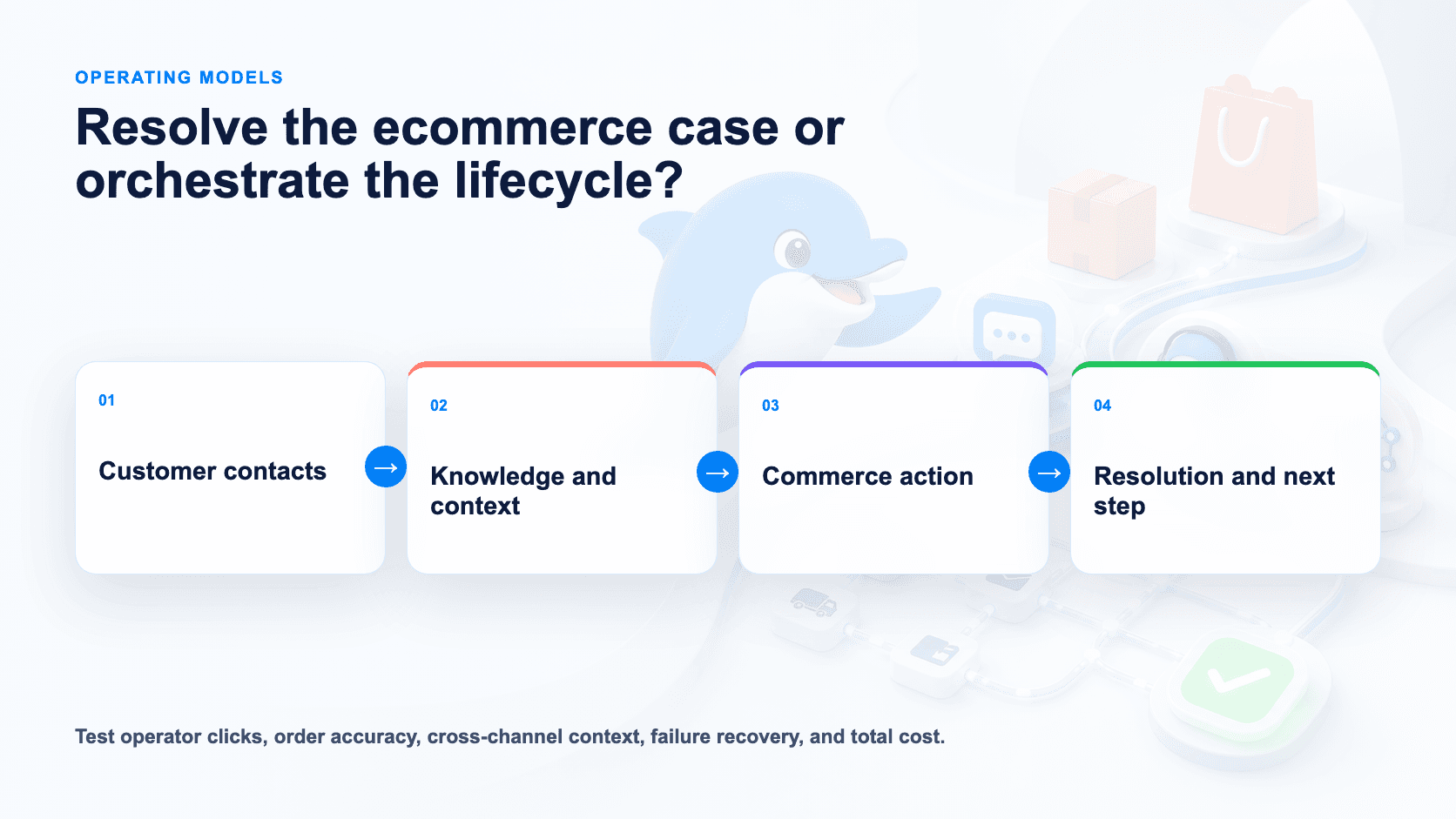
If the daily problem is “help agents resolve ecommerce conversations,” Re:amaze may require less assembly. If it is “design how customers move through the entire conversational process,” UChat may be the stronger starting point.
AI Agent And Automation Design
Re:amaze documents an AI Agent for Chat, Email and SMS that can use FAQ content, response templates, custom context and URLs [S1]. It also provides AI-assisted response functions and automation through workflows, bots and proactive Cues [S1].
UChat documents AI Agents with knowledge, instructions, model choice and functions [S4]. Its visual Flow Builder provides deterministic steps around the Agent, while integrations, APIs, webhooks and Mini Apps connect business systems [S6][S9].
Ask whether AI should mainly resolve service questions inside the desk or participate in a longer business process across channels and systems.
Neither model wins automatically. Re:amaze may give support leaders a more coherent operating surface. UChat may give automation teams more composition freedom. Test missing knowledge, a refund exception, an unavailable ecommerce action and a transfer to a human.
Channels, Integrations And Lifecycle
Re:amaze documents email, live chat, social, SMS, voice, video and push capabilities, with plan and provider conditions [S1]. Its directory includes Shopify operations as well as Facebook, Instagram, Messenger, WhatsApp through Twilio, X, Stripe and other connections [S1].
UChat documents web, social, messaging, voice and SMS channel families [S5]. It also documents integrations, APIs, webhooks and Mini Apps [S9]. CRM Boards and Tickets can continue work after the immediate conversation [S8].
The meaningful question is not the raw channel count. Test whether identity, fields, order context, consent and human history remain usable when a customer crosses channels. A channel logo on a page is evidence of availability, not evidence that your complete workflow is solved.
Pricing And Total Cost
Re:amaze lists Basic at $29, Pro at $49 and Plus at $69 per team member per month. Annualized prices are lower at $26.10, $44.10 and $62.10 respectively [S1]. It also lists a $59 flat Starter plan with unlimited team members and 500 responded conversations per month [S1].
AI usage needs separate attention. The current plans include 5, 10 or 20 AI resolutions per user depending on tier, and additional AI resolutions are listed at $0.85 each [S1]. Model peak traffic rather than an average month.
UChat lists Free $0, Business $15 and Partner $199 as entry prices [S2]. Confirm billing period, bots, users, members, AI provider usage, channel fees and add-ons.
For Re:amaze, calculate seats, brands, responded conversations, AI resolutions, channels and required workforce features. For UChat, calculate resources, AI usage, provider charges and implementation. Include operator time and maintenance in both. Different pricing units make headline-price comparisons unreliable.
Both vendors document 14-day trial paths [S1][S11]. Use the trial to measure real work per resolved outcome.
Agency And Multi-Client Delivery
Re:amaze Pro and higher tiers document multiple-brand support [S1]. That is useful for one organization or service team managing several brands from a helpdesk.
UChat Partner documents a different proposition: white-label interfaces and domains, client plan controls and billing [S3]. It is designed for an agency or reseller that wants clients to experience the platform under the agency's brand.
These capabilities can look similar in a checklist but solve different ownership problems. Test ten clients or brands. Examine isolation, login experience, reusable setup, permissions, brand surfaces, reporting, support access and billing. Choose Re:amaze when the agency operates the desk on behalf of clients. Choose UChat when the client is buying access to the agency's branded automation platform.
When Re:amaze May Be A Better Fit
Re:amaze may be better for an ecommerce support organization that wants one operational home [S1]. Its storefront connections, shared inboxes, agent tools, multiple brands, reporting and higher-tier workforce controls speak directly to frontline service management.
The flat Starter package may also appeal to a small team with many collaborators but limited responded-conversation volume [S1]. Test the limits carefully, but the packaging can be easier to forecast than per-seat plans.
Finally, if the team values mature helpdesk administration more than broad visual journey design, Re:amaze's focus may be a strength. UChat's Flow Builder and channel architecture should not be purchased merely because they are available.
Run A Fair Proof Of Concept
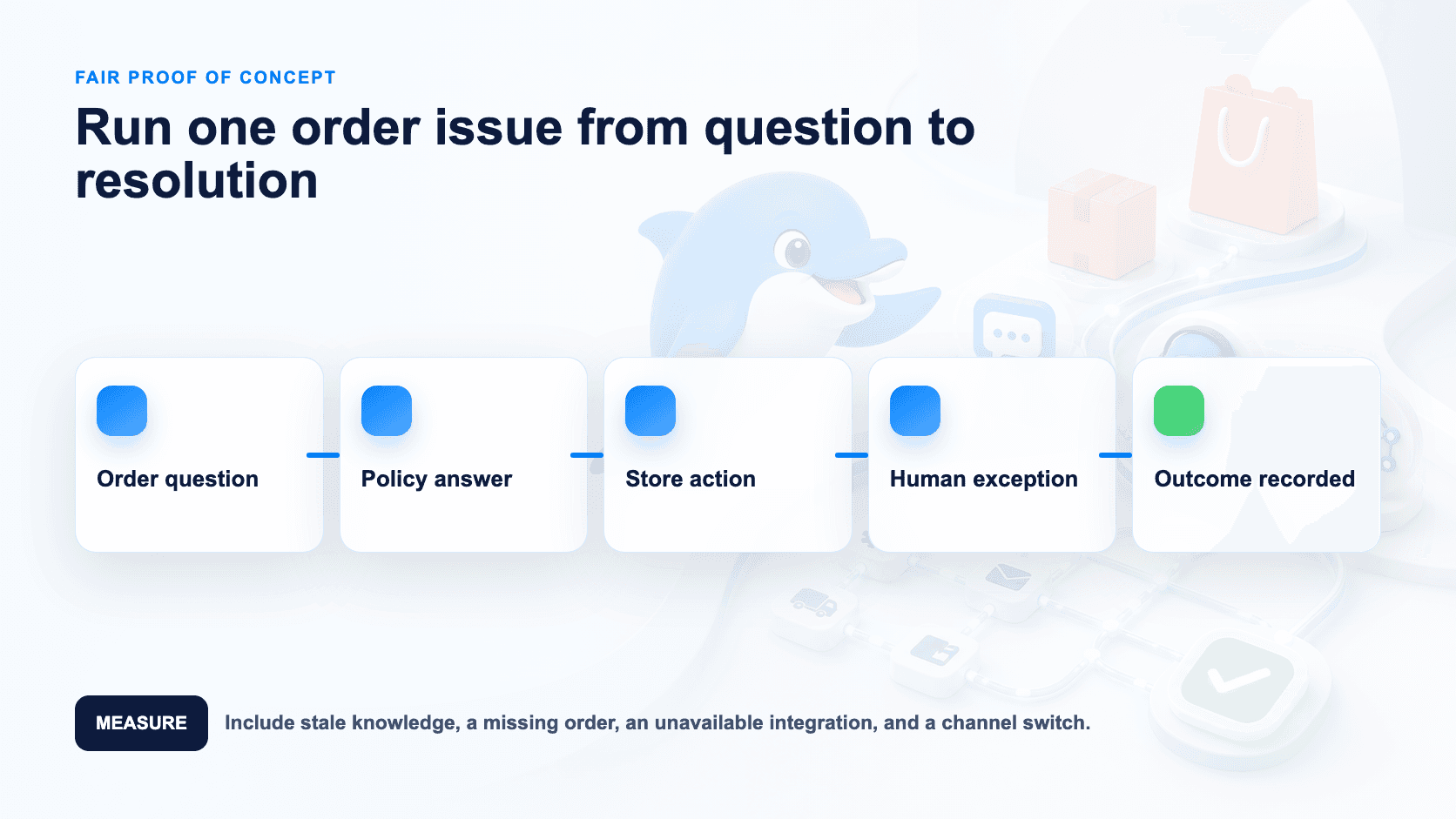
Use one ecommerce service journey:
A shopper asks about an order through a supported channel.
AI answers a policy question from approved knowledge.
The workflow identifies the order and attempts one permitted action.
An exception requires a human.
The operator receives context and completes the resolution.
The outcome is recorded and reportable.
The customer returns through another channel.
Measure answer quality, action accuracy, operator clicks, handoff context, cross-channel identity, setup time, failure recovery and total monthly cost. Include a stale FAQ, missing order and unavailable integration.
Decision Checklist
Is the primary owner a support leader, ecommerce operator or automation specialist?
Do agents need store actions in the same service workspace [S1]?
How many brands, users and responded conversations are required [S1]?
How many AI resolutions will a peak month consume [S1]?
Must the journey span broad social, messaging, voice or SMS channels [S5]?
Does AI need custom functions and deterministic flow logic [S4][S6]?
What happens after handoff: inbox closure, CRM stage or ticket [S8]?
Are APIs, webhooks or a custom integration required [S9]?
Is multi-brand administration enough, or do clients need a white-label platform [S1][S3]?
Which system gave operators the clearest next action in the proof of concept?
FAQ
Is Re:amaze only a shared inbox? No. It documents AI Agent, chatbots, automation, proactive Cues, FAQ, live chat, reporting and ecommerce integrations [S1].
Does UChat support human service? Yes. UChat documents Live Chat handoff, CRM Boards and Tickets [S7][S8].
Which is better for Shopify support? Re:amaze has a focused ecommerce helpdesk proposition [S1]. UChat can connect ecommerce actions to broader flows [S9]. Test the exact action.
Which is better for multichannel automation? UChat documents broad channel families and a visual Flow Builder [S5][S6]. Re:amaze also supports multiple service channels, but its operating center is the helpdesk [S1].
Which is cheaper? It depends on users, conversations, AI resolutions, resources and channels. Build a workload model using both vendors' actual billing units [S1][S2].
Which is better for agencies? Re:amaze may fit an agency operating support for multiple brands [S1]. UChat has the clearer documented white-label resale model [S3].
Final Verdict And CTA
Choose Re:amaze for ecommerce customer-service operations, store context, multi-brand administration and frontline helpdesk depth [S1]. Choose UChat for visual multichannel journeys, configurable AI actions, lifecycle automation and branded client delivery [S3]–[S9].
Start a 14-day UChat trial with Pro access and no credit card [S11]. Agencies can book a Partner Plan demo [S12].
Related comparisons: UChat vs Gorgias · UChat vs Intercom · UChat vs Zendesk AI
Explore UChat's official pages for pricing, AI Agents, channels, Flow Builder, Live Chat, CRM, integrations and the Partner program.
Sources reviewed 12 August 2026.
Quick verdict: Choose Re:amaze when the center of gravity is an ecommerce customer-service desk: shared inboxes, store context, multiple brands, frontline reporting and AI inside that operation. Choose UChat when the center of gravity is the customer journey: visual multichannel automation, configurable AI functions, business actions, lifecycle tools or white-label client delivery [S1][S3]–[S9].
Table Of Contents
Quick Verdict And Scorecard
Recommendation By Use Case
Feature Comparison
Ecommerce Service And Operator Workflow
AI Agent And Automation Design
Channels, Integrations And Lifecycle
Pricing And Total Cost
Agency And Multi-Client Delivery
When Re:amaze May Be A Better Fit
Run A Fair Proof Of Concept
Decision Checklist
FAQ
Final Verdict And CTA
Quick Verdict And Scorecard
Dimension | Re:amaze | UChat | Starting edge |
|---|---|---|---|
Core model | Ecommerce helpdesk, live chat and AI Agent [S1] | Multichannel visual automation platform [S10] | Re:amaze for service operations; UChat for journey orchestration |
Operator work | Inboxes, brands, reporting, workforce features and channels by plan [S1] | Live Chat, CRM Boards and Tickets [S7][S8] | Re:amaze for a mature helpdesk surface |
AI | FAQ, templates, context and URL knowledge across Chat, Email and SMS [S1] | Knowledge, instructions, model choice and AI functions [S4] | Depends on answer-versus-action depth |
Ecommerce | Store integrations and operator-side commerce actions [S1] | Ecommerce integrations inside configurable flows [S9] | Re:amaze for helpdesk commerce; test automation actions in both |
Channels | Email, chat, social, SMS, voice, video and push by plan [S1] | Web, social, messaging, voice and SMS families [S5] | Different breadth and operating model |
Pricing | Flat Starter or per-user tiers plus AI usage [S1] | Free $0, Business $15 and Partner $199 listed entry prices [S2] | Model seats, conversations and AI workload |
Agency delivery | Multiple brands on eligible plans [S1] | White label, custom domains, client plans and billing [S3] | UChat for branded resale |
How We Compared
We reviewed Re:amaze's current homepage, pricing, AI documentation and integration directory. We compared them with UChat's public pricing, Partner, AI Agent, Channels, Flow Builder, Live Chat, CRM and Integrations pages. The result distinguishes an operator-centered helpdesk from a broader automation platform rather than pretending the products are identical [S1]–[S10].
Recommendation By Use Case
Shopify or ecommerce team wanting support agents to handle conversations and store actions from one workspace: Start with Re:amaze [S1].
Support organization managing multiple consumer brands, teams, shifts, CSAT and detailed service operations: Re:amaze deserves the first proof of concept [S1].
Business automating acquisition and service across social, messaging, web, voice and SMS: Start with UChat [S5][S6].
Team that needs AI functions, visual branches, APIs, webhooks and lifecycle stages beyond the inbox: Start with UChat [S4][S6][S8][S9].
Agency selling clients access to a platform carrying the agency's brand: Start with UChat Partner [S3].
Small support team needing unlimited users and predictable conversation volume: Examine Re:amaze Starter carefully [S1].
Feature Comparison
Capability | Re:amaze | UChat |
|---|---|---|
Service workspace | Shared inboxes, live chat, social, FAQ and reporting [S1] | Live Chat with CRM Boards and Tickets [S7][S8] |
AI knowledge | FAQ, response templates, custom context and URLs [S1] | Knowledge, instructions, model choice and functions [S4] |
Automation | Workflows, macros, templates, bots and proactive Cues [S1] | Visual Flow Builder plus integrations and actions [S6][S9] |
Ecommerce | Shopify and other commerce integrations [S1] | Ecommerce integrations in broader flows [S9] |
Brand model | Multiple brands on Pro and above [S1] | White-label client platform on Partner [S3] |
Channels | Email, chat, social, SMS, voice, video and push by plan [S1] | Web, social, messaging, voice and SMS [S5] |
Extensibility | Integration directory and platform connections [S1] | APIs, webhooks, integrations and Mini Apps [S9] |
Ecommerce Service And Operator Workflow
Re:amaze begins with the support team. Its plans document unlimited inboxes, live chat, social channels, FAQ, workflow tools, templates, reporting and an AI Agent [S1]. Higher tiers add multiple brands, site visitors, advanced reporting, SMS, voice, workforce controls, CSAT and video capabilities [S1].
Its ecommerce integrations are especially relevant because operators can work with store context while serving the customer [S1]. For a team measured on queue health, response quality and order resolution, that concentration is valuable.
UChat begins with the journey. It documents Live Chat for human intervention, then CRM Boards and Tickets for lifecycle work [S7][S8]. Its ecommerce connections sit inside a wider integration and flow architecture [S6][S9]. That can be useful when an order question is only one step in acquisition, qualification, payment, follow-up or re-engagement.
If the daily problem is “help agents resolve ecommerce conversations,” Re:amaze may require less assembly. If it is “design how customers move through the entire conversational process,” UChat may be the stronger starting point.
AI Agent And Automation Design
Re:amaze documents an AI Agent for Chat, Email and SMS that can use FAQ content, response templates, custom context and URLs [S1]. It also provides AI-assisted response functions and automation through workflows, bots and proactive Cues [S1].
UChat documents AI Agents with knowledge, instructions, model choice and functions [S4]. Its visual Flow Builder provides deterministic steps around the Agent, while integrations, APIs, webhooks and Mini Apps connect business systems [S6][S9].
Ask whether AI should mainly resolve service questions inside the desk or participate in a longer business process across channels and systems.
Neither model wins automatically. Re:amaze may give support leaders a more coherent operating surface. UChat may give automation teams more composition freedom. Test missing knowledge, a refund exception, an unavailable ecommerce action and a transfer to a human.
Channels, Integrations And Lifecycle
Re:amaze documents email, live chat, social, SMS, voice, video and push capabilities, with plan and provider conditions [S1]. Its directory includes Shopify operations as well as Facebook, Instagram, Messenger, WhatsApp through Twilio, X, Stripe and other connections [S1].
UChat documents web, social, messaging, voice and SMS channel families [S5]. It also documents integrations, APIs, webhooks and Mini Apps [S9]. CRM Boards and Tickets can continue work after the immediate conversation [S8].
The meaningful question is not the raw channel count. Test whether identity, fields, order context, consent and human history remain usable when a customer crosses channels. A channel logo on a page is evidence of availability, not evidence that your complete workflow is solved.
Pricing And Total Cost
Re:amaze lists Basic at $29, Pro at $49 and Plus at $69 per team member per month. Annualized prices are lower at $26.10, $44.10 and $62.10 respectively [S1]. It also lists a $59 flat Starter plan with unlimited team members and 500 responded conversations per month [S1].
AI usage needs separate attention. The current plans include 5, 10 or 20 AI resolutions per user depending on tier, and additional AI resolutions are listed at $0.85 each [S1]. Model peak traffic rather than an average month.
UChat lists Free $0, Business $15 and Partner $199 as entry prices [S2]. Confirm billing period, bots, users, members, AI provider usage, channel fees and add-ons.
For Re:amaze, calculate seats, brands, responded conversations, AI resolutions, channels and required workforce features. For UChat, calculate resources, AI usage, provider charges and implementation. Include operator time and maintenance in both. Different pricing units make headline-price comparisons unreliable.
Both vendors document 14-day trial paths [S1][S11]. Use the trial to measure real work per resolved outcome.
Agency And Multi-Client Delivery
Re:amaze Pro and higher tiers document multiple-brand support [S1]. That is useful for one organization or service team managing several brands from a helpdesk.
UChat Partner documents a different proposition: white-label interfaces and domains, client plan controls and billing [S3]. It is designed for an agency or reseller that wants clients to experience the platform under the agency's brand.
These capabilities can look similar in a checklist but solve different ownership problems. Test ten clients or brands. Examine isolation, login experience, reusable setup, permissions, brand surfaces, reporting, support access and billing. Choose Re:amaze when the agency operates the desk on behalf of clients. Choose UChat when the client is buying access to the agency's branded automation platform.
When Re:amaze May Be A Better Fit
Re:amaze may be better for an ecommerce support organization that wants one operational home [S1]. Its storefront connections, shared inboxes, agent tools, multiple brands, reporting and higher-tier workforce controls speak directly to frontline service management.
The flat Starter package may also appeal to a small team with many collaborators but limited responded-conversation volume [S1]. Test the limits carefully, but the packaging can be easier to forecast than per-seat plans.
Finally, if the team values mature helpdesk administration more than broad visual journey design, Re:amaze's focus may be a strength. UChat's Flow Builder and channel architecture should not be purchased merely because they are available.
Run A Fair Proof Of Concept
Use one ecommerce service journey:
A shopper asks about an order through a supported channel.
AI answers a policy question from approved knowledge.
The workflow identifies the order and attempts one permitted action.
An exception requires a human.
The operator receives context and completes the resolution.
The outcome is recorded and reportable.
The customer returns through another channel.
Measure answer quality, action accuracy, operator clicks, handoff context, cross-channel identity, setup time, failure recovery and total monthly cost. Include a stale FAQ, missing order and unavailable integration.
Decision Checklist
Is the primary owner a support leader, ecommerce operator or automation specialist?
Do agents need store actions in the same service workspace [S1]?
How many brands, users and responded conversations are required [S1]?
How many AI resolutions will a peak month consume [S1]?
Must the journey span broad social, messaging, voice or SMS channels [S5]?
Does AI need custom functions and deterministic flow logic [S4][S6]?
What happens after handoff: inbox closure, CRM stage or ticket [S8]?
Are APIs, webhooks or a custom integration required [S9]?
Is multi-brand administration enough, or do clients need a white-label platform [S1][S3]?
Which system gave operators the clearest next action in the proof of concept?
FAQ
Is Re:amaze only a shared inbox? No. It documents AI Agent, chatbots, automation, proactive Cues, FAQ, live chat, reporting and ecommerce integrations [S1].
Does UChat support human service? Yes. UChat documents Live Chat handoff, CRM Boards and Tickets [S7][S8].
Which is better for Shopify support? Re:amaze has a focused ecommerce helpdesk proposition [S1]. UChat can connect ecommerce actions to broader flows [S9]. Test the exact action.
Which is better for multichannel automation? UChat documents broad channel families and a visual Flow Builder [S5][S6]. Re:amaze also supports multiple service channels, but its operating center is the helpdesk [S1].
Which is cheaper? It depends on users, conversations, AI resolutions, resources and channels. Build a workload model using both vendors' actual billing units [S1][S2].
Which is better for agencies? Re:amaze may fit an agency operating support for multiple brands [S1]. UChat has the clearer documented white-label resale model [S3].
Final Verdict And CTA
Choose Re:amaze for ecommerce customer-service operations, store context, multi-brand administration and frontline helpdesk depth [S1]. Choose UChat for visual multichannel journeys, configurable AI actions, lifecycle automation and branded client delivery [S3]–[S9].
Start a 14-day UChat trial with Pro access and no credit card [S11]. Agencies can book a Partner Plan demo [S12].
Related comparisons: UChat vs Gorgias · UChat vs Intercom · UChat vs Zendesk AI
Explore UChat's official pages for pricing, AI Agents, channels, Flow Builder, Live Chat, CRM, integrations and the Partner program.
Sources reviewed 12 August 2026.