15 minutes
UChat
Posted by
UChat vs Respond.io: Which Omnichannel AI Platform Fits Your Growth Model?
15 minutes
Posted by
UChat

Quick Verdict
UChat and Respond.io now overlap in more places than a feature checklist suggests. Both bring AI, automation, messaging channels, team collaboration, integrations, and human handoff into one platform.
The practical difference is the business you are building around those conversations. Respond.io is a strong fit for a mid-market B2C team that wants to consolidate sales and support conversations around one operational inbox. UChat is the stronger fit when you want to compose more of the automation yourself, connect AI to visual flows and business actions, or deliver the platform to clients under your own brand.
Respond.io deserves serious consideration for structured, high-volume conversation operations, especially when WhatsApp, social messaging, calls, lifecycle reporting, and a unified team inbox sit at the center of the sales process.
UChat becomes more relevant when the same project also needs multiple AI providers, AI Functions, visual workflow logic, CRM and ticket boards, Mini Apps, broader solution packaging, or full-white-label agency delivery.
Table Of Contents
Scorecard
Recommendation By Use Case
Feature Comparison: Who Each Platform Is Built For
Omnichannel Inbox Or Omnichannel Automation
AI Agents And Workflow Depth
Human Handoff CRM And Reporting
Channels WhatsApp Web Chat And Voice
Integrations APIs And Extension Paths
Pricing And Scaling
Reseller Program Or Full White Label
When Respond.io May Be A Better Fit
When UChat Is The Better Fit
FAQ
CTA: Ready To Test UChat
Scorecard
If this describes your business | Better starting point | Why |
|---|---|---|
A mid-market B2C team managing a large volume of sales conversations | Respond.io | Its public positioning centers on revenue conversations, unified inbox operations, CRM context, lifecycle visibility, AI Agents, and calls. |
A team that wants AI Agents working alongside structured visual automation | Both | Respond.io combines AI Agents with Workflows; UChat combines AI Agents and AI Functions with its visual Flow Builder. The right choice depends on the actions and operating model you need. |
A business comparing WhatsApp, Instagram, Messenger, TikTok, web chat, email, SMS, and voice | Both | Both platforms now cover a broad channel set. Channel count alone should not decide this comparison. |
An agency referring or implementing a platform for clients | Respond.io or UChat | Respond.io has a commission-based reseller program; UChat has a full-white-label Partner platform. These are different agency models. |
An agency that wants its own domain, brand, client prices, workspaces, and billing automation | UChat | These are central parts of UChat Partner rather than an affiliate-style add-on. |
A smaller business that needs an affordable all-feature entry point | UChat | UChat Business is publicly listed at $15/month, while Respond.io Growth is the first listed plan with Workflows and AI Agents at $159/month for 1,000 monthly active contacts. The usage models are different, so total cost still depends on scale. |
Recommendation By Use Case
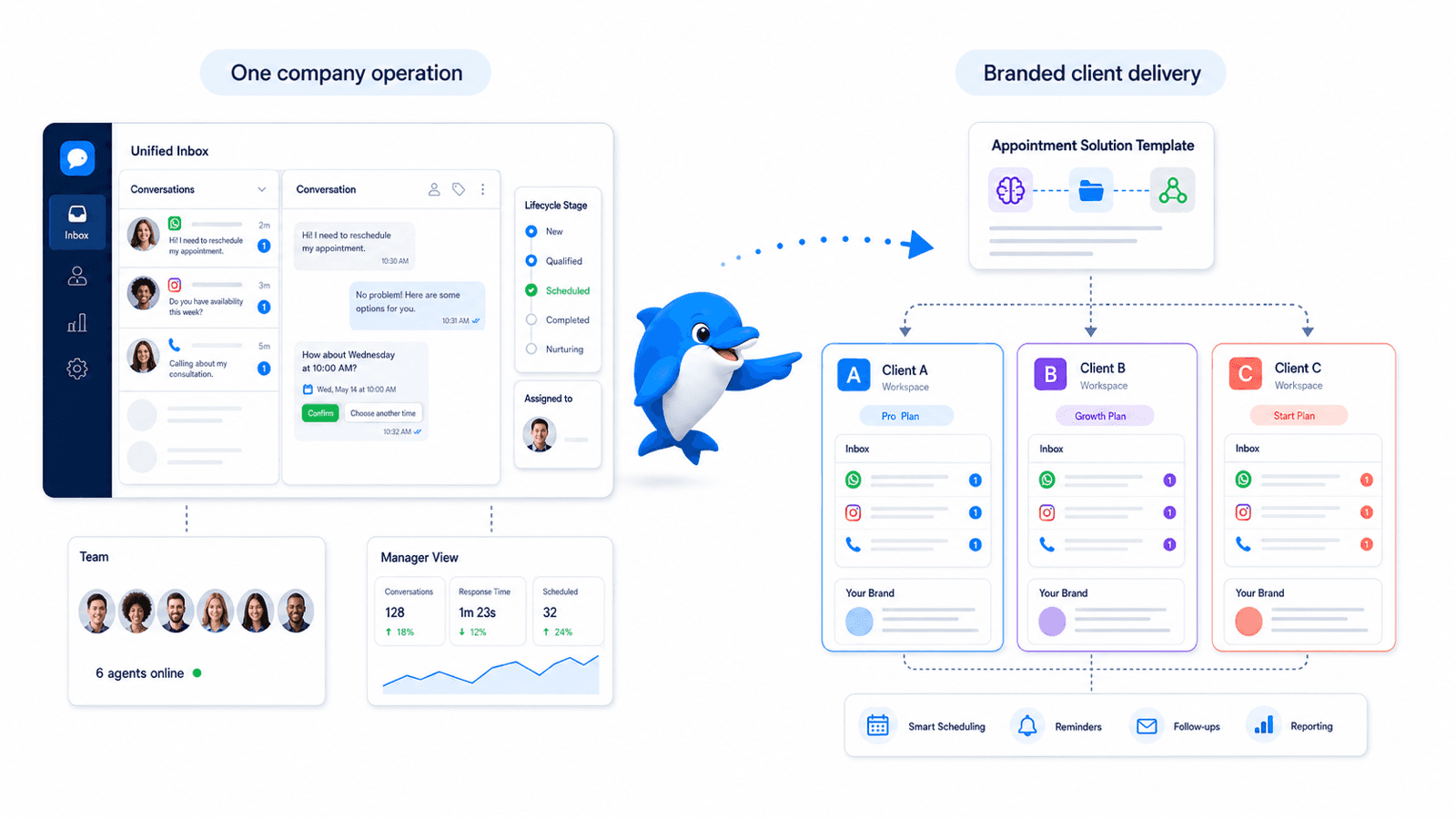
Imagine two Monday mornings.
In the first business, 30 sales and support agents open one workspace. They need every WhatsApp message, Instagram DM, call, assignment, lifecycle stage, and follow-up visible to managers. The platform is part of their internal revenue operation. That is the cleaner Respond.io starting point.
In the second business, an agency is preparing to launch the same appointment-booking solution for several clients. Each client needs its own workspace, brand, plan, limits, billing path, template, and support experience. That is the cleaner UChat Partner starting point.
Many buyers sit between these examples. The rest of the comparison explains which architecture gives them fewer compromises.
Feature Comparison: Who Each Platform Is Built For
Respond.io describes itself as a customer conversation management platform for mid-market B2C businesses. Its strongest story is not “build a chatbot.” It is “run revenue conversations without losing context.” Messages, calls, AI Agents, human agents, CRM data, lifecycle stages, routing, and reporting sit inside one operating layer.
That makes sense for businesses such as education providers, travel companies, automotive groups, healthcare services, retailers, and other teams where customers normally speak to someone before booking or buying.
UChat is positioned more broadly as a no-code AI Agent and automation platform. It supports visual automation for sales, support, engagement, ecommerce, lead qualification, appointments, and cross-channel customer journeys. It also keeps advanced paths available through JavaScript, external requests, AI Functions, APIs, webhooks, and Mini Apps.
That broader construction layer changes the buyer. UChat can serve the business running the automation, the consultant building it, or the agency turning the same platform into a branded client offer.
Omnichannel Inbox Or Omnichannel Automation
Both platforms bring conversations together, but they emphasize a different center of gravity.
Respond.io starts from the operational inbox. A lead can move from WhatsApp to Instagram, a call, or another channel while the team retains contact history and CRM context. AI Agents can qualify and route the lead, while managers see lifecycle stages, team activity, and revenue leaks.
UChat starts from the automation architecture. Its Flow Builder lets a team design messages, questions, conditions, actions, API requests, ticket triggers, AI tasks, and human handoff. Omni Channel lets one bot logic work across supported channels while individual channel restrictions still apply.
Neither approach is automatically better. The question is whether your main operational surface is the inbox or the workflow.
If managers mainly need visibility, assignment, routing, lifecycle control, and consistent follow-up across a busy sales team, Respond.io's inbox-centered model is attractive.
If builders need to control how data is captured, transformed, passed through flows, sent to external systems, and reused across client solutions, UChat's visual automation model deserves closer attention.
AI Agents And Workflow Depth
An AI Agent on Respond.io can do considerably more than answer FAQs. The public product page shows it reading text, images, documents, voice notes, and audio, then qualifying leads, recommending products, updating lifecycle data, triggering Workflows, making HTTP requests, blocking spam, or passing the conversation to a person. Voice calls and cross-channel context are part of the same story.
UChat approaches the problem through a builder's toolkit. Instructions and business knowledge can be paired with a choice of LLM providers, AI Functions, MCP and web-search tools, voice, and live chat handoff. Flow Builder then places those probabilistic decisions beside explicit conditions, actions, fields, tickets, and external requests.
The distinction is not “AI versus no AI.” It is how each team wants AI to participate in the system.
AI requirement | Respond.io approach | UChat approach |
|---|---|---|
Qualify, route, follow up, and update conversation lifecycle | Native AI Agents inside the conversation operation. | AI Agents and AI Functions can drive Flow Builder actions and data paths. |
Use multimedia and voice conversations | AI Agents process several media formats and support chat and voice calls. | AI Agents operate across messaging and voice channels, with provider and flow configuration. |
Keep critical paths deterministic | Workflows run alongside AI Agents. | Visual Flow Builder, Function Flow, conditions, actions, and AI Functions can be composed together. |
Select models and external tools | Respond.io says task-specialized models are orchestrated inside its AI system. | UChat publicly lists OpenAI, Claude, Gemini, xAI, DeepSeek, Coze, and other providers, plus MCP and AI Functions. |
Buyer takeaway: Choose based on the control surface you need, not on whether the homepage says “AI Agent.”
What A UChat Workflow Can Look Like
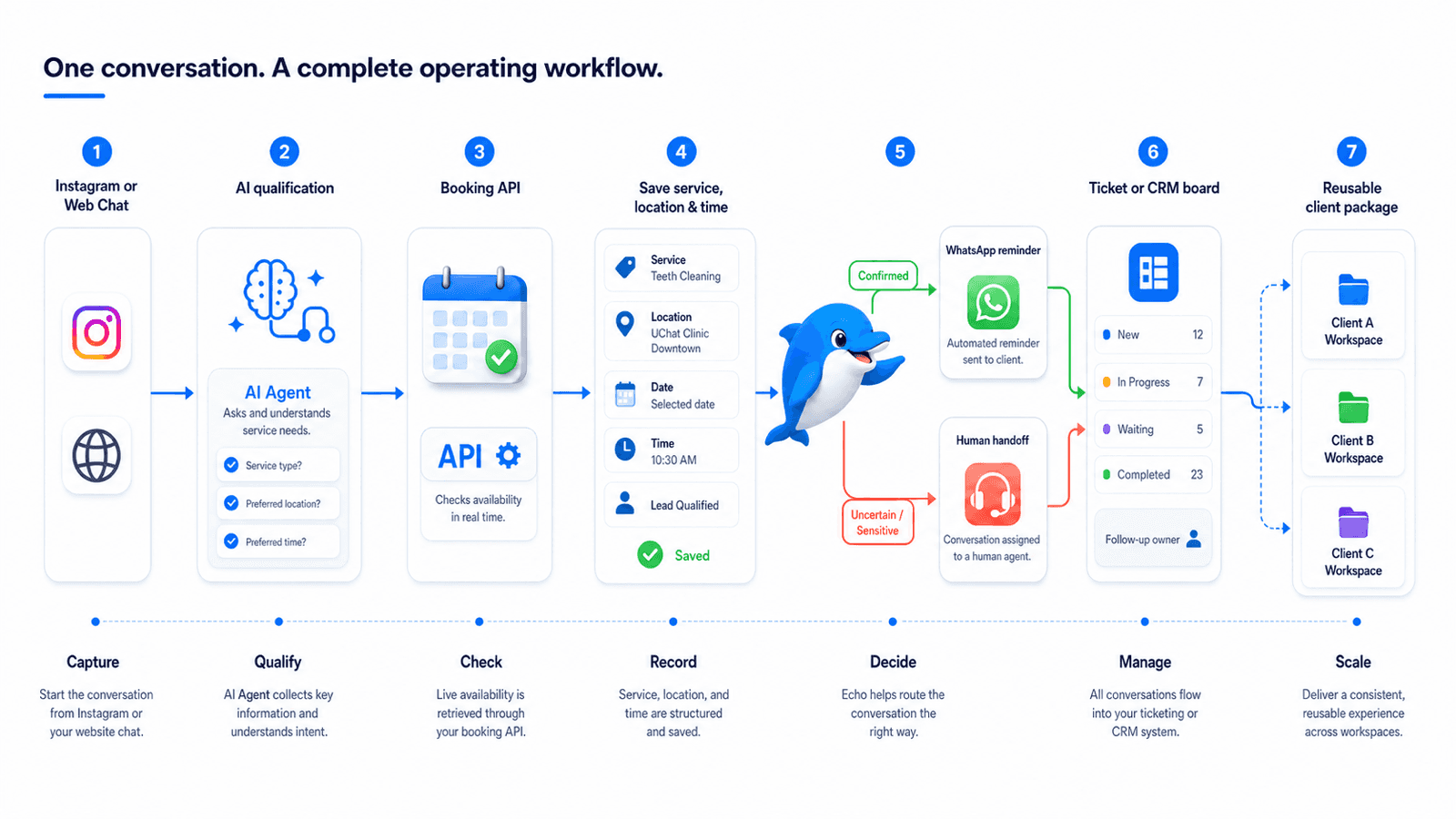
Consider an agency building an appointment-booking solution for a clinic.
An Instagram or Web Chat conversation enters the same reusable bot logic.
An AI Agent answers service questions and qualifies the enquiry.
An AI Function checks availability or calls the clinic's booking API.
Flow Builder stores the selected service, location, and preferred time in fields.
A confirmed booking triggers a WhatsApp reminder; an uncertain or sensitive enquiry transfers to a person with the collected context.
A ticket or CRM-board item records work that needs follow-up.
The agency packages the flow and integration for installation into another branded client workspace.
The value is not any one step. It is that AI, deterministic flow logic, channel delivery, human work, and reusable client packaging can sit in the same solution.
Human Handoff CRM And Reporting
Respond.io is particularly clear about the operating layer around a conversation. It combines team and custom inboxes, assignment, customer lifecycle management, contact and call activity, mobile access, advanced reports, broadcasts, and integrations. Its AI Agents are designed to hand sensitive or high-value conversations to people with context.
UChat also supports AI-to-human transfer, assignment, mobile app access, response-time analytics, CRM boards, and ticket boards. Teams can use boards for pipeline-style work and tickets for structured issue management while keeping a direct path back to the conversation.
This creates a useful split:
Respond.io is easier to understand as a customer conversation operating system. Its lifecycle and reporting language is closely tied to revenue-team management.
UChat is easier to extend into a custom process. The live conversation can connect to flow logic, fields, ecommerce, boards, tickets, external requests, and partner-built solutions.
For a mature contact operation, compare reporting definitions, assignment rules, user permissions, audit needs, and the exact CRM synchronization path in a live trial. Those details matter more than a checkmark beside “team inbox.”
Channels WhatsApp Web Chat And Voice
Both reviewed product pages describe genuine omnichannel platforms, so channel count is not a useful shortcut for this decision.
WhatsApp, Instagram, Facebook Messenger, TikTok, Viber, Telegram, LINE, email, web chat, voice calls, and SMS all appear in Respond.io's current public channel material. Custom channels can enter through API and webhook paths. On WhatsApp specifically, Respond.io presents itself as a Business Solution Provider and documents coexistence and calling.
UChat's public list also extends beyond 15 messaging and social surfaces: Web Chat, Messenger, WhatsApp, Instagram, Telegram, Viber, SMS, Voice, WeChat, LINE, Slack, VK, Intercom, JivoChat, and others. The more distinctive part is Omni Channel, which lets builders reuse bot logic while still respecting the rules of each destination.
The practical evaluation should cover:
The exact triggers and message types required on each channel.
How contacts and conversation history are matched across channels.
How channel-specific restrictions are represented in the automation.
Whether voice means WhatsApp calling, VoIP, a programmable voice bot, or all three.
How broadcasts, templates, comments, ads, handoff, and reporting behave for the target channel.
WhatsApp deserves its own proof-of-concept. Respond.io's BSP, coexistence, calling, inbox, lifecycle, and reporting path is a real strength. UChat's value is how WhatsApp can participate in a larger automation involving other channels, AI Functions, ecommerce, tickets, and partner-delivered solutions.
Integrations APIs And Extension Paths
Respond.io already has a credible extension surface. Its current integration directory includes HubSpot, Salesforce, Google Sheets, Cal.com, Zapier, Make, n8n, ecommerce systems, email providers, webhooks, and custom channels. Developer API begins on Growth; Advanced adds HTTP requests, incoming and outgoing webhooks, and custom channels.
The UChat route is less about a fixed connector catalogue and more about how a builder packages the work. Shopify, HubSpot, Zapier, MCP servers, Stripe, Calendly, Google Sheets, JavaScript, external requests, APIs, and webhooks can feed a flow; Mini Apps turn a repeatable integration into something that can be installed again instead of rebuilt for every customer.
For a technical buyer, the useful comparison is concrete:
Can the platform call the required endpoint and map the response?
Can an external system start or continue the automation?
Can the integration be packaged and installed repeatedly?
Can the same integration be deployed across client workspaces?
Which plan or add-on unlocks HTTP requests, webhooks, API capacity, or custom channels?
Respond.io has a credible integration and developer surface. UChat's strongest argument is not that Respond.io lacks APIs; it is that UChat combines those extension paths with a builder and partner distribution model designed for repeatable client solutions.
Pricing And Scaling
The pricing models are different enough that the cheapest headline price can mislead.
Respond.io prices by plan, users, and monthly active contacts. At the 1,000-contact level on monthly billing, its public pricing listed the following on 2026-08-01:
Respond.io plan | Monthly price | Included users | Important boundary |
|---|---|---|---|
Starter | $79 | 5 | Inbox collaboration, mobile app, AI Prompt/Assist, and basic reports. |
Growth | $159 | 10 | Adds broadcasts, Workflows, AI Agents, advanced reports, Zapier/Make, and Developer API. |
Advanced | $279 | 10 | Adds multiple workspaces, HTTP requests, webhooks, SSO, and custom channels. |
Enterprise | Custom | Unlimited | Adds more workspaces and higher API limits. |
UChat's public pricing listed Free at $0, Business at $15/month, and Partner at $199/month on 2026-08-01. Business includes one bot, 1,000 bot users, five members, unlimited automations, unlimited conversations, and Pro features. Partner adds full white label and uses separate client-license costs and add-ons.
Respond.io counts the contacts a team actively talks to in a month. UChat counts bot users stored across bots and applies bot, member, and bot-user limits. A team should model its own data rather than converting one metric directly into the other.
Before deciding, calculate:
monthly active contacts versus total bot users;
number of human agents and workspaces;
required AI, workflow, API, webhook, reporting, and security tier;
channel-provider fees for WhatsApp, SMS, voice, and AI models;
agency license, support, implementation, and payment costs where relevant.
Reseller Program Or Full White Label
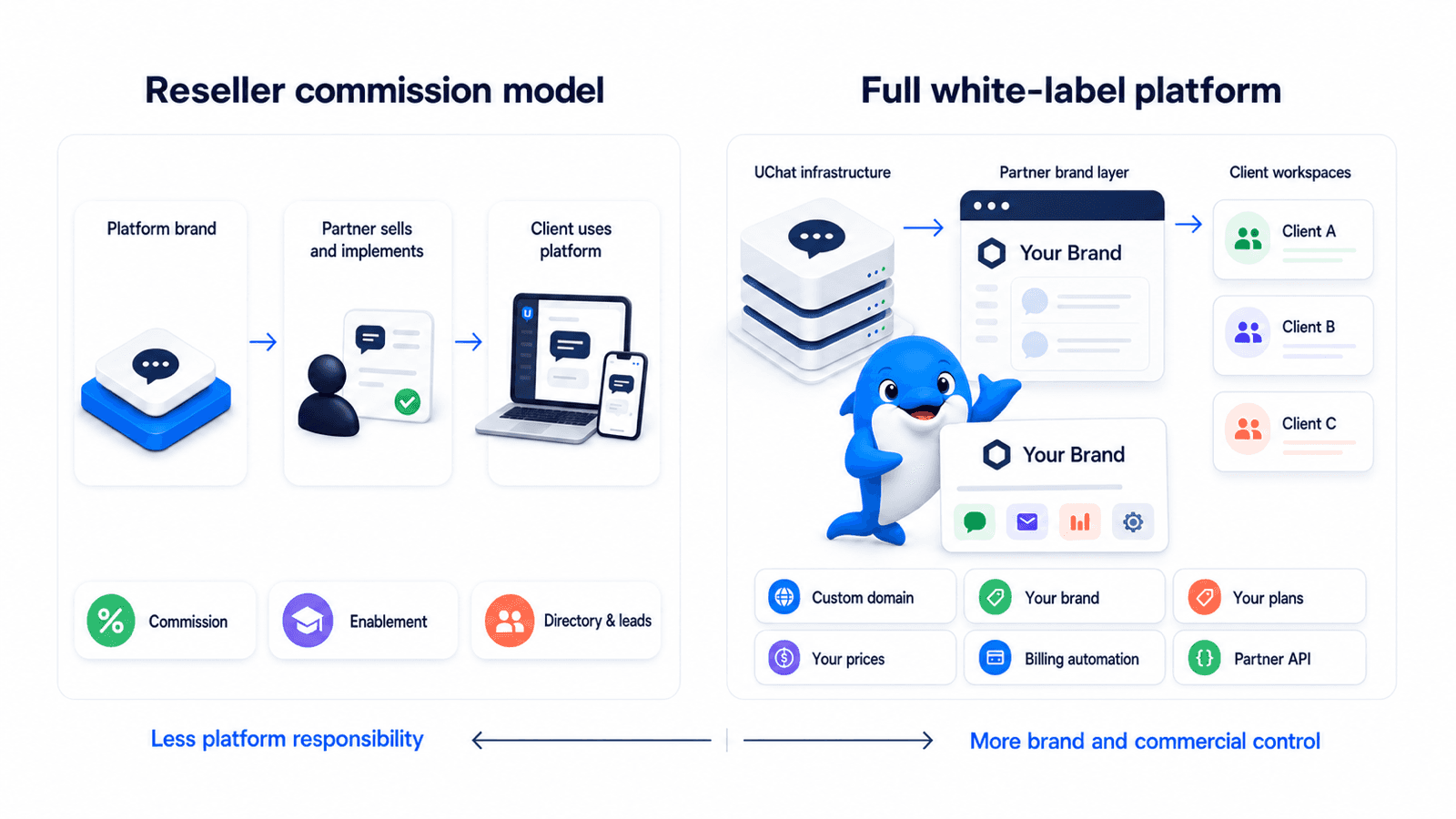
This is the clearest strategic difference, and the safest comparison is simply to follow what each public partner page promises.
Respond.io has a real Reseller Partner Program. Partners can promote and resell Respond.io, support implementation, own the customer relationship in many cases, receive enablement and partner-manager support, appear in a partner directory, receive selected leads, and earn advertised lifetime commissions of 15% to 40%.
That can be attractive to a consultant who wants to recommend a recognized platform and earn recurring commission without operating the entire software layer.
UChat Partner is designed for a different outcome: the agency can present the platform as its own.
custom domain, branding, login page, dashboard, colors, links, and knowledge resources;
client-facing plans and prices set by the partner;
partner-managed client workspaces and usage;
billing, onboarding, upgrade, downgrade, and cancellation automation;
Partner API access;
branded templates, Mini Apps, and marketplace options;
partner support and consultation.
Respond.io's public reseller model centers on commission and partner benefits. UChat's public Partner model centers on operating a client-facing platform with the partner's domain, brand, plans, prices, and automation.
Neither model is universally better. Commission-based resale has less platform responsibility. Full white label provides more control over brand, packaging, client pricing, and recurring services, but the partner also owns more onboarding, support, and delivery work.
When Respond.io May Be A Better Fit
Choose Respond.io first when your own mid-market B2C revenue team is the product's primary user and the central challenge is operational: consolidate customer conversations and calls, preserve CRM context, route work, manage lifecycle stages, and measure follow-up. Its WhatsApp BSP, coexistence, calling, AI Agent, onboarding, and security story makes it particularly relevant when WhatsApp-led conversation operations are already business-critical.
For agencies, its public reseller program is also a legitimate lower-responsibility path: sell and implement Respond.io, receive commission and enablement, and avoid operating a fully branded software platform.
When UChat Is The Better Fit
Choose UChat first when the conversation is only one part of the product you are building. You may need AI Agents connected to visual flow logic and AI Functions, several model providers, ecommerce actions, CRM boards, tickets, live handoff, external APIs, or reusable Mini Apps.
The case becomes clearest for an agency that wants its own domain, brand, client prices, plan packaging, workspaces, templates, billing automation, and Partner API. The strongest UChat argument is not one feature; it is the ability to turn channels, AI, flows, data, integrations, and human operations into a solution that can be reused and sold.
FAQ
Is UChat cheaper than Respond.io?
UChat has a lower published entry price: Business was listed at $15/month on 2026-08-01. Respond.io Starter was listed at $79/month, while Growth at $159/month was the first plan listing Workflows and AI Agents. However, Respond.io uses monthly active contacts and UChat uses bot-user, bot, and member limits, so compare your real operating scenario rather than only starting price.
Does Respond.io have AI Agents?
Yes. Respond.io AI Agents can qualify leads, route conversations, update fields and lifecycle stages, trigger Workflows, make HTTP requests, process several media formats, support voice calls, and hand conversations to people. It should not be described as a basic chatbot or reply assistant.
Does Respond.io support white label?
Respond.io's reviewed public reseller page describes commissions, enablement, directory benefits, lead flow, and reseller responsibilities. UChat's reviewed Partner page describes a custom domain, full branding, custom client pricing, client workspace management, and Partner API operations. Buyers who need negotiated Respond.io branding terms should confirm them directly with Respond.io.
Which platform is better for WhatsApp?
Respond.io has a strong WhatsApp-specific proposition as a BSP, including coexistence, calling, inbox operations, AI, broadcasts, lifecycle management, and reporting. UChat is compelling when WhatsApp needs to participate in a wider custom automation involving other channels, AI Functions, ecommerce, tickets, and agency delivery. Test the exact WhatsApp use case on both platforms.
Which platform is better for agencies?
Choose based on the agency model. Respond.io suits consultants who want enablement and recurring commission while reselling Respond.io. UChat Partner suits agencies that want clients to log into a platform carrying the agency's domain, brand, plans, prices, and support experience.
Can both platforms connect to external systems?
Yes. Respond.io offers native integrations, Developer API, HTTP requests, webhooks, Zapier, Make, n8n, and custom channels depending on plan. UChat supports native integrations, external requests, APIs, webhooks, AI Functions, MCP servers, and reusable Mini Apps.
CTA: Ready To Test UChat
The fastest way to decide is to build one real workflow, not another spreadsheet.
Start a 14-day UChat free trial with access to Pro features. No credit card is required.
Planning to deliver automation under your own brand? Book a UChat Partner demo and evaluate the white-label model with your actual client plans and support process.
For more comparisons, read UChat vs ManyChat, UChat vs Chatfuel, and UChat vs Landbot.
Sources And Review Date
Pricing and feature packaging were reviewed on 1 August 2026. Product details can change, so verify current limits before purchasing. Primary sources: UChat, UChat pricing, UChat Partner, Respond.io, Respond.io pricing, Respond.io AI Agents, Respond.io integrations, Respond.io WhatsApp Business API, and Respond.io Reseller Partner Program.
Quick Verdict
UChat and Respond.io now overlap in more places than a feature checklist suggests. Both bring AI, automation, messaging channels, team collaboration, integrations, and human handoff into one platform.
The practical difference is the business you are building around those conversations. Respond.io is a strong fit for a mid-market B2C team that wants to consolidate sales and support conversations around one operational inbox. UChat is the stronger fit when you want to compose more of the automation yourself, connect AI to visual flows and business actions, or deliver the platform to clients under your own brand.
Respond.io deserves serious consideration for structured, high-volume conversation operations, especially when WhatsApp, social messaging, calls, lifecycle reporting, and a unified team inbox sit at the center of the sales process.
UChat becomes more relevant when the same project also needs multiple AI providers, AI Functions, visual workflow logic, CRM and ticket boards, Mini Apps, broader solution packaging, or full-white-label agency delivery.
Table Of Contents
Scorecard
Recommendation By Use Case
Feature Comparison: Who Each Platform Is Built For
Omnichannel Inbox Or Omnichannel Automation
AI Agents And Workflow Depth
Human Handoff CRM And Reporting
Channels WhatsApp Web Chat And Voice
Integrations APIs And Extension Paths
Pricing And Scaling
Reseller Program Or Full White Label
When Respond.io May Be A Better Fit
When UChat Is The Better Fit
FAQ
CTA: Ready To Test UChat
Scorecard
If this describes your business | Better starting point | Why |
|---|---|---|
A mid-market B2C team managing a large volume of sales conversations | Respond.io | Its public positioning centers on revenue conversations, unified inbox operations, CRM context, lifecycle visibility, AI Agents, and calls. |
A team that wants AI Agents working alongside structured visual automation | Both | Respond.io combines AI Agents with Workflows; UChat combines AI Agents and AI Functions with its visual Flow Builder. The right choice depends on the actions and operating model you need. |
A business comparing WhatsApp, Instagram, Messenger, TikTok, web chat, email, SMS, and voice | Both | Both platforms now cover a broad channel set. Channel count alone should not decide this comparison. |
An agency referring or implementing a platform for clients | Respond.io or UChat | Respond.io has a commission-based reseller program; UChat has a full-white-label Partner platform. These are different agency models. |
An agency that wants its own domain, brand, client prices, workspaces, and billing automation | UChat | These are central parts of UChat Partner rather than an affiliate-style add-on. |
A smaller business that needs an affordable all-feature entry point | UChat | UChat Business is publicly listed at $15/month, while Respond.io Growth is the first listed plan with Workflows and AI Agents at $159/month for 1,000 monthly active contacts. The usage models are different, so total cost still depends on scale. |
Recommendation By Use Case
Imagine two Monday mornings.
In the first business, 30 sales and support agents open one workspace. They need every WhatsApp message, Instagram DM, call, assignment, lifecycle stage, and follow-up visible to managers. The platform is part of their internal revenue operation. That is the cleaner Respond.io starting point.
In the second business, an agency is preparing to launch the same appointment-booking solution for several clients. Each client needs its own workspace, brand, plan, limits, billing path, template, and support experience. That is the cleaner UChat Partner starting point.
Many buyers sit between these examples. The rest of the comparison explains which architecture gives them fewer compromises.
Feature Comparison: Who Each Platform Is Built For
Respond.io describes itself as a customer conversation management platform for mid-market B2C businesses. Its strongest story is not “build a chatbot.” It is “run revenue conversations without losing context.” Messages, calls, AI Agents, human agents, CRM data, lifecycle stages, routing, and reporting sit inside one operating layer.
That makes sense for businesses such as education providers, travel companies, automotive groups, healthcare services, retailers, and other teams where customers normally speak to someone before booking or buying.
UChat is positioned more broadly as a no-code AI Agent and automation platform. It supports visual automation for sales, support, engagement, ecommerce, lead qualification, appointments, and cross-channel customer journeys. It also keeps advanced paths available through JavaScript, external requests, AI Functions, APIs, webhooks, and Mini Apps.
That broader construction layer changes the buyer. UChat can serve the business running the automation, the consultant building it, or the agency turning the same platform into a branded client offer.
Omnichannel Inbox Or Omnichannel Automation
Both platforms bring conversations together, but they emphasize a different center of gravity.
Respond.io starts from the operational inbox. A lead can move from WhatsApp to Instagram, a call, or another channel while the team retains contact history and CRM context. AI Agents can qualify and route the lead, while managers see lifecycle stages, team activity, and revenue leaks.
UChat starts from the automation architecture. Its Flow Builder lets a team design messages, questions, conditions, actions, API requests, ticket triggers, AI tasks, and human handoff. Omni Channel lets one bot logic work across supported channels while individual channel restrictions still apply.
Neither approach is automatically better. The question is whether your main operational surface is the inbox or the workflow.
If managers mainly need visibility, assignment, routing, lifecycle control, and consistent follow-up across a busy sales team, Respond.io's inbox-centered model is attractive.
If builders need to control how data is captured, transformed, passed through flows, sent to external systems, and reused across client solutions, UChat's visual automation model deserves closer attention.
AI Agents And Workflow Depth
An AI Agent on Respond.io can do considerably more than answer FAQs. The public product page shows it reading text, images, documents, voice notes, and audio, then qualifying leads, recommending products, updating lifecycle data, triggering Workflows, making HTTP requests, blocking spam, or passing the conversation to a person. Voice calls and cross-channel context are part of the same story.
UChat approaches the problem through a builder's toolkit. Instructions and business knowledge can be paired with a choice of LLM providers, AI Functions, MCP and web-search tools, voice, and live chat handoff. Flow Builder then places those probabilistic decisions beside explicit conditions, actions, fields, tickets, and external requests.
The distinction is not “AI versus no AI.” It is how each team wants AI to participate in the system.
AI requirement | Respond.io approach | UChat approach |
|---|---|---|
Qualify, route, follow up, and update conversation lifecycle | Native AI Agents inside the conversation operation. | AI Agents and AI Functions can drive Flow Builder actions and data paths. |
Use multimedia and voice conversations | AI Agents process several media formats and support chat and voice calls. | AI Agents operate across messaging and voice channels, with provider and flow configuration. |
Keep critical paths deterministic | Workflows run alongside AI Agents. | Visual Flow Builder, Function Flow, conditions, actions, and AI Functions can be composed together. |
Select models and external tools | Respond.io says task-specialized models are orchestrated inside its AI system. | UChat publicly lists OpenAI, Claude, Gemini, xAI, DeepSeek, Coze, and other providers, plus MCP and AI Functions. |
Buyer takeaway: Choose based on the control surface you need, not on whether the homepage says “AI Agent.”
What A UChat Workflow Can Look Like
Consider an agency building an appointment-booking solution for a clinic.
An Instagram or Web Chat conversation enters the same reusable bot logic.
An AI Agent answers service questions and qualifies the enquiry.
An AI Function checks availability or calls the clinic's booking API.
Flow Builder stores the selected service, location, and preferred time in fields.
A confirmed booking triggers a WhatsApp reminder; an uncertain or sensitive enquiry transfers to a person with the collected context.
A ticket or CRM-board item records work that needs follow-up.
The agency packages the flow and integration for installation into another branded client workspace.
The value is not any one step. It is that AI, deterministic flow logic, channel delivery, human work, and reusable client packaging can sit in the same solution.
Human Handoff CRM And Reporting
Respond.io is particularly clear about the operating layer around a conversation. It combines team and custom inboxes, assignment, customer lifecycle management, contact and call activity, mobile access, advanced reports, broadcasts, and integrations. Its AI Agents are designed to hand sensitive or high-value conversations to people with context.
UChat also supports AI-to-human transfer, assignment, mobile app access, response-time analytics, CRM boards, and ticket boards. Teams can use boards for pipeline-style work and tickets for structured issue management while keeping a direct path back to the conversation.
This creates a useful split:
Respond.io is easier to understand as a customer conversation operating system. Its lifecycle and reporting language is closely tied to revenue-team management.
UChat is easier to extend into a custom process. The live conversation can connect to flow logic, fields, ecommerce, boards, tickets, external requests, and partner-built solutions.
For a mature contact operation, compare reporting definitions, assignment rules, user permissions, audit needs, and the exact CRM synchronization path in a live trial. Those details matter more than a checkmark beside “team inbox.”
Channels WhatsApp Web Chat And Voice
Both reviewed product pages describe genuine omnichannel platforms, so channel count is not a useful shortcut for this decision.
WhatsApp, Instagram, Facebook Messenger, TikTok, Viber, Telegram, LINE, email, web chat, voice calls, and SMS all appear in Respond.io's current public channel material. Custom channels can enter through API and webhook paths. On WhatsApp specifically, Respond.io presents itself as a Business Solution Provider and documents coexistence and calling.
UChat's public list also extends beyond 15 messaging and social surfaces: Web Chat, Messenger, WhatsApp, Instagram, Telegram, Viber, SMS, Voice, WeChat, LINE, Slack, VK, Intercom, JivoChat, and others. The more distinctive part is Omni Channel, which lets builders reuse bot logic while still respecting the rules of each destination.
The practical evaluation should cover:
The exact triggers and message types required on each channel.
How contacts and conversation history are matched across channels.
How channel-specific restrictions are represented in the automation.
Whether voice means WhatsApp calling, VoIP, a programmable voice bot, or all three.
How broadcasts, templates, comments, ads, handoff, and reporting behave for the target channel.
WhatsApp deserves its own proof-of-concept. Respond.io's BSP, coexistence, calling, inbox, lifecycle, and reporting path is a real strength. UChat's value is how WhatsApp can participate in a larger automation involving other channels, AI Functions, ecommerce, tickets, and partner-delivered solutions.
Integrations APIs And Extension Paths
Respond.io already has a credible extension surface. Its current integration directory includes HubSpot, Salesforce, Google Sheets, Cal.com, Zapier, Make, n8n, ecommerce systems, email providers, webhooks, and custom channels. Developer API begins on Growth; Advanced adds HTTP requests, incoming and outgoing webhooks, and custom channels.
The UChat route is less about a fixed connector catalogue and more about how a builder packages the work. Shopify, HubSpot, Zapier, MCP servers, Stripe, Calendly, Google Sheets, JavaScript, external requests, APIs, and webhooks can feed a flow; Mini Apps turn a repeatable integration into something that can be installed again instead of rebuilt for every customer.
For a technical buyer, the useful comparison is concrete:
Can the platform call the required endpoint and map the response?
Can an external system start or continue the automation?
Can the integration be packaged and installed repeatedly?
Can the same integration be deployed across client workspaces?
Which plan or add-on unlocks HTTP requests, webhooks, API capacity, or custom channels?
Respond.io has a credible integration and developer surface. UChat's strongest argument is not that Respond.io lacks APIs; it is that UChat combines those extension paths with a builder and partner distribution model designed for repeatable client solutions.
Pricing And Scaling
The pricing models are different enough that the cheapest headline price can mislead.
Respond.io prices by plan, users, and monthly active contacts. At the 1,000-contact level on monthly billing, its public pricing listed the following on 2026-08-01:
Respond.io plan | Monthly price | Included users | Important boundary |
|---|---|---|---|
Starter | $79 | 5 | Inbox collaboration, mobile app, AI Prompt/Assist, and basic reports. |
Growth | $159 | 10 | Adds broadcasts, Workflows, AI Agents, advanced reports, Zapier/Make, and Developer API. |
Advanced | $279 | 10 | Adds multiple workspaces, HTTP requests, webhooks, SSO, and custom channels. |
Enterprise | Custom | Unlimited | Adds more workspaces and higher API limits. |
UChat's public pricing listed Free at $0, Business at $15/month, and Partner at $199/month on 2026-08-01. Business includes one bot, 1,000 bot users, five members, unlimited automations, unlimited conversations, and Pro features. Partner adds full white label and uses separate client-license costs and add-ons.
Respond.io counts the contacts a team actively talks to in a month. UChat counts bot users stored across bots and applies bot, member, and bot-user limits. A team should model its own data rather than converting one metric directly into the other.
Before deciding, calculate:
monthly active contacts versus total bot users;
number of human agents and workspaces;
required AI, workflow, API, webhook, reporting, and security tier;
channel-provider fees for WhatsApp, SMS, voice, and AI models;
agency license, support, implementation, and payment costs where relevant.
Reseller Program Or Full White Label
This is the clearest strategic difference, and the safest comparison is simply to follow what each public partner page promises.
Respond.io has a real Reseller Partner Program. Partners can promote and resell Respond.io, support implementation, own the customer relationship in many cases, receive enablement and partner-manager support, appear in a partner directory, receive selected leads, and earn advertised lifetime commissions of 15% to 40%.
That can be attractive to a consultant who wants to recommend a recognized platform and earn recurring commission without operating the entire software layer.
UChat Partner is designed for a different outcome: the agency can present the platform as its own.
custom domain, branding, login page, dashboard, colors, links, and knowledge resources;
client-facing plans and prices set by the partner;
partner-managed client workspaces and usage;
billing, onboarding, upgrade, downgrade, and cancellation automation;
Partner API access;
branded templates, Mini Apps, and marketplace options;
partner support and consultation.
Respond.io's public reseller model centers on commission and partner benefits. UChat's public Partner model centers on operating a client-facing platform with the partner's domain, brand, plans, prices, and automation.
Neither model is universally better. Commission-based resale has less platform responsibility. Full white label provides more control over brand, packaging, client pricing, and recurring services, but the partner also owns more onboarding, support, and delivery work.
When Respond.io May Be A Better Fit
Choose Respond.io first when your own mid-market B2C revenue team is the product's primary user and the central challenge is operational: consolidate customer conversations and calls, preserve CRM context, route work, manage lifecycle stages, and measure follow-up. Its WhatsApp BSP, coexistence, calling, AI Agent, onboarding, and security story makes it particularly relevant when WhatsApp-led conversation operations are already business-critical.
For agencies, its public reseller program is also a legitimate lower-responsibility path: sell and implement Respond.io, receive commission and enablement, and avoid operating a fully branded software platform.
When UChat Is The Better Fit
Choose UChat first when the conversation is only one part of the product you are building. You may need AI Agents connected to visual flow logic and AI Functions, several model providers, ecommerce actions, CRM boards, tickets, live handoff, external APIs, or reusable Mini Apps.
The case becomes clearest for an agency that wants its own domain, brand, client prices, plan packaging, workspaces, templates, billing automation, and Partner API. The strongest UChat argument is not one feature; it is the ability to turn channels, AI, flows, data, integrations, and human operations into a solution that can be reused and sold.
FAQ
Is UChat cheaper than Respond.io?
UChat has a lower published entry price: Business was listed at $15/month on 2026-08-01. Respond.io Starter was listed at $79/month, while Growth at $159/month was the first plan listing Workflows and AI Agents. However, Respond.io uses monthly active contacts and UChat uses bot-user, bot, and member limits, so compare your real operating scenario rather than only starting price.
Does Respond.io have AI Agents?
Yes. Respond.io AI Agents can qualify leads, route conversations, update fields and lifecycle stages, trigger Workflows, make HTTP requests, process several media formats, support voice calls, and hand conversations to people. It should not be described as a basic chatbot or reply assistant.
Does Respond.io support white label?
Respond.io's reviewed public reseller page describes commissions, enablement, directory benefits, lead flow, and reseller responsibilities. UChat's reviewed Partner page describes a custom domain, full branding, custom client pricing, client workspace management, and Partner API operations. Buyers who need negotiated Respond.io branding terms should confirm them directly with Respond.io.
Which platform is better for WhatsApp?
Respond.io has a strong WhatsApp-specific proposition as a BSP, including coexistence, calling, inbox operations, AI, broadcasts, lifecycle management, and reporting. UChat is compelling when WhatsApp needs to participate in a wider custom automation involving other channels, AI Functions, ecommerce, tickets, and agency delivery. Test the exact WhatsApp use case on both platforms.
Which platform is better for agencies?
Choose based on the agency model. Respond.io suits consultants who want enablement and recurring commission while reselling Respond.io. UChat Partner suits agencies that want clients to log into a platform carrying the agency's domain, brand, plans, prices, and support experience.
Can both platforms connect to external systems?
Yes. Respond.io offers native integrations, Developer API, HTTP requests, webhooks, Zapier, Make, n8n, and custom channels depending on plan. UChat supports native integrations, external requests, APIs, webhooks, AI Functions, MCP servers, and reusable Mini Apps.
CTA: Ready To Test UChat
The fastest way to decide is to build one real workflow, not another spreadsheet.
Start a 14-day UChat free trial with access to Pro features. No credit card is required.
Planning to deliver automation under your own brand? Book a UChat Partner demo and evaluate the white-label model with your actual client plans and support process.
For more comparisons, read UChat vs ManyChat, UChat vs Chatfuel, and UChat vs Landbot.
Sources And Review Date
Pricing and feature packaging were reviewed on 1 August 2026. Product details can change, so verify current limits before purchasing. Primary sources: UChat, UChat pricing, UChat Partner, Respond.io, Respond.io pricing, Respond.io AI Agents, Respond.io integrations, Respond.io WhatsApp Business API, and Respond.io Reseller Partner Program.