10 minutes
UChat
Posted by
UChat vs SendPulse: Which Automation Platform Fits?
10 minutes
Posted by
UChat

Quick verdict: Choose SendPulse when email, SMS, web push, landing pages and CRM form the center of the marketing stack and chatbots extend those campaigns. Choose UChat when the primary product is a deeper conversational journey across more channel types, AI functions, visible automation, human operations and white-label client delivery.
Table Of Contents
Quick Verdict And Scorecard
Recommendation By Use Case
Feature Comparison
Two Different Operating Centers
AI Agents And Flow Logic
Channels, Campaigns And Human Work
CRM, Integrations And Business Actions
Pricing And Total Operating Cost
Agency And White-Label Delivery
When SendPulse May Be A Better Fit
Run One Cross-Channel Revenue Test
Decision Checklist
FAQ
Final Verdict And CTA
Quick Verdict And Scorecard
Dimension | SendPulse | UChat | Starting edge |
|---|---|---|---|
Product center | Marketing suite with chatbot, CRM, email, SMS and web push | Conversational automation and customer-journey platform | Depends on the system of work |
Visual automation | Messenger-specific flows plus Automation 360 | Channel flows, workflows, function flows and AI functions | UChat for conversation depth; SendPulse for suite journeys |
AI | AI Agent element inside flows | Agent roles, knowledge, functions and team handoff | Test goal completion and tools |
Public channels | Facebook, Instagram, WhatsApp, TikTok, Telegram, Viber and live chat | Broader social, messaging, web, voice and SMS families | UChat for channel breadth |
CRM and marketing | Built-in CRM connected to email and campaign products | CRM Boards, Tickets and conversational lifecycle | Different operating centers |
Agency model | Agency and expert partner routes | Full white-label Partner platform and client billing | UChat for platform resale |
Entry price | Free Basic; Pro scales from $12 monthly at 500 subscribers | Free; Pro $15 monthly; Partner $199 monthly | SendPulse for inexpensive suite entry |
How We Compared
We reviewed SendPulse's current chatbot product page, messenger pricing and help documentation for AI Agent, flow building and API requests. We compared them with UChat's current pricing and product pages. Prices and packaging were captured on 22 August 2026.
The products overlap more than a superficial review suggests. SendPulse has visual flows, AI, CRM, social-channel automation, API requests, commerce and live chat. UChat also has CRM and broadcasts. The useful distinction is which operating center should own the customer journey.
Recommendation By Use Case
Team wanting one vendor for email campaigns, SMS, web push, landing pages, CRM and chatbots: Start with SendPulse.
Small business needing a free social chatbot with modest subscriber and message volume: Evaluate SendPulse Basic.
Business building complex conversational qualification, API actions, structured handoff and ticket closure: Start with UChat.
Team serving WeChat, LINE, voice or a wider set of messaging environments: Start with UChat's documented channel architecture.
Agency selling branded automation workspaces and controlling client plans, billing and domains: Start with UChat Partner.
Marketing team whose success metric is coordinated outbound nurture across email and mobile channels: Put SendPulse first.
Feature Comparison
Capability | SendPulse | UChat |
|---|---|---|
Flow builder | Visual chatbot flows with triggers, filters, actions, API requests and reusable scenarios | Visual messages, conditions, actions, APIs, workflows and function flows |
AI behavior | AI Agent element can respond, wait for goals, branch and pass data | Agents use knowledge, constraints, multiple LLMs, functions and handoff roles |
Social acquisition | Comment, story, ad and campaign routes across supported social channels | Channel-specific triggers integrated into wider automation |
Outbound marketing | Email, SMS, web push and Automation 360 are native suite products | Broadcasts and channel messaging; external marketing tools through integrations |
Human operation | Omnichannel inbox and manual conversation management | Live Chat routing, mobile operation, CRM Boards and Tickets |
Business data | Built-in CRM, subscriber variables, tags and deal actions | Custom fields, CRM Boards, Tickets, AI Functions and integrations |
Agency delivery | Partner catalog and expert ecosystem | Branded domain, UI, client plans, billing, workspace controls and Partner API |
Two Different Operating Centers
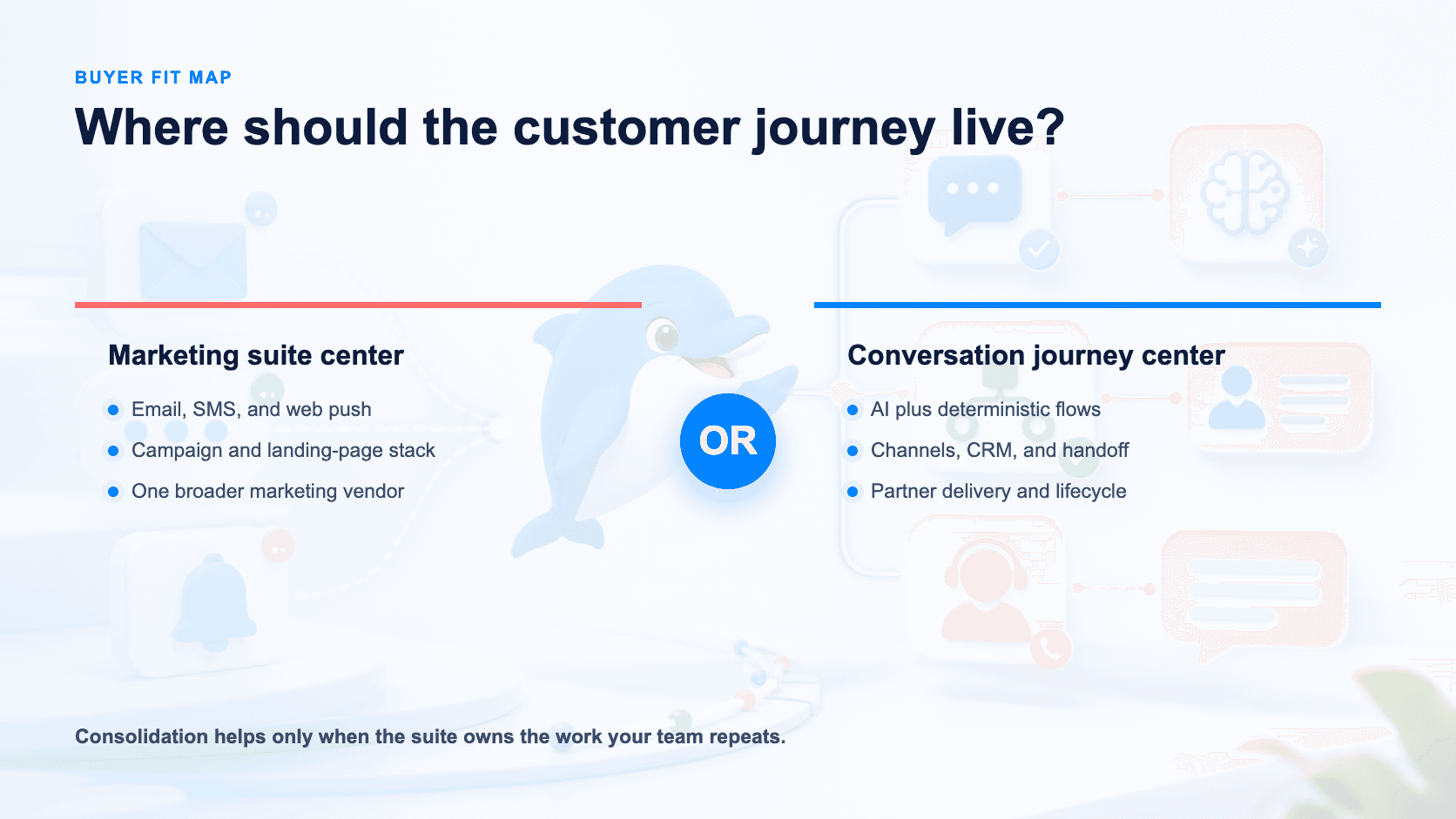
SendPulse is designed as a broad marketing stack. The navigation itself places chatbots beside email marketing, Automation 360, transactional email, SMS, web push, landing pages, pop-ups, CRM and course products. That matters when a lifecycle marketer wants one subscriber record to move across several outbound programs.
UChat is centered on conversations and the work that happens inside or immediately after them. A user can enter from a channel, interact with deterministic flows and AI Agents, call business systems, transfer to Live Chat, move through a CRM Board or open a Ticket. External email or campaign platforms can be connected when needed.
Neither center is inherently better. If the team's daily work begins in email segmentation and campaign orchestration, SendPulse reduces tool boundaries. If it begins in a customer conversation that must branch, act, escalate and close, UChat keeps more of that operating context together.
Bottom line: Choose the platform that owns the next three steps after the customer replies, not the one with the longer feature menu.
AI Agents And Flow Logic
SendPulse's AI Agent element can generate an immediate response or hold a conversation until a goal is achieved. Green and red exits route the next step based on success or timeout, and variables can carry AI output into later flow elements. This is a thoughtful bridge between probabilistic conversation and deterministic marketing logic.
UChat lets builders define role-specific Agents with knowledge, constraints, model choice and AI Functions. Primary, secondary and handoff Agents can cooperate, while normal flows keep exact conditions, actions and recovery visible.
The important similarity is that both combine AI with flows. Do not decide from an “AI versus rules” framing. Instead test how each platform handles memory, structured extraction, tool errors, model cost, timeout, auditability and a human takeover after the AI has partially completed a task.
A good proof requires failure. Remove a required CRM field, return a 500 response from an API and change an offer halfway through the test. Measure how quickly another operator can identify the failing layer.
Channels, Campaigns And Human Work
SendPulse publicly supports chatbot creation for Facebook, Instagram, WhatsApp, TikTok, Telegram, Viber and live chat. Its suite can coordinate those interactions with email, SMS and web push. Flow copying across messaging platforms can reduce repetitive setup.
UChat publishes a wider set of channel families, including major social and messaging channels, web chat, SMS, voice and region-specific environments. One platform architecture connects those conversations to Live Chat, CRM and Ticket operations.
Channel count alone is a weak decision tool. Create a row for each required entry trigger, reply window, content format, broadcast behavior, handoff, identity model and usage fee. The channel must support the business action, not merely appear on a product page.
CRM, Integrations And Business Actions
SendPulse chatbots can save subscriber variables and tags, create or edit CRM deals, call APIs, use Google Sheets and continue into other SendPulse automations. That makes it credible for lead capture and nurture without a separate CRM on day one.
UChat's AI Functions and Flow Builder actions can read or write external systems, while native CRM Boards and Tickets preserve visible ownership inside UChat. Mini Apps, APIs, webhooks, Zapier and Make extend the action layer.
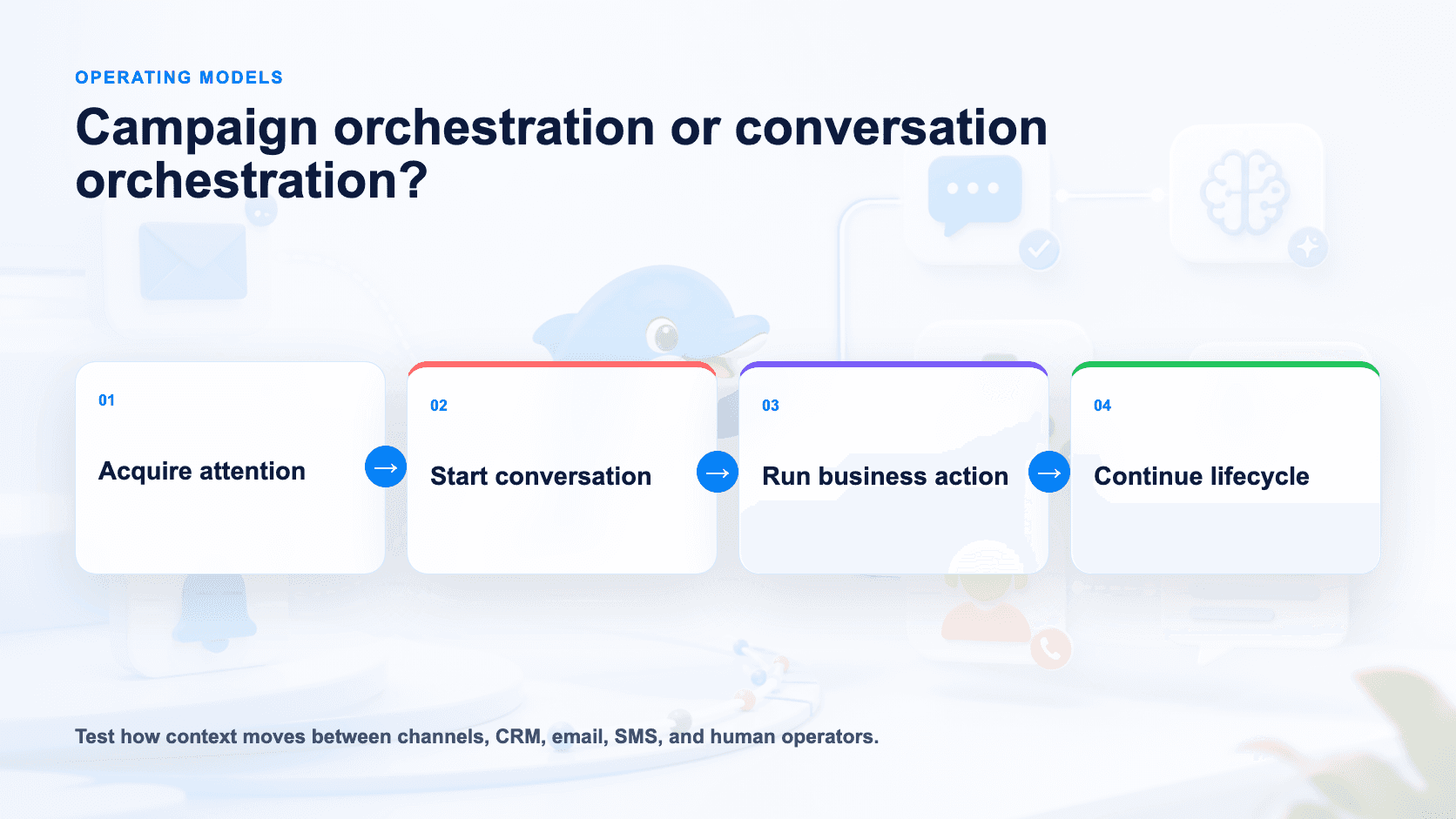
For the buying test, define one atomic outcome: “A qualified Instagram lead books a consultation, enters the CRM with source and budget, receives a reminder and has a named human owner.” Count setup surfaces, data copies, retry behavior and manual cleanup in both products.
Pricing And Total Operating Cost
SendPulse Basic is publicly free with three chatbots, 500 subscribers and up to 10,000 monthly messages across bots. At 500 subscribers, Pro lists $12 monthly or $9.60 per month when billed yearly, then scales with subscriber volume. Other SendPulse products may have separate pricing, so a complete suite quote must include every module used.
UChat lists a free plan with 200 bot users and a 14-day Pro trial. Pro is $15 monthly with one bot, 1,000 bot users and five members; usage can auto-scale. Partner is $199 monthly before relevant client workspace and usage costs.
Do not compare a SendPulse chatbot subscription with a UChat Partner license. Build two scenarios:
One business operating its own marketing and conversations.
One agency operating ten branded client solutions.
For each, include subscribers or bot users, messages, AI usage, WhatsApp fees, SMS, email volume, seats, client workspaces, integration tools and maintenance hours. Suite consolidation can favor SendPulse; conversation and client-delivery consolidation can favor UChat.
Agency And White-Label Delivery
SendPulse has agency, affiliate, expert and partner-catalog programs. Those routes can support consultants delivering SendPulse services, but they are not the same commercial product as running a fully branded client platform.
UChat Partner explicitly covers custom domain, login and dashboard, client workspaces, plans and pricing, billing automation, templates, Mini Apps and Partner API lifecycle control. This is designed for an agency selling the software layer under its own brand.
Distinguish referral economics from platform resale. Ask whether the client logs into the vendor's brand or yours, who invoices the client, whether you control plan limits, and whether onboarding and cancellation can be automated.
When SendPulse May Be A Better Fit
SendPulse may be better when a small team wants a low-cost entry into social chatbots and expects the free limits to cover early volume. It also has a clearer fit when email, SMS, web push and landing-page campaigns are as important as the chatbot itself.
It may reduce operational complexity for a marketing department already using SendPulse CRM and Automation 360. Moving a subscriber through native campaign products can be simpler than connecting several specialist tools.
Finally, a company that does not need a branded client platform should not pay for partner infrastructure merely because it sounds more capable. Start from the workflow, not the largest plan.
Run One Cross-Channel Revenue Test
Build one journey in both products:
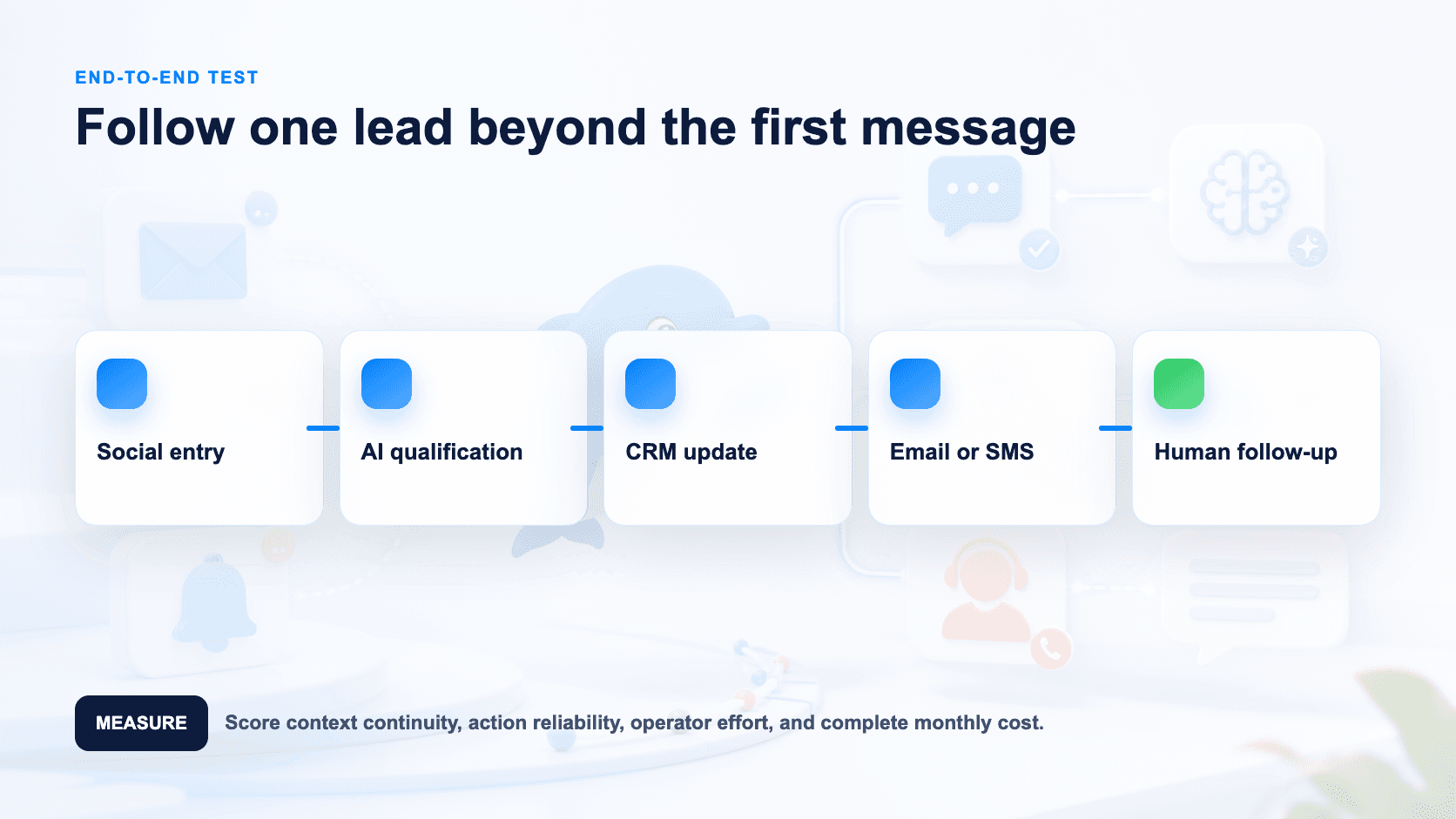
A prospect comments on a social post.
The bot begins a compliant private conversation.
AI answers one open-ended question.
A flow captures structured qualification fields.
The record enters CRM with source attribution.
Email or SMS sends a follow-up.
A human receives context and closes the outcome.
Replay it with an API failure, duplicate lead and returning customer. Measure completion, manual touches, data quality, debugging time, channel cost and maintenance after a policy change. One full journey reveals more than seven isolated feature demos.
Decision Checklist
Is the operating center a marketing suite or a conversation journey?
Which outbound products must be native?
Which channels and triggers are truly required?
How should AI success and timeout route the flow?
Where must CRM ownership and Ticket closure live?
How many separate subscriptions does each design replace?
Does the agency need a branded client platform?
Can a second operator diagnose a failed action?
What is annual cost at expected subscriber and message volume?
Which architecture remains easier to change?
FAQ
Does SendPulse have AI agents?
Yes. Its AI Agent element can respond, wait for a goal, branch on success or timeout and pass data into later flow steps.
Does SendPulse support Instagram and WhatsApp automation?
Yes. SendPulse publicly supports Instagram, WhatsApp, Facebook, TikTok, Telegram, Viber and live chat bots.
Which is better for email marketing?
SendPulse is the clearer choice when native email marketing and Automation 360 are central. UChat can connect email services, but its product center is conversational automation.
Which is better for a white-label agency?
UChat has the more explicit full-white-label platform model with domain, UI, client plans, billing and Partner API controls. SendPulse has partner and expert routes, which serve a different commercial model.
Which platform is cheaper?
SendPulse has a strong free entry and low initial Pro price, while UChat's Pro and Partner plans reflect different operating scopes. Compare the complete tool stack and expected volume.
Final Verdict And CTA
Choose SendPulse when chatbots should sit inside one integrated outbound marketing suite. Choose UChat when conversation depth, broader channels, AI Functions, human lifecycle tools and white-label client operations are the priority.
Test the conversation architecture in a 14-day UChat trial with full Pro access and no credit card. Agencies can book a Partner Plan demo to inspect branding, client plans and billing automation.
Related comparisons: UChat vs ManyChat · UChat vs HighLevel · UChat vs Flow XO
Explore UChat's official pages for pricing, AI Agents, channels, Flow Builder, CRM, integrations and the Partner program.
Sources reviewed 22 August 2026.
Quick verdict: Choose SendPulse when email, SMS, web push, landing pages and CRM form the center of the marketing stack and chatbots extend those campaigns. Choose UChat when the primary product is a deeper conversational journey across more channel types, AI functions, visible automation, human operations and white-label client delivery.
Table Of Contents
Quick Verdict And Scorecard
Recommendation By Use Case
Feature Comparison
Two Different Operating Centers
AI Agents And Flow Logic
Channels, Campaigns And Human Work
CRM, Integrations And Business Actions
Pricing And Total Operating Cost
Agency And White-Label Delivery
When SendPulse May Be A Better Fit
Run One Cross-Channel Revenue Test
Decision Checklist
FAQ
Final Verdict And CTA
Quick Verdict And Scorecard
Dimension | SendPulse | UChat | Starting edge |
|---|---|---|---|
Product center | Marketing suite with chatbot, CRM, email, SMS and web push | Conversational automation and customer-journey platform | Depends on the system of work |
Visual automation | Messenger-specific flows plus Automation 360 | Channel flows, workflows, function flows and AI functions | UChat for conversation depth; SendPulse for suite journeys |
AI | AI Agent element inside flows | Agent roles, knowledge, functions and team handoff | Test goal completion and tools |
Public channels | Facebook, Instagram, WhatsApp, TikTok, Telegram, Viber and live chat | Broader social, messaging, web, voice and SMS families | UChat for channel breadth |
CRM and marketing | Built-in CRM connected to email and campaign products | CRM Boards, Tickets and conversational lifecycle | Different operating centers |
Agency model | Agency and expert partner routes | Full white-label Partner platform and client billing | UChat for platform resale |
Entry price | Free Basic; Pro scales from $12 monthly at 500 subscribers | Free; Pro $15 monthly; Partner $199 monthly | SendPulse for inexpensive suite entry |
How We Compared
We reviewed SendPulse's current chatbot product page, messenger pricing and help documentation for AI Agent, flow building and API requests. We compared them with UChat's current pricing and product pages. Prices and packaging were captured on 22 August 2026.
The products overlap more than a superficial review suggests. SendPulse has visual flows, AI, CRM, social-channel automation, API requests, commerce and live chat. UChat also has CRM and broadcasts. The useful distinction is which operating center should own the customer journey.
Recommendation By Use Case
Team wanting one vendor for email campaigns, SMS, web push, landing pages, CRM and chatbots: Start with SendPulse.
Small business needing a free social chatbot with modest subscriber and message volume: Evaluate SendPulse Basic.
Business building complex conversational qualification, API actions, structured handoff and ticket closure: Start with UChat.
Team serving WeChat, LINE, voice or a wider set of messaging environments: Start with UChat's documented channel architecture.
Agency selling branded automation workspaces and controlling client plans, billing and domains: Start with UChat Partner.
Marketing team whose success metric is coordinated outbound nurture across email and mobile channels: Put SendPulse first.
Feature Comparison
Capability | SendPulse | UChat |
|---|---|---|
Flow builder | Visual chatbot flows with triggers, filters, actions, API requests and reusable scenarios | Visual messages, conditions, actions, APIs, workflows and function flows |
AI behavior | AI Agent element can respond, wait for goals, branch and pass data | Agents use knowledge, constraints, multiple LLMs, functions and handoff roles |
Social acquisition | Comment, story, ad and campaign routes across supported social channels | Channel-specific triggers integrated into wider automation |
Outbound marketing | Email, SMS, web push and Automation 360 are native suite products | Broadcasts and channel messaging; external marketing tools through integrations |
Human operation | Omnichannel inbox and manual conversation management | Live Chat routing, mobile operation, CRM Boards and Tickets |
Business data | Built-in CRM, subscriber variables, tags and deal actions | Custom fields, CRM Boards, Tickets, AI Functions and integrations |
Agency delivery | Partner catalog and expert ecosystem | Branded domain, UI, client plans, billing, workspace controls and Partner API |
Two Different Operating Centers
SendPulse is designed as a broad marketing stack. The navigation itself places chatbots beside email marketing, Automation 360, transactional email, SMS, web push, landing pages, pop-ups, CRM and course products. That matters when a lifecycle marketer wants one subscriber record to move across several outbound programs.
UChat is centered on conversations and the work that happens inside or immediately after them. A user can enter from a channel, interact with deterministic flows and AI Agents, call business systems, transfer to Live Chat, move through a CRM Board or open a Ticket. External email or campaign platforms can be connected when needed.
Neither center is inherently better. If the team's daily work begins in email segmentation and campaign orchestration, SendPulse reduces tool boundaries. If it begins in a customer conversation that must branch, act, escalate and close, UChat keeps more of that operating context together.
Bottom line: Choose the platform that owns the next three steps after the customer replies, not the one with the longer feature menu.
AI Agents And Flow Logic
SendPulse's AI Agent element can generate an immediate response or hold a conversation until a goal is achieved. Green and red exits route the next step based on success or timeout, and variables can carry AI output into later flow elements. This is a thoughtful bridge between probabilistic conversation and deterministic marketing logic.
UChat lets builders define role-specific Agents with knowledge, constraints, model choice and AI Functions. Primary, secondary and handoff Agents can cooperate, while normal flows keep exact conditions, actions and recovery visible.
The important similarity is that both combine AI with flows. Do not decide from an “AI versus rules” framing. Instead test how each platform handles memory, structured extraction, tool errors, model cost, timeout, auditability and a human takeover after the AI has partially completed a task.
A good proof requires failure. Remove a required CRM field, return a 500 response from an API and change an offer halfway through the test. Measure how quickly another operator can identify the failing layer.
Channels, Campaigns And Human Work
SendPulse publicly supports chatbot creation for Facebook, Instagram, WhatsApp, TikTok, Telegram, Viber and live chat. Its suite can coordinate those interactions with email, SMS and web push. Flow copying across messaging platforms can reduce repetitive setup.
UChat publishes a wider set of channel families, including major social and messaging channels, web chat, SMS, voice and region-specific environments. One platform architecture connects those conversations to Live Chat, CRM and Ticket operations.
Channel count alone is a weak decision tool. Create a row for each required entry trigger, reply window, content format, broadcast behavior, handoff, identity model and usage fee. The channel must support the business action, not merely appear on a product page.
CRM, Integrations And Business Actions
SendPulse chatbots can save subscriber variables and tags, create or edit CRM deals, call APIs, use Google Sheets and continue into other SendPulse automations. That makes it credible for lead capture and nurture without a separate CRM on day one.
UChat's AI Functions and Flow Builder actions can read or write external systems, while native CRM Boards and Tickets preserve visible ownership inside UChat. Mini Apps, APIs, webhooks, Zapier and Make extend the action layer.
For the buying test, define one atomic outcome: “A qualified Instagram lead books a consultation, enters the CRM with source and budget, receives a reminder and has a named human owner.” Count setup surfaces, data copies, retry behavior and manual cleanup in both products.
Pricing And Total Operating Cost
SendPulse Basic is publicly free with three chatbots, 500 subscribers and up to 10,000 monthly messages across bots. At 500 subscribers, Pro lists $12 monthly or $9.60 per month when billed yearly, then scales with subscriber volume. Other SendPulse products may have separate pricing, so a complete suite quote must include every module used.
UChat lists a free plan with 200 bot users and a 14-day Pro trial. Pro is $15 monthly with one bot, 1,000 bot users and five members; usage can auto-scale. Partner is $199 monthly before relevant client workspace and usage costs.
Do not compare a SendPulse chatbot subscription with a UChat Partner license. Build two scenarios:
One business operating its own marketing and conversations.
One agency operating ten branded client solutions.
For each, include subscribers or bot users, messages, AI usage, WhatsApp fees, SMS, email volume, seats, client workspaces, integration tools and maintenance hours. Suite consolidation can favor SendPulse; conversation and client-delivery consolidation can favor UChat.
Agency And White-Label Delivery
SendPulse has agency, affiliate, expert and partner-catalog programs. Those routes can support consultants delivering SendPulse services, but they are not the same commercial product as running a fully branded client platform.
UChat Partner explicitly covers custom domain, login and dashboard, client workspaces, plans and pricing, billing automation, templates, Mini Apps and Partner API lifecycle control. This is designed for an agency selling the software layer under its own brand.
Distinguish referral economics from platform resale. Ask whether the client logs into the vendor's brand or yours, who invoices the client, whether you control plan limits, and whether onboarding and cancellation can be automated.
When SendPulse May Be A Better Fit
SendPulse may be better when a small team wants a low-cost entry into social chatbots and expects the free limits to cover early volume. It also has a clearer fit when email, SMS, web push and landing-page campaigns are as important as the chatbot itself.
It may reduce operational complexity for a marketing department already using SendPulse CRM and Automation 360. Moving a subscriber through native campaign products can be simpler than connecting several specialist tools.
Finally, a company that does not need a branded client platform should not pay for partner infrastructure merely because it sounds more capable. Start from the workflow, not the largest plan.
Run One Cross-Channel Revenue Test
Build one journey in both products:
A prospect comments on a social post.
The bot begins a compliant private conversation.
AI answers one open-ended question.
A flow captures structured qualification fields.
The record enters CRM with source attribution.
Email or SMS sends a follow-up.
A human receives context and closes the outcome.
Replay it with an API failure, duplicate lead and returning customer. Measure completion, manual touches, data quality, debugging time, channel cost and maintenance after a policy change. One full journey reveals more than seven isolated feature demos.
Decision Checklist
Is the operating center a marketing suite or a conversation journey?
Which outbound products must be native?
Which channels and triggers are truly required?
How should AI success and timeout route the flow?
Where must CRM ownership and Ticket closure live?
How many separate subscriptions does each design replace?
Does the agency need a branded client platform?
Can a second operator diagnose a failed action?
What is annual cost at expected subscriber and message volume?
Which architecture remains easier to change?
FAQ
Does SendPulse have AI agents?
Yes. Its AI Agent element can respond, wait for a goal, branch on success or timeout and pass data into later flow steps.
Does SendPulse support Instagram and WhatsApp automation?
Yes. SendPulse publicly supports Instagram, WhatsApp, Facebook, TikTok, Telegram, Viber and live chat bots.
Which is better for email marketing?
SendPulse is the clearer choice when native email marketing and Automation 360 are central. UChat can connect email services, but its product center is conversational automation.
Which is better for a white-label agency?
UChat has the more explicit full-white-label platform model with domain, UI, client plans, billing and Partner API controls. SendPulse has partner and expert routes, which serve a different commercial model.
Which platform is cheaper?
SendPulse has a strong free entry and low initial Pro price, while UChat's Pro and Partner plans reflect different operating scopes. Compare the complete tool stack and expected volume.
Final Verdict And CTA
Choose SendPulse when chatbots should sit inside one integrated outbound marketing suite. Choose UChat when conversation depth, broader channels, AI Functions, human lifecycle tools and white-label client operations are the priority.
Test the conversation architecture in a 14-day UChat trial with full Pro access and no credit card. Agencies can book a Partner Plan demo to inspect branding, client plans and billing automation.
Related comparisons: UChat vs ManyChat · UChat vs HighLevel · UChat vs Flow XO
Explore UChat's official pages for pricing, AI Agents, channels, Flow Builder, CRM, integrations and the Partner program.
Sources reviewed 22 August 2026.