11 minutes
UChat
Posted by
UChat vs Yellow.ai: Enterprise Agentic AI or Flexible Customer Automation?
11 minutes
Posted by
UChat

Quick Verdict
UChat and Yellow.ai both combine AI Agents, channels, knowledge, workflows and business-system actions. They are designed around different buying motions.
Choose Yellow.ai when the organization is building a governed enterprise Agentic AI program. Choose UChat when a team or agency needs accessible visual automation, channel-specific journeys, transparent entry pricing and a platform it can shape around its own delivery model.
Yellow.ai brings Agentic RAG, natural-language Agent building, automated testing, conversation traces, analytics, enterprise security and more than 150 integrations into one AI lifecycle. Its Enterprise plan covers 35+ channels across chat, voice, email and SMS.
UChat gives builders a visual operating surface where AI Agents work with deterministic nodes, reusable Function Flows, APIs, payments, CRM Boards, Tickets, human support and follow-up automation. UChat Partner extends that architecture into branded client workspaces and billing.
Table Of Contents
Scorecard
Recommendation By Use Case
Feature Comparison: AI Agent Architecture
Building Testing And Improving Agents
Omnichannel Voice Email And Human Work
Integrations Actions And Enterprise Systems
Security Governance And Operational Control
Pricing Resolutions And Platform Resources
Agency And White-Label Delivery
When Yellow.ai May Be A Better Fit
Decision Checklist
FAQ
Final Verdict And CTA
Scorecard
Decision area | Better starting fit | Why |
|---|---|---|
Enterprise Agentic AI lifecycle | Yellow.ai | Discovery, builder, RAG, testing, traces and analytics form one program. |
Enterprise integrations | Yellow.ai | The platform promotes 150+ integrations across CRM, ERP, helpdesk, payments and voice. |
Formal security and compliance | Yellow.ai | SOC 2, GDPR and ISO controls are explicitly packaged and documented. |
Enterprise multimodal orchestration | Yellow.ai | Enterprise lists 35+ channels across chat, voice, email and SMS. |
Direct visual journey control | UChat | AI, deterministic nodes, APIs, CRM and Function Flows are exposed in one builder. |
Channel-specific acquisition automation | UChat | Comments, ads, messages, forms and destination behavior can start journeys. |
Built-in customer lifecycle tools | UChat | Boards, Tickets, Live Chat and flows connect lead, sale, onboarding and support. |
Transparent SMB entry pricing | UChat | Business starts at $15 monthly with public resource limits. |
Full-white-label agency platform | UChat | Partner Plan includes client workspaces, branding, plans, billing and Partner API. |
Recommendation By Use Case
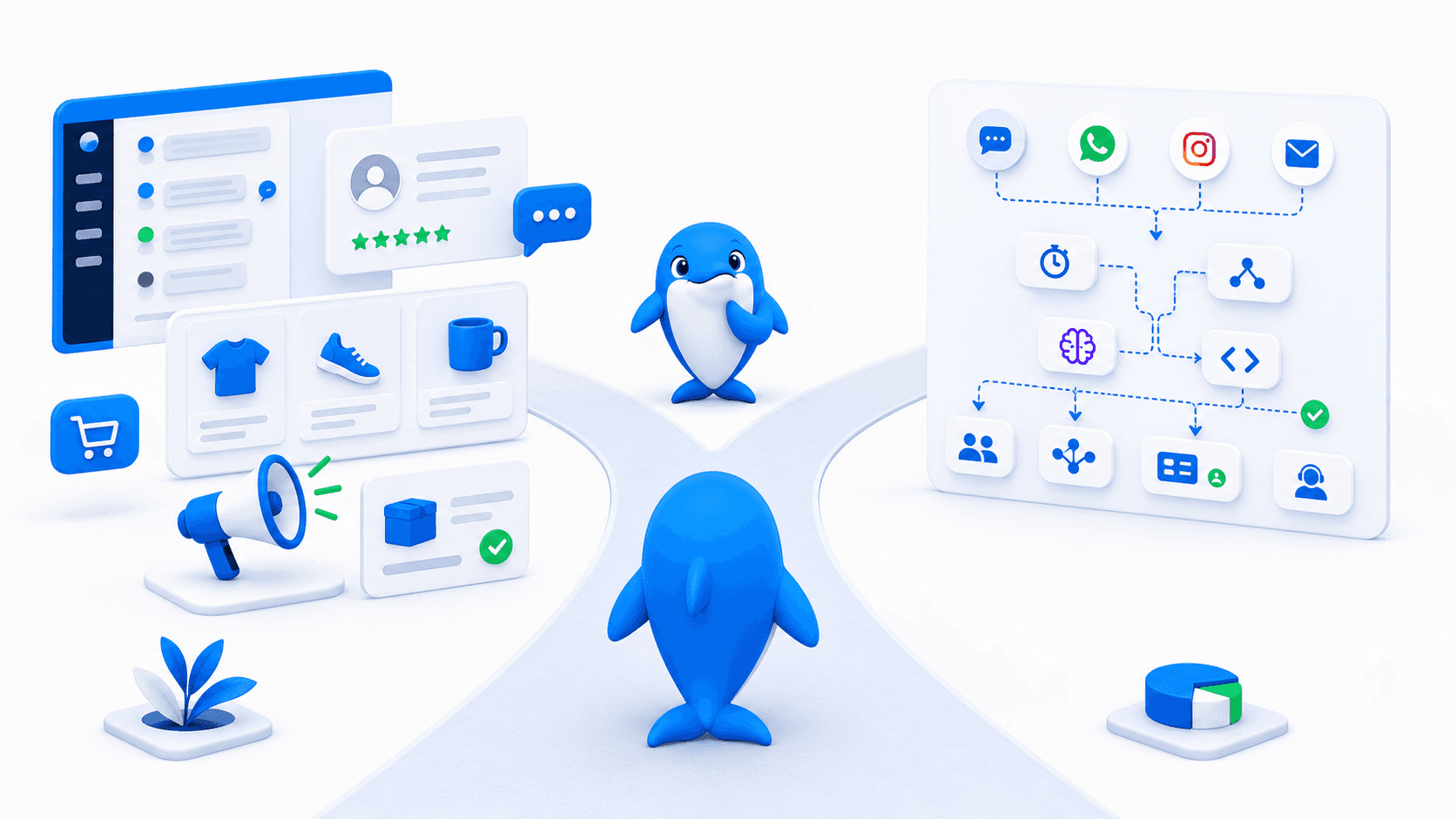
Yellow.ai fits an enterprise transformation program. A large organization can connect historical conversations and knowledge, create Agents for complex service goals, test behavior at scale, inspect traces, govern access and integrate with established CRM, ERP, ITSM and contact-center systems.
UChat fits solution building and repeatable delivery. A team can visually connect a social or messaging entry point to qualification, AI reasoning, an API action, payment, CRM stage, human handoff and follow-up without making an enterprise AI program the prerequisite.
The distinction is partly scale, but not only scale. Yellow.ai packages more governance and AI lifecycle infrastructure. UChat provides more direct access to the customer journey and a Partner model for agencies selling that journey under their own brand.
Feature Comparison: AI Agent Architecture
Yellow.ai describes an Agentic AI platform that can plan actions, select tools, retain context and execute multi-step work. Its builder uses natural-language instructions, while Agentic RAG connects reasoning and action to websites, APIs and third-party knowledge.
Official examples include order fulfilment, ticketing and approvals. Yellow.ai says its architecture can use more than 15 LLMs, allowing different models to be selected for different tasks rather than locking the program to one provider.
UChat AI Agents can use business knowledge, roles, instructions and callable functions. Model options include OpenAI, Claude, DeepSeek and xAI. The Flow Builder combines those Agents with messages, questions, conditions, actions, external requests and channel-specific nodes.
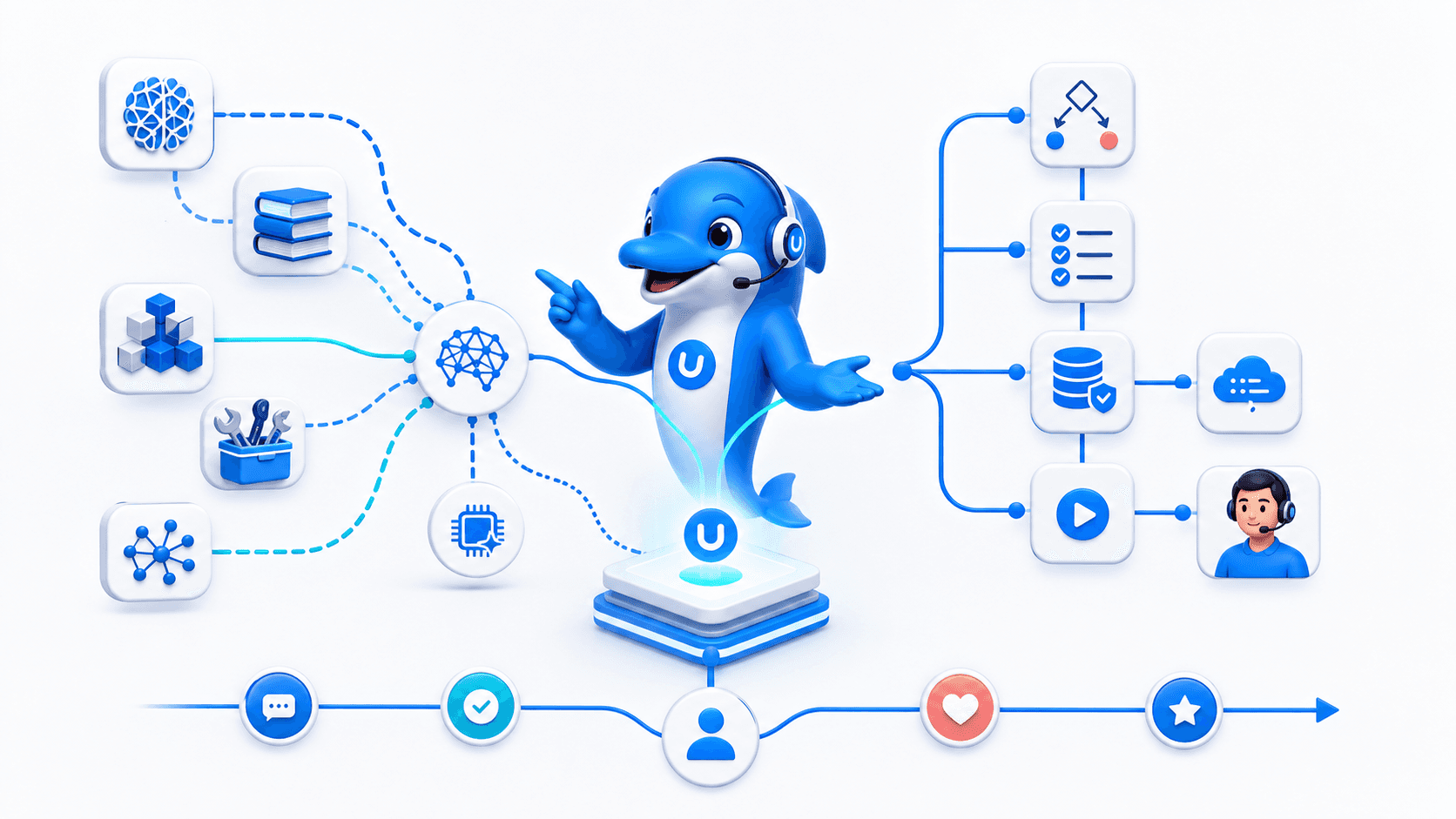
Function Flows isolate reusable operations. One can validate an identity, query an order system, apply deterministic policy and return either a verified outcome or an escalation reason. Web Chat, WhatsApp, Instagram and voice-related flows can reuse that operation while retaining their own interaction rules.
For an enterprise standardizing autonomous service Agents, Yellow.ai offers a more explicit Agentic architecture. UChat is easier to shape when AI is one component inside a visual customer-automation solution.
Evaluate controlled outcomes, not an “agentic” label. Test missing data, conflicting records, unavailable tools, approval thresholds, rollback, duplicate requests and the evidence left after an action.
Building Testing And Improving Agents
Yellow.ai's lifecycle is one of its clearest strengths. Agentic Discovery can analyze historical customer data, knowledge and procedures to identify issues and create starting Agents. The builder supports multi-step goals without requiring every path to be manually scripted.
An AI copilot exposes conversation traces so teams can inspect decisions and workflow calls. Automated testing is designed to cover dynamic conversations and edge cases across channels before release.
After deployment, Yellow.ai analytics track resolution, automation opportunities, sentiment and topics. The platform also describes knowledge-gap detection and generated knowledge improvements as part of a learning loop.
UChat testing is more builder-led. Teams can make critical conditions, functions, API calls, fallback branches and transfers visible in the flow, then test the actual journey in its workspace and target channels. This can be easier for solution teams that want to inspect business logic directly.
The trade-off is meaningful. Yellow.ai packages a more formal AI development and optimization lifecycle. UChat offers an understandable visual system for teams that prefer to own the orchestration without adopting a larger enterprise operating model.
Omnichannel Voice Email And Human Work
Yellow.ai Enterprise lists all 35+ supported channels across chat, voice, email and SMS. Its product story emphasizes carrying context across modalities, including images, documents and voice.
VoiceX and Intelligent Email Agents are part of the Enterprise capability set. The platform can integrate with contact-center systems and hand AI work into existing service operations.
UChat supports Web Chat, Messenger, Instagram, WhatsApp, Telegram, SMS, WeChat, LINE, Viber, TikTok, RCS and other channels. Voice automation can connect to phone and real-time AI calling, subject to provider and regional requirements.
UChat's Omni Channel approach shares core logic while preserving channel-specific triggers, templates, media, comments, ads and delivery rules. Live Chat, assignments, mobile handling and Tickets connect human work to the same customer record and lifecycle.
Yellow.ai has the stronger published enterprise omnichannel package. UChat deserves consideration when the differentiator is not simply channel coverage, but the ability to design destination-specific acquisition, transaction and follow-up behavior.
Integrations Actions And Enterprise Systems
Yellow.ai promotes more than 150 prebuilt enterprise integrations. Official examples span Salesforce, HubSpot, SAP, Oracle, Workday, BambooHR, ServiceNow, Jira, Zendesk, Freshdesk, Genesys and NICE.
Its integration catalog also covers payments, commerce, knowledge stores and voice systems. This breadth matters when procurement requires AI to fit an established enterprise architecture rather than replace it.
UChat connects AI providers, ecommerce, payments, calendars, storage, email and custom systems through native integrations, Zapier, Make, external requests, APIs and Mini Apps. Examples include Shopify, WooCommerce, Stripe, PayPal, Calendly, Google Sheets, Gmail and Cloudinary.
UChat's advantage is configurability at the journey layer. A builder can combine an integration action with data collection, channel behavior, deterministic policy, CRM movement and customer communication in one visual flow.
For both platforms, inspect authentication, permissions, retries, duplicate protection, rollback, audit records and data residency. Integration count does not prove that the exact production action is controlled correctly.
Security Governance And Operational Control
Yellow.ai explicitly presents enterprise security as a core capability. Its platform materials reference SOC 2, GDPR and ISO standards, while the homepage also displays HIPAA and PCI-DSS credentials. Enterprise pricing includes role-based access controls and compliance.
That published posture can reduce procurement friction for regulated or global organizations. Buyers should still confirm certificate scope, hosting region, retention, encryption, subprocessors and whether a given workload is covered.
UChat provides workspace permissions, audit logs and explicit control over flow logic, Agent actions and human escalation. Critical decisions can be represented as deterministic nodes rather than left entirely to model behavior.
However, organizations with formal enterprise governance requirements should validate UChat's current certifications and controls directly instead of assuming visual control is equivalent to Yellow.ai's packaged compliance program.
Pricing Resolutions And Platform Resources
Yellow.ai published two plan levels on 2 August 2026:
Yellow.ai plan | Price or usage | AI Agents | Channel and platform scope |
|---|---|---|---|
Free | 500 resolutions monthly, then $0.99 per resolution | 1 | Limited builder, channels, voice, email, integrations, analytics and governance. |
Enterprise | Contact sales | Unlimited | Unlimited usage and listed access to all 35+ channels, 150+ integrations and enterprise controls. |
The Free tier also listed two human Agents, 1,000 User360 records, basic access control and one active campaign with ten templates. It provides a useful evaluation route, but “limited” appears across many of the capabilities that define Yellow.ai's enterprise value.
UChat pricing reviewed on the same date:
UChat item | Monthly platform cost | Included capacity or unit |
|---|---|---|
Business | $15 | One bot, 1,000 bot users and five members. |
Extra bot | $10 | One additional bot. |
Extra member | $10 | One additional workspace member. |
First 5,000 extra bot users | $5 per 1,000 | Added after the included 1,000. |
Later bot-user capacity | $20 per 5,000 | Charged in 5,000-user blocks. |
Partner Plan | $199 | White labeling and multi-client platform operations. |
The units are not equivalent. Yellow.ai prices Free overage by AI resolution and quotes Enterprise commercially. UChat prices platform resources publicly, while model, channel, voice and provider charges can still apply.
For a smaller team or agency, UChat is easier to budget before a sales process. For an enterprise, Yellow.ai's quote may include capabilities, support and governance that would require separate implementation elsewhere.
Agency And White-Label Delivery
Yellow.ai is a credible platform for large consultancies and systems integrators delivering enterprise AI programs. Its integrations, governance, testing and analytics can support complex transformation work.
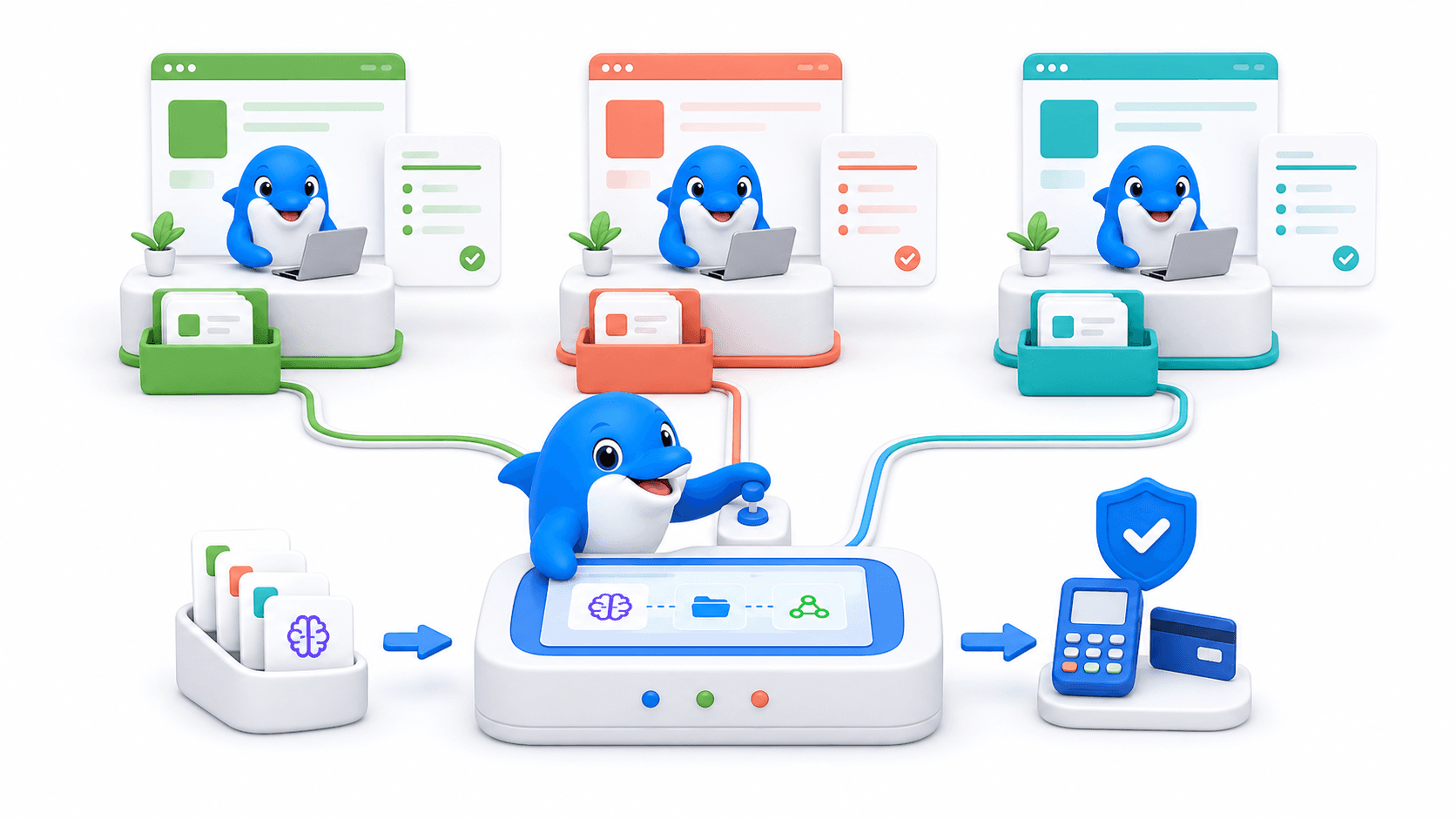
UChat Partner targets agencies that want to operate the platform as part of their own offer. Partners can customize the domain, login, dashboard, navigation, support paths and marketplace; manage client workspaces; define plans and selling prices; connect billing; install templates; impersonate workspaces; and automate provisioning through Partner API.
The partner owns the client relationship and sets the retail price. This is a productized agency model, not only an implementation relationship.
Agencies should compare more than logo removal. The useful test covers client tenancy, workspace management, plans, billing, template deployment, support ownership, usage events and lifecycle automation.
When Yellow.ai May Be A Better Fit
Yellow.ai may be better when:
the organization is funding an enterprise Agentic AI program;
formal discovery, automated testing, traces and continuous optimization are required;
150+ enterprise integrations reduce architecture risk;
voice, email, chat and SMS need one governed enterprise layer;
SOC 2, GDPR and ISO controls are central to procurement;
custom commercial packaging and enterprise support are acceptable; or
the buyer does not need a full-white-label agency platform.
Choosing UChat only for transparent pricing could underestimate enterprise integration and governance work. Choosing Yellow.ai for a smaller, channel-specific automation project could introduce a heavier buying and operating model than the team needs.
Decision Checklist
Is this an enterprise AI program or a customer-journey automation project?
Which discovery, testing, trace and optimization controls are mandatory?
Which certifications, regions and governance policies must procurement verify?
What counts as a resolution, user, Agent and channel interaction for cost modeling?
Which CRM, ERP, ITSM, contact-center and payment actions are required?
Which channel-specific events must start or continue automation?
Which actions require deterministic policy, approval or rollback?
Does an agency need branding, client workspaces, plans, billing and Partner API?
Can the proof of concept reproduce the hardest workflow and exception path?
FAQ
Is Yellow.ai only a chatbot platform?
No. Yellow.ai positions itself as an enterprise Agentic AI platform spanning chat, voice, email, SMS, knowledge, workflows, integrations, testing, analytics and governance.
Can both platforms execute business actions?
Yes. Yellow.ai Agents can call tools and enterprise workflows. UChat uses AI functions, visual nodes, APIs, Mini Apps and reusable Function Flows.
Which is easier for a smaller team?
UChat offers a more accessible visual builder and public resource pricing. Yellow.ai has a Free evaluation tier, but many enterprise capabilities are limited until a commercial plan.
Which is better for enterprise governance?
Yellow.ai has the stronger publicly packaged enterprise governance story, including testing, traces, role controls and named compliance standards. UChat buyers should validate current controls against their exact requirements.
Which is better for an agency?
UChat maps more directly to agencies that want their own branded platform, separate client workspaces, custom pricing, billing automation and Partner API. Yellow.ai suits consultancies implementing enterprise AI transformation.
Can I test UChat first?
Yes. UChat offers a 14-day trial with Pro features and no credit card required. Yellow.ai also provides a limited Free tier.
Final Verdict And CTA
Yellow.ai is a serious enterprise Agentic AI platform. Its multi-LLM architecture, Agentic RAG, automated testing, analytics, 150+ integrations and governance packaging are meaningful advantages for complex programs.
UChat is the stronger fit when a builder or agency wants to create customer automation directly, connect AI to visible business logic and deliver the result through an accessible or fully branded platform.
Start a 14-day UChat free trial with full Pro access and no credit card required.
Agencies can book a Partner Plan demo to explore white-label delivery, client workspaces, billing automation and Partner API operations.
Related comparisons: UChat vs Voiceflow, UChat vs Zendesk AI and UChat vs Kommunicate.
Sources And Review Date
Product and pricing details were reviewed on 2 August 2026. Packaging can change. Primary sources: Yellow.ai, Yellow.ai pricing, Yellow.ai platform, Yellow.ai integrations, UChat, UChat AI Agent, UChat channels, UChat Flow Builder, UChat CRM, UChat pricing, and UChat Partner.
Quick Verdict
UChat and Yellow.ai both combine AI Agents, channels, knowledge, workflows and business-system actions. They are designed around different buying motions.
Choose Yellow.ai when the organization is building a governed enterprise Agentic AI program. Choose UChat when a team or agency needs accessible visual automation, channel-specific journeys, transparent entry pricing and a platform it can shape around its own delivery model.
Yellow.ai brings Agentic RAG, natural-language Agent building, automated testing, conversation traces, analytics, enterprise security and more than 150 integrations into one AI lifecycle. Its Enterprise plan covers 35+ channels across chat, voice, email and SMS.
UChat gives builders a visual operating surface where AI Agents work with deterministic nodes, reusable Function Flows, APIs, payments, CRM Boards, Tickets, human support and follow-up automation. UChat Partner extends that architecture into branded client workspaces and billing.
Table Of Contents
Scorecard
Recommendation By Use Case
Feature Comparison: AI Agent Architecture
Building Testing And Improving Agents
Omnichannel Voice Email And Human Work
Integrations Actions And Enterprise Systems
Security Governance And Operational Control
Pricing Resolutions And Platform Resources
Agency And White-Label Delivery
When Yellow.ai May Be A Better Fit
Decision Checklist
FAQ
Final Verdict And CTA
Scorecard
Decision area | Better starting fit | Why |
|---|---|---|
Enterprise Agentic AI lifecycle | Yellow.ai | Discovery, builder, RAG, testing, traces and analytics form one program. |
Enterprise integrations | Yellow.ai | The platform promotes 150+ integrations across CRM, ERP, helpdesk, payments and voice. |
Formal security and compliance | Yellow.ai | SOC 2, GDPR and ISO controls are explicitly packaged and documented. |
Enterprise multimodal orchestration | Yellow.ai | Enterprise lists 35+ channels across chat, voice, email and SMS. |
Direct visual journey control | UChat | AI, deterministic nodes, APIs, CRM and Function Flows are exposed in one builder. |
Channel-specific acquisition automation | UChat | Comments, ads, messages, forms and destination behavior can start journeys. |
Built-in customer lifecycle tools | UChat | Boards, Tickets, Live Chat and flows connect lead, sale, onboarding and support. |
Transparent SMB entry pricing | UChat | Business starts at $15 monthly with public resource limits. |
Full-white-label agency platform | UChat | Partner Plan includes client workspaces, branding, plans, billing and Partner API. |
Recommendation By Use Case
Yellow.ai fits an enterprise transformation program. A large organization can connect historical conversations and knowledge, create Agents for complex service goals, test behavior at scale, inspect traces, govern access and integrate with established CRM, ERP, ITSM and contact-center systems.
UChat fits solution building and repeatable delivery. A team can visually connect a social or messaging entry point to qualification, AI reasoning, an API action, payment, CRM stage, human handoff and follow-up without making an enterprise AI program the prerequisite.
The distinction is partly scale, but not only scale. Yellow.ai packages more governance and AI lifecycle infrastructure. UChat provides more direct access to the customer journey and a Partner model for agencies selling that journey under their own brand.
Feature Comparison: AI Agent Architecture
Yellow.ai describes an Agentic AI platform that can plan actions, select tools, retain context and execute multi-step work. Its builder uses natural-language instructions, while Agentic RAG connects reasoning and action to websites, APIs and third-party knowledge.
Official examples include order fulfilment, ticketing and approvals. Yellow.ai says its architecture can use more than 15 LLMs, allowing different models to be selected for different tasks rather than locking the program to one provider.
UChat AI Agents can use business knowledge, roles, instructions and callable functions. Model options include OpenAI, Claude, DeepSeek and xAI. The Flow Builder combines those Agents with messages, questions, conditions, actions, external requests and channel-specific nodes.
Function Flows isolate reusable operations. One can validate an identity, query an order system, apply deterministic policy and return either a verified outcome or an escalation reason. Web Chat, WhatsApp, Instagram and voice-related flows can reuse that operation while retaining their own interaction rules.
For an enterprise standardizing autonomous service Agents, Yellow.ai offers a more explicit Agentic architecture. UChat is easier to shape when AI is one component inside a visual customer-automation solution.
Evaluate controlled outcomes, not an “agentic” label. Test missing data, conflicting records, unavailable tools, approval thresholds, rollback, duplicate requests and the evidence left after an action.
Building Testing And Improving Agents
Yellow.ai's lifecycle is one of its clearest strengths. Agentic Discovery can analyze historical customer data, knowledge and procedures to identify issues and create starting Agents. The builder supports multi-step goals without requiring every path to be manually scripted.
An AI copilot exposes conversation traces so teams can inspect decisions and workflow calls. Automated testing is designed to cover dynamic conversations and edge cases across channels before release.
After deployment, Yellow.ai analytics track resolution, automation opportunities, sentiment and topics. The platform also describes knowledge-gap detection and generated knowledge improvements as part of a learning loop.
UChat testing is more builder-led. Teams can make critical conditions, functions, API calls, fallback branches and transfers visible in the flow, then test the actual journey in its workspace and target channels. This can be easier for solution teams that want to inspect business logic directly.
The trade-off is meaningful. Yellow.ai packages a more formal AI development and optimization lifecycle. UChat offers an understandable visual system for teams that prefer to own the orchestration without adopting a larger enterprise operating model.
Omnichannel Voice Email And Human Work
Yellow.ai Enterprise lists all 35+ supported channels across chat, voice, email and SMS. Its product story emphasizes carrying context across modalities, including images, documents and voice.
VoiceX and Intelligent Email Agents are part of the Enterprise capability set. The platform can integrate with contact-center systems and hand AI work into existing service operations.
UChat supports Web Chat, Messenger, Instagram, WhatsApp, Telegram, SMS, WeChat, LINE, Viber, TikTok, RCS and other channels. Voice automation can connect to phone and real-time AI calling, subject to provider and regional requirements.
UChat's Omni Channel approach shares core logic while preserving channel-specific triggers, templates, media, comments, ads and delivery rules. Live Chat, assignments, mobile handling and Tickets connect human work to the same customer record and lifecycle.
Yellow.ai has the stronger published enterprise omnichannel package. UChat deserves consideration when the differentiator is not simply channel coverage, but the ability to design destination-specific acquisition, transaction and follow-up behavior.
Integrations Actions And Enterprise Systems
Yellow.ai promotes more than 150 prebuilt enterprise integrations. Official examples span Salesforce, HubSpot, SAP, Oracle, Workday, BambooHR, ServiceNow, Jira, Zendesk, Freshdesk, Genesys and NICE.
Its integration catalog also covers payments, commerce, knowledge stores and voice systems. This breadth matters when procurement requires AI to fit an established enterprise architecture rather than replace it.
UChat connects AI providers, ecommerce, payments, calendars, storage, email and custom systems through native integrations, Zapier, Make, external requests, APIs and Mini Apps. Examples include Shopify, WooCommerce, Stripe, PayPal, Calendly, Google Sheets, Gmail and Cloudinary.
UChat's advantage is configurability at the journey layer. A builder can combine an integration action with data collection, channel behavior, deterministic policy, CRM movement and customer communication in one visual flow.
For both platforms, inspect authentication, permissions, retries, duplicate protection, rollback, audit records and data residency. Integration count does not prove that the exact production action is controlled correctly.
Security Governance And Operational Control
Yellow.ai explicitly presents enterprise security as a core capability. Its platform materials reference SOC 2, GDPR and ISO standards, while the homepage also displays HIPAA and PCI-DSS credentials. Enterprise pricing includes role-based access controls and compliance.
That published posture can reduce procurement friction for regulated or global organizations. Buyers should still confirm certificate scope, hosting region, retention, encryption, subprocessors and whether a given workload is covered.
UChat provides workspace permissions, audit logs and explicit control over flow logic, Agent actions and human escalation. Critical decisions can be represented as deterministic nodes rather than left entirely to model behavior.
However, organizations with formal enterprise governance requirements should validate UChat's current certifications and controls directly instead of assuming visual control is equivalent to Yellow.ai's packaged compliance program.
Pricing Resolutions And Platform Resources
Yellow.ai published two plan levels on 2 August 2026:
Yellow.ai plan | Price or usage | AI Agents | Channel and platform scope |
|---|---|---|---|
Free | 500 resolutions monthly, then $0.99 per resolution | 1 | Limited builder, channels, voice, email, integrations, analytics and governance. |
Enterprise | Contact sales | Unlimited | Unlimited usage and listed access to all 35+ channels, 150+ integrations and enterprise controls. |
The Free tier also listed two human Agents, 1,000 User360 records, basic access control and one active campaign with ten templates. It provides a useful evaluation route, but “limited” appears across many of the capabilities that define Yellow.ai's enterprise value.
UChat pricing reviewed on the same date:
UChat item | Monthly platform cost | Included capacity or unit |
|---|---|---|
Business | $15 | One bot, 1,000 bot users and five members. |
Extra bot | $10 | One additional bot. |
Extra member | $10 | One additional workspace member. |
First 5,000 extra bot users | $5 per 1,000 | Added after the included 1,000. |
Later bot-user capacity | $20 per 5,000 | Charged in 5,000-user blocks. |
Partner Plan | $199 | White labeling and multi-client platform operations. |
The units are not equivalent. Yellow.ai prices Free overage by AI resolution and quotes Enterprise commercially. UChat prices platform resources publicly, while model, channel, voice and provider charges can still apply.
For a smaller team or agency, UChat is easier to budget before a sales process. For an enterprise, Yellow.ai's quote may include capabilities, support and governance that would require separate implementation elsewhere.
Agency And White-Label Delivery
Yellow.ai is a credible platform for large consultancies and systems integrators delivering enterprise AI programs. Its integrations, governance, testing and analytics can support complex transformation work.
UChat Partner targets agencies that want to operate the platform as part of their own offer. Partners can customize the domain, login, dashboard, navigation, support paths and marketplace; manage client workspaces; define plans and selling prices; connect billing; install templates; impersonate workspaces; and automate provisioning through Partner API.
The partner owns the client relationship and sets the retail price. This is a productized agency model, not only an implementation relationship.
Agencies should compare more than logo removal. The useful test covers client tenancy, workspace management, plans, billing, template deployment, support ownership, usage events and lifecycle automation.
When Yellow.ai May Be A Better Fit
Yellow.ai may be better when:
the organization is funding an enterprise Agentic AI program;
formal discovery, automated testing, traces and continuous optimization are required;
150+ enterprise integrations reduce architecture risk;
voice, email, chat and SMS need one governed enterprise layer;
SOC 2, GDPR and ISO controls are central to procurement;
custom commercial packaging and enterprise support are acceptable; or
the buyer does not need a full-white-label agency platform.
Choosing UChat only for transparent pricing could underestimate enterprise integration and governance work. Choosing Yellow.ai for a smaller, channel-specific automation project could introduce a heavier buying and operating model than the team needs.
Decision Checklist
Is this an enterprise AI program or a customer-journey automation project?
Which discovery, testing, trace and optimization controls are mandatory?
Which certifications, regions and governance policies must procurement verify?
What counts as a resolution, user, Agent and channel interaction for cost modeling?
Which CRM, ERP, ITSM, contact-center and payment actions are required?
Which channel-specific events must start or continue automation?
Which actions require deterministic policy, approval or rollback?
Does an agency need branding, client workspaces, plans, billing and Partner API?
Can the proof of concept reproduce the hardest workflow and exception path?
FAQ
Is Yellow.ai only a chatbot platform?
No. Yellow.ai positions itself as an enterprise Agentic AI platform spanning chat, voice, email, SMS, knowledge, workflows, integrations, testing, analytics and governance.
Can both platforms execute business actions?
Yes. Yellow.ai Agents can call tools and enterprise workflows. UChat uses AI functions, visual nodes, APIs, Mini Apps and reusable Function Flows.
Which is easier for a smaller team?
UChat offers a more accessible visual builder and public resource pricing. Yellow.ai has a Free evaluation tier, but many enterprise capabilities are limited until a commercial plan.
Which is better for enterprise governance?
Yellow.ai has the stronger publicly packaged enterprise governance story, including testing, traces, role controls and named compliance standards. UChat buyers should validate current controls against their exact requirements.
Which is better for an agency?
UChat maps more directly to agencies that want their own branded platform, separate client workspaces, custom pricing, billing automation and Partner API. Yellow.ai suits consultancies implementing enterprise AI transformation.
Can I test UChat first?
Yes. UChat offers a 14-day trial with Pro features and no credit card required. Yellow.ai also provides a limited Free tier.
Final Verdict And CTA
Yellow.ai is a serious enterprise Agentic AI platform. Its multi-LLM architecture, Agentic RAG, automated testing, analytics, 150+ integrations and governance packaging are meaningful advantages for complex programs.
UChat is the stronger fit when a builder or agency wants to create customer automation directly, connect AI to visible business logic and deliver the result through an accessible or fully branded platform.
Start a 14-day UChat free trial with full Pro access and no credit card required.
Agencies can book a Partner Plan demo to explore white-label delivery, client workspaces, billing automation and Partner API operations.
Related comparisons: UChat vs Voiceflow, UChat vs Zendesk AI and UChat vs Kommunicate.
Sources And Review Date
Product and pricing details were reviewed on 2 August 2026. Packaging can change. Primary sources: Yellow.ai, Yellow.ai pricing, Yellow.ai platform, Yellow.ai integrations, UChat, UChat AI Agent, UChat channels, UChat Flow Builder, UChat CRM, UChat pricing, and UChat Partner.