14 minutes
UChat
Posted by
UChat vs Botpress: Which AI Agent Platform Fits Your Workflow?
14 minutes
Posted by
UChat

Quick Verdict
UChat and Botpress can both build AI Agents that answer from business knowledge, call tools, follow workflows and hand conversations to humans. The bigger difference is where each platform puts the center of gravity.
Choose Botpress when engineering the AI Agent is the main product problem. Choose UChat when that agent must operate inside a broader customer journey across channels, CRM, payments, support and branded client workspaces.
Botpress is a compelling platform for product and development teams. Its Studio, Autonomous Nodes and Agent Development Kit provide visual and code-first paths for creating agents with knowledge, tools, variables and reusable workflows.
UChat is the stronger fit for automation operators and agencies that want AI reasoning to work alongside deterministic flows, native channel automation, ecommerce, payments, CRM, tickets and full-white-label client delivery.
Table Of Contents
Scorecard
Recommendation By Use Case
Feature Comparison: Botpress Studio And Developer Experience
AI Agents, Autonomous Nodes And Flow Control
Knowledge, Tools And Business Actions
Channels And Customer Journey Deployment
Human Handoff, Inbox, CRM And Tickets
Integrations, Ecommerce And Payments
Pricing And Usage Models
Agency And White-Label Delivery
When Botpress May Be A Better Fit
Decision Checklist
FAQ
Final Verdict And CTA
Scorecard
Decision area | Better starting fit | Why |
|---|---|---|
Developer-led AI Agent product | Botpress | Studio, ADK, Autonomous Nodes and extensibility create a strong agent engineering environment. |
Autonomous reasoning and tool selection | Botpress | Autonomous Nodes are explicitly designed to let an LLM select tools and callable workflows. |
Deterministic customer journey design | UChat | Visual flows can coordinate messages, conditions, data capture, actions, APIs and AI in one journey. |
Breadth of native customer channels | UChat | UChat is designed to reuse automation across a broad collection of messaging and voice channels. |
Human support around an AI Agent | Depends | Botpress Desk provides a focused helpdesk path; UChat connects handoff with live chat, CRM boards, tickets and mobile handling. |
Ecommerce, payment and follow-up automation | UChat | These capabilities sit inside the same customer automation environment rather than only behind custom agent tools. |
Code-first extensibility | Botpress | The ADK is a meaningful advantage for teams that want agent development in code. |
Full-white-label agency platform | UChat | Partner Plan extends branding beyond the widget into login, dashboard, domain, plans, billing and client workspaces. |
Fast experiment with a few AI Agents | Botpress | The Free plan supports three AI Agents and provides a low-friction path into Studio. |
Predictable small-business automation plan | UChat | UChat's Business plan starts from platform limits rather than a per-conversation helpdesk model. |
Recommendation By Use Case
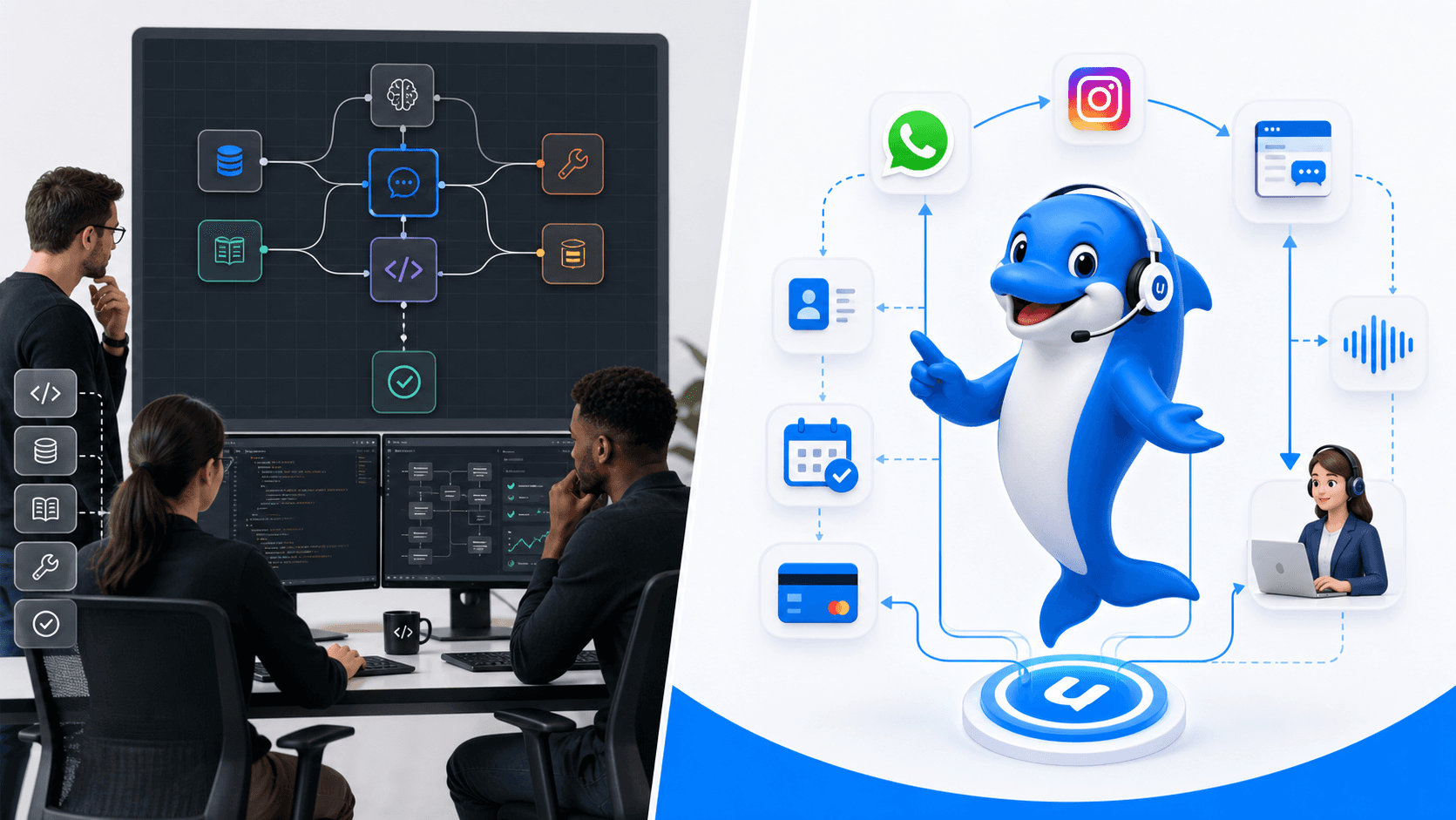
Botpress will feel natural to a product or engineering team that wants a dedicated AI Agent platform, expects to combine visual building with code, and values fine control over autonomous reasoning, tools, variables and integrations.
UChat becomes more useful when a growth, support or automation team needs to connect AI with acquisition, qualification, booking, payment, CRM updates, live chat and follow-up across multiple channels.
UChat Partner is designed for agencies that want to sell that system under their own brand, control client-facing prices and plans, manage separate workspaces, install reusable solutions and automate account operations.
Short version: Botpress is centered on building the agent. UChat is centered on building the operating journey around the conversation.
Feature Comparison: Botpress Studio And Developer Experience
Botpress deserves credit for treating AI Agent development as a real engineering discipline.
Its Studio is a visual development environment for workflows, prompts, variables, knowledge and integrations. Teams can preview agents, inspect behavior and monitor performance. Developers who want to work in code can use the Agent Development Kit rather than forcing every implementation through a visual interface.
That combination makes Botpress attractive when the agent itself is part of a software product. A team can use visual workflows for shared understanding while keeping deeper integrations and development practices in code.
UChat also provides a visual builder, APIs, external requests, functions and Mini Apps, but its design starts closer to customer automation. Builders work with channel messages, questions, conditions, user fields, tags, sequences, payments, ecommerce actions, transfers and follow-up steps.
This is not a simple no-code versus code comparison. Both platforms can support technical work. The distinction is whether the team primarily thinks in terms of an AI Agent runtime or an end-to-end customer journey.
AI Agents, Autonomous Nodes And Flow Control
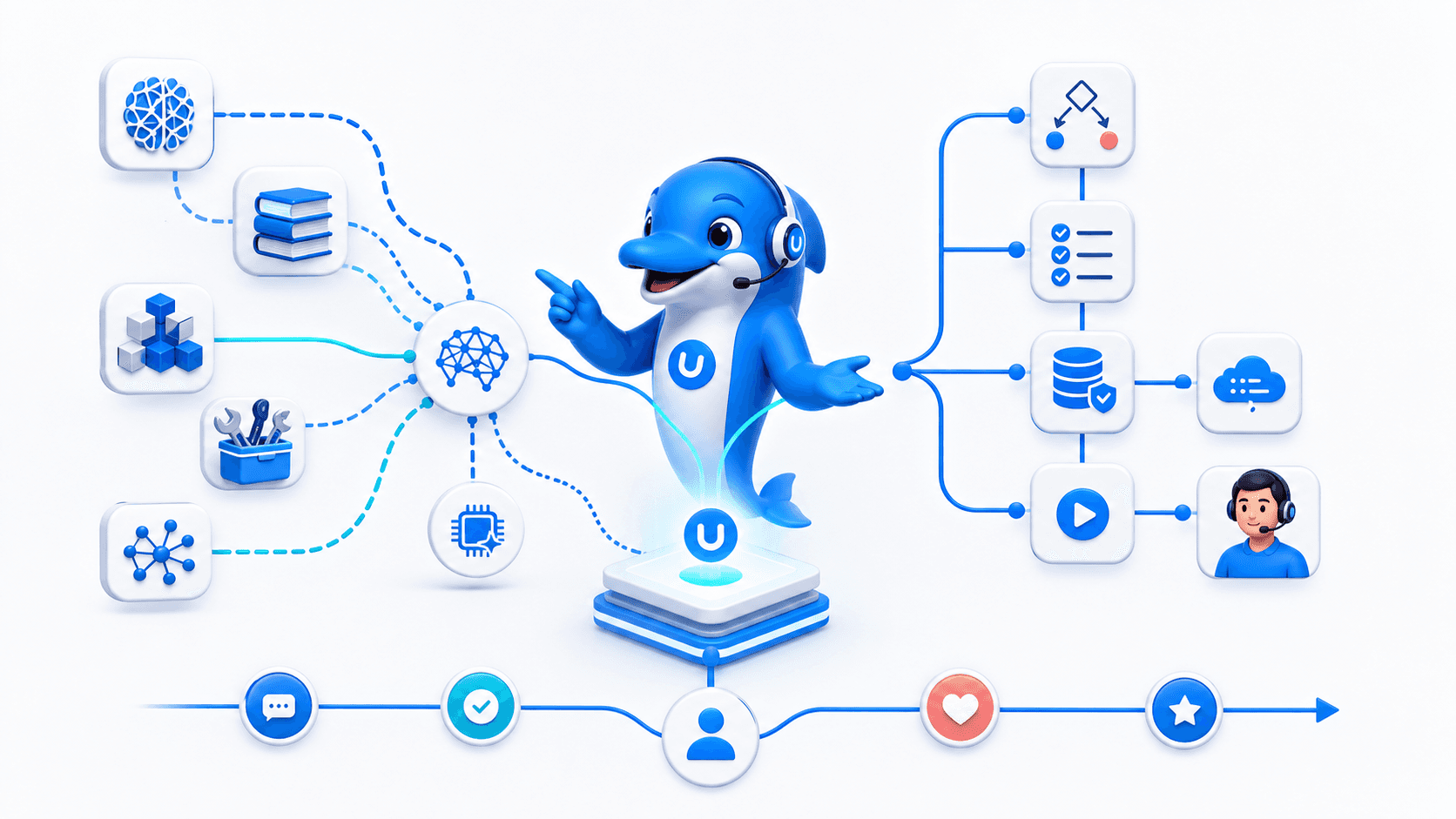
Botpress Autonomous Nodes use an LLM to decide what to say and which tools to execute. Builders can provide instructions, variables, knowledge bases and callable workflows, then define exit conditions that return control to the wider flow. A node can also run logic without sending a conversational response.
This is a thoughtful model. It allows autonomous reasoning to live inside a larger, inspectable workflow instead of turning the entire bot into one open-ended prompt.
UChat AI Agents follow a similar practical principle: give AI a role, knowledge and functions, but combine it with explicit automation where predictability matters. A flow can collect required data before an agent runs, let the agent choose an appropriate function, validate the result, route by condition and continue with deterministic actions.
UChat can also organize multiple specialized AI Agents and hand work between them. One agent can qualify a lead, another can answer product questions, and a third can coordinate booking or support, while the flow controls the business rules around those interactions.
The real decision is how your team wants to divide responsibility between AI and workflow logic:
Botpress offers an agent-development model with Autonomous Nodes, tools and callable workflows.
UChat offers an automation model where AI Agents, normal flows and function-oriented logic can operate together across the customer lifecycle.
Neither approach removes the need for design. The better one is the model your team can test, govern and maintain.
Knowledge, Tools And Business Actions
Botpress Knowledge Bases can supply agents with information from documents, websites and structured data. Tables provide operational storage, while tools and integrations let an Autonomous Node take action. This supports agents that do more than retrieve an answer.
UChat AI Agents can also use uploaded or connected business knowledge and call functions. The difference becomes clearer after the function returns.
A UChat journey might:
identify the channel and campaign that produced a lead;
collect name, location, budget and preferred service;
let an AI Agent qualify intent and answer questions;
call an availability or CRM API;
book an appointment or take payment;
assign the contact to a human when confidence is low;
move the customer on a CRM board;
send a WhatsApp reminder; and
reuse the same solution in another client workspace.
Botpress can implement many custom actions through tools, integrations and code. UChat's advantage is that more of the surrounding customer-operation vocabulary already exists inside the platform.
The question is not whether an agent can call an API. It is how much of the complete customer journey your team wants to assemble, observe and reuse without building the surrounding operating layer from scratch.
Channels And Customer Journey Deployment
Botpress provides official channel integrations including Webchat, WhatsApp, Instagram and Facebook Messenger. Its Hub also connects business systems and allows teams to create additional integrations. For an AI Agent deployed into a selected set of customer touchpoints, this can be enough.
UChat is designed around a wider channel automation canvas. Depending on the setup, the same underlying business logic can operate across Web Chat, Facebook Messenger, Instagram, WhatsApp, Telegram, SMS, voice, Slack, WeChat, LINE, Viber, RCS, TikTok and other supported channels.
That breadth matters when channel behavior is part of the solution. A WhatsApp journey may use templates and delivery events. Instagram can begin from social engagement. Voice requires call handling. Web Chat can use page context and browser behavior. UChat lets the builder reuse shared logic while still working with channel-specific triggers and message types.
The practical value depends on the channels your customers actually use.
Botpress may be the cleaner choice when the company has a smaller approved channel set and an engineering team to own integration work. UChat becomes more attractive when channel expansion is a product requirement rather than a future custom project.
Human Handoff, Inbox, CRM And Tickets
Botpress has moved new workspaces toward Botpress Desk for human handoff. Its HITL model can let a live agent join a conversation, approve AI-generated output and take over sensitive scenarios. Team plans add routing, role-based access control and team analytics.
That is a credible support operation, not an afterthought.
UChat places human handling inside a broader customer record. Conversations can transfer to Live Chat, be assigned to team members and handled from mobile. The same contact can move through CRM-style Boards, create or update Tickets, retain custom fields and continue through automated follow-up.
Choose Botpress Desk when the AI helpdesk is the operational center. Choose UChat when support is one part of a journey that also includes lead generation, sales qualification, booking, transactions and retention.
Teams should still test their actual queue requirements. Compare routing, permissions, service metrics, escalation, mobile behavior and reporting rather than assuming that every inbox works the same way.
Integrations, Ecommerce And Payments
Botpress Hub includes integrations for channels, helpdesks and business systems, and the ADK gives developers a path to create their own. This is one of Botpress's strongest arguments for a technical team: the platform is meant to be extended.
UChat combines third-party integrations with native customer-journey actions. Builders can work with tools such as Shopify, WooCommerce, Stripe, PayPal, Calendly, Google Sheets, Gmail, Zapier, Make and external APIs. Mini Apps can package custom triggers and actions for reuse.
For a developer team, Botpress's extensibility may be the deciding factor. For an automation agency, UChat can shorten the route from a conversation to a packaged commercial outcome: capture a lead, sell a product, collect payment, update a record, notify a team and continue follow-up.
Pricing And Usage Models
Botpress and UChat meter different resources, so the headline prices need context.
On 2 August 2026, Botpress publicly displayed:
Botpress plan | Price | Included usage and selected capabilities |
|---|---|---|
Free | $0 | 100 conversations, three seats, three AI Agents, Studio, ADK and Botpress Desk. |
Plus | $150/month billed annually | 250 conversations, three seats, unlimited AI Agents, white-label webchat, branded Help Center custom domain and live-chat support. |
Team | $750/month billed annually | 1,500 conversations, unlimited seats, teams, routing, RBAC, analytics and real-time collaboration. |
Enterprise | Custom | Custom volume, pricing and enterprise support. |
Botpress defines a billable conversation around an exchange containing at least two messages during the billing month. Plus and Team can add conversation packs. Its pricing page states that AI usage is included, which reduces a common source of unpredictable LLM markup.
UChat's Business plan starts at $15 per month and is packaged around bots, bot users and members, with add-ons available when usage grows. A 14-day trial provides access to Pro features without requiring a credit card.
UChat Partner is $199 per month. It includes a partner workspace with five bots, 10,000 bot users and five members. Client workspaces then use partner cost plans, with default monthly examples of $10 for Business, $30 for Business Light and $100 for Business Large. Partners can define client-facing prices and request customized plan limits.
Pricing is not directly comparable because the commercial units are different:
Botpress emphasizes conversations, seats, agent-building capabilities and AI helpdesk operations.
UChat emphasizes platform plans, bots, bot users, team members and optional partner workspace licensing.
Estimate your expected conversations, contacts, builders, support agents, channels, client workspaces and external service costs before deciding.
Agency And White-Label Delivery
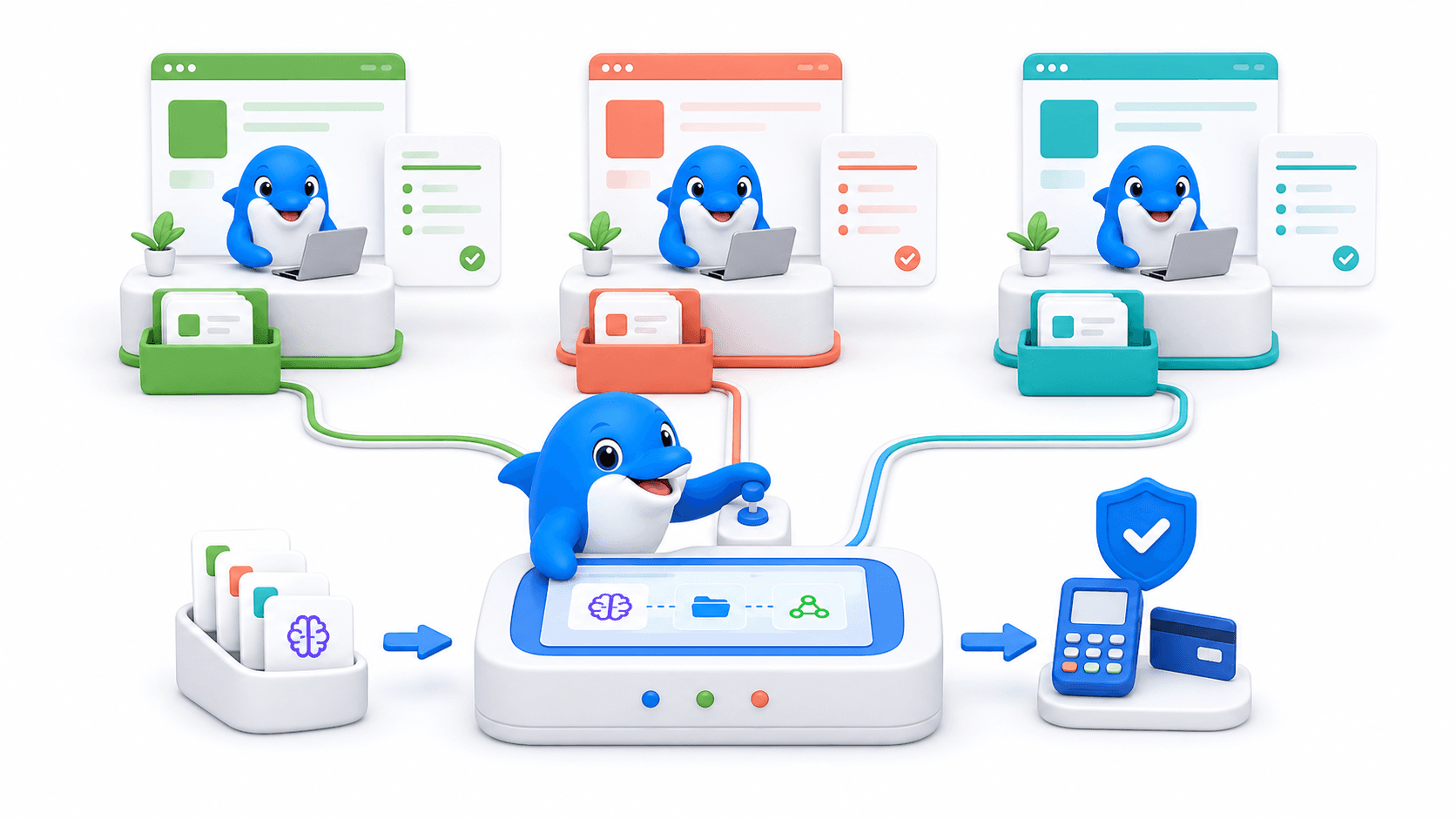
Botpress Plus includes white-label webchat, allowing teams to remove Botpress branding from the customer-facing widget. It also includes a branded Help Center on a custom domain. These are useful capabilities for embedding an agent into a branded customer experience.
UChat Partner goes further because the partner business model is built around the platform itself becoming the agency's product.
Partners can configure a custom domain, login experience, dashboard branding, navigation, support links and client-facing plans. They can manage client workspaces, impersonate a workspace for support, install templates, connect billing and automate onboarding or plan operations through the Partner API.
The partner controls what the client pays. UChat deducts the underlying workspace cost, while the partner keeps the client relationship and the remaining gross margin after platform, payment and service-delivery costs.
This distinction matters:
White-label webchat brands the customer-facing agent surface.
Full-white-label platform delivery brands the client login, operating environment, support path, plans and recurring service model.
An agency only needing a branded widget may find Botpress sufficient. An agency selling a complete automation platform will usually find UChat Partner closer to the intended operating model.
When Botpress May Be A Better Fit
Botpress may be the better choice when:
the AI Agent itself is a software product;
developers want a code-first ADK alongside a visual Studio;
Autonomous Nodes and tool orchestration are central requirements;
the team wants to create custom integrations and own the engineering layer;
a focused AI helpdesk with Botpress Desk matches the service workflow; or
full platform white labeling and broad native channel operations are not required.
In those situations, UChat's additional channel, CRM, commerce and partner capabilities may add operational surface the team does not need.
Decision Checklist
Choose Botpress when most of these are true:
you are building an AI Agent product with a developer-led team;
visual and code-first development both matter;
autonomous tool selection is more important than packaged customer journeys;
your required channels are covered by Botpress integrations;
custom integration development is expected; and
Botpress Desk fits the human-support model.
Choose UChat when most of these are true:
AI must work inside a larger marketing, sales or support journey;
deterministic flows and AI reasoning need to coexist;
broad native channel deployment matters;
CRM boards, tickets, ecommerce or payment actions are part of the solution;
operations teams need to maintain the automation visually; or
an agency wants a branded platform with client workspaces, pricing and billing control.
FAQ
Is Botpress more technical than UChat?
Botpress has a particularly strong developer story through Studio and the ADK. UChat also supports APIs, functions, external requests and Mini Apps, but organizes visual work more directly around channel and customer-journey automation.
Can both platforms build AI Agents that take action?
Yes. Botpress Autonomous Nodes can select tools and callable workflows. UChat AI Agents can use functions inside flows that continue with channel, CRM, payment and follow-up actions.
Does Botpress support WhatsApp and Instagram?
Yes. Botpress documents official integrations for WhatsApp, Instagram, Messenger and Webchat. UChat supports those channels as part of a broader native channel portfolio. Always test the exact triggers, message types and operational requirements your use case needs.
Does Botpress provide human handoff?
Yes. Botpress uses Botpress Desk for new-workspace human handoff and documents HITL capabilities. UChat provides Live Chat transfer, assignment, mobile handling, CRM Boards and Tickets. Compare the complete support workflow rather than the existence of a handoff button.
Which platform is better for a white-label agency?
Botpress Plus includes white-label webchat and a branded Help Center. UChat Partner is designed for broader platform-level white labeling, client workspace management, custom pricing, billing automation and Partner API operations.
Which platform is cheaper?
That depends on usage. Botpress meters conversations and packages team capabilities by plan. UChat meters plans, bots, bot users and members. Model the resources your implementation will actually consume instead of comparing only entry prices.
Can I test UChat before deciding?
Yes. UChat offers a 14-day free trial with access to Pro features and no credit card required.
Final Verdict And CTA
Botpress is a serious AI Agent development platform. Its visual Studio, code-first ADK, Autonomous Nodes, knowledge capabilities, integrations and helpdesk path make it a strong option for developer-led teams.
UChat is the stronger fit when the agent is only one part of the job. It connects AI with channel-native customer journeys, deterministic automation, CRM, tickets, ecommerce, payments and full-white-label agency delivery.
Choose Botpress to engineer the agent. Choose UChat to operationalize the customer journey around it.
Start a 14-day UChat free trial with full access to Pro features and no credit card required.
Agencies can book a Partner Plan demo to explore full-white-label delivery, client workspaces, billing automation and Partner API operations.
Related comparisons: UChat vs Tidio and UChat vs Respond.io.
Sources And Review Date
Product and pricing details were reviewed on 2 August 2026. Packaging can change. Primary sources: Botpress, Botpress pricing, Botpress documentation, Autonomous Nodes, Botpress integrations, Botpress HITL, Botpress WhatsApp, Botpress Instagram, UChat, UChat AI Agent, UChat channels, UChat Flow Builder, UChat Live Chat, UChat CRM, UChat pricing, and UChat Partner.
Quick Verdict
UChat and Botpress can both build AI Agents that answer from business knowledge, call tools, follow workflows and hand conversations to humans. The bigger difference is where each platform puts the center of gravity.
Choose Botpress when engineering the AI Agent is the main product problem. Choose UChat when that agent must operate inside a broader customer journey across channels, CRM, payments, support and branded client workspaces.
Botpress is a compelling platform for product and development teams. Its Studio, Autonomous Nodes and Agent Development Kit provide visual and code-first paths for creating agents with knowledge, tools, variables and reusable workflows.
UChat is the stronger fit for automation operators and agencies that want AI reasoning to work alongside deterministic flows, native channel automation, ecommerce, payments, CRM, tickets and full-white-label client delivery.
Table Of Contents
Scorecard
Recommendation By Use Case
Feature Comparison: Botpress Studio And Developer Experience
AI Agents, Autonomous Nodes And Flow Control
Knowledge, Tools And Business Actions
Channels And Customer Journey Deployment
Human Handoff, Inbox, CRM And Tickets
Integrations, Ecommerce And Payments
Pricing And Usage Models
Agency And White-Label Delivery
When Botpress May Be A Better Fit
Decision Checklist
FAQ
Final Verdict And CTA
Scorecard
Decision area | Better starting fit | Why |
|---|---|---|
Developer-led AI Agent product | Botpress | Studio, ADK, Autonomous Nodes and extensibility create a strong agent engineering environment. |
Autonomous reasoning and tool selection | Botpress | Autonomous Nodes are explicitly designed to let an LLM select tools and callable workflows. |
Deterministic customer journey design | UChat | Visual flows can coordinate messages, conditions, data capture, actions, APIs and AI in one journey. |
Breadth of native customer channels | UChat | UChat is designed to reuse automation across a broad collection of messaging and voice channels. |
Human support around an AI Agent | Depends | Botpress Desk provides a focused helpdesk path; UChat connects handoff with live chat, CRM boards, tickets and mobile handling. |
Ecommerce, payment and follow-up automation | UChat | These capabilities sit inside the same customer automation environment rather than only behind custom agent tools. |
Code-first extensibility | Botpress | The ADK is a meaningful advantage for teams that want agent development in code. |
Full-white-label agency platform | UChat | Partner Plan extends branding beyond the widget into login, dashboard, domain, plans, billing and client workspaces. |
Fast experiment with a few AI Agents | Botpress | The Free plan supports three AI Agents and provides a low-friction path into Studio. |
Predictable small-business automation plan | UChat | UChat's Business plan starts from platform limits rather than a per-conversation helpdesk model. |
Recommendation By Use Case
Botpress will feel natural to a product or engineering team that wants a dedicated AI Agent platform, expects to combine visual building with code, and values fine control over autonomous reasoning, tools, variables and integrations.
UChat becomes more useful when a growth, support or automation team needs to connect AI with acquisition, qualification, booking, payment, CRM updates, live chat and follow-up across multiple channels.
UChat Partner is designed for agencies that want to sell that system under their own brand, control client-facing prices and plans, manage separate workspaces, install reusable solutions and automate account operations.
Short version: Botpress is centered on building the agent. UChat is centered on building the operating journey around the conversation.
Feature Comparison: Botpress Studio And Developer Experience
Botpress deserves credit for treating AI Agent development as a real engineering discipline.
Its Studio is a visual development environment for workflows, prompts, variables, knowledge and integrations. Teams can preview agents, inspect behavior and monitor performance. Developers who want to work in code can use the Agent Development Kit rather than forcing every implementation through a visual interface.
That combination makes Botpress attractive when the agent itself is part of a software product. A team can use visual workflows for shared understanding while keeping deeper integrations and development practices in code.
UChat also provides a visual builder, APIs, external requests, functions and Mini Apps, but its design starts closer to customer automation. Builders work with channel messages, questions, conditions, user fields, tags, sequences, payments, ecommerce actions, transfers and follow-up steps.
This is not a simple no-code versus code comparison. Both platforms can support technical work. The distinction is whether the team primarily thinks in terms of an AI Agent runtime or an end-to-end customer journey.
AI Agents, Autonomous Nodes And Flow Control
Botpress Autonomous Nodes use an LLM to decide what to say and which tools to execute. Builders can provide instructions, variables, knowledge bases and callable workflows, then define exit conditions that return control to the wider flow. A node can also run logic without sending a conversational response.
This is a thoughtful model. It allows autonomous reasoning to live inside a larger, inspectable workflow instead of turning the entire bot into one open-ended prompt.
UChat AI Agents follow a similar practical principle: give AI a role, knowledge and functions, but combine it with explicit automation where predictability matters. A flow can collect required data before an agent runs, let the agent choose an appropriate function, validate the result, route by condition and continue with deterministic actions.
UChat can also organize multiple specialized AI Agents and hand work between them. One agent can qualify a lead, another can answer product questions, and a third can coordinate booking or support, while the flow controls the business rules around those interactions.
The real decision is how your team wants to divide responsibility between AI and workflow logic:
Botpress offers an agent-development model with Autonomous Nodes, tools and callable workflows.
UChat offers an automation model where AI Agents, normal flows and function-oriented logic can operate together across the customer lifecycle.
Neither approach removes the need for design. The better one is the model your team can test, govern and maintain.
Knowledge, Tools And Business Actions
Botpress Knowledge Bases can supply agents with information from documents, websites and structured data. Tables provide operational storage, while tools and integrations let an Autonomous Node take action. This supports agents that do more than retrieve an answer.
UChat AI Agents can also use uploaded or connected business knowledge and call functions. The difference becomes clearer after the function returns.
A UChat journey might:
identify the channel and campaign that produced a lead;
collect name, location, budget and preferred service;
let an AI Agent qualify intent and answer questions;
call an availability or CRM API;
book an appointment or take payment;
assign the contact to a human when confidence is low;
move the customer on a CRM board;
send a WhatsApp reminder; and
reuse the same solution in another client workspace.
Botpress can implement many custom actions through tools, integrations and code. UChat's advantage is that more of the surrounding customer-operation vocabulary already exists inside the platform.
The question is not whether an agent can call an API. It is how much of the complete customer journey your team wants to assemble, observe and reuse without building the surrounding operating layer from scratch.
Channels And Customer Journey Deployment
Botpress provides official channel integrations including Webchat, WhatsApp, Instagram and Facebook Messenger. Its Hub also connects business systems and allows teams to create additional integrations. For an AI Agent deployed into a selected set of customer touchpoints, this can be enough.
UChat is designed around a wider channel automation canvas. Depending on the setup, the same underlying business logic can operate across Web Chat, Facebook Messenger, Instagram, WhatsApp, Telegram, SMS, voice, Slack, WeChat, LINE, Viber, RCS, TikTok and other supported channels.
That breadth matters when channel behavior is part of the solution. A WhatsApp journey may use templates and delivery events. Instagram can begin from social engagement. Voice requires call handling. Web Chat can use page context and browser behavior. UChat lets the builder reuse shared logic while still working with channel-specific triggers and message types.
The practical value depends on the channels your customers actually use.
Botpress may be the cleaner choice when the company has a smaller approved channel set and an engineering team to own integration work. UChat becomes more attractive when channel expansion is a product requirement rather than a future custom project.
Human Handoff, Inbox, CRM And Tickets
Botpress has moved new workspaces toward Botpress Desk for human handoff. Its HITL model can let a live agent join a conversation, approve AI-generated output and take over sensitive scenarios. Team plans add routing, role-based access control and team analytics.
That is a credible support operation, not an afterthought.
UChat places human handling inside a broader customer record. Conversations can transfer to Live Chat, be assigned to team members and handled from mobile. The same contact can move through CRM-style Boards, create or update Tickets, retain custom fields and continue through automated follow-up.
Choose Botpress Desk when the AI helpdesk is the operational center. Choose UChat when support is one part of a journey that also includes lead generation, sales qualification, booking, transactions and retention.
Teams should still test their actual queue requirements. Compare routing, permissions, service metrics, escalation, mobile behavior and reporting rather than assuming that every inbox works the same way.
Integrations, Ecommerce And Payments
Botpress Hub includes integrations for channels, helpdesks and business systems, and the ADK gives developers a path to create their own. This is one of Botpress's strongest arguments for a technical team: the platform is meant to be extended.
UChat combines third-party integrations with native customer-journey actions. Builders can work with tools such as Shopify, WooCommerce, Stripe, PayPal, Calendly, Google Sheets, Gmail, Zapier, Make and external APIs. Mini Apps can package custom triggers and actions for reuse.
For a developer team, Botpress's extensibility may be the deciding factor. For an automation agency, UChat can shorten the route from a conversation to a packaged commercial outcome: capture a lead, sell a product, collect payment, update a record, notify a team and continue follow-up.
Pricing And Usage Models
Botpress and UChat meter different resources, so the headline prices need context.
On 2 August 2026, Botpress publicly displayed:
Botpress plan | Price | Included usage and selected capabilities |
|---|---|---|
Free | $0 | 100 conversations, three seats, three AI Agents, Studio, ADK and Botpress Desk. |
Plus | $150/month billed annually | 250 conversations, three seats, unlimited AI Agents, white-label webchat, branded Help Center custom domain and live-chat support. |
Team | $750/month billed annually | 1,500 conversations, unlimited seats, teams, routing, RBAC, analytics and real-time collaboration. |
Enterprise | Custom | Custom volume, pricing and enterprise support. |
Botpress defines a billable conversation around an exchange containing at least two messages during the billing month. Plus and Team can add conversation packs. Its pricing page states that AI usage is included, which reduces a common source of unpredictable LLM markup.
UChat's Business plan starts at $15 per month and is packaged around bots, bot users and members, with add-ons available when usage grows. A 14-day trial provides access to Pro features without requiring a credit card.
UChat Partner is $199 per month. It includes a partner workspace with five bots, 10,000 bot users and five members. Client workspaces then use partner cost plans, with default monthly examples of $10 for Business, $30 for Business Light and $100 for Business Large. Partners can define client-facing prices and request customized plan limits.
Pricing is not directly comparable because the commercial units are different:
Botpress emphasizes conversations, seats, agent-building capabilities and AI helpdesk operations.
UChat emphasizes platform plans, bots, bot users, team members and optional partner workspace licensing.
Estimate your expected conversations, contacts, builders, support agents, channels, client workspaces and external service costs before deciding.
Agency And White-Label Delivery
Botpress Plus includes white-label webchat, allowing teams to remove Botpress branding from the customer-facing widget. It also includes a branded Help Center on a custom domain. These are useful capabilities for embedding an agent into a branded customer experience.
UChat Partner goes further because the partner business model is built around the platform itself becoming the agency's product.
Partners can configure a custom domain, login experience, dashboard branding, navigation, support links and client-facing plans. They can manage client workspaces, impersonate a workspace for support, install templates, connect billing and automate onboarding or plan operations through the Partner API.
The partner controls what the client pays. UChat deducts the underlying workspace cost, while the partner keeps the client relationship and the remaining gross margin after platform, payment and service-delivery costs.
This distinction matters:
White-label webchat brands the customer-facing agent surface.
Full-white-label platform delivery brands the client login, operating environment, support path, plans and recurring service model.
An agency only needing a branded widget may find Botpress sufficient. An agency selling a complete automation platform will usually find UChat Partner closer to the intended operating model.
When Botpress May Be A Better Fit
Botpress may be the better choice when:
the AI Agent itself is a software product;
developers want a code-first ADK alongside a visual Studio;
Autonomous Nodes and tool orchestration are central requirements;
the team wants to create custom integrations and own the engineering layer;
a focused AI helpdesk with Botpress Desk matches the service workflow; or
full platform white labeling and broad native channel operations are not required.
In those situations, UChat's additional channel, CRM, commerce and partner capabilities may add operational surface the team does not need.
Decision Checklist
Choose Botpress when most of these are true:
you are building an AI Agent product with a developer-led team;
visual and code-first development both matter;
autonomous tool selection is more important than packaged customer journeys;
your required channels are covered by Botpress integrations;
custom integration development is expected; and
Botpress Desk fits the human-support model.
Choose UChat when most of these are true:
AI must work inside a larger marketing, sales or support journey;
deterministic flows and AI reasoning need to coexist;
broad native channel deployment matters;
CRM boards, tickets, ecommerce or payment actions are part of the solution;
operations teams need to maintain the automation visually; or
an agency wants a branded platform with client workspaces, pricing and billing control.
FAQ
Is Botpress more technical than UChat?
Botpress has a particularly strong developer story through Studio and the ADK. UChat also supports APIs, functions, external requests and Mini Apps, but organizes visual work more directly around channel and customer-journey automation.
Can both platforms build AI Agents that take action?
Yes. Botpress Autonomous Nodes can select tools and callable workflows. UChat AI Agents can use functions inside flows that continue with channel, CRM, payment and follow-up actions.
Does Botpress support WhatsApp and Instagram?
Yes. Botpress documents official integrations for WhatsApp, Instagram, Messenger and Webchat. UChat supports those channels as part of a broader native channel portfolio. Always test the exact triggers, message types and operational requirements your use case needs.
Does Botpress provide human handoff?
Yes. Botpress uses Botpress Desk for new-workspace human handoff and documents HITL capabilities. UChat provides Live Chat transfer, assignment, mobile handling, CRM Boards and Tickets. Compare the complete support workflow rather than the existence of a handoff button.
Which platform is better for a white-label agency?
Botpress Plus includes white-label webchat and a branded Help Center. UChat Partner is designed for broader platform-level white labeling, client workspace management, custom pricing, billing automation and Partner API operations.
Which platform is cheaper?
That depends on usage. Botpress meters conversations and packages team capabilities by plan. UChat meters plans, bots, bot users and members. Model the resources your implementation will actually consume instead of comparing only entry prices.
Can I test UChat before deciding?
Yes. UChat offers a 14-day free trial with access to Pro features and no credit card required.
Final Verdict And CTA
Botpress is a serious AI Agent development platform. Its visual Studio, code-first ADK, Autonomous Nodes, knowledge capabilities, integrations and helpdesk path make it a strong option for developer-led teams.
UChat is the stronger fit when the agent is only one part of the job. It connects AI with channel-native customer journeys, deterministic automation, CRM, tickets, ecommerce, payments and full-white-label agency delivery.
Choose Botpress to engineer the agent. Choose UChat to operationalize the customer journey around it.
Start a 14-day UChat free trial with full access to Pro features and no credit card required.
Agencies can book a Partner Plan demo to explore full-white-label delivery, client workspaces, billing automation and Partner API operations.
Related comparisons: UChat vs Tidio and UChat vs Respond.io.
Sources And Review Date
Product and pricing details were reviewed on 2 August 2026. Packaging can change. Primary sources: Botpress, Botpress pricing, Botpress documentation, Autonomous Nodes, Botpress integrations, Botpress HITL, Botpress WhatsApp, Botpress Instagram, UChat, UChat AI Agent, UChat channels, UChat Flow Builder, UChat Live Chat, UChat CRM, UChat pricing, and UChat Partner.