12 minutes
UChat
Posted by
UChat vs Tidio: Which Platform Fits Your Customer Automation Strategy?
12 minutes
Posted by
UChat

Quick Verdict
Tidio and UChat can both automate conversations, connect AI with human support, and help teams manage customer messages. The important difference is what you want the platform to become inside your business.
Choose Tidio for rapid support deployment. Choose UChat when conversations need to become configurable, cross-channel business workflows or a branded service you sell to clients.
Tidio is a strong starting point for an SMB that wants website live chat, ticketing, Shopify support, proactive Flows, and Lyro AI in one focused product.
UChat is the stronger fit for technical operators and agencies that need broader channel automation, configurable AI Agents, visual workflow control, API actions, CRM and ticket operations, or a full-white-label client platform.
Table Of Contents
Scorecard
Recommendation By Use Case
Feature Comparison: Where Tidio Is Strongest
When UChat Makes Sense
Lyro AI And UChat AI Agents
Flows And Actions After The First Reply
Channels And The Customer Inbox
Live Chat Tickets And CRM
Ecommerce Integrations And APIs
Pricing And Usage Models
Agency And White-Label Delivery
Decision Checklist
FAQ
Final Verdict And CTA
Scorecard
If this describes your business | Better starting point | Why |
|---|---|---|
A small support or ecommerce team wants live chat, tickets, and AI working quickly | Tidio | The product is centered on an accessible customer-service workflow, with strong website and Shopify positioning. |
A team wants AI inside detailed visual journeys, integrations, and deterministic business logic | UChat | AI Agents can work with Flow Builder, Function Flows, fields, conditions, API requests, tools, and human transfer. |
A business wants a shared inbox for web chat, email, Instagram, Messenger, and WhatsApp | Tidio | Tidio presents these channels as one focused support inbox. |
A business needs reusable automation across a wider mix of social, messaging, web, SMS, and voice channels | UChat | UChat's Omni Channel model is designed around building logic once and adapting it across supported channels. |
An agency wants its own domain, branding, client plans, prices, workspaces, and billing path | UChat Partner | White-label client delivery is part of UChat's operating model, not only a branding option. |
A team wants AI support with a guided knowledge and performance-management experience | Tidio | Lyro emphasizes controlled knowledge, handoff, conversation review, resolution metrics, and CSAT. |
Recommendation By Use Case

Tidio starts with the support team. A visitor asks a question, Lyro or a Flow responds, a human takes over when needed, and the conversation can become a ticket. The interface and pricing are organized around customer-service conversations, AI conversations, and visitors reached by Flows.
UChat starts with the journey a builder wants to create. A social comment, web chat, WhatsApp message, phone call, or API event can enter a workflow. AI can understand intent, a visual flow can collect structured data, an integration can update another system, and a human can take over with context.
Tidio centers customer service. UChat centers automation architecture. Both include automation and human support, but they organize the work differently.
That difference matters more than a checklist of overlapping features.
Feature Comparison: Where Tidio Is Strongest
Tidio makes sense when the first goal is to improve support without designing a large automation architecture.
Its public product pages bring together:
website live chat and a real-time visitor view;
a multichannel inbox for live chat, email, Instagram, Messenger, and WhatsApp;
ticket conversion, priority, filtering, and routing;
Lyro AI for knowledge-based answers and recurring support tasks;
no-code Flows for proactive support and sales journeys;
deep Shopify actions inside the support experience;
analytics for support and AI performance.
This is a coherent package for a growing ecommerce or support team. If the main job is answering customer questions faster, Tidio may require less solution design than UChat.
When UChat Makes Sense
UChat becomes more useful when the first response is only the beginning.
UChat is built for the work after intent detection.
A customer conversation might need to:
identify intent with an AI Agent;
ask for missing account, order, or booking details;
save answers into custom fields;
call an external API or reusable Function Flow;
update a CRM Board or create a Ticket;
send a payment, booking, or template message;
transfer an exception to the right person;
continue later on another supported channel;
be packaged as a reusable solution for another client.
That is where UChat's broader builder surface earns its complexity. It may take more thought to design, but the result can cover more of the operating workflow.
Lyro AI And UChat AI Agents

Lyro is not a basic FAQ widget. Tidio says it works from the content and guidance a business provides, supports human handoff, can connect to external systems, and gives teams conversation review, resolution, satisfaction, and performance signals. Tidio also offers Lyro as a standalone product for other helpdesks.
This makes Lyro attractive for a team that wants a guided AI support deployment with clear service metrics.
UChat AI Agents are designed to work inside a more configurable automation environment. An agent can use business knowledge and instructions, call AI Functions or tools, coordinate with flows, collect data, trigger actions, and transfer to a human. UChat also supports multiple AI configuration paths and providers rather than making one service-specific AI agent the center of the product.
The tradeoff is focus versus flexibility. Tidio gives support teams a more prescriptive AI service experience. UChat gives builders more ways to decide where AI reasons and where explicit workflow logic takes control.
Flows And Actions After The First Reply
Tidio Flows is a genuine automation product. It provides a no-code builder for support and sales journeys, including proactive website engagement and Instagram-related triggers. A fair comparison should not suggest that Tidio only answers chats.
UChat's distinction appears when workflows become more operational. Flow Builder supports messages, questions, conditions, delays, transfers, data operations, external requests, integrations, and channel actions. Function Flows can isolate reusable logic, while AI Functions let an agent invoke defined business capabilities.
Consider an appointment workflow:
A prospect arrives from Instagram, WhatsApp, Messenger, or web chat.
AI answers service questions and identifies the request.
The flow collects location, service, and preferred time.
An API checks availability and creates the booking.
The workflow sends confirmation and follow-up messages.
An exception creates a Ticket and assigns a person.
The trigger is not the whole product. The workflow after the trigger determines how much manual work remains.
Channels And The Customer Inbox
Tidio's public materials emphasize a practical support-channel set: live chat, email, Instagram, Messenger, and WhatsApp. For many SMB support teams, that may be exactly the required coverage.
UChat supports a wider mix of web, social, messaging, SMS, and voice channels. Its Omni Channel model helps builders reuse logic while still accounting for channel-specific restrictions such as message windows, templates, supported content, and approval rules.
Do not choose by channel count alone. Test the exact requirement:
comments, story replies, ads, DMs, templates, broadcasts, or phone calls;
supported media, buttons, catalogs, payments, and message windows;
customer identity and history across channels;
provider fees and approval requirements;
how AI, automation, and human handoff behave in that channel.
Tidio offers a focused multichannel support inbox. UChat offers a broader channel automation canvas.
Live Chat Tickets And CRM
Tidio has a clear customer-service proposition. Conversations can become tickets, teams can manage priority and routing, and higher plans add collaboration and service-management controls. Its Shopify workflow is especially relevant to ecommerce support.
UChat includes Live Chat handoff, agent and group assignment, mobile handling, customer data, CRM-style Boards, and Tickets. These are useful when human work needs to remain connected to the automation that created it.
Choose Tidio when the support desk is the operating center. Choose UChat when support is one stage in a broader journey that also includes acquisition, qualification, booking, ecommerce, payments, and follow-up.
Ecommerce Integrations And APIs
Tidio is particularly strong around Shopify. Its public live-chat material highlights viewing and managing order details without leaving the inbox, while its integrations connect common customer-service and ecommerce tools.
UChat supports native integrations, external requests, JavaScript, webhooks, Zapier and Make connections, and Mini Apps. Builders can combine ecommerce, calendars, payments, CRMs, spreadsheets, storage, AI providers, and custom APIs inside the workflow.
For a serious evaluation, ignore the raw integration count. Test whether the platform can reliably:
retrieve and update the required record;
authenticate per client or workspace;
handle errors and missing data;
continue the conversation after the action;
package the integration for repeated client delivery.
Pricing And Usage Models
Tidio and UChat meter different things, so their starting prices are not directly comparable.
On 2 August 2026, Tidio's annual pricing page displayed:
Tidio plan | Monthly equivalent when billed annually | Selected packaging |
|---|---|---|
Starter | $24.17/month | 100 billable conversations, live chat and ticketing, basic analytics, 100 Flow visitors, and a one-off Lyro allowance |
Growth | $49.17/month | Starts from 250 billable conversations and adds collaboration and automation features |
Plus | $300/month plus usage | Custom quotas, custom branding, OpenAPI, departments, ticket automations, and premium support |
Premium | Contact sales | Higher-volume managed AI, custom service, and enterprise controls |
Tidio separately meters billable human conversations, Lyro AI conversations, and visitors reached with Flows. Quotas and packaging can change, so model the expected monthly mix.
UChat Business starts at $15/month and includes one bot, 1,000 bot users, five members, and Pro features. Add-ons apply when usage exceeds plan limits. UChat offers a 14-day free trial with no credit card required.
UChat Partner is $199/month before client workspace licenses and add-ons. It includes a partner workspace with five bots, 10,000 bot users, and five members, plus the white-label and client-management operating layer.
For client workspaces, UChat's default partner cost examples are $10/month for Business, $30/month for Business Light, and $100/month for Business Large. These default plans are starting structures rather than fixed resale packages: partners can set their own selling prices, and eligible limits can be customized with applicable workspace and add-on costs.
Compare total cost using:
human conversations and team members;
AI conversations and model-provider usage;
visitors reached by proactive automation;
stored bot users, bots, and workspaces;
WhatsApp, SMS, voice, and email charges;
required branding, APIs, security, analytics, and support;
implementation and ongoing maintenance.
Agency And White-Label Delivery
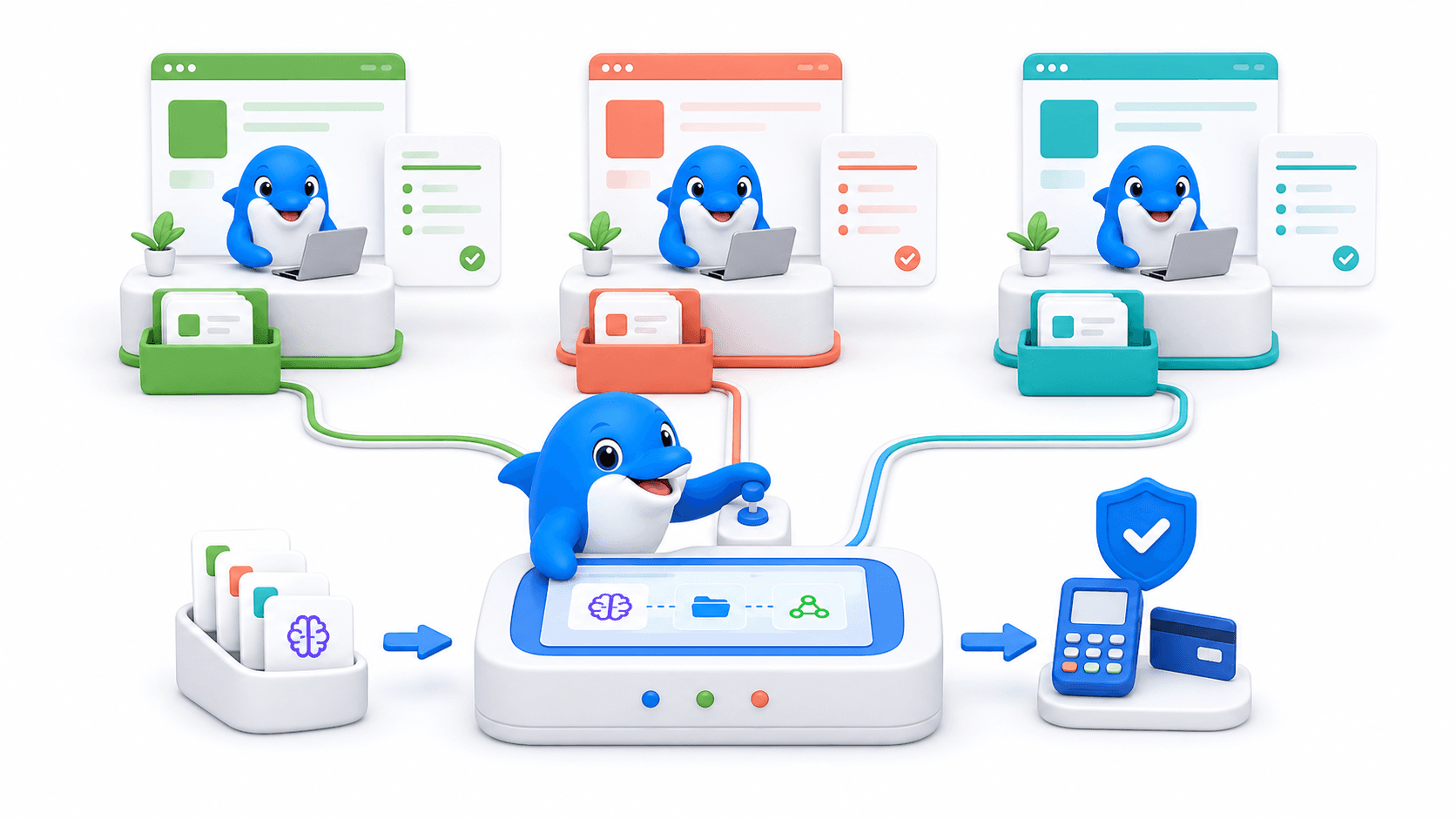
Tidio Plus lists custom branding and multiproject capabilities. These can matter to a larger service team managing multiple properties.
UChat Partner is built around a broader agency business model. Partners can use a custom domain and branding, configure client-facing plans and prices, manage client workspaces, automate onboarding and billing, package templates, and use the Partner API.
The partner sets the sales price and keeps the client-facing revenue, while UChat deducts the applicable platform and workspace costs. This lets an agency combine software access, implementation, templates, integrations, support, and consulting into its own recurring offer.
Branding is only one layer. A partner operating model also determines who owns the client, pricing, workspace, billing path, and reusable solution.
For an agency that wants to sell managed automation under its own brand, this is UChat's clearest advantage.
When Tidio May Be A Better Fit
Tidio may be the better choice when a support or ecommerce team wants a focused service product, values fast adoption, relies heavily on Shopify, and prefers Lyro's guided AI support experience. In that situation, UChat's broader builder can introduce flexibility the team does not need.
Decision Checklist
The scorecard gives the fast answer. Use this shorter implementation check before committing to a trial.
Choose Tidio when most of these are true:
website customer service is the main use case;
the team values quick deployment and a focused support interface;
Shopify support is central;
Lyro's guided AI support model matches the organization;
the required channels fit Tidio's inbox;
the team does not need a full white-label client platform.
Choose UChat when most of these are true:
conversations must trigger detailed business workflows;
the project needs a broader range of channel automations;
builders want AI beside explicit visual logic and reusable functions;
CRM, tickets, APIs, payments, bookings, or ecommerce actions must work together;
the solution will be reused across clients or verticals;
an agency wants its own domain, pricing, billing path, workspaces, and brand.
FAQ
Is UChat a Tidio helpdesk replacement?
Not for every team. UChat includes Live Chat, assignment, Boards, Tickets, customer data, and mobile handling, but Tidio provides a more focused website-support and ecommerce service experience. Compare the exact queue, reporting, routing, and Shopify workflows your team needs.
Does Tidio support automation beyond live chat?
Yes. Tidio Flows supports no-code support and sales journeys, while Lyro automates knowledge-based customer-service work. Tidio also connects multiple customer channels in its inbox.
Which platform offers more flexible workflow building?
UChat is generally the stronger fit when AI, visual logic, Function Flows, external requests, integrations, channel actions, CRM, and Tickets must work as one larger automation.
Which is better for Shopify support?
Tidio is a strong option for a team that wants Shopify order context and actions inside a focused support inbox. UChat may fit better when Shopify activity must connect to broader channel, payment, CRM, API, and agency workflows.
Which is better for agencies?
UChat is generally the stronger fit when an agency wants a full-white-label platform with its own domain, client plans, sales prices, billing path, workspaces, templates, and Partner API automation.
Can I test UChat before deciding?
Yes. UChat offers a 14-day free trial with access to Pro features and no credit card requirement.
Final Verdict And CTA
Tidio is a credible choice for SMB customer service. It packages live chat, ticketing, Shopify support, Flows, and Lyro AI into a product that can be easier for a support team to adopt.
UChat is the better choice when customer conversations must connect to more channels, richer workflow logic, business actions, CRM and tickets, or a branded agency delivery model.
Choose Tidio to improve the support desk. Choose UChat to build the automation system around the conversation.
Start UChat's 14-day free trial with no credit card required.
If you want to sell automation under your own brand, book a UChat Partner demo.
You can also compare UChat vs Intercom and UChat vs Respond.io.
Sources And Review Date
Product and pricing details were reviewed on 2 August 2026. Packaging can change. Primary sources: Tidio pricing, Lyro AI, Tidio Live Chat, Tidio Flows, Tidio Helpdesk, Tidio integrations, UChat, UChat AI Agent, UChat channels, UChat Flow Builder, UChat pricing, and UChat Partner.
Quick Verdict
Tidio and UChat can both automate conversations, connect AI with human support, and help teams manage customer messages. The important difference is what you want the platform to become inside your business.
Choose Tidio for rapid support deployment. Choose UChat when conversations need to become configurable, cross-channel business workflows or a branded service you sell to clients.
Tidio is a strong starting point for an SMB that wants website live chat, ticketing, Shopify support, proactive Flows, and Lyro AI in one focused product.
UChat is the stronger fit for technical operators and agencies that need broader channel automation, configurable AI Agents, visual workflow control, API actions, CRM and ticket operations, or a full-white-label client platform.
Table Of Contents
Scorecard
Recommendation By Use Case
Feature Comparison: Where Tidio Is Strongest
When UChat Makes Sense
Lyro AI And UChat AI Agents
Flows And Actions After The First Reply
Channels And The Customer Inbox
Live Chat Tickets And CRM
Ecommerce Integrations And APIs
Pricing And Usage Models
Agency And White-Label Delivery
Decision Checklist
FAQ
Final Verdict And CTA
Scorecard
If this describes your business | Better starting point | Why |
|---|---|---|
A small support or ecommerce team wants live chat, tickets, and AI working quickly | Tidio | The product is centered on an accessible customer-service workflow, with strong website and Shopify positioning. |
A team wants AI inside detailed visual journeys, integrations, and deterministic business logic | UChat | AI Agents can work with Flow Builder, Function Flows, fields, conditions, API requests, tools, and human transfer. |
A business wants a shared inbox for web chat, email, Instagram, Messenger, and WhatsApp | Tidio | Tidio presents these channels as one focused support inbox. |
A business needs reusable automation across a wider mix of social, messaging, web, SMS, and voice channels | UChat | UChat's Omni Channel model is designed around building logic once and adapting it across supported channels. |
An agency wants its own domain, branding, client plans, prices, workspaces, and billing path | UChat Partner | White-label client delivery is part of UChat's operating model, not only a branding option. |
A team wants AI support with a guided knowledge and performance-management experience | Tidio | Lyro emphasizes controlled knowledge, handoff, conversation review, resolution metrics, and CSAT. |
Recommendation By Use Case
Tidio starts with the support team. A visitor asks a question, Lyro or a Flow responds, a human takes over when needed, and the conversation can become a ticket. The interface and pricing are organized around customer-service conversations, AI conversations, and visitors reached by Flows.
UChat starts with the journey a builder wants to create. A social comment, web chat, WhatsApp message, phone call, or API event can enter a workflow. AI can understand intent, a visual flow can collect structured data, an integration can update another system, and a human can take over with context.
Tidio centers customer service. UChat centers automation architecture. Both include automation and human support, but they organize the work differently.
That difference matters more than a checklist of overlapping features.
Feature Comparison: Where Tidio Is Strongest
Tidio makes sense when the first goal is to improve support without designing a large automation architecture.
Its public product pages bring together:
website live chat and a real-time visitor view;
a multichannel inbox for live chat, email, Instagram, Messenger, and WhatsApp;
ticket conversion, priority, filtering, and routing;
Lyro AI for knowledge-based answers and recurring support tasks;
no-code Flows for proactive support and sales journeys;
deep Shopify actions inside the support experience;
analytics for support and AI performance.
This is a coherent package for a growing ecommerce or support team. If the main job is answering customer questions faster, Tidio may require less solution design than UChat.
When UChat Makes Sense
UChat becomes more useful when the first response is only the beginning.
UChat is built for the work after intent detection.
A customer conversation might need to:
identify intent with an AI Agent;
ask for missing account, order, or booking details;
save answers into custom fields;
call an external API or reusable Function Flow;
update a CRM Board or create a Ticket;
send a payment, booking, or template message;
transfer an exception to the right person;
continue later on another supported channel;
be packaged as a reusable solution for another client.
That is where UChat's broader builder surface earns its complexity. It may take more thought to design, but the result can cover more of the operating workflow.
Lyro AI And UChat AI Agents
Lyro is not a basic FAQ widget. Tidio says it works from the content and guidance a business provides, supports human handoff, can connect to external systems, and gives teams conversation review, resolution, satisfaction, and performance signals. Tidio also offers Lyro as a standalone product for other helpdesks.
This makes Lyro attractive for a team that wants a guided AI support deployment with clear service metrics.
UChat AI Agents are designed to work inside a more configurable automation environment. An agent can use business knowledge and instructions, call AI Functions or tools, coordinate with flows, collect data, trigger actions, and transfer to a human. UChat also supports multiple AI configuration paths and providers rather than making one service-specific AI agent the center of the product.
The tradeoff is focus versus flexibility. Tidio gives support teams a more prescriptive AI service experience. UChat gives builders more ways to decide where AI reasons and where explicit workflow logic takes control.
Flows And Actions After The First Reply
Tidio Flows is a genuine automation product. It provides a no-code builder for support and sales journeys, including proactive website engagement and Instagram-related triggers. A fair comparison should not suggest that Tidio only answers chats.
UChat's distinction appears when workflows become more operational. Flow Builder supports messages, questions, conditions, delays, transfers, data operations, external requests, integrations, and channel actions. Function Flows can isolate reusable logic, while AI Functions let an agent invoke defined business capabilities.
Consider an appointment workflow:
A prospect arrives from Instagram, WhatsApp, Messenger, or web chat.
AI answers service questions and identifies the request.
The flow collects location, service, and preferred time.
An API checks availability and creates the booking.
The workflow sends confirmation and follow-up messages.
An exception creates a Ticket and assigns a person.
The trigger is not the whole product. The workflow after the trigger determines how much manual work remains.
Channels And The Customer Inbox
Tidio's public materials emphasize a practical support-channel set: live chat, email, Instagram, Messenger, and WhatsApp. For many SMB support teams, that may be exactly the required coverage.
UChat supports a wider mix of web, social, messaging, SMS, and voice channels. Its Omni Channel model helps builders reuse logic while still accounting for channel-specific restrictions such as message windows, templates, supported content, and approval rules.
Do not choose by channel count alone. Test the exact requirement:
comments, story replies, ads, DMs, templates, broadcasts, or phone calls;
supported media, buttons, catalogs, payments, and message windows;
customer identity and history across channels;
provider fees and approval requirements;
how AI, automation, and human handoff behave in that channel.
Tidio offers a focused multichannel support inbox. UChat offers a broader channel automation canvas.
Live Chat Tickets And CRM
Tidio has a clear customer-service proposition. Conversations can become tickets, teams can manage priority and routing, and higher plans add collaboration and service-management controls. Its Shopify workflow is especially relevant to ecommerce support.
UChat includes Live Chat handoff, agent and group assignment, mobile handling, customer data, CRM-style Boards, and Tickets. These are useful when human work needs to remain connected to the automation that created it.
Choose Tidio when the support desk is the operating center. Choose UChat when support is one stage in a broader journey that also includes acquisition, qualification, booking, ecommerce, payments, and follow-up.
Ecommerce Integrations And APIs
Tidio is particularly strong around Shopify. Its public live-chat material highlights viewing and managing order details without leaving the inbox, while its integrations connect common customer-service and ecommerce tools.
UChat supports native integrations, external requests, JavaScript, webhooks, Zapier and Make connections, and Mini Apps. Builders can combine ecommerce, calendars, payments, CRMs, spreadsheets, storage, AI providers, and custom APIs inside the workflow.
For a serious evaluation, ignore the raw integration count. Test whether the platform can reliably:
retrieve and update the required record;
authenticate per client or workspace;
handle errors and missing data;
continue the conversation after the action;
package the integration for repeated client delivery.
Pricing And Usage Models
Tidio and UChat meter different things, so their starting prices are not directly comparable.
On 2 August 2026, Tidio's annual pricing page displayed:
Tidio plan | Monthly equivalent when billed annually | Selected packaging |
|---|---|---|
Starter | $24.17/month | 100 billable conversations, live chat and ticketing, basic analytics, 100 Flow visitors, and a one-off Lyro allowance |
Growth | $49.17/month | Starts from 250 billable conversations and adds collaboration and automation features |
Plus | $300/month plus usage | Custom quotas, custom branding, OpenAPI, departments, ticket automations, and premium support |
Premium | Contact sales | Higher-volume managed AI, custom service, and enterprise controls |
Tidio separately meters billable human conversations, Lyro AI conversations, and visitors reached with Flows. Quotas and packaging can change, so model the expected monthly mix.
UChat Business starts at $15/month and includes one bot, 1,000 bot users, five members, and Pro features. Add-ons apply when usage exceeds plan limits. UChat offers a 14-day free trial with no credit card required.
UChat Partner is $199/month before client workspace licenses and add-ons. It includes a partner workspace with five bots, 10,000 bot users, and five members, plus the white-label and client-management operating layer.
For client workspaces, UChat's default partner cost examples are $10/month for Business, $30/month for Business Light, and $100/month for Business Large. These default plans are starting structures rather than fixed resale packages: partners can set their own selling prices, and eligible limits can be customized with applicable workspace and add-on costs.
Compare total cost using:
human conversations and team members;
AI conversations and model-provider usage;
visitors reached by proactive automation;
stored bot users, bots, and workspaces;
WhatsApp, SMS, voice, and email charges;
required branding, APIs, security, analytics, and support;
implementation and ongoing maintenance.
Agency And White-Label Delivery
Tidio Plus lists custom branding and multiproject capabilities. These can matter to a larger service team managing multiple properties.
UChat Partner is built around a broader agency business model. Partners can use a custom domain and branding, configure client-facing plans and prices, manage client workspaces, automate onboarding and billing, package templates, and use the Partner API.
The partner sets the sales price and keeps the client-facing revenue, while UChat deducts the applicable platform and workspace costs. This lets an agency combine software access, implementation, templates, integrations, support, and consulting into its own recurring offer.
Branding is only one layer. A partner operating model also determines who owns the client, pricing, workspace, billing path, and reusable solution.
For an agency that wants to sell managed automation under its own brand, this is UChat's clearest advantage.
When Tidio May Be A Better Fit
Tidio may be the better choice when a support or ecommerce team wants a focused service product, values fast adoption, relies heavily on Shopify, and prefers Lyro's guided AI support experience. In that situation, UChat's broader builder can introduce flexibility the team does not need.
Decision Checklist
The scorecard gives the fast answer. Use this shorter implementation check before committing to a trial.
Choose Tidio when most of these are true:
website customer service is the main use case;
the team values quick deployment and a focused support interface;
Shopify support is central;
Lyro's guided AI support model matches the organization;
the required channels fit Tidio's inbox;
the team does not need a full white-label client platform.
Choose UChat when most of these are true:
conversations must trigger detailed business workflows;
the project needs a broader range of channel automations;
builders want AI beside explicit visual logic and reusable functions;
CRM, tickets, APIs, payments, bookings, or ecommerce actions must work together;
the solution will be reused across clients or verticals;
an agency wants its own domain, pricing, billing path, workspaces, and brand.
FAQ
Is UChat a Tidio helpdesk replacement?
Not for every team. UChat includes Live Chat, assignment, Boards, Tickets, customer data, and mobile handling, but Tidio provides a more focused website-support and ecommerce service experience. Compare the exact queue, reporting, routing, and Shopify workflows your team needs.
Does Tidio support automation beyond live chat?
Yes. Tidio Flows supports no-code support and sales journeys, while Lyro automates knowledge-based customer-service work. Tidio also connects multiple customer channels in its inbox.
Which platform offers more flexible workflow building?
UChat is generally the stronger fit when AI, visual logic, Function Flows, external requests, integrations, channel actions, CRM, and Tickets must work as one larger automation.
Which is better for Shopify support?
Tidio is a strong option for a team that wants Shopify order context and actions inside a focused support inbox. UChat may fit better when Shopify activity must connect to broader channel, payment, CRM, API, and agency workflows.
Which is better for agencies?
UChat is generally the stronger fit when an agency wants a full-white-label platform with its own domain, client plans, sales prices, billing path, workspaces, templates, and Partner API automation.
Can I test UChat before deciding?
Yes. UChat offers a 14-day free trial with access to Pro features and no credit card requirement.
Final Verdict And CTA
Tidio is a credible choice for SMB customer service. It packages live chat, ticketing, Shopify support, Flows, and Lyro AI into a product that can be easier for a support team to adopt.
UChat is the better choice when customer conversations must connect to more channels, richer workflow logic, business actions, CRM and tickets, or a branded agency delivery model.
Choose Tidio to improve the support desk. Choose UChat to build the automation system around the conversation.
Start UChat's 14-day free trial with no credit card required.
If you want to sell automation under your own brand, book a UChat Partner demo.
You can also compare UChat vs Intercom and UChat vs Respond.io.
Sources And Review Date
Product and pricing details were reviewed on 2 August 2026. Packaging can change. Primary sources: Tidio pricing, Lyro AI, Tidio Live Chat, Tidio Flows, Tidio Helpdesk, Tidio integrations, UChat, UChat AI Agent, UChat channels, UChat Flow Builder, UChat pricing, and UChat Partner.