12 minutes
UChat
Posted by
UChat vs Dialogflow CX: Packaged Automation or Google Cloud Agent Engine?
12 minutes
Posted by
UChat

Quick verdict: Choose Dialogflow CX — now part of Google Cloud Conversational Agents — for deterministic, code-adjacent state control, usage pricing, and documented enterprise compliance. Choose UChat for a packaged visual builder with channels, live chat, and CRM tooling. Neither is a drop-in replacement for the other.
Table Of Contents
Quick Verdict And Scorecard
Recommendation By Use Case
Feature Comparison
Architecture And Automation Engine
Channels And Entry Points
Workflow Integrations And APIs
Human Handoff And Operations
When Dialogflow CX May Be A Better Fit
Pricing And Total Cost
Agency And Multi-Client Delivery
Run A Fair Proof Of Concept
Decision Checklist
FAQ
Final Verdict And CTA
Quick Verdict And Scorecard
Dimension | Dialogflow CX | UChat | Edge |
|---|---|---|---|
Product shape | Google Cloud Conversational Agents combine deterministic Flows (the Dialogflow CX layer) with generative Playbooks [S1] | Visual multichannel automation platform positioned as a packaged builder [S10] | Depends — engineered stack vs. packaged product |
Pricing model | Usage-based: Flows chat $0.007/request, Flows voice $0.001/second; Playbooks chat $0.012/request, Playbooks voice $0.002/second [S1] | Listed entry prices: Free $0, Business $15, Partner $199; confirm billing terms [S2] | Not comparable directly — consumption vs. listed plan entry prices |
Trial path | $600 in Flows credits and $1,000 in Playbooks credits for eligible new users, expiring after 12 months [S1] | Free plan at $0 with limits to confirm [S2] | Different units; compare eligibility, limits and expected workload |
Build approach | Deterministic Flows plus generative Playbooks configured within Google Cloud [S1] | Visual drag-and-drop Flow Builder [S6] | Depends — state control vs. visual flow design |
Compliance and security | HIPAA, ISO and SOC certifications, data residency, CMEK, VPC Service Controls, Access Transparency and FedRAMP High documented [S1] | Not detailed in the sources reviewed — confirm directly | Dialogflow CX — enterprise controls explicitly documented |
Channels | Built-in, partner, open-source and API-based integrations including Phone Gateway, Messenger, LINE, Slack and Google Chat [S1] | Web, social, messaging, voice and SMS channel coverage [S5] | Depends — verify overlap for your specific channel mix |
Human handoff / support tooling | Not detailed in the sources reviewed — confirm directly | Live Chat plus Boards and Tickets for support workflows [S7][S8] | UChat — operational layer named explicitly |
Agency / white-label tooling | Not detailed in the sources reviewed — confirm directly | White label, custom domains, client plan controls and billing [S3] | UChat — agency delivery is a stated feature set |
How We Compared
We reviewed current official architecture, pricing, integration and security pages from Google Cloud, then compared them with UChat's public pricing, AI Agent, channel, Flow Builder, Live Chat, CRM, integration and Partner pages. We scored product boundaries, design model, channels, handoff, cost units and agency delivery. Unmentioned capabilities remain proof-of-concept questions, not evidence of absence. [S1]–[S10]
Recommendation By Use Case
Team that needs deterministic Flows and generative Playbooks in Google Cloud: Start with Dialogflow CX [S1].
Workload requiring named security and compliance controls: Evaluate Dialogflow CX's documented controls, then validate the exact services, region, configuration and contract [S1].
Agency or reseller managing client bots: UChat documents white label, custom domains, and client plan and billing controls [S3].
Marketing, support, or ops team without developers: UChat's visual Flow Builder supports direct building and iteration [S6].
Business running support across many channels with a small team: UChat. Coverage across web, social, messaging, voice and SMS [S5], plus Live Chat and CRM Boards and Tickets [S7][S8], gives one place to build, chat and track requests.
Team that wants visual flow design with configurable AI Agents: UChat documents a Flow Builder plus instructions, knowledge, functions and model choice [S4][S6].
Startup testing automation before committing budget: Either can work, but cost mechanics differ sharply — Dialogflow CX bills per request and per voice second with stated new-account credits [S1], while UChat's Free plan starts at $0 with limits worth confirming [S2].
Team needing both deep Google Cloud integration and packaged operations tooling: Neither platform is fully confirmed to cover both; verify Dialogflow CX's operator tooling and UChat's Google Cloud connectivity directly.
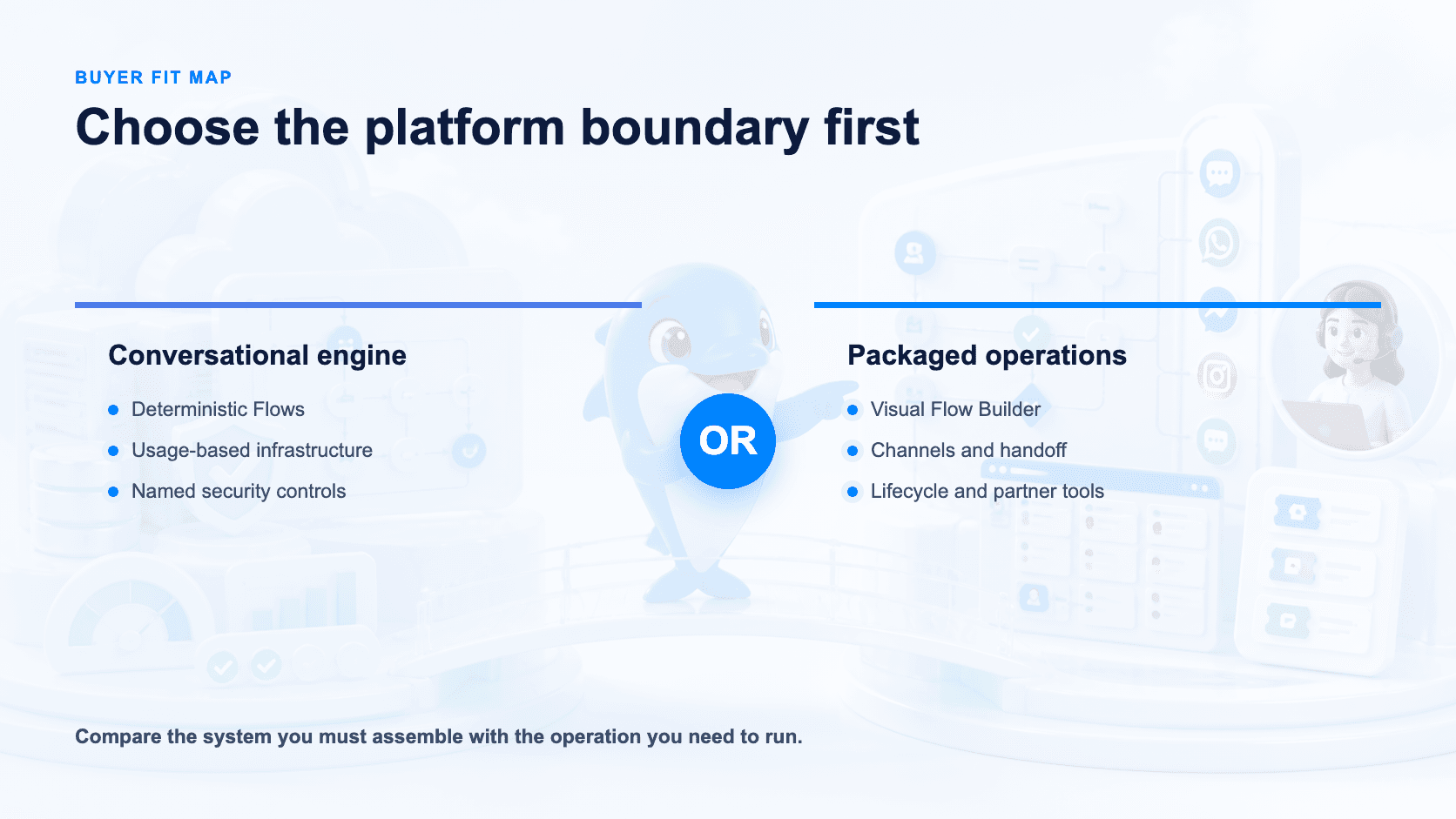
Feature Comparison
Capability | Dialogflow CX | UChat |
|---|---|---|
Integrations | Phone Gateway, Messenger, LINE, Slack, Google Chat and API-based integrations [S1] | Integrations, APIs, webhooks and Mini Apps [S9] |
Security and compliance | HIPAA, ISO, SOC, CMEK, VPC Service Controls, Access Transparency, FedRAMP High [S1] | Not detailed in sources reviewed — confirm directly |
Live support | Not detailed in sources reviewed | Live Chat [S7] |
Ticketing / CRM-lite | Not detailed in sources reviewed | Boards/Tickets [S8] |
Agency features | Not detailed in sources reviewed | White label, custom domain, client plans, billing [S3] |
Build interface | Console-based Flow and Playbook configuration [S1] | Drag-and-drop Flow Builder [S6] |
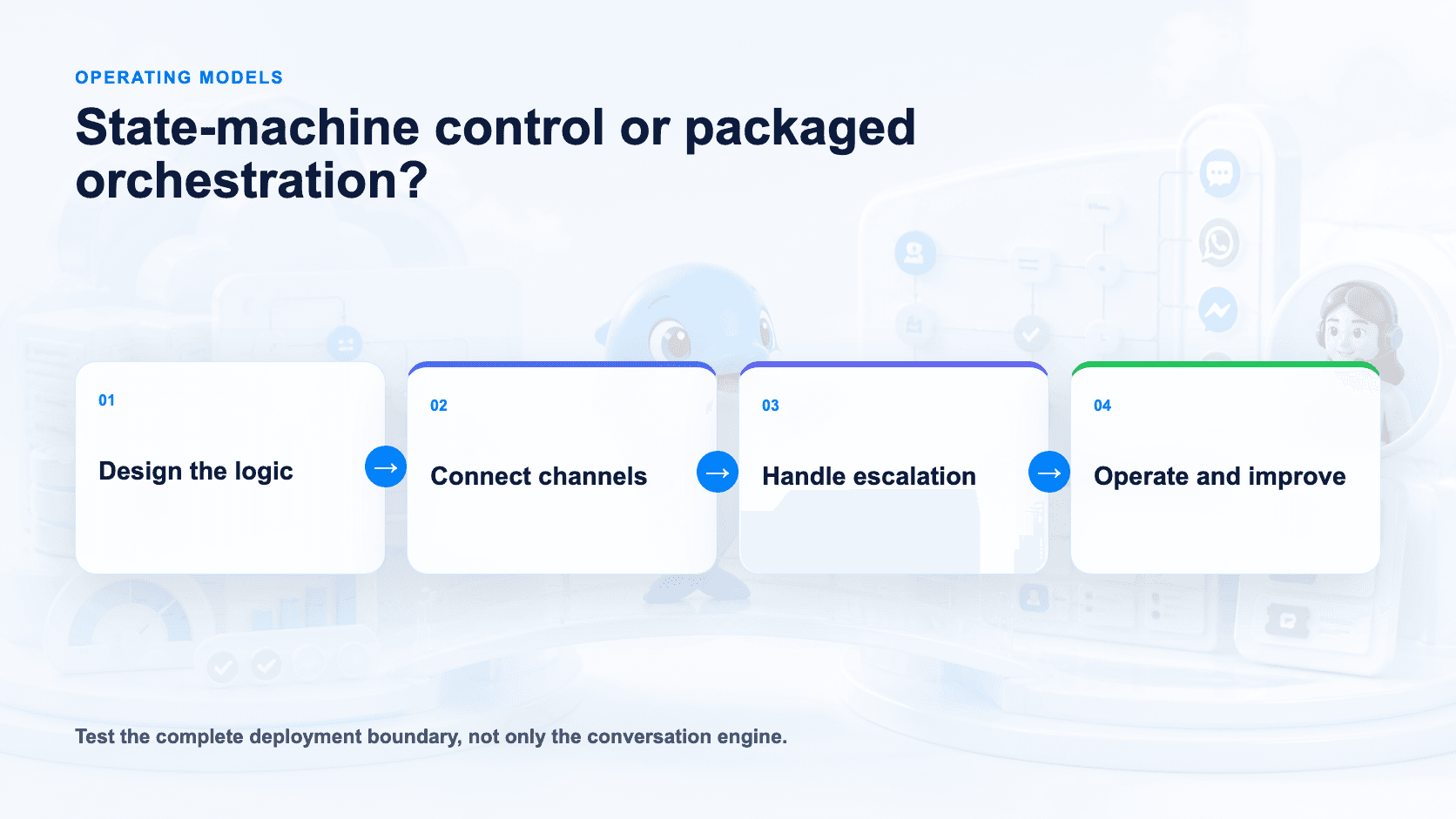
Architecture And Automation Engine
The products make different assumptions about the platform boundary. Google now places Dialogflow CX's deterministic Flows beside generative Playbooks in Conversational Agents [S1]. Buyers therefore need to evaluate a two-part engine with distinct pricing and design patterns [S1].
UChat pairs a visual, no-code automation builder [S6] with a broader multichannel product [S10]. Builders assemble a Flow and layer an AI Agent, configured with instructions, knowledge, functions, and model choice [S4]. Google separates state and generation; UChat puts both in one visual workspace.
The architectural split is not "better" versus "worse." Dialogflow CX documents deterministic Flows and generative Playbooks [S1]. UChat documents a visual Flow Builder and configurable AI Agents [S4][S6]. Test which design model fits the people who will own changes after launch.
Neither source states the other platform lacks a given capability — Google's documentation doesn't market a no-code builder the way UChat does, and UChat's pages don't market a deterministic-plus-generative dual engine the way Google does [S1][S6]. Treat gaps as unverified, not absent.
Channels And Entry Points
Dialogflow CX documents built-in, partner, open-source and API-based integrations, naming Phone Gateway, Messenger, LINE, Slack and Google Chat explicitly [S1]. Each channel conversation follows the applicable request or voice-second billing [S1].
UChat's public feature set lists web, social, messaging, voice and SMS channels [S5], all assembled through the same visual Flow Builder used for the rest of the automation [S6]. For a team that wants one interface to launch a channel and build the logic behind it, that consolidation is the selling point. Where the two channel lists actually overlap isn't fully resolvable from the sources reviewed — confirm against your exact requirements before committing.
Workflow Integrations And APIs
UChat extends past the conversation itself with Live Chat for human handoff [S7], CRM Boards and Tickets for tracking requests [S8], and a broader set of integrations, APIs, webhooks and Mini Apps for connecting to external systems [S9]. For agencies, UChat also documents white labeling, custom domains and client-specific plans and billing [S3].
Dialogflow CX offers built-in, partner, open-source, and API-based paths [S1], with governance controls such as CMEK, VPC Service Controls, and Access Transparency [S1]. This is governed cloud connectivity; UChat extends its builder through webhooks and Mini Apps. Ask each vendor to map required connectors before assuming parity.
Human Handoff And Operations
For workflows that require human handoff, UChat names the operational layer directly: Live Chat handles handoff [S7], while Boards and Tickets provide lifecycle tools [S8]. Test the exact queue, ownership, record and reporting behavior your team needs.
The Dialogflow CX documentation reviewed here focuses on architecture, pricing, channel integration and security [S1] rather than naming a specific human-agent queue or ticketing layer. That does not mean Google Cloud teams cannot add one. Buyers should ask the proposed implementation team to demonstrate the human queue and transcript-handoff stack, including any separate contact-center product and its cost.
When Dialogflow CX May Be A Better Fit
Dialogflow CX may fit better when a team needs deterministic, auditable conversation control and documented enterprise compliance. Flows provide state-machine precision, while Playbooks add generative behavior [S1].
The compliance surface is explicit and extensive: HIPAA, ISO and SOC certifications, data residency controls, customer-managed encryption keys (CMEK), VPC Service Controls, Access Transparency and FedRAMP High are all documented [S1]. These are platform controls, not automatic proof that a particular workload is compliant; verify region, services, configuration and contractual scope. Usage-based pricing can suit variable workloads because cost follows requests and voice-seconds [S1]. Teams already standardized on Google Cloud should test how Dialogflow CX fits their existing architecture rather than assume the integration is automatic.
Pricing And Total Cost
The pricing models reflect two different buyers. Dialogflow CX bills by consumption: Flows chat is $0.007 per request and Flows voice is $0.001 per second; Playbooks chat is $0.012 per request and Playbooks voice is $0.002 per second [S1]. Eligible new users can access $600 in Flows credits and $1,000 in Playbooks credits, expiring after 12 months [S1] — a useful pilot runway, but confirm current eligibility before planning around it. Total cost also depends on generative-feature usage, data-store storage and any adjacent Google Cloud services touched [S1], so a request-price comparison alone understates the real bill.
Usage-based pricing rewards efficient design and punishes runaway conversations. Model your expected request volume, voice minutes and Playbook usage before comparing headline per-request numbers.
UChat publishes listed entry prices instead: Free at $0, Business at $15, and Partner at $199 [S2]. These are entry-tier prices, not confirmed flat totals — verify the billing period, conversation or contact allowances, add-on costs, third-party channel-provider fees, and applicable taxes before budgeting [S2]. Treating UChat's $15 or $199 figures as directly comparable to Dialogflow CX's per-request pricing isn't accurate — one is a subscription entry point, the other a consumption meter — so a fair total-cost comparison requires modeling actual usage against both [S1][S2].
Agency And Multi-Client Delivery
UChat's Partner plan is built explicitly for this use case: white-label branding, custom domains, and client plan and billing management let an agency resell bots under its own name and manage multiple client accounts from one place [S3]. Combined with the Flow Builder [S6] and Mini Apps and webhook integrations [S9], a non-technical team can customize and launch client bots without writing code, with AI Agents' knowledge sources and model choice tuning each deployment [S4].
The sources reviewed here do not document a packaged agency or reseller program for Dialogflow CX [S1]. That is not proof that no partner route exists. Ask Google or the implementation partner to demonstrate account structure, branding, client access and billing if these are purchase criteria.
Run A Fair Proof Of Concept
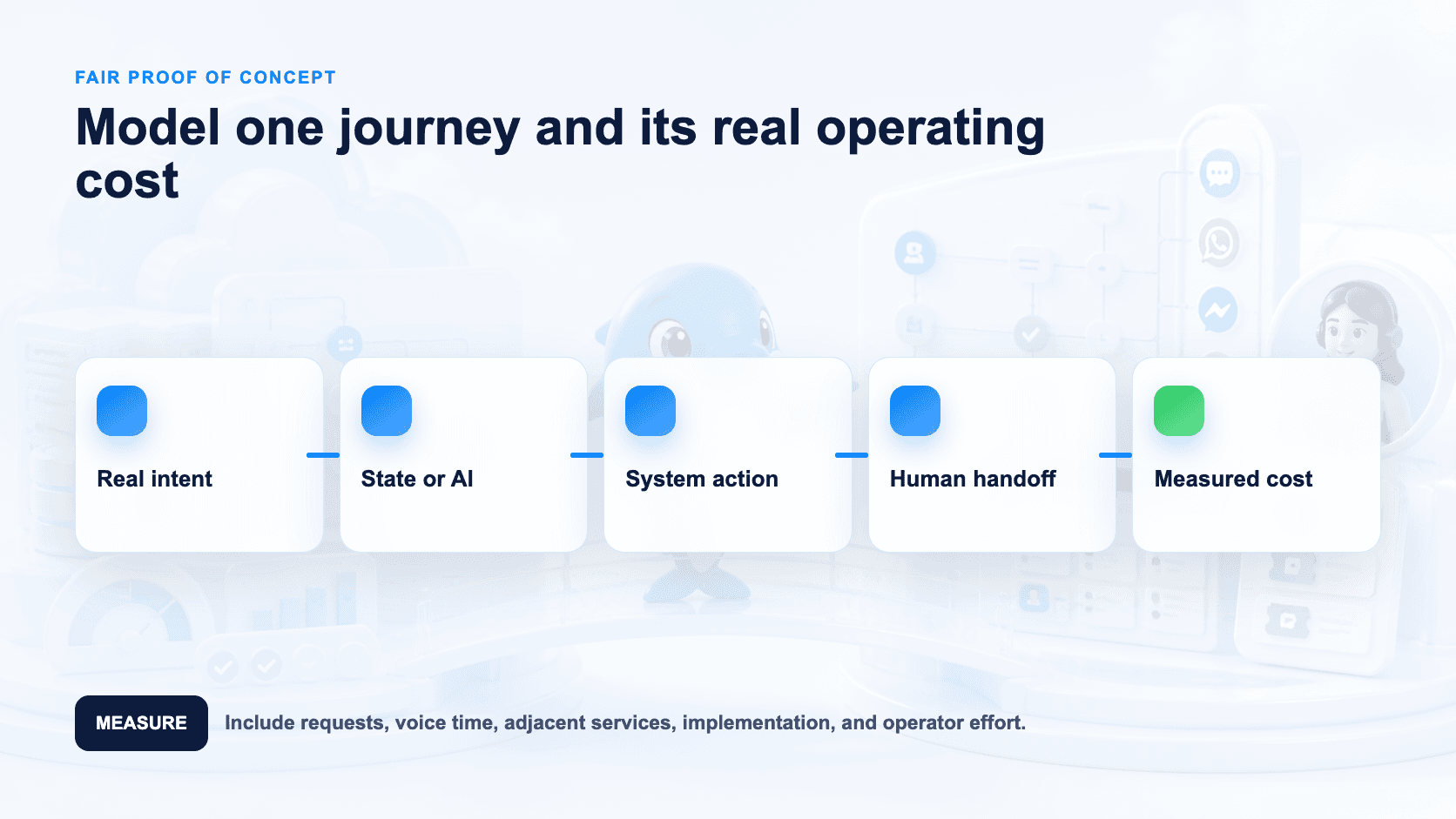
Don't decide from pricing pages alone — run both platforms against the same use case and measure the full cost, not just the sticker price. On Dialogflow CX, build a representative Flow (and, if relevant, a Playbook) and estimate cost using the stated $0.007/$0.012 request rates and $0.001/$0.002 voice-second rates for your expected volume [S1], then add implementation and ongoing engineering time. On UChat, start on the Free plan [S2] and build the same journey in the visual Flow Builder [S6] with an AI Agent [S4], then add any channel-provider fees.
Score both against: request/voice cost at your real volume, implementation time, compliance requirements met, channel coverage for your audience, and who on your team can maintain it after launch. A proof of concept that only compares list prices will miss the engineering time, provider fees and compliance work that usually decide the real total cost [S1][S2].
Decision Checklist
Need deterministic Flows and Playbooks, or a visual Flow Builder? Compare the actual editing and governance workflow [S1][S6].
Need HIPAA, ISO, SOC or FedRAMP High documentation? Dialogflow CX documents this explicitly [S1]; confirm UChat's posture directly.
Can you model request volume and voice minutes? Dialogflow CX is calculated from usage [S1]; UChat's listed entry prices still require plan and add-on confirmation [S2].
Need web, social, messaging, voice and SMS in one visual builder? UChat documents coverage across those categories [S5]; confirm the exact provider, region and plan for each channel, then compare Dialogflow CX's integration list [S1].
Need live chat handoff and ticketing in the same product? UChat has Live Chat [S7] and Boards/Tickets [S8]; confirm what Google Cloud or an integrator adds for Dialogflow CX.
Reselling or white-labeling for multiple clients? UChat has white label, custom domain and client billing [S3]; no equivalent tier is documented for Dialogflow CX here.
Need CMEK, VPC Service Controls or Access Transparency for a specific workload? Dialogflow CX documents these directly [S1].
Do the new-account credits ($600 Flows / $1,000 Playbooks) cover your pilot? Model usage against them first [S1].
Need APIs, webhooks or a Mini Apps layer? UChat provides these [S9]; confirm Dialogflow CX's equivalents [S1].
Already invested in Google Cloud? Test whether Dialogflow CX reduces integration work in your actual architecture; do not assume savings without a deployment design [S1].
FAQ
Is UChat or Dialogflow CX cheaper to start with? The models are different, so headline figures cannot answer that question. UChat lists Free $0, Business $15 and Partner $199 as entry prices [S2]. Dialogflow CX bills per request and voice-second ($0.007–$0.012 chat, $0.001–$0.002 voice) [S1] and lists $600–$1,000 in credits for eligible new users [S1]. Model the same workload, implementation and adjacent services before comparing.
Does UChat offer the same deterministic Flows-plus-generative-Playbooks architecture? Not as documented. UChat's core model is a visual, no-code Flow Builder [S6] paired with configurable AI Agents [S4] — a different architecture, not a lesser one.
Does Dialogflow CX include a built-in live chat and ticketing layer like UChat? Not detailed in the sources reviewed — confirm directly if a packaged human-handoff workspace is required.
Can I white-label and resell on UChat? Yes — white label, custom domain and client plans/billing are built for this [S3]. No equivalent program is documented for Dialogflow CX here.
Which platform should a compliance-audited team evaluate first? Dialogflow CX documents HIPAA, ISO, SOC, FedRAMP High, CMEK and VPC Service Controls [S1]. Fit still depends on the workload, services, region, configuration and contract.
Does UChat support the same voice and SMS channels as Dialogflow CX? UChat lists voice and SMS alongside web, social and messaging [S5]; Dialogflow CX lists Phone Gateway and enterprise messaging integrations [S1]. Confirm exact provider overlap for your needs.
Final Verdict And CTA
Choose Dialogflow CX for deterministic-plus-generative control, usage pricing, and documented enterprise compliance inside Google Cloud [S1]. Choose UChat for a packaged visual multichannel platform with AI Agents, live chat, CRM tooling, and agency white-labeling [S2]–[S10]. Test real workflows and confirm current pricing and compliance scope.
Start a free UChat trial: https://www.uchat.com.au/login
Book a partner demo: https://link.uchat.au/partner-meeting
Related comparisons: UChat vs Rasa · UChat vs Chatfuel · UChat vs ManyChat · UChat vs Landbot
Sources reviewed 12 August 2026.
Quick verdict: Choose Dialogflow CX — now part of Google Cloud Conversational Agents — for deterministic, code-adjacent state control, usage pricing, and documented enterprise compliance. Choose UChat for a packaged visual builder with channels, live chat, and CRM tooling. Neither is a drop-in replacement for the other.
Table Of Contents
Quick Verdict And Scorecard
Recommendation By Use Case
Feature Comparison
Architecture And Automation Engine
Channels And Entry Points
Workflow Integrations And APIs
Human Handoff And Operations
When Dialogflow CX May Be A Better Fit
Pricing And Total Cost
Agency And Multi-Client Delivery
Run A Fair Proof Of Concept
Decision Checklist
FAQ
Final Verdict And CTA
Quick Verdict And Scorecard
Dimension | Dialogflow CX | UChat | Edge |
|---|---|---|---|
Product shape | Google Cloud Conversational Agents combine deterministic Flows (the Dialogflow CX layer) with generative Playbooks [S1] | Visual multichannel automation platform positioned as a packaged builder [S10] | Depends — engineered stack vs. packaged product |
Pricing model | Usage-based: Flows chat $0.007/request, Flows voice $0.001/second; Playbooks chat $0.012/request, Playbooks voice $0.002/second [S1] | Listed entry prices: Free $0, Business $15, Partner $199; confirm billing terms [S2] | Not comparable directly — consumption vs. listed plan entry prices |
Trial path | $600 in Flows credits and $1,000 in Playbooks credits for eligible new users, expiring after 12 months [S1] | Free plan at $0 with limits to confirm [S2] | Different units; compare eligibility, limits and expected workload |
Build approach | Deterministic Flows plus generative Playbooks configured within Google Cloud [S1] | Visual drag-and-drop Flow Builder [S6] | Depends — state control vs. visual flow design |
Compliance and security | HIPAA, ISO and SOC certifications, data residency, CMEK, VPC Service Controls, Access Transparency and FedRAMP High documented [S1] | Not detailed in the sources reviewed — confirm directly | Dialogflow CX — enterprise controls explicitly documented |
Channels | Built-in, partner, open-source and API-based integrations including Phone Gateway, Messenger, LINE, Slack and Google Chat [S1] | Web, social, messaging, voice and SMS channel coverage [S5] | Depends — verify overlap for your specific channel mix |
Human handoff / support tooling | Not detailed in the sources reviewed — confirm directly | Live Chat plus Boards and Tickets for support workflows [S7][S8] | UChat — operational layer named explicitly |
Agency / white-label tooling | Not detailed in the sources reviewed — confirm directly | White label, custom domains, client plan controls and billing [S3] | UChat — agency delivery is a stated feature set |
How We Compared
We reviewed current official architecture, pricing, integration and security pages from Google Cloud, then compared them with UChat's public pricing, AI Agent, channel, Flow Builder, Live Chat, CRM, integration and Partner pages. We scored product boundaries, design model, channels, handoff, cost units and agency delivery. Unmentioned capabilities remain proof-of-concept questions, not evidence of absence. [S1]–[S10]
Recommendation By Use Case
Team that needs deterministic Flows and generative Playbooks in Google Cloud: Start with Dialogflow CX [S1].
Workload requiring named security and compliance controls: Evaluate Dialogflow CX's documented controls, then validate the exact services, region, configuration and contract [S1].
Agency or reseller managing client bots: UChat documents white label, custom domains, and client plan and billing controls [S3].
Marketing, support, or ops team without developers: UChat's visual Flow Builder supports direct building and iteration [S6].
Business running support across many channels with a small team: UChat. Coverage across web, social, messaging, voice and SMS [S5], plus Live Chat and CRM Boards and Tickets [S7][S8], gives one place to build, chat and track requests.
Team that wants visual flow design with configurable AI Agents: UChat documents a Flow Builder plus instructions, knowledge, functions and model choice [S4][S6].
Startup testing automation before committing budget: Either can work, but cost mechanics differ sharply — Dialogflow CX bills per request and per voice second with stated new-account credits [S1], while UChat's Free plan starts at $0 with limits worth confirming [S2].
Team needing both deep Google Cloud integration and packaged operations tooling: Neither platform is fully confirmed to cover both; verify Dialogflow CX's operator tooling and UChat's Google Cloud connectivity directly.
Feature Comparison
Capability | Dialogflow CX | UChat |
|---|---|---|
Integrations | Phone Gateway, Messenger, LINE, Slack, Google Chat and API-based integrations [S1] | Integrations, APIs, webhooks and Mini Apps [S9] |
Security and compliance | HIPAA, ISO, SOC, CMEK, VPC Service Controls, Access Transparency, FedRAMP High [S1] | Not detailed in sources reviewed — confirm directly |
Live support | Not detailed in sources reviewed | Live Chat [S7] |
Ticketing / CRM-lite | Not detailed in sources reviewed | Boards/Tickets [S8] |
Agency features | Not detailed in sources reviewed | White label, custom domain, client plans, billing [S3] |
Build interface | Console-based Flow and Playbook configuration [S1] | Drag-and-drop Flow Builder [S6] |
Architecture And Automation Engine
The products make different assumptions about the platform boundary. Google now places Dialogflow CX's deterministic Flows beside generative Playbooks in Conversational Agents [S1]. Buyers therefore need to evaluate a two-part engine with distinct pricing and design patterns [S1].
UChat pairs a visual, no-code automation builder [S6] with a broader multichannel product [S10]. Builders assemble a Flow and layer an AI Agent, configured with instructions, knowledge, functions, and model choice [S4]. Google separates state and generation; UChat puts both in one visual workspace.
The architectural split is not "better" versus "worse." Dialogflow CX documents deterministic Flows and generative Playbooks [S1]. UChat documents a visual Flow Builder and configurable AI Agents [S4][S6]. Test which design model fits the people who will own changes after launch.
Neither source states the other platform lacks a given capability — Google's documentation doesn't market a no-code builder the way UChat does, and UChat's pages don't market a deterministic-plus-generative dual engine the way Google does [S1][S6]. Treat gaps as unverified, not absent.
Channels And Entry Points
Dialogflow CX documents built-in, partner, open-source and API-based integrations, naming Phone Gateway, Messenger, LINE, Slack and Google Chat explicitly [S1]. Each channel conversation follows the applicable request or voice-second billing [S1].
UChat's public feature set lists web, social, messaging, voice and SMS channels [S5], all assembled through the same visual Flow Builder used for the rest of the automation [S6]. For a team that wants one interface to launch a channel and build the logic behind it, that consolidation is the selling point. Where the two channel lists actually overlap isn't fully resolvable from the sources reviewed — confirm against your exact requirements before committing.
Workflow Integrations And APIs
UChat extends past the conversation itself with Live Chat for human handoff [S7], CRM Boards and Tickets for tracking requests [S8], and a broader set of integrations, APIs, webhooks and Mini Apps for connecting to external systems [S9]. For agencies, UChat also documents white labeling, custom domains and client-specific plans and billing [S3].
Dialogflow CX offers built-in, partner, open-source, and API-based paths [S1], with governance controls such as CMEK, VPC Service Controls, and Access Transparency [S1]. This is governed cloud connectivity; UChat extends its builder through webhooks and Mini Apps. Ask each vendor to map required connectors before assuming parity.
Human Handoff And Operations
For workflows that require human handoff, UChat names the operational layer directly: Live Chat handles handoff [S7], while Boards and Tickets provide lifecycle tools [S8]. Test the exact queue, ownership, record and reporting behavior your team needs.
The Dialogflow CX documentation reviewed here focuses on architecture, pricing, channel integration and security [S1] rather than naming a specific human-agent queue or ticketing layer. That does not mean Google Cloud teams cannot add one. Buyers should ask the proposed implementation team to demonstrate the human queue and transcript-handoff stack, including any separate contact-center product and its cost.
When Dialogflow CX May Be A Better Fit
Dialogflow CX may fit better when a team needs deterministic, auditable conversation control and documented enterprise compliance. Flows provide state-machine precision, while Playbooks add generative behavior [S1].
The compliance surface is explicit and extensive: HIPAA, ISO and SOC certifications, data residency controls, customer-managed encryption keys (CMEK), VPC Service Controls, Access Transparency and FedRAMP High are all documented [S1]. These are platform controls, not automatic proof that a particular workload is compliant; verify region, services, configuration and contractual scope. Usage-based pricing can suit variable workloads because cost follows requests and voice-seconds [S1]. Teams already standardized on Google Cloud should test how Dialogflow CX fits their existing architecture rather than assume the integration is automatic.
Pricing And Total Cost
The pricing models reflect two different buyers. Dialogflow CX bills by consumption: Flows chat is $0.007 per request and Flows voice is $0.001 per second; Playbooks chat is $0.012 per request and Playbooks voice is $0.002 per second [S1]. Eligible new users can access $600 in Flows credits and $1,000 in Playbooks credits, expiring after 12 months [S1] — a useful pilot runway, but confirm current eligibility before planning around it. Total cost also depends on generative-feature usage, data-store storage and any adjacent Google Cloud services touched [S1], so a request-price comparison alone understates the real bill.
Usage-based pricing rewards efficient design and punishes runaway conversations. Model your expected request volume, voice minutes and Playbook usage before comparing headline per-request numbers.
UChat publishes listed entry prices instead: Free at $0, Business at $15, and Partner at $199 [S2]. These are entry-tier prices, not confirmed flat totals — verify the billing period, conversation or contact allowances, add-on costs, third-party channel-provider fees, and applicable taxes before budgeting [S2]. Treating UChat's $15 or $199 figures as directly comparable to Dialogflow CX's per-request pricing isn't accurate — one is a subscription entry point, the other a consumption meter — so a fair total-cost comparison requires modeling actual usage against both [S1][S2].
Agency And Multi-Client Delivery
UChat's Partner plan is built explicitly for this use case: white-label branding, custom domains, and client plan and billing management let an agency resell bots under its own name and manage multiple client accounts from one place [S3]. Combined with the Flow Builder [S6] and Mini Apps and webhook integrations [S9], a non-technical team can customize and launch client bots without writing code, with AI Agents' knowledge sources and model choice tuning each deployment [S4].
The sources reviewed here do not document a packaged agency or reseller program for Dialogflow CX [S1]. That is not proof that no partner route exists. Ask Google or the implementation partner to demonstrate account structure, branding, client access and billing if these are purchase criteria.
Run A Fair Proof Of Concept
Don't decide from pricing pages alone — run both platforms against the same use case and measure the full cost, not just the sticker price. On Dialogflow CX, build a representative Flow (and, if relevant, a Playbook) and estimate cost using the stated $0.007/$0.012 request rates and $0.001/$0.002 voice-second rates for your expected volume [S1], then add implementation and ongoing engineering time. On UChat, start on the Free plan [S2] and build the same journey in the visual Flow Builder [S6] with an AI Agent [S4], then add any channel-provider fees.
Score both against: request/voice cost at your real volume, implementation time, compliance requirements met, channel coverage for your audience, and who on your team can maintain it after launch. A proof of concept that only compares list prices will miss the engineering time, provider fees and compliance work that usually decide the real total cost [S1][S2].
Decision Checklist
Need deterministic Flows and Playbooks, or a visual Flow Builder? Compare the actual editing and governance workflow [S1][S6].
Need HIPAA, ISO, SOC or FedRAMP High documentation? Dialogflow CX documents this explicitly [S1]; confirm UChat's posture directly.
Can you model request volume and voice minutes? Dialogflow CX is calculated from usage [S1]; UChat's listed entry prices still require plan and add-on confirmation [S2].
Need web, social, messaging, voice and SMS in one visual builder? UChat documents coverage across those categories [S5]; confirm the exact provider, region and plan for each channel, then compare Dialogflow CX's integration list [S1].
Need live chat handoff and ticketing in the same product? UChat has Live Chat [S7] and Boards/Tickets [S8]; confirm what Google Cloud or an integrator adds for Dialogflow CX.
Reselling or white-labeling for multiple clients? UChat has white label, custom domain and client billing [S3]; no equivalent tier is documented for Dialogflow CX here.
Need CMEK, VPC Service Controls or Access Transparency for a specific workload? Dialogflow CX documents these directly [S1].
Do the new-account credits ($600 Flows / $1,000 Playbooks) cover your pilot? Model usage against them first [S1].
Need APIs, webhooks or a Mini Apps layer? UChat provides these [S9]; confirm Dialogflow CX's equivalents [S1].
Already invested in Google Cloud? Test whether Dialogflow CX reduces integration work in your actual architecture; do not assume savings without a deployment design [S1].
FAQ
Is UChat or Dialogflow CX cheaper to start with? The models are different, so headline figures cannot answer that question. UChat lists Free $0, Business $15 and Partner $199 as entry prices [S2]. Dialogflow CX bills per request and voice-second ($0.007–$0.012 chat, $0.001–$0.002 voice) [S1] and lists $600–$1,000 in credits for eligible new users [S1]. Model the same workload, implementation and adjacent services before comparing.
Does UChat offer the same deterministic Flows-plus-generative-Playbooks architecture? Not as documented. UChat's core model is a visual, no-code Flow Builder [S6] paired with configurable AI Agents [S4] — a different architecture, not a lesser one.
Does Dialogflow CX include a built-in live chat and ticketing layer like UChat? Not detailed in the sources reviewed — confirm directly if a packaged human-handoff workspace is required.
Can I white-label and resell on UChat? Yes — white label, custom domain and client plans/billing are built for this [S3]. No equivalent program is documented for Dialogflow CX here.
Which platform should a compliance-audited team evaluate first? Dialogflow CX documents HIPAA, ISO, SOC, FedRAMP High, CMEK and VPC Service Controls [S1]. Fit still depends on the workload, services, region, configuration and contract.
Does UChat support the same voice and SMS channels as Dialogflow CX? UChat lists voice and SMS alongside web, social and messaging [S5]; Dialogflow CX lists Phone Gateway and enterprise messaging integrations [S1]. Confirm exact provider overlap for your needs.
Final Verdict And CTA
Choose Dialogflow CX for deterministic-plus-generative control, usage pricing, and documented enterprise compliance inside Google Cloud [S1]. Choose UChat for a packaged visual multichannel platform with AI Agents, live chat, CRM tooling, and agency white-labeling [S2]–[S10]. Test real workflows and confirm current pricing and compliance scope.
Start a free UChat trial: https://www.uchat.com.au/login
Book a partner demo: https://link.uchat.au/partner-meeting
Related comparisons: UChat vs Rasa · UChat vs Chatfuel · UChat vs ManyChat · UChat vs Landbot
Sources reviewed 12 August 2026.