10 minutes
UChat
Posted by
UChat vs Tars: Flexible Automation or Enterprise AI Agents?
10 minutes
Posted by
UChat

Quick verdict: Choose Tars when an enterprise support or acquisition program prioritizes measurable retrieval quality, synthetic testing, governance and an outcome-analysis loop. Choose UChat when you need a more accessible entry point, broader channel families, visual deterministic workflows, lifecycle tools or a white-label platform for client delivery [S1]–[S9].
Table Of Contents
Quick Verdict And Scorecard
Recommendation By Use Case
Feature Comparison
The Current Tars Product Boundary
AI Quality, Knowledge And Evaluation
Workflow Composition And Business Actions
Channels, Operations And Governance
Pricing And Total Cost
Agency And Multi-Client Delivery
When Tars May Be A Better Fit
Run A Fair Proof Of Concept
Decision Checklist
FAQ
Final Verdict And CTA
Quick Verdict And Scorecard
Dimension | Tars | UChat | Starting edge |
|---|---|---|---|
Core model | Outcome-oriented AI Agents for support and sales [S1] | Multichannel visual automation platform [S10] | Tars for enterprise AI programs; UChat for broader workflow composition |
Quality loop | Synthetic conversations, evaluators, staging, analytics and improvement [S1] | Build and test configurable AI inside visual journeys [S4][S6] | Tars for publicly documented evaluation rigor |
Workflow | Agent tools and custom integrations [S1] | Flow Builder, AI functions, APIs, webhooks and Mini Apps [S4][S6][S9] | UChat for explicit deterministic composition |
Channels | Web, WhatsApp and Email continuity documented [S1] | Web, social, messaging, voice and SMS families [S5] | UChat for broader channel architecture |
Governance | Enterprise RBAC, SSO, compliance and configurable retention by plan [S1] | Verify required governance controls directly | Tars for the documented enterprise package |
Entry pricing | Freemium $0; Premium from $499 monthly [S1] | Free $0, Business $15 and Partner $199 listed entry prices [S2] | UChat for accessible entry; compare equivalent scope |
Agency delivery | Enterprise implementation and services [S1] | White label, custom domains, plans and billing [S3] | Different models: managed enterprise versus branded resale |
How We Compared
We reviewed Tars' current homepage, pricing and tool pages, then compared them with UChat's public pricing, Partner, AI Agent, Channels, Flow Builder, Live Chat, CRM and Integrations pages. This article uses Tars' current AI Agent positioning rather than reducing it to its older conversational landing-page reputation [S1]–[S10].
Recommendation By Use Case
Enterprise CX team needing a formal build-test-deploy-analyze-improve loop: Start with Tars [S1].
Regulated organization evaluating SSO, RBAC, retention and named compliance requirements: Put Tars Enterprise on the shortlist [S1].
Team needing visual flows across social, messaging, web, voice and SMS: Start with UChat [S5][S6].
Automation builder combining deterministic logic, AI functions, APIs, webhooks and lifecycle stages: Start with UChat [S4][S6][S8][S9].
Agency selling a platform under its own domain and brand: Start with UChat Partner [S3].
High-stakes enterprise buyer wanting vendor-led implementation and evaluation: Tars' service model may justify its higher starting cost [S1].
Feature Comparison
Capability | Tars | UChat |
|---|---|---|
AI setup | Agent behavior, knowledge, tools and outcome design [S1] | Instructions, knowledge, model choice and functions [S4] |
Evaluation | Synthetic multi-turn tests, LLM judges and human validation [S1] | Testable AI within visual workflows [S4][S6] |
Workflow | Agent tools, actions and custom connections [S1] | Visual Flow Builder plus APIs, webhooks and Mini Apps [S6][S9] |
Channels | Web, WhatsApp and Email continuity documented [S1] | Web, social, messaging, voice and SMS [S5] |
Human service | Customer-facing Live Chat handoff sold as an add-on [S1] | Live Chat handoff [S7] |
Lifecycle | Outcome analytics and conversation improvement [S1] | CRM Boards and Tickets [S8] |
Governance | SSO, RBAC, compliance and retention by plan [S1] | Confirm required controls during procurement |
Partner model | Enterprise services and custom implementation [S1] | White-label client platform and billing [S3] |
The Current Tars Product Boundary
Tars now positions itself around AI Agents for customer support and acquisition [S1]. Its current product story includes knowledge retrieval, evaluation, analytics, tools, cross-channel continuity and enterprise governance. Buyers should evaluate that current platform, not assume the product is merely a conversational form builder.
The homepage describes Agents that recognize context, act through tools and follow up. It also frames success around whether the customer achieved the intended outcome rather than whether a ticket was merely deflected [S1]. That is a meaningful enterprise CX proposition.
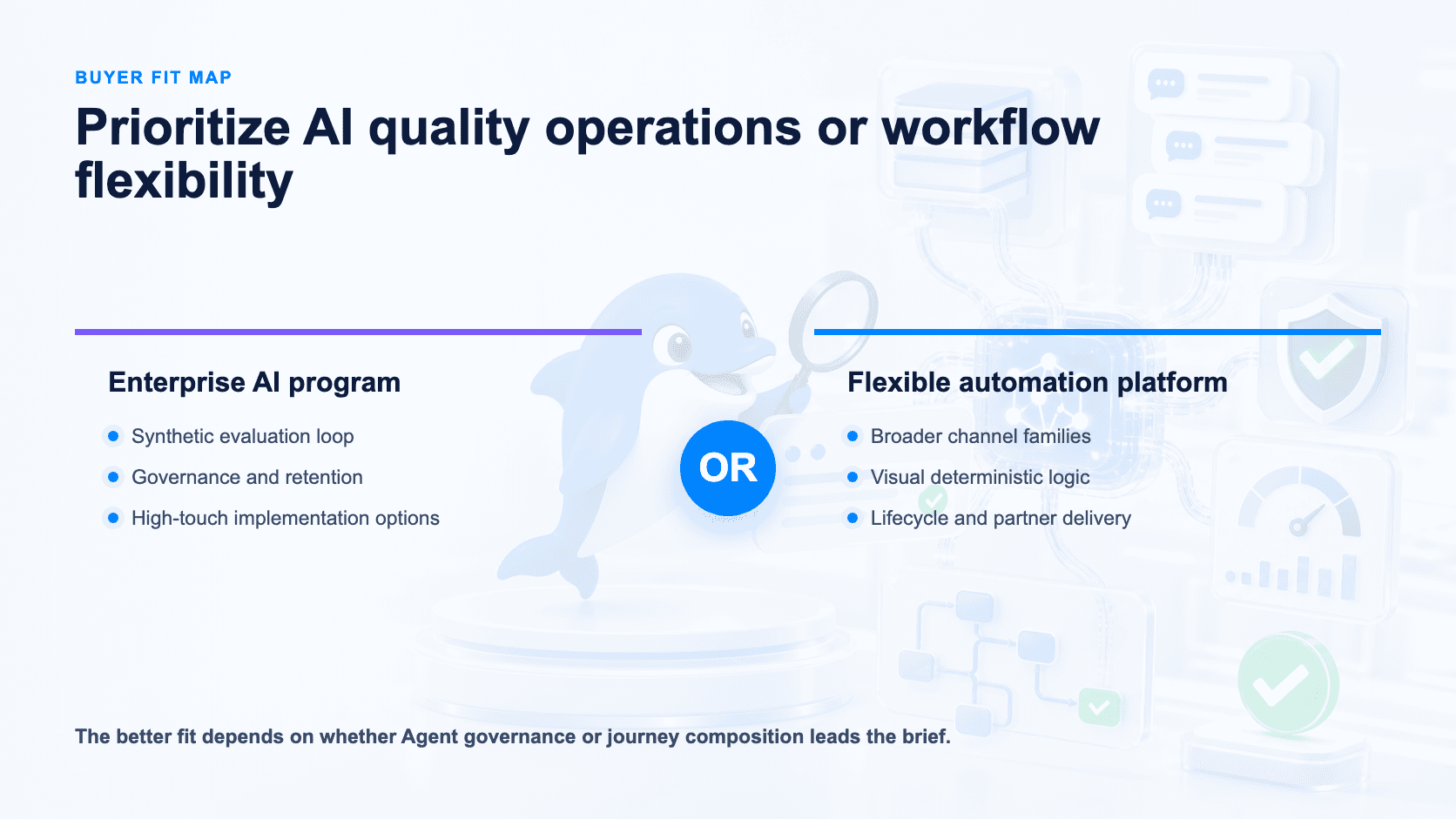
UChat's boundary is broader conversation automation. AI Agents are one component alongside a Flow Builder, channels, Live Chat, CRM Boards, Tickets and integrations [S4]–[S9]. This makes the comparison one of emphasis: AI quality operations as the center versus customer-journey composition as the center.
AI Quality, Knowledge And Evaluation
Tars publicly describes a rigorous loop. Teams configure knowledge, behavior and tools; generate synthetic multi-turn conversations; score responses with LLM-based evaluators; validate evaluators with human annotation; stage changes; analyze failures; and feed them back into the next build [S1].
That process matters for enterprise teams that need more than a demo that answers five happy-path questions. It creates a language for regression testing, error analysis and continuous improvement.
UChat documents configurable AI Agents with instructions, knowledge, model choice and functions [S4]. Its Flow Builder can place deterministic control around AI behavior [S6]. Buyers should define their own evaluation set and release process, then test how easily the platform supports it.
Tars has the clearer public evidence for an evaluation-led Agent lifecycle. UChat's case is the flexibility to combine AI with explicit flow logic, channels and business actions.
If governance and measurable retrieval quality lead the buying criteria, Tars may deserve the edge. If the team values channel and workflow composition more, UChat may produce the better operating fit.
Workflow Composition And Business Actions
Tars documents Agents connected to more than 1,000 tools or custom-created tools, plus integrations with AI model ecosystems [S1]. Its examples focus on completing outcomes such as bookings, claims, returns and work orders rather than answering alone.
UChat documents AI functions, a drag-and-drop Flow Builder, integrations, APIs, webhooks and Mini Apps [S4][S6][S9]. This explicit separation between probabilistic AI and deterministic flow components is useful when a team wants firm control over validation, branching, delays, routing and system actions.
Build the same outcome in both. Count how many critical steps are visible, testable and recoverable. More connectors do not guarantee a safer workflow; more blocks do not guarantee a simpler one. The maintainers need to understand failures without reconstructing the entire conversation.
Channels, Operations And Governance
Tars documents one deployment across Web, WhatsApp and Email with conversation continuity [S1]. Its pricing page separately lists a customer-facing Live Chat add-on that hands a conversation to a live agent. Enterprise features include RBAC, SSO, configurable retention and vendor-stated security or compliance controls [S1]. The separate phrase “Live Chat support” in the Premium plan is vendor support, not evidence that the customer-facing handoff add-on is included.
UChat documents a broader set of channel families across web, social, messaging, voice and SMS [S5]. It provides Live Chat handoff and lifecycle tools through CRM Boards and Tickets [S7][S8].
For a regulated enterprise, governance may outweigh channel count. Verify roles, audit needs, retention, data location, model policies, approval gates and incident response with both vendors. For an automation business coordinating more public channel families, test UChat's breadth and shared data model.
Pricing And Total Cost
Tars lists Freemium at $0, Premium from $499 per month and custom Enterprise pricing [S1]. Freemium includes 50 conversations monthly, basic LLM access, five knowledge bases and one-month retention. Premium includes advanced LLM access, 20 knowledge bases, live-chat support and 12-month retention, with conversation volume affecting price [S1].
The pricing page captured on 12 August 2026 lists the customer-facing Live Chat handoff add-on at $600 per seat annually for Premium and Enterprise buyers. It separately lists professional support services at $5,000 per Agent annually for Premium buyers; the page describes these as a designated customer success manager and guided support [S1]. These are optional or separately packaged costs, not capabilities included across every Tars plan.
UChat lists Free $0, Business $15 and Partner $199 as entry prices [S2]. Confirm billing period, resource limits, AI provider costs, channel fees, members and add-ons.
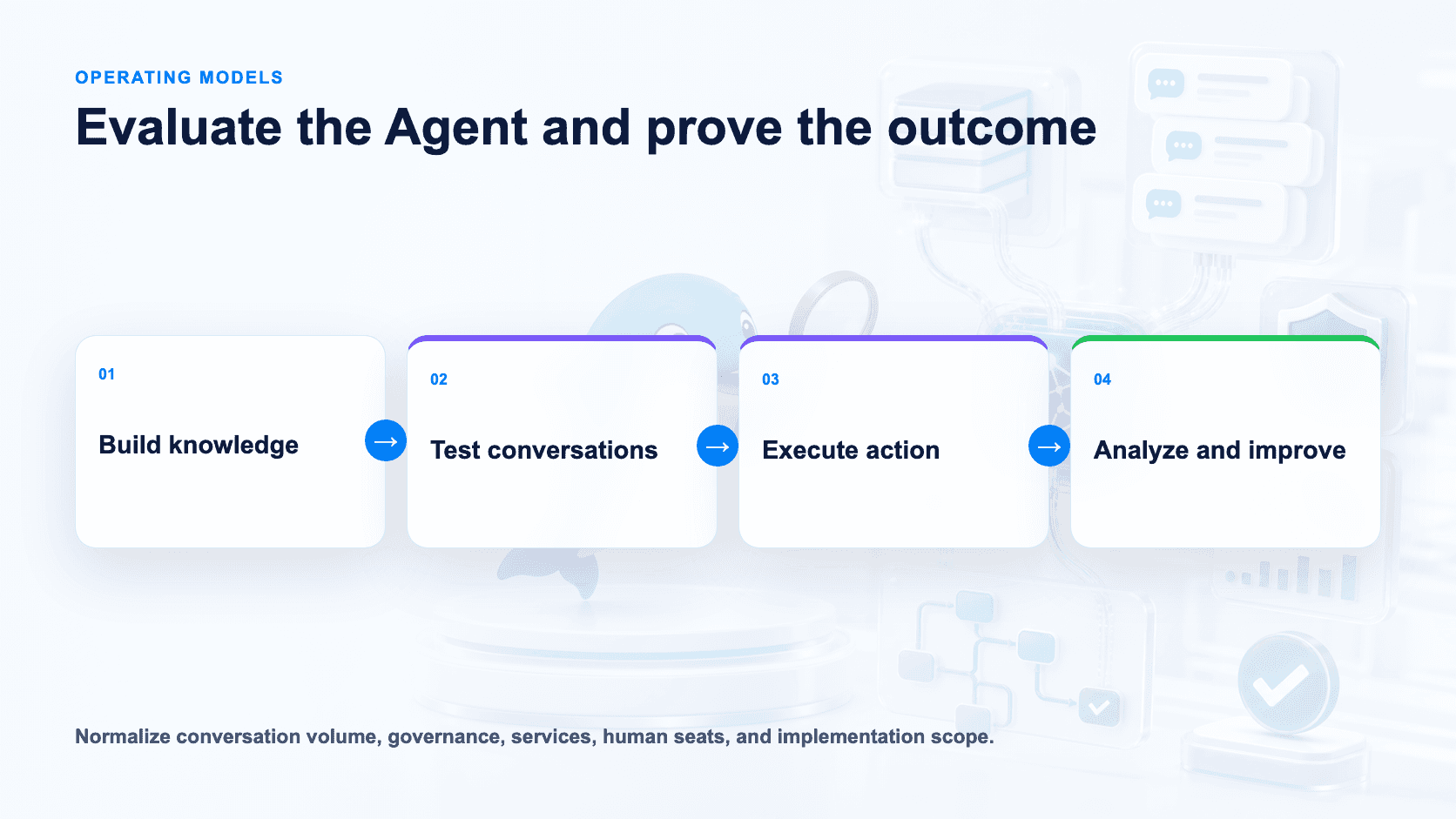
Compare annual cost at the same conversation volume, number of Agents, knowledge bases, retention, human seats, governance, implementation and support. Tars may look expensive beside UChat's entry plan because it is packaging a different level of enterprise operation. Normalize scope before drawing a price conclusion.
Agency And Multi-Client Delivery
Tars Enterprise documents white-glove onboarding, custom integrations and a dedicated account manager. Premium buyers can separately purchase professional support services [S1]. That can suit a consultancy delivering a bespoke AI program with the vendor closely involved.
UChat Partner documents white-label domains and interfaces, client plans and billing [S3]. That suits an agency or reseller that wants a repeatable platform business under its own brand.
These are different scaling models. Tars leans toward high-touch enterprise implementation. UChat provides the clearer public path for branded multi-client resale. Agencies should test client isolation, reusable assets, permissions, reporting, support access and economics across ten customers before choosing.
When Tars May Be A Better Fit
Tars may be better when AI quality assurance is itself a formal operating discipline. Its documented synthetic testing, evaluator validation, failure analysis and improvement loop give an enterprise team a stronger starting framework [S1].
It may also be better when procurement requires named governance controls, white-glove Enterprise onboarding, longer retention or a dedicated account manager [S1]. Optional guided support may reduce implementation risk for a high-value Premium deployment, but buyers should include its separate price.
Finally, teams focused on a few high-volume support or acquisition journeys may value Tars' outcome-centered product boundary more than UChat's broader channel and reseller flexibility.
Run A Fair Proof Of Concept
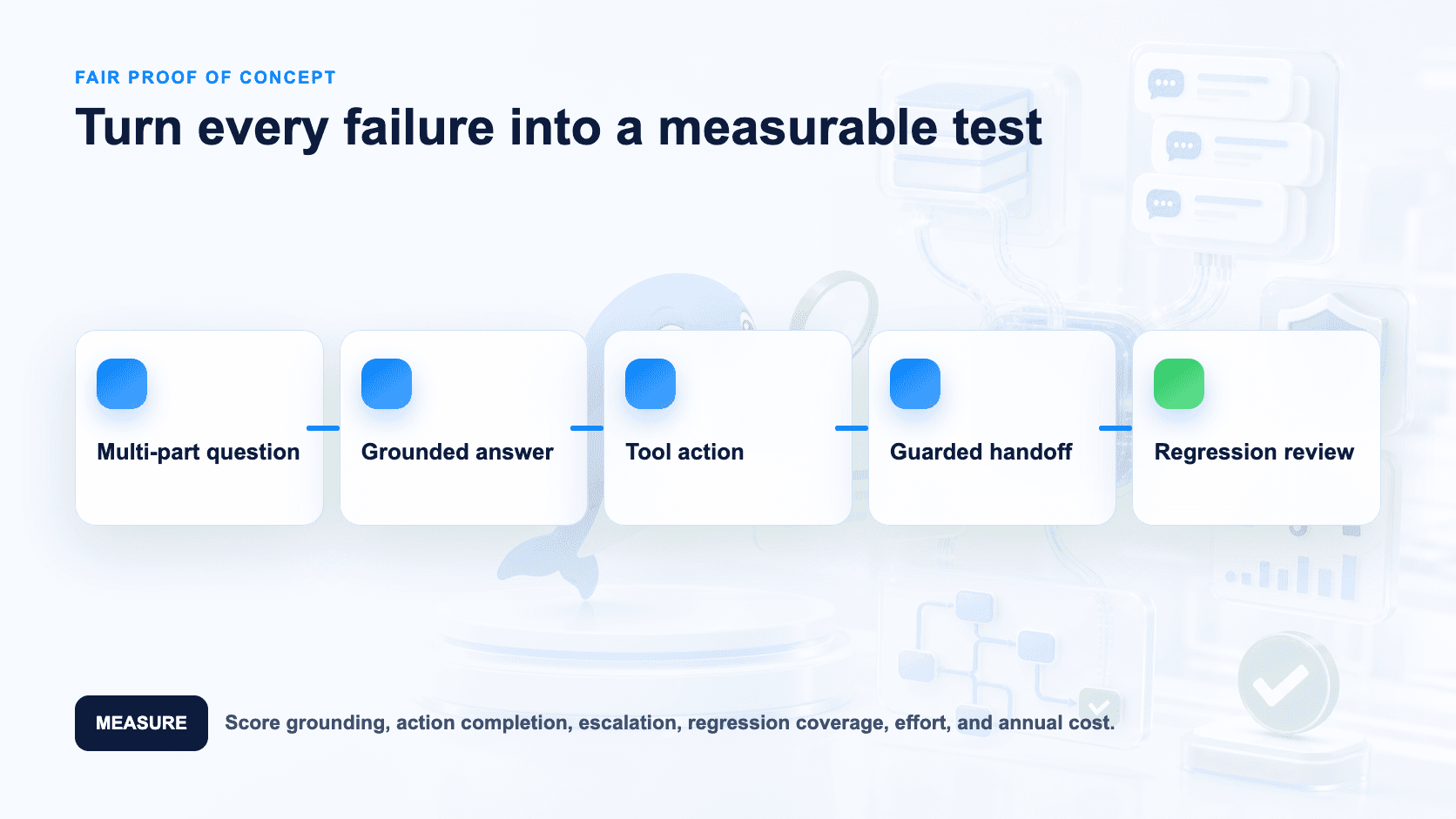
Choose one high-value outcome, not a generic FAQ:
The customer asks a multi-part question using approved knowledge.
The Agent identifies intent and required data.
It calls one real or sandboxed business action.
An ambiguous policy triggers a guarded response.
A failed tool call follows a visible recovery path.
A human takes over with full context.
The team evaluates the outcome and turns the failure into a regression test.
Measure answer correctness, retrieval grounding, completed actions, escalation quality, setup time, regression coverage, operator effort and total annual cost. Include adversarial phrasing, stale knowledge and a channel switch.
Decision Checklist
Is the primary need enterprise AI quality operations or broad workflow composition?
Do you need synthetic tests, evaluator validation and formal regression review [S1]?
Which channel families are mandatory [S1][S5]?
Must the process combine probabilistic AI with deterministic visual steps [S4][S6]?
Which tools, APIs or webhooks must execute reliably [S1][S9]?
What roles, SSO, retention and compliance controls are required [S1]?
Does work continue through CRM Boards or Tickets [S8]?
Are live-chat seats or professional services part of the Tars scope [S1]?
Do clients need a branded platform rather than a bespoke implementation [S3]?
Which product completed the outcome and explained its failures more clearly?
FAQ
Is Tars still mainly a conversational landing-page tool? Its current official positioning is an AI Agent platform for customer support and acquisition with knowledge, evaluation, analytics and tools [S1].
Does UChat provide AI functions and visual logic? Yes. UChat documents AI functions, model choices and a visual Flow Builder [S4][S6].
Which has stronger AI evaluation? Tars publishes the more detailed evaluation lifecycle, including synthetic conversations and evaluator validation [S1]. UChat buyers should implement and test their required evaluation process directly.
Which supports more channel families? UChat documents a broader portfolio [S5]. Tars documents continuity across Web, WhatsApp and Email [S1]. Verify exact deployment details.
Which is cheaper? UChat has a lower published entry point, while Tars Premium packages a more enterprise-oriented scope [S1][S2]. Compare equivalent volume, governance, services and support.
Which is better for agencies? UChat has the clearer documented white-label reseller model [S3]. Tars may fit consultancies delivering high-touch enterprise Agent programs [S1].
Final Verdict And CTA
Choose Tars for enterprise AI Agent quality, governance, outcome analytics and optional or Enterprise-level implementation support [S1]. Choose UChat for accessible visual automation across more channel families, explicit business workflows, lifecycle tools and branded client delivery [S2]–[S9].
Start a 14-day UChat trial with Pro access and no credit card [S11]. Agencies can book a Partner Plan demo [S12].
Related comparisons: UChat vs Yellow.ai · UChat vs Ada · UChat vs Voiceflow
Explore UChat's official pages for pricing, AI Agents, channels, Flow Builder, Live Chat, CRM, integrations and the Partner program.
Sources reviewed 12 August 2026.
Quick verdict: Choose Tars when an enterprise support or acquisition program prioritizes measurable retrieval quality, synthetic testing, governance and an outcome-analysis loop. Choose UChat when you need a more accessible entry point, broader channel families, visual deterministic workflows, lifecycle tools or a white-label platform for client delivery [S1]–[S9].
Table Of Contents
Quick Verdict And Scorecard
Recommendation By Use Case
Feature Comparison
The Current Tars Product Boundary
AI Quality, Knowledge And Evaluation
Workflow Composition And Business Actions
Channels, Operations And Governance
Pricing And Total Cost
Agency And Multi-Client Delivery
When Tars May Be A Better Fit
Run A Fair Proof Of Concept
Decision Checklist
FAQ
Final Verdict And CTA
Quick Verdict And Scorecard
Dimension | Tars | UChat | Starting edge |
|---|---|---|---|
Core model | Outcome-oriented AI Agents for support and sales [S1] | Multichannel visual automation platform [S10] | Tars for enterprise AI programs; UChat for broader workflow composition |
Quality loop | Synthetic conversations, evaluators, staging, analytics and improvement [S1] | Build and test configurable AI inside visual journeys [S4][S6] | Tars for publicly documented evaluation rigor |
Workflow | Agent tools and custom integrations [S1] | Flow Builder, AI functions, APIs, webhooks and Mini Apps [S4][S6][S9] | UChat for explicit deterministic composition |
Channels | Web, WhatsApp and Email continuity documented [S1] | Web, social, messaging, voice and SMS families [S5] | UChat for broader channel architecture |
Governance | Enterprise RBAC, SSO, compliance and configurable retention by plan [S1] | Verify required governance controls directly | Tars for the documented enterprise package |
Entry pricing | Freemium $0; Premium from $499 monthly [S1] | Free $0, Business $15 and Partner $199 listed entry prices [S2] | UChat for accessible entry; compare equivalent scope |
Agency delivery | Enterprise implementation and services [S1] | White label, custom domains, plans and billing [S3] | Different models: managed enterprise versus branded resale |
How We Compared
We reviewed Tars' current homepage, pricing and tool pages, then compared them with UChat's public pricing, Partner, AI Agent, Channels, Flow Builder, Live Chat, CRM and Integrations pages. This article uses Tars' current AI Agent positioning rather than reducing it to its older conversational landing-page reputation [S1]–[S10].
Recommendation By Use Case
Enterprise CX team needing a formal build-test-deploy-analyze-improve loop: Start with Tars [S1].
Regulated organization evaluating SSO, RBAC, retention and named compliance requirements: Put Tars Enterprise on the shortlist [S1].
Team needing visual flows across social, messaging, web, voice and SMS: Start with UChat [S5][S6].
Automation builder combining deterministic logic, AI functions, APIs, webhooks and lifecycle stages: Start with UChat [S4][S6][S8][S9].
Agency selling a platform under its own domain and brand: Start with UChat Partner [S3].
High-stakes enterprise buyer wanting vendor-led implementation and evaluation: Tars' service model may justify its higher starting cost [S1].
Feature Comparison
Capability | Tars | UChat |
|---|---|---|
AI setup | Agent behavior, knowledge, tools and outcome design [S1] | Instructions, knowledge, model choice and functions [S4] |
Evaluation | Synthetic multi-turn tests, LLM judges and human validation [S1] | Testable AI within visual workflows [S4][S6] |
Workflow | Agent tools, actions and custom connections [S1] | Visual Flow Builder plus APIs, webhooks and Mini Apps [S6][S9] |
Channels | Web, WhatsApp and Email continuity documented [S1] | Web, social, messaging, voice and SMS [S5] |
Human service | Customer-facing Live Chat handoff sold as an add-on [S1] | Live Chat handoff [S7] |
Lifecycle | Outcome analytics and conversation improvement [S1] | CRM Boards and Tickets [S8] |
Governance | SSO, RBAC, compliance and retention by plan [S1] | Confirm required controls during procurement |
Partner model | Enterprise services and custom implementation [S1] | White-label client platform and billing [S3] |
The Current Tars Product Boundary
Tars now positions itself around AI Agents for customer support and acquisition [S1]. Its current product story includes knowledge retrieval, evaluation, analytics, tools, cross-channel continuity and enterprise governance. Buyers should evaluate that current platform, not assume the product is merely a conversational form builder.
The homepage describes Agents that recognize context, act through tools and follow up. It also frames success around whether the customer achieved the intended outcome rather than whether a ticket was merely deflected [S1]. That is a meaningful enterprise CX proposition.
UChat's boundary is broader conversation automation. AI Agents are one component alongside a Flow Builder, channels, Live Chat, CRM Boards, Tickets and integrations [S4]–[S9]. This makes the comparison one of emphasis: AI quality operations as the center versus customer-journey composition as the center.
AI Quality, Knowledge And Evaluation
Tars publicly describes a rigorous loop. Teams configure knowledge, behavior and tools; generate synthetic multi-turn conversations; score responses with LLM-based evaluators; validate evaluators with human annotation; stage changes; analyze failures; and feed them back into the next build [S1].
That process matters for enterprise teams that need more than a demo that answers five happy-path questions. It creates a language for regression testing, error analysis and continuous improvement.
UChat documents configurable AI Agents with instructions, knowledge, model choice and functions [S4]. Its Flow Builder can place deterministic control around AI behavior [S6]. Buyers should define their own evaluation set and release process, then test how easily the platform supports it.
Tars has the clearer public evidence for an evaluation-led Agent lifecycle. UChat's case is the flexibility to combine AI with explicit flow logic, channels and business actions.
If governance and measurable retrieval quality lead the buying criteria, Tars may deserve the edge. If the team values channel and workflow composition more, UChat may produce the better operating fit.
Workflow Composition And Business Actions
Tars documents Agents connected to more than 1,000 tools or custom-created tools, plus integrations with AI model ecosystems [S1]. Its examples focus on completing outcomes such as bookings, claims, returns and work orders rather than answering alone.
UChat documents AI functions, a drag-and-drop Flow Builder, integrations, APIs, webhooks and Mini Apps [S4][S6][S9]. This explicit separation between probabilistic AI and deterministic flow components is useful when a team wants firm control over validation, branching, delays, routing and system actions.
Build the same outcome in both. Count how many critical steps are visible, testable and recoverable. More connectors do not guarantee a safer workflow; more blocks do not guarantee a simpler one. The maintainers need to understand failures without reconstructing the entire conversation.
Channels, Operations And Governance
Tars documents one deployment across Web, WhatsApp and Email with conversation continuity [S1]. Its pricing page separately lists a customer-facing Live Chat add-on that hands a conversation to a live agent. Enterprise features include RBAC, SSO, configurable retention and vendor-stated security or compliance controls [S1]. The separate phrase “Live Chat support” in the Premium plan is vendor support, not evidence that the customer-facing handoff add-on is included.
UChat documents a broader set of channel families across web, social, messaging, voice and SMS [S5]. It provides Live Chat handoff and lifecycle tools through CRM Boards and Tickets [S7][S8].
For a regulated enterprise, governance may outweigh channel count. Verify roles, audit needs, retention, data location, model policies, approval gates and incident response with both vendors. For an automation business coordinating more public channel families, test UChat's breadth and shared data model.
Pricing And Total Cost
Tars lists Freemium at $0, Premium from $499 per month and custom Enterprise pricing [S1]. Freemium includes 50 conversations monthly, basic LLM access, five knowledge bases and one-month retention. Premium includes advanced LLM access, 20 knowledge bases, live-chat support and 12-month retention, with conversation volume affecting price [S1].
The pricing page captured on 12 August 2026 lists the customer-facing Live Chat handoff add-on at $600 per seat annually for Premium and Enterprise buyers. It separately lists professional support services at $5,000 per Agent annually for Premium buyers; the page describes these as a designated customer success manager and guided support [S1]. These are optional or separately packaged costs, not capabilities included across every Tars plan.
UChat lists Free $0, Business $15 and Partner $199 as entry prices [S2]. Confirm billing period, resource limits, AI provider costs, channel fees, members and add-ons.
Compare annual cost at the same conversation volume, number of Agents, knowledge bases, retention, human seats, governance, implementation and support. Tars may look expensive beside UChat's entry plan because it is packaging a different level of enterprise operation. Normalize scope before drawing a price conclusion.
Agency And Multi-Client Delivery
Tars Enterprise documents white-glove onboarding, custom integrations and a dedicated account manager. Premium buyers can separately purchase professional support services [S1]. That can suit a consultancy delivering a bespoke AI program with the vendor closely involved.
UChat Partner documents white-label domains and interfaces, client plans and billing [S3]. That suits an agency or reseller that wants a repeatable platform business under its own brand.
These are different scaling models. Tars leans toward high-touch enterprise implementation. UChat provides the clearer public path for branded multi-client resale. Agencies should test client isolation, reusable assets, permissions, reporting, support access and economics across ten customers before choosing.
When Tars May Be A Better Fit
Tars may be better when AI quality assurance is itself a formal operating discipline. Its documented synthetic testing, evaluator validation, failure analysis and improvement loop give an enterprise team a stronger starting framework [S1].
It may also be better when procurement requires named governance controls, white-glove Enterprise onboarding, longer retention or a dedicated account manager [S1]. Optional guided support may reduce implementation risk for a high-value Premium deployment, but buyers should include its separate price.
Finally, teams focused on a few high-volume support or acquisition journeys may value Tars' outcome-centered product boundary more than UChat's broader channel and reseller flexibility.
Run A Fair Proof Of Concept
Choose one high-value outcome, not a generic FAQ:
The customer asks a multi-part question using approved knowledge.
The Agent identifies intent and required data.
It calls one real or sandboxed business action.
An ambiguous policy triggers a guarded response.
A failed tool call follows a visible recovery path.
A human takes over with full context.
The team evaluates the outcome and turns the failure into a regression test.
Measure answer correctness, retrieval grounding, completed actions, escalation quality, setup time, regression coverage, operator effort and total annual cost. Include adversarial phrasing, stale knowledge and a channel switch.
Decision Checklist
Is the primary need enterprise AI quality operations or broad workflow composition?
Do you need synthetic tests, evaluator validation and formal regression review [S1]?
Which channel families are mandatory [S1][S5]?
Must the process combine probabilistic AI with deterministic visual steps [S4][S6]?
Which tools, APIs or webhooks must execute reliably [S1][S9]?
What roles, SSO, retention and compliance controls are required [S1]?
Does work continue through CRM Boards or Tickets [S8]?
Are live-chat seats or professional services part of the Tars scope [S1]?
Do clients need a branded platform rather than a bespoke implementation [S3]?
Which product completed the outcome and explained its failures more clearly?
FAQ
Is Tars still mainly a conversational landing-page tool? Its current official positioning is an AI Agent platform for customer support and acquisition with knowledge, evaluation, analytics and tools [S1].
Does UChat provide AI functions and visual logic? Yes. UChat documents AI functions, model choices and a visual Flow Builder [S4][S6].
Which has stronger AI evaluation? Tars publishes the more detailed evaluation lifecycle, including synthetic conversations and evaluator validation [S1]. UChat buyers should implement and test their required evaluation process directly.
Which supports more channel families? UChat documents a broader portfolio [S5]. Tars documents continuity across Web, WhatsApp and Email [S1]. Verify exact deployment details.
Which is cheaper? UChat has a lower published entry point, while Tars Premium packages a more enterprise-oriented scope [S1][S2]. Compare equivalent volume, governance, services and support.
Which is better for agencies? UChat has the clearer documented white-label reseller model [S3]. Tars may fit consultancies delivering high-touch enterprise Agent programs [S1].
Final Verdict And CTA
Choose Tars for enterprise AI Agent quality, governance, outcome analytics and optional or Enterprise-level implementation support [S1]. Choose UChat for accessible visual automation across more channel families, explicit business workflows, lifecycle tools and branded client delivery [S2]–[S9].
Start a 14-day UChat trial with Pro access and no credit card [S11]. Agencies can book a Partner Plan demo [S12].
Related comparisons: UChat vs Yellow.ai · UChat vs Ada · UChat vs Voiceflow
Explore UChat's official pages for pricing, AI Agents, channels, Flow Builder, Live Chat, CRM, integrations and the Partner program.
Sources reviewed 12 August 2026.