21 minutes
UChat
Posted by
WhatsApp API Pricing Calculator: Estimate Total Cost
21 minutes
Posted by
UChat

WhatsApp API pricing does not have one universal per-message or monthly price. Meta currently charges for each message it delivers, with the rate determined by the recipient's market and the message category. Your actual operating cost can also include a provider fee, an automation platform, AI or integration usage and tax.
That means a useful estimate needs more than “message count × one rate.” It must separate message categories and time-sensitive free contexts, apply volume tiers correctly and then add the rest of the delivery stack.
This guide provides that model. The calculator uses a versioned snapshot of Meta's public rate selector captured on August 31, 2026, covering 38 current market groups and five selected billing currencies: USD, AUD, EUR, GBP and INR. It does not claim to cover every official billing currency. It also compares the rules in force through September 30 with the announced changes from October 1, 2026. Treat every result as an estimate, not an invoice, and verify Meta's live WhatsApp Business Platform pricing before making a budget or launch decision.
Important October 2026 change: Meta says that from October 1 it will charge per delivered service message and will again charge utility messages sent in response to users inside the open 24-hour customer-service window. Service messages will use the market utility/authentication rate without volume tiers. The qualifying 72-hour free-entry window remains free for message delivery. The calculator's October result is provisional until the final future-effective rate card and nine announced standalone-market changes are loaded. See Meta's upcoming pricing update.
Last verified August 31, 2026. Meta pricing, market groups, categories, free-entry rules, volume tiers, provider charges, platform plans and taxes can change. Meta said it would publish the rates taking effect October 1 by September 1, so the snapshot and examples must be refreshed again on the approved publication date.
WhatsApp API pricing calculator preview
The UChat calculator models the monthly messaging-stack costs you choose to enter instead of showing only Meta's message charge. Select a currency, recipient market and pricing scenario; enter delivered volume by category and context; then add any provider, platform, AI and tax inputs that apply to your setup.
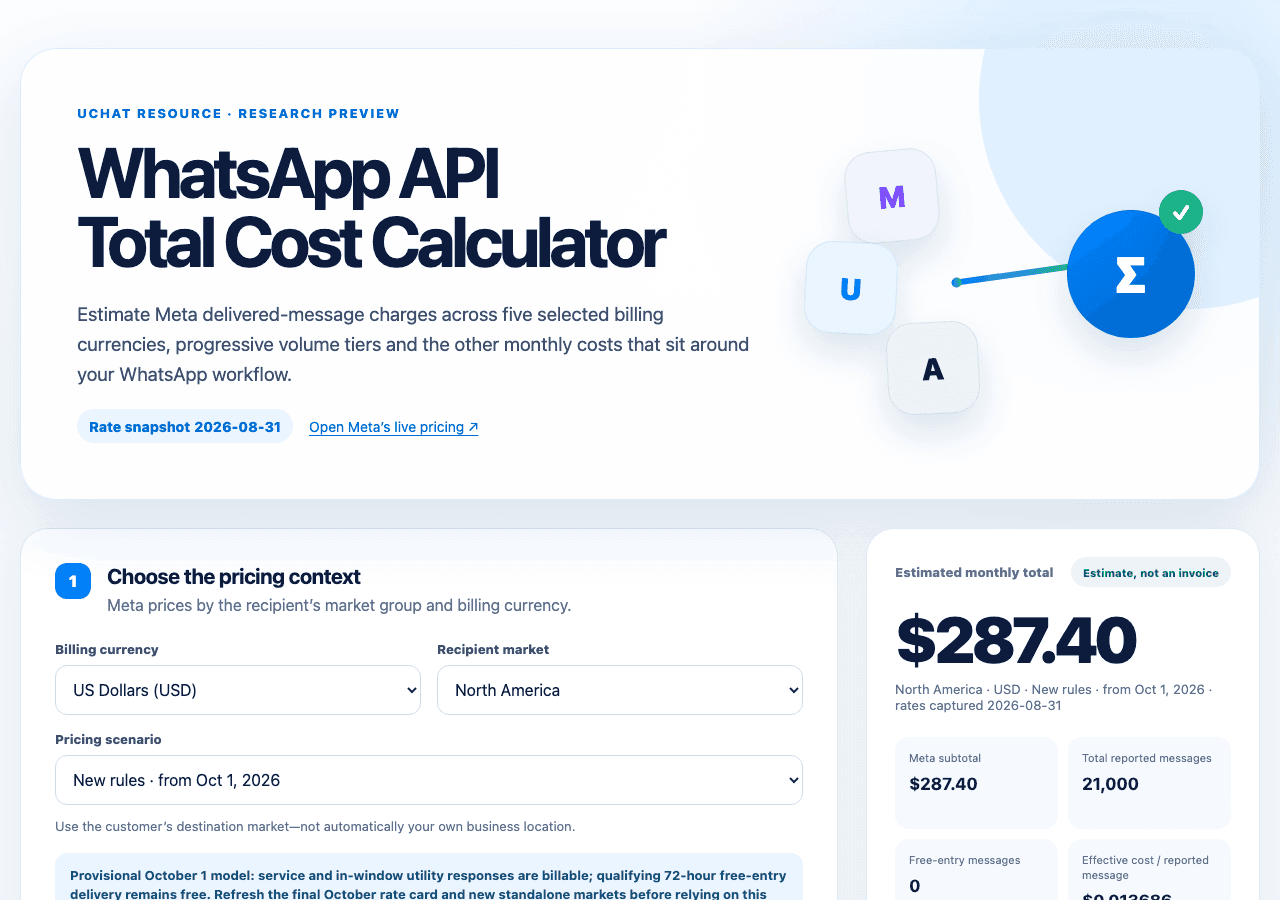
The interactive build is prepared for deployment with this guide. Until it is inserted into the public page, use the worksheet below with Meta's current rate selector.
Calculator inputs
Input | What to enter | Do not enter |
|---|---|---|
Billing currency | The currency used for the relevant rate card or budget | A currency conversion you cannot reconcile to a bill |
Recipient market | The market mapped from the recipient's WhatsApp number country calling code | Your company's location unless it maps to the same recipient market |
Pricing scenario | Current rules through September 30, 2026, or the announced rules from October 1 | A blended month without splitting volume at the effective date |
Marketing | Delivered marketing templates expected to be charged | Sent, queued, rejected or failed messages |
Utility | Delivered utility templates outside the in-window response volume entered separately | In-window utility responses entered a second time |
Authentication | Delivered authentication templates | Marketing or service traffic relabelled for a lower rate |
International authentication | Eligible delivered international authentication messages | This category when the captured rate card marks it unavailable |
Service in the 24-hour window | Delivered free-form replies from people or third-party automation | Meta Business Agent usage charges or inbound customer messages |
Utility inside the 24-hour window | Delivered utility templates sent in response to users | Utility volume already entered above |
Qualifying 72-hour free entry | Delivered messages that satisfy the current ad or Page CTA entry rule | Advertising spend or traffic that does not meet the rule |
Provider fees | Per-message processing and fixed BSP charges in your agreement | Meta's rate a second time |
Platform allocation | The portion of your automation-platform plan assigned to WhatsApp | The full company plan if only part supports this channel |
AI and tools | Model, integration, data or other usage attributable to the workflow | Costs already included elsewhere |
Tax | A percentage relevant to your estimate | Tax treatment you have not verified |
The result shows the Meta subtotal, each additional layer, estimated total, total reported messages, free-context volume and effective cost per reported message. Estimate, not an invoice. The unit cost is useful for planning, but it is not a replacement for reconciling category, delivery and billing data.
The short answer: how much does the WhatsApp API cost?
There is no accurate answer without at least five facts:
Which market are the recipients in?
Which category does each delivered message belong to?
Which pricing date or scenario applies?
Which messages occur in a qualifying free context?
What provider, platform and AI costs sit above Meta's charge?
Meta's current pricing page says the WhatsApp Business Platform charges per message delivered, not per message sent. The rate varies by recipient market and category. Through September 30, 2026, service messages in the open 24-hour window and qualifying utility responses are free at the Meta delivery layer. From October 1, both become billable. Qualifying 72-hour free-entry messages remain free for message delivery under Meta's announced rule.
Utility and authentication messages may also receive progressive volume rates. This is not a retrospective discount applied to every message. Each band of volume is priced at the rate for that band.
Your WhatsApp Business API cost is therefore better represented as a ledger:
Meta delivered-message cost + provider variable fee + provider fixed fee + allocated platform cost + AI and integration usage + tax = estimated monthly operating total
This separation prevents two common errors: calling Meta's rate the complete cost, or counting a provider's bundled price as an additional Meta charge without checking what it includes.
How WhatsApp per-message pricing works in 2026
Meta moved away from the older conversation-based pricing model. Current estimates should use the per-delivered-message model shown on the official live pricing page. If a guide still starts with a fixed charge for a 24-hour “conversation,” check its date and source before using its numbers.
Three variables drive the Meta layer.
1. Delivered status
Meta charges the applicable message when it is delivered. A business may create or send a larger number of messages than recipients actually receive. Do not use campaign audience size or API send attempts as a billing proxy unless you have confirmed it reconciles to delivered records.
For forecasting, start with expected delivered volume. For reporting, use the delivery and category data available in your WhatsApp account, provider or connected platform, then reconcile it against the invoice.
2. Recipient market
The applicable rate is based on the market mapped from the recipient's WhatsApp number country calling code, not simply where your business is registered or where the operator sits. A company can therefore have several rates in one month if it messages customers in several markets.
Build one estimate per meaningful market and currency combination, then combine the totals. A global average rate can hide expensive marketing traffic in one market behind cheaper service traffic in another.
3. Message category
The category describes the purpose and content of the message. The public categories relevant to this calculator are:
Category | Typical purpose | Pricing treatment to model |
|---|---|---|
Offers, announcements, promotions, re-engagement and other content that is not utility or authentication | Chargeable delivered messages at the current market rate | |
A specific transaction, account, order, service or user-requested update | Free in the qualifying response context through September 30; chargeable there from October 1 | |
One-time passwords and verification messages | Chargeable delivered messages; eligible international authentication may use a separate rate | |
Free-form customer-service replies inside the open service window | Free through September 30; chargeable from October 1 at the market utility/authentication rate without volume tiers |
The template's approval or name does not give a business permission to misclassify its purpose. Design the calculator around the category Meta applies, and follow the current WhatsApp Business Messaging Policy.
Marketing, utility, authentication and service costs
Marketing messages
Marketing commonly represents the largest controllable Meta cost because promotional volume can be high and marketing rates are distinct from utility or authentication rates.
Use the marketing input for delivered templates that promote, announce, recommend or re-engage. Do not reduce the estimate by assuming every message after a customer reply becomes free. The customer-service window affects service and qualifying response treatment; it does not turn promotional content into service.
Cost control should come from permission, relevance, segmentation, frequency and conversion quality—not from trying to force a promotional message into another category.
Utility messages
Utility messages support a specific transaction or customer request, such as an order, account or service update. Meta's current pricing page says utility messages sent in response to users are not charged under the rules in force through September 30, 2026. Meta's announced update says those in-window utility messages become billable on October 1.
Separate in-window utility responses from other utility traffic in your data so you can compare the two periods. In the October scenario, the calculator combines both utility inputs for the charge and applies the published utility tiers progressively. If you only have one total, choose a conservative chargeable estimate until delivery and context reporting can support a better split.
Authentication messages
Authentication templates support verification and one-time-password workflows. The standard authentication rate and volume thresholds depend on the market. Meta's rate card also includes international authentication pricing for eligible markets.
Do not assume that every market supports an international-authentication input or that its rate equals the standard authentication rate. A non-zero rate in the card does not prove that a particular WABA has reached the eligibility threshold, completed its notice/start period or avoids an applicable primary-location exception. The calculator keeps the field disabled until the user confirms those account-specific conditions, unless the user intentionally supplies a current manual override. Verify the current Authentication-International rules before budgeting.
Service messages
Service messages are free-form replies sent by a person or third-party automation within the open 24-hour customer-service window. Meta prices these messages at zero through September 30, 2026. From October 1, service becomes billable: Meta says it will charge per delivered service message at the applicable market utility/authentication rate and will not offer service-message volume tiers. Each new user message still resets the operational window.
Even before the rule changes, free delivery does not mean operationally costless. The customer-service exchange may still use an automation platform, AI model, CRM, human agent or provider feature. Track service volume as its own input so the same workload can be priced under either scenario.
Meta also tells Solution Providers and directly integrated businesses to have a payment method on file for relevant WABAs by September 30, 2026; otherwise service-message delivery may stop when charging begins. Confirm this in the current account and official documentation before the deadline.
The 24-hour customer-service window
When a user messages the business, a 24-hour customer-service window opens. A new user message resets the window. Through September 30, Meta does not charge service messages in that window, and qualifying utility responses can also be free. From October 1, the window remains important because it determines when free-form service messages can be sent, but it no longer makes those business replies free.
This window matters for both cost and workflow design:
customer messages need an accurate received time;
automations need to know whether the service window is open;
delayed work may cross the boundary;
follow-up outside the window may require an approved template;
marketing content remains subject to its category and policy;
the selected pricing date determines whether service and utility responses are free or billable.
Do not use the window as a blanket “free conversation” deduction. Classify the actual messages and avoid entering the same volume as both chargeable and free.
The 72-hour qualifying free-entry period
Meta's current pricing page describes a free-entry point for a user who enters through a qualifying Click-to-WhatsApp ad or Facebook Page call-to-action. When the business responds within the required time, a 72-hour free period begins in which message delivery is not charged under that rule. Meta's October update explicitly says this delivery benefit remains unchanged.
The calculator keeps qualifying free-entry volume separate because it is easy to overstate. Only include traffic that satisfies the current entry and response conditions. Do not count the same message again as free service or free utility simply because more than one description appears to fit.
Advertising cost is outside this calculator. A message may be free under the WhatsApp pricing rule while the ad click that initiated it still has a media cost.
How progressive volume tiers change the estimate
For eligible utility and authentication traffic, Meta's public rate card contains progressive monthly volume tiers. “Progressive” means each part of the volume is priced in the band where it falls. Meta aggregates eligible volume by market–category pair across the WABAs owned by the same business portfolio, so do not calculate the tier separately for each phone number, bot or UChat workspace.
The August 31, 2026 snapshot shows this North America USD utility example:
messages 1–80,000: USD 0.0034 each;
messages 80,001–750,000: USD 0.0032 each;
later bands continue at the rates captured in the current card.
At 80,001 delivered utility messages, the calculation is:
80,000 × $0.0034 = $272.0000
      1 × $0.0032 = $0.0032
Meta utility subtotal = $272.0032
80,000 × $0.0034 = $272.0000
      1 × $0.0032 = $0.0032
Meta utility subtotal = $272.0032
80,000 × $0.0034 = $272.0000
      1 × $0.0032 = $0.0032
Meta utility subtotal = $272.0032
It would be wrong to multiply all 80,001 messages by USD 0.0032. It would also be wrong to keep charging every message at USD 0.0034 after the threshold.
The calculator applies bands progressively. If you enter a manual rate override, it makes that choice visible and uses a flat rate for the category because a single override cannot safely reproduce an unknown tier table.
The WhatsApp Total Cost Ledger
The Meta subtotal is only the first layer. A complete monthly estimate should keep five layers visible.
Layer 1: Meta delivered-message cost
This is the sum of chargeable delivered marketing, utility, authentication, eligible international-authentication and—under the October scenario—service messages. Utility and authentication receive the applicable progressive tiers; service does not. Qualifying free contexts remain visible but add zero to this layer.
Layer 2: provider or BSP charges
A provider may charge a per-message processing fee, a monthly fee, an account fee, support or other services. Contracts vary. Some quoted prices bundle costs, while others show Meta and provider charges separately.
Read the agreement and invoice definition before adding the number. The calculator provides separate variable and fixed fields so the assumption can be audited.
Layer 3: automation-platform cost
An automation platform can add channels, workflows, AI orchestration, integrations, inboxes, analytics and team operations. If a plan supports more than WhatsApp, allocate only the portion relevant to this budget and document the allocation method.
UChat's current pricing page separates the UChat platform subscription from third-party WhatsApp, telecom and AI-provider usage, and states that UChat does not mark up those third-party rates. Check the current plan and included capacity instead of hard-coding an evergreen platform price into this estimate.
Layer 4: AI and integration usage
An AI agent may incur model usage, speech, retrieval, vector, API or third-party integration costs. A deterministic order-status notification may have little or no AI usage. A long support conversation with several model and tool calls may have more.
Estimate this layer from the actual workflow design. Do not multiply every WhatsApp message by one AI price if only some messages invoke AI. Meta Business Agent is a separate Meta product with its own usage pricing; this calculator does not model it. A UChat AI Agent connected to a third-party model should not be labelled as Meta Business Agent.
Layer 5: tax and other entered charges
Tax treatment depends on jurisdiction, supplier, invoice and business circumstances. The optional tax field applies a simple percentage to the entered subtotal; it is not tax advice or a substitute for invoice accounting.
Keep any implementation, human-support, advertising or internal labour cost outside the calculator unless you intentionally add it to a documented field. Those costs matter to profitability even when they are not part of the WhatsApp API bill.
Worked WhatsApp API cost example
Consider a North America USD estimate using the rates captured on August 31, 2026. First apply the rules in force through September 30:
Volume | Treatment | Estimated Meta cost |
|---|---|---|
10,000 marketing | 10,000 × USD 0.0250 | USD 250.00 |
5,000 chargeable utility | 5,000 × USD 0.0034 | USD 17.00 |
1,000 authentication | 1,000 × USD 0.0034 | USD 3.40 |
4,000 service | Free through September 30 inside the open window | USD 0.00 |
1,000 qualifying utility responses | Free through September 30 inside the open window | USD 0.00 |
21,000 reported messages | 16,000 chargeable + 5,000 free-context | USD 270.40 |
With no provider, platform, AI or tax inputs, the through-September estimate is USD 270.40. The effective Meta cost across all 21,000 reported messages is approximately USD 0.012876 per message.
Now switch the same message mix to the announced October 1 rules. The 1,000 utility responses join the other utility volume, while 4,000 service messages use the market's utility/authentication list rate without volume tiers:
Current Meta subtotal       $270.40
In-window utility              3.40
Service messages              13.60
October Meta subtotal        $287.40
Current Meta subtotal       $270.40
In-window utility              3.40
Service messages              13.60
October Meta subtotal        $287.40
Current Meta subtotal       $270.40
In-window utility              3.40
Service messages              13.60
October Meta subtotal        $287.40
Provisional October projection. This uses the current August 31 market rate and Meta's announced treatment. Refresh it after Meta publishes the final October rate card and before approving the budget.
Now suppose the business enters a USD 75 provider fixed fee, allocates USD 99 of its platform plan, estimates USD 35 of AI and integration usage, and applies no tax:
Meta subtotal             $287.40
Provider fixed fee          75.00
Platform allocation         99.00
AI and integrations         35.00
Estimated monthly total    $496.40
Meta subtotal             $287.40
Provider fixed fee          75.00
Platform allocation         99.00
AI and integrations         35.00
Estimated monthly total    $496.40
Meta subtotal             $287.40
Provider fixed fee          75.00
Platform allocation         99.00
AI and integrations         35.00
Estimated monthly total    $496.40
These additional figures are illustrative, not UChat or provider price claims. Replace them with your current contract, plan and usage data.
How to collect accurate calculator inputs
A better estimate comes from reconcilable inputs, not from adding more decimal places.
Before launch
Use a message plan:
List each workflow that can send a WhatsApp message.
Identify its expected category and recipient markets.
Estimate delivered—not merely attempted—volume.
Split service, in-window utility and free-entry contexts.
Choose the pricing period and split any month that crosses an effective date.
Add provider, platform and AI assumptions from current agreements.
Run low, expected and high scenarios.
Document who owns each assumption and when it should be refreshed.
After launch
Replace forecasts with observed data:
delivered volume by category and market;
failed and rejected messages kept outside delivered cost;
customer-service-window and free-entry context where available;
provider statement or invoice;
platform plan and attributable usage;
AI-provider usage;
tax shown on the actual invoice.
UChat has publicly documented WhatsApp analytics for message performance and template cost analysis. Because interfaces and fields can change, verify the current analytics available in your workspace before writing an operating procedure around a historical screen.
How to reduce WhatsApp API cost responsibly
Cost control should improve relevance and workflow quality without trying to evade Meta's categories or policies.
Improve marketing selection
Send marketing only to people with the appropriate permission and a relevant reason to receive it. Segment by lifecycle and intent, cap frequency, remove unresponsive audiences and measure the business result—not only delivery.
Make every service reply useful
When a customer initiates contact, resolve the issue efficiently. Give the bot the approved knowledge and workflows it needs, avoid unnecessarily splitting one answer into several outbound messages, and escalate with context when automation should stop. From October 1, each delivered service reply creates a Meta charge, so both answer quality and message count matter.
Separate utility from promotion
Keep transactional updates focused on the transaction or user request. If a message adds promotional content, do not budget it as pure utility.
Prevent duplicate and unnecessary messages
Use idempotency, state checks and workflow conditions so a retry does not create duplicate notifications. Combine information when that improves the customer experience, but do not conceal required or time-sensitive details merely to reduce count.
Track failures before scaling
Failed messages may not add a delivered-message charge, but they can signal bad data, template, policy, quality or implementation problems. Fix the cause before increasing volume. The WhatsApp error code guide helps separate delivery, template, payment and permission problems.
Common WhatsApp pricing mistakes
Using the old conversation model
A historical article or video may describe one charge for a 24-hour conversation. Meta's current public pricing uses delivered messages. Use the current official page, not an old rate table.
Multiplying all traffic by one rate
Marketing, utility, authentication, international authentication and service treatment can differ. Recipient markets differ, and the effective date changes which contexts are free. One blended rate is an output, not a valid starting assumption.
Counting sent messages instead of delivered messages
Audience size, send attempts and delivered messages are not interchangeable. Reconcile the metric used by the current billing rule.
Assuming the 24-hour window will remain free
The customer-service window does not erase the message's purpose or Meta's category rules. It also stops being a free delivery window for service and utility responses on October 1, 2026. Track the pricing period and each treatment explicitly.
Giving service messages a volume discount
Meta says service messages will use the market utility/authentication rate from October 1 but will not receive volume tiers. Do not copy the lowest utility tier onto service volume.
Applying a lower tier to all volume
Progressive rates apply by band. The threshold message receives the next rate; earlier messages remain in their prior bands.
Forgetting provider, platform or AI cost
Meta's charge may be only one part of the operating stack. Keep each commercial layer separate so vendor comparisons remain honest.
Double-counting a bundled fee
A provider quote may already include one or more layers. Confirm whether the quoted number includes Meta charges before adding it to the ledger.
Publishing an undated rate table
A precise rate without a capture date can become confidently wrong. Show the date, link the live source and define a refresh trigger.
WhatsApp API pricing FAQ
Is the WhatsApp Business API free?
Not as a complete operating system. Meta charges applicable delivered marketing, utility and authentication messages. Service and qualifying utility responses are free at the Meta layer only through September 30, 2026; both become billable on October 1. Qualifying 72-hour free-entry delivery remains free under the announced rule. A provider, platform, AI model, integrations, advertising, staff and tax can still add cost.
How much do 10,000 WhatsApp API messages cost?
It depends on recipient market, category, delivery, pricing date, free context and volume tier. In the August 31, 2026 North America USD snapshot, 10,000 delivered marketing messages would produce a Meta subtotal of USD 250.00, while 10,000 chargeable utility messages at the first captured tier would produce USD 34.00. These are dated examples, not permanent prices.
Does WhatsApp API pricing have a monthly fee?
Meta's current message layer is based on delivered messages, but another provider or automation platform may have a monthly or fixed fee. Add those separately and verify what each quote includes.
Is WhatsApp Cloud API pricing different from WhatsApp API pricing?
Cloud API is Meta's hosted API path for the WhatsApp Business Platform. The Meta message-pricing rules still apply. Your total can differ according to the provider, platform, hosting responsibilities, integrations and support model around the API.
What is the WhatsApp API cost per message?
There is no single global rate. The applicable rate depends on recipient market, category and effective date, and eligible utility or authentication volume can cross progressive tiers. From October 1, 2026, service messages use the market utility/authentication rate without volume tiers.
What changes to WhatsApp API pricing on October 1, 2026?
Meta will charge per delivered service message and will charge utility messages sent in response to users inside the open 24-hour window. The 24-hour window still controls when free-form service replies may be sent, but no longer makes them free. The qualifying 72-hour free-entry window remains free for message delivery.
Are WhatsApp messages still priced per conversation?
Meta's current public pricing is per delivered message. Treat conversation-based rate explanations as historical unless the official current documentation says otherwise.
Does UChat add a markup to Meta's WhatsApp rate?
UChat's current public pricing page states that it does not mark up third-party WhatsApp, telecom or AI-provider rates. UChat's platform subscription and any applicable third-party usage are separate cost layers. Verify the current pricing page and your actual invoices before budgeting.
Does this calculator include WhatsApp calling?
No. WhatsApp Business Calling uses a separate per-minute pricing model and operational workflow. Keep calling charges out of message estimates and use the dedicated WhatsApp Business Calling guide.
How often should I update the estimate?
Refresh it whenever Meta changes pricing, categories, markets, free-window rules or tiers; whenever your provider or platform agreement changes; and whenever observed delivery or category mix moves materially away from forecast. For a new budget, check the official rate selector on the day you approve it.
Build the budget, then build the workflow
A defensible WhatsApp budget makes every layer visible. Start with delivered volume by market, category and pricing period; account for qualifying free contexts; apply progressive tiers only where available; then add provider, platform, AI and tax assumptions without double-counting.
Once the estimate is clear, use UChat's WhatsApp Cloud API connection course for the implementation path, explore the visual Flow Builder for workflow logic, and review current UChat pricing for the platform layer.
The calculator should make uncertainty explicit. If a message cannot be classified, a fee cannot be reconciled or a rate snapshot is stale, do not hide the assumption behind a precise total. Update the input, record the source and rerun the estimate.
WhatsApp API pricing does not have one universal per-message or monthly price. Meta currently charges for each message it delivers, with the rate determined by the recipient's market and the message category. Your actual operating cost can also include a provider fee, an automation platform, AI or integration usage and tax.
That means a useful estimate needs more than “message count × one rate.” It must separate message categories and time-sensitive free contexts, apply volume tiers correctly and then add the rest of the delivery stack.
This guide provides that model. The calculator uses a versioned snapshot of Meta's public rate selector captured on August 31, 2026, covering 38 current market groups and five selected billing currencies: USD, AUD, EUR, GBP and INR. It does not claim to cover every official billing currency. It also compares the rules in force through September 30 with the announced changes from October 1, 2026. Treat every result as an estimate, not an invoice, and verify Meta's live WhatsApp Business Platform pricing before making a budget or launch decision.
Important October 2026 change: Meta says that from October 1 it will charge per delivered service message and will again charge utility messages sent in response to users inside the open 24-hour customer-service window. Service messages will use the market utility/authentication rate without volume tiers. The qualifying 72-hour free-entry window remains free for message delivery. The calculator's October result is provisional until the final future-effective rate card and nine announced standalone-market changes are loaded. See Meta's upcoming pricing update.
Last verified August 31, 2026. Meta pricing, market groups, categories, free-entry rules, volume tiers, provider charges, platform plans and taxes can change. Meta said it would publish the rates taking effect October 1 by September 1, so the snapshot and examples must be refreshed again on the approved publication date.
WhatsApp API pricing calculator preview
The UChat calculator models the monthly messaging-stack costs you choose to enter instead of showing only Meta's message charge. Select a currency, recipient market and pricing scenario; enter delivered volume by category and context; then add any provider, platform, AI and tax inputs that apply to your setup.
The interactive build is prepared for deployment with this guide. Until it is inserted into the public page, use the worksheet below with Meta's current rate selector.
Calculator inputs
Input | What to enter | Do not enter |
|---|---|---|
Billing currency | The currency used for the relevant rate card or budget | A currency conversion you cannot reconcile to a bill |
Recipient market | The market mapped from the recipient's WhatsApp number country calling code | Your company's location unless it maps to the same recipient market |
Pricing scenario | Current rules through September 30, 2026, or the announced rules from October 1 | A blended month without splitting volume at the effective date |
Marketing | Delivered marketing templates expected to be charged | Sent, queued, rejected or failed messages |
Utility | Delivered utility templates outside the in-window response volume entered separately | In-window utility responses entered a second time |
Authentication | Delivered authentication templates | Marketing or service traffic relabelled for a lower rate |
International authentication | Eligible delivered international authentication messages | This category when the captured rate card marks it unavailable |
Service in the 24-hour window | Delivered free-form replies from people or third-party automation | Meta Business Agent usage charges or inbound customer messages |
Utility inside the 24-hour window | Delivered utility templates sent in response to users | Utility volume already entered above |
Qualifying 72-hour free entry | Delivered messages that satisfy the current ad or Page CTA entry rule | Advertising spend or traffic that does not meet the rule |
Provider fees | Per-message processing and fixed BSP charges in your agreement | Meta's rate a second time |
Platform allocation | The portion of your automation-platform plan assigned to WhatsApp | The full company plan if only part supports this channel |
AI and tools | Model, integration, data or other usage attributable to the workflow | Costs already included elsewhere |
Tax | A percentage relevant to your estimate | Tax treatment you have not verified |
The result shows the Meta subtotal, each additional layer, estimated total, total reported messages, free-context volume and effective cost per reported message. Estimate, not an invoice. The unit cost is useful for planning, but it is not a replacement for reconciling category, delivery and billing data.
The short answer: how much does the WhatsApp API cost?
There is no accurate answer without at least five facts:
Which market are the recipients in?
Which category does each delivered message belong to?
Which pricing date or scenario applies?
Which messages occur in a qualifying free context?
What provider, platform and AI costs sit above Meta's charge?
Meta's current pricing page says the WhatsApp Business Platform charges per message delivered, not per message sent. The rate varies by recipient market and category. Through September 30, 2026, service messages in the open 24-hour window and qualifying utility responses are free at the Meta delivery layer. From October 1, both become billable. Qualifying 72-hour free-entry messages remain free for message delivery under Meta's announced rule.
Utility and authentication messages may also receive progressive volume rates. This is not a retrospective discount applied to every message. Each band of volume is priced at the rate for that band.
Your WhatsApp Business API cost is therefore better represented as a ledger:
Meta delivered-message cost + provider variable fee + provider fixed fee + allocated platform cost + AI and integration usage + tax = estimated monthly operating total
This separation prevents two common errors: calling Meta's rate the complete cost, or counting a provider's bundled price as an additional Meta charge without checking what it includes.
How WhatsApp per-message pricing works in 2026
Meta moved away from the older conversation-based pricing model. Current estimates should use the per-delivered-message model shown on the official live pricing page. If a guide still starts with a fixed charge for a 24-hour “conversation,” check its date and source before using its numbers.
Three variables drive the Meta layer.
1. Delivered status
Meta charges the applicable message when it is delivered. A business may create or send a larger number of messages than recipients actually receive. Do not use campaign audience size or API send attempts as a billing proxy unless you have confirmed it reconciles to delivered records.
For forecasting, start with expected delivered volume. For reporting, use the delivery and category data available in your WhatsApp account, provider or connected platform, then reconcile it against the invoice.
2. Recipient market
The applicable rate is based on the market mapped from the recipient's WhatsApp number country calling code, not simply where your business is registered or where the operator sits. A company can therefore have several rates in one month if it messages customers in several markets.
Build one estimate per meaningful market and currency combination, then combine the totals. A global average rate can hide expensive marketing traffic in one market behind cheaper service traffic in another.
3. Message category
The category describes the purpose and content of the message. The public categories relevant to this calculator are:
Category | Typical purpose | Pricing treatment to model |
|---|---|---|
Offers, announcements, promotions, re-engagement and other content that is not utility or authentication | Chargeable delivered messages at the current market rate | |
A specific transaction, account, order, service or user-requested update | Free in the qualifying response context through September 30; chargeable there from October 1 | |
One-time passwords and verification messages | Chargeable delivered messages; eligible international authentication may use a separate rate | |
Free-form customer-service replies inside the open service window | Free through September 30; chargeable from October 1 at the market utility/authentication rate without volume tiers |
The template's approval or name does not give a business permission to misclassify its purpose. Design the calculator around the category Meta applies, and follow the current WhatsApp Business Messaging Policy.
Marketing, utility, authentication and service costs
Marketing messages
Marketing commonly represents the largest controllable Meta cost because promotional volume can be high and marketing rates are distinct from utility or authentication rates.
Use the marketing input for delivered templates that promote, announce, recommend or re-engage. Do not reduce the estimate by assuming every message after a customer reply becomes free. The customer-service window affects service and qualifying response treatment; it does not turn promotional content into service.
Cost control should come from permission, relevance, segmentation, frequency and conversion quality—not from trying to force a promotional message into another category.
Utility messages
Utility messages support a specific transaction or customer request, such as an order, account or service update. Meta's current pricing page says utility messages sent in response to users are not charged under the rules in force through September 30, 2026. Meta's announced update says those in-window utility messages become billable on October 1.
Separate in-window utility responses from other utility traffic in your data so you can compare the two periods. In the October scenario, the calculator combines both utility inputs for the charge and applies the published utility tiers progressively. If you only have one total, choose a conservative chargeable estimate until delivery and context reporting can support a better split.
Authentication messages
Authentication templates support verification and one-time-password workflows. The standard authentication rate and volume thresholds depend on the market. Meta's rate card also includes international authentication pricing for eligible markets.
Do not assume that every market supports an international-authentication input or that its rate equals the standard authentication rate. A non-zero rate in the card does not prove that a particular WABA has reached the eligibility threshold, completed its notice/start period or avoids an applicable primary-location exception. The calculator keeps the field disabled until the user confirms those account-specific conditions, unless the user intentionally supplies a current manual override. Verify the current Authentication-International rules before budgeting.
Service messages
Service messages are free-form replies sent by a person or third-party automation within the open 24-hour customer-service window. Meta prices these messages at zero through September 30, 2026. From October 1, service becomes billable: Meta says it will charge per delivered service message at the applicable market utility/authentication rate and will not offer service-message volume tiers. Each new user message still resets the operational window.
Even before the rule changes, free delivery does not mean operationally costless. The customer-service exchange may still use an automation platform, AI model, CRM, human agent or provider feature. Track service volume as its own input so the same workload can be priced under either scenario.
Meta also tells Solution Providers and directly integrated businesses to have a payment method on file for relevant WABAs by September 30, 2026; otherwise service-message delivery may stop when charging begins. Confirm this in the current account and official documentation before the deadline.
The 24-hour customer-service window
When a user messages the business, a 24-hour customer-service window opens. A new user message resets the window. Through September 30, Meta does not charge service messages in that window, and qualifying utility responses can also be free. From October 1, the window remains important because it determines when free-form service messages can be sent, but it no longer makes those business replies free.
This window matters for both cost and workflow design:
customer messages need an accurate received time;
automations need to know whether the service window is open;
delayed work may cross the boundary;
follow-up outside the window may require an approved template;
marketing content remains subject to its category and policy;
the selected pricing date determines whether service and utility responses are free or billable.
Do not use the window as a blanket “free conversation” deduction. Classify the actual messages and avoid entering the same volume as both chargeable and free.
The 72-hour qualifying free-entry period
Meta's current pricing page describes a free-entry point for a user who enters through a qualifying Click-to-WhatsApp ad or Facebook Page call-to-action. When the business responds within the required time, a 72-hour free period begins in which message delivery is not charged under that rule. Meta's October update explicitly says this delivery benefit remains unchanged.
The calculator keeps qualifying free-entry volume separate because it is easy to overstate. Only include traffic that satisfies the current entry and response conditions. Do not count the same message again as free service or free utility simply because more than one description appears to fit.
Advertising cost is outside this calculator. A message may be free under the WhatsApp pricing rule while the ad click that initiated it still has a media cost.
How progressive volume tiers change the estimate
For eligible utility and authentication traffic, Meta's public rate card contains progressive monthly volume tiers. “Progressive” means each part of the volume is priced in the band where it falls. Meta aggregates eligible volume by market–category pair across the WABAs owned by the same business portfolio, so do not calculate the tier separately for each phone number, bot or UChat workspace.
The August 31, 2026 snapshot shows this North America USD utility example:
messages 1–80,000: USD 0.0034 each;
messages 80,001–750,000: USD 0.0032 each;
later bands continue at the rates captured in the current card.
At 80,001 delivered utility messages, the calculation is:
80,000 × $0.0034 = $272.0000
      1 × $0.0032 = $0.0032
Meta utility subtotal = $272.0032
80,000 × $0.0034 = $272.0000
      1 × $0.0032 = $0.0032
Meta utility subtotal = $272.0032
80,000 × $0.0034 = $272.0000
      1 × $0.0032 = $0.0032
Meta utility subtotal = $272.0032
It would be wrong to multiply all 80,001 messages by USD 0.0032. It would also be wrong to keep charging every message at USD 0.0034 after the threshold.
The calculator applies bands progressively. If you enter a manual rate override, it makes that choice visible and uses a flat rate for the category because a single override cannot safely reproduce an unknown tier table.
The WhatsApp Total Cost Ledger
The Meta subtotal is only the first layer. A complete monthly estimate should keep five layers visible.
Layer 1: Meta delivered-message cost
This is the sum of chargeable delivered marketing, utility, authentication, eligible international-authentication and—under the October scenario—service messages. Utility and authentication receive the applicable progressive tiers; service does not. Qualifying free contexts remain visible but add zero to this layer.
Layer 2: provider or BSP charges
A provider may charge a per-message processing fee, a monthly fee, an account fee, support or other services. Contracts vary. Some quoted prices bundle costs, while others show Meta and provider charges separately.
Read the agreement and invoice definition before adding the number. The calculator provides separate variable and fixed fields so the assumption can be audited.
Layer 3: automation-platform cost
An automation platform can add channels, workflows, AI orchestration, integrations, inboxes, analytics and team operations. If a plan supports more than WhatsApp, allocate only the portion relevant to this budget and document the allocation method.
UChat's current pricing page separates the UChat platform subscription from third-party WhatsApp, telecom and AI-provider usage, and states that UChat does not mark up those third-party rates. Check the current plan and included capacity instead of hard-coding an evergreen platform price into this estimate.
Layer 4: AI and integration usage
An AI agent may incur model usage, speech, retrieval, vector, API or third-party integration costs. A deterministic order-status notification may have little or no AI usage. A long support conversation with several model and tool calls may have more.
Estimate this layer from the actual workflow design. Do not multiply every WhatsApp message by one AI price if only some messages invoke AI. Meta Business Agent is a separate Meta product with its own usage pricing; this calculator does not model it. A UChat AI Agent connected to a third-party model should not be labelled as Meta Business Agent.
Layer 5: tax and other entered charges
Tax treatment depends on jurisdiction, supplier, invoice and business circumstances. The optional tax field applies a simple percentage to the entered subtotal; it is not tax advice or a substitute for invoice accounting.
Keep any implementation, human-support, advertising or internal labour cost outside the calculator unless you intentionally add it to a documented field. Those costs matter to profitability even when they are not part of the WhatsApp API bill.
Worked WhatsApp API cost example
Consider a North America USD estimate using the rates captured on August 31, 2026. First apply the rules in force through September 30:
Volume | Treatment | Estimated Meta cost |
|---|---|---|
10,000 marketing | 10,000 × USD 0.0250 | USD 250.00 |
5,000 chargeable utility | 5,000 × USD 0.0034 | USD 17.00 |
1,000 authentication | 1,000 × USD 0.0034 | USD 3.40 |
4,000 service | Free through September 30 inside the open window | USD 0.00 |
1,000 qualifying utility responses | Free through September 30 inside the open window | USD 0.00 |
21,000 reported messages | 16,000 chargeable + 5,000 free-context | USD 270.40 |
With no provider, platform, AI or tax inputs, the through-September estimate is USD 270.40. The effective Meta cost across all 21,000 reported messages is approximately USD 0.012876 per message.
Now switch the same message mix to the announced October 1 rules. The 1,000 utility responses join the other utility volume, while 4,000 service messages use the market's utility/authentication list rate without volume tiers:
Current Meta subtotal       $270.40
In-window utility              3.40
Service messages              13.60
October Meta subtotal        $287.40
Current Meta subtotal       $270.40
In-window utility              3.40
Service messages              13.60
October Meta subtotal        $287.40
Current Meta subtotal       $270.40
In-window utility              3.40
Service messages              13.60
October Meta subtotal        $287.40
Provisional October projection. This uses the current August 31 market rate and Meta's announced treatment. Refresh it after Meta publishes the final October rate card and before approving the budget.
Now suppose the business enters a USD 75 provider fixed fee, allocates USD 99 of its platform plan, estimates USD 35 of AI and integration usage, and applies no tax:
Meta subtotal             $287.40
Provider fixed fee          75.00
Platform allocation         99.00
AI and integrations         35.00
Estimated monthly total    $496.40
Meta subtotal             $287.40
Provider fixed fee          75.00
Platform allocation         99.00
AI and integrations         35.00
Estimated monthly total    $496.40
Meta subtotal             $287.40
Provider fixed fee          75.00
Platform allocation         99.00
AI and integrations         35.00
Estimated monthly total    $496.40
These additional figures are illustrative, not UChat or provider price claims. Replace them with your current contract, plan and usage data.
How to collect accurate calculator inputs
A better estimate comes from reconcilable inputs, not from adding more decimal places.
Before launch
Use a message plan:
List each workflow that can send a WhatsApp message.
Identify its expected category and recipient markets.
Estimate delivered—not merely attempted—volume.
Split service, in-window utility and free-entry contexts.
Choose the pricing period and split any month that crosses an effective date.
Add provider, platform and AI assumptions from current agreements.
Run low, expected and high scenarios.
Document who owns each assumption and when it should be refreshed.
After launch
Replace forecasts with observed data:
delivered volume by category and market;
failed and rejected messages kept outside delivered cost;
customer-service-window and free-entry context where available;
provider statement or invoice;
platform plan and attributable usage;
AI-provider usage;
tax shown on the actual invoice.
UChat has publicly documented WhatsApp analytics for message performance and template cost analysis. Because interfaces and fields can change, verify the current analytics available in your workspace before writing an operating procedure around a historical screen.
How to reduce WhatsApp API cost responsibly
Cost control should improve relevance and workflow quality without trying to evade Meta's categories or policies.
Improve marketing selection
Send marketing only to people with the appropriate permission and a relevant reason to receive it. Segment by lifecycle and intent, cap frequency, remove unresponsive audiences and measure the business result—not only delivery.
Make every service reply useful
When a customer initiates contact, resolve the issue efficiently. Give the bot the approved knowledge and workflows it needs, avoid unnecessarily splitting one answer into several outbound messages, and escalate with context when automation should stop. From October 1, each delivered service reply creates a Meta charge, so both answer quality and message count matter.
Separate utility from promotion
Keep transactional updates focused on the transaction or user request. If a message adds promotional content, do not budget it as pure utility.
Prevent duplicate and unnecessary messages
Use idempotency, state checks and workflow conditions so a retry does not create duplicate notifications. Combine information when that improves the customer experience, but do not conceal required or time-sensitive details merely to reduce count.
Track failures before scaling
Failed messages may not add a delivered-message charge, but they can signal bad data, template, policy, quality or implementation problems. Fix the cause before increasing volume. The WhatsApp error code guide helps separate delivery, template, payment and permission problems.
Common WhatsApp pricing mistakes
Using the old conversation model
A historical article or video may describe one charge for a 24-hour conversation. Meta's current public pricing uses delivered messages. Use the current official page, not an old rate table.
Multiplying all traffic by one rate
Marketing, utility, authentication, international authentication and service treatment can differ. Recipient markets differ, and the effective date changes which contexts are free. One blended rate is an output, not a valid starting assumption.
Counting sent messages instead of delivered messages
Audience size, send attempts and delivered messages are not interchangeable. Reconcile the metric used by the current billing rule.
Assuming the 24-hour window will remain free
The customer-service window does not erase the message's purpose or Meta's category rules. It also stops being a free delivery window for service and utility responses on October 1, 2026. Track the pricing period and each treatment explicitly.
Giving service messages a volume discount
Meta says service messages will use the market utility/authentication rate from October 1 but will not receive volume tiers. Do not copy the lowest utility tier onto service volume.
Applying a lower tier to all volume
Progressive rates apply by band. The threshold message receives the next rate; earlier messages remain in their prior bands.
Forgetting provider, platform or AI cost
Meta's charge may be only one part of the operating stack. Keep each commercial layer separate so vendor comparisons remain honest.
Double-counting a bundled fee
A provider quote may already include one or more layers. Confirm whether the quoted number includes Meta charges before adding it to the ledger.
Publishing an undated rate table
A precise rate without a capture date can become confidently wrong. Show the date, link the live source and define a refresh trigger.
WhatsApp API pricing FAQ
Is the WhatsApp Business API free?
Not as a complete operating system. Meta charges applicable delivered marketing, utility and authentication messages. Service and qualifying utility responses are free at the Meta layer only through September 30, 2026; both become billable on October 1. Qualifying 72-hour free-entry delivery remains free under the announced rule. A provider, platform, AI model, integrations, advertising, staff and tax can still add cost.
How much do 10,000 WhatsApp API messages cost?
It depends on recipient market, category, delivery, pricing date, free context and volume tier. In the August 31, 2026 North America USD snapshot, 10,000 delivered marketing messages would produce a Meta subtotal of USD 250.00, while 10,000 chargeable utility messages at the first captured tier would produce USD 34.00. These are dated examples, not permanent prices.
Does WhatsApp API pricing have a monthly fee?
Meta's current message layer is based on delivered messages, but another provider or automation platform may have a monthly or fixed fee. Add those separately and verify what each quote includes.
Is WhatsApp Cloud API pricing different from WhatsApp API pricing?
Cloud API is Meta's hosted API path for the WhatsApp Business Platform. The Meta message-pricing rules still apply. Your total can differ according to the provider, platform, hosting responsibilities, integrations and support model around the API.
What is the WhatsApp API cost per message?
There is no single global rate. The applicable rate depends on recipient market, category and effective date, and eligible utility or authentication volume can cross progressive tiers. From October 1, 2026, service messages use the market utility/authentication rate without volume tiers.
What changes to WhatsApp API pricing on October 1, 2026?
Meta will charge per delivered service message and will charge utility messages sent in response to users inside the open 24-hour window. The 24-hour window still controls when free-form service replies may be sent, but no longer makes them free. The qualifying 72-hour free-entry window remains free for message delivery.
Are WhatsApp messages still priced per conversation?
Meta's current public pricing is per delivered message. Treat conversation-based rate explanations as historical unless the official current documentation says otherwise.
Does UChat add a markup to Meta's WhatsApp rate?
UChat's current public pricing page states that it does not mark up third-party WhatsApp, telecom or AI-provider rates. UChat's platform subscription and any applicable third-party usage are separate cost layers. Verify the current pricing page and your actual invoices before budgeting.
Does this calculator include WhatsApp calling?
No. WhatsApp Business Calling uses a separate per-minute pricing model and operational workflow. Keep calling charges out of message estimates and use the dedicated WhatsApp Business Calling guide.
How often should I update the estimate?
Refresh it whenever Meta changes pricing, categories, markets, free-window rules or tiers; whenever your provider or platform agreement changes; and whenever observed delivery or category mix moves materially away from forecast. For a new budget, check the official rate selector on the day you approve it.
Build the budget, then build the workflow
A defensible WhatsApp budget makes every layer visible. Start with delivered volume by market, category and pricing period; account for qualifying free contexts; apply progressive tiers only where available; then add provider, platform, AI and tax assumptions without double-counting.
Once the estimate is clear, use UChat's WhatsApp Cloud API connection course for the implementation path, explore the visual Flow Builder for workflow logic, and review current UChat pricing for the platform layer.
The calculator should make uncertainty explicit. If a message cannot be classified, a fee cannot be reconciled or a rate snapshot is stale, do not hide the assumption behind a precise total. Update the input, record the source and rerun the estimate.