19 minutes
UChat
Posted by
8 Best ManyChat Alternatives for Agencies in 2026
19 minutes
Posted by
UChat

The right ManyChat alternative depends on what your agency is actually selling. Choose UChat for a branded automation platform with your own domain, client workspaces, pricing model, Partner API and broader workflow stack. Chatrace is a direct white-label social-automation option, HighLevel suits CRM-first agencies, Botpress suits developer-led AI projects, respond.io suits messaging operations, Landbot suits web and WhatsApp experiences, Tidio suits ecommerce support, and Chatfuel suits focused social automation.
ManyChat itself remains a good option for agencies running repeatable Instagram, TikTok, Messenger or WhatsApp campaigns. The reason to change is not that ManyChat cannot serve agencies. It is that a managed social-automation service and a white-labeled software platform are different businesses.
Reviewed August 31, 2026. Competitor plans and features change, so verify the linked official pages before buying. UChat publishes this comparison and is included as one option; every product is evaluated with the same operating-model criteria and first-party sources.
ManyChat alternatives at a glance
Platform | Best for | Client-facing brand model | Client operating model | Main tradeoff |
|---|---|---|---|---|
UChat | Agencies reselling a branded omnichannel automation platform | Full agency-branded domain, login and client platform | Partner-controlled client workspaces, plans and lifecycle | More setup than a single social campaign tool |
Chatrace | Agencies wanting a bundled white-label social and messaging platform | Agency domain, brand name, logo and client-facing platform | Central client-account management with agency pricing controls | Higher bundled base cost and a less modular licensing model |
HighLevel | Agencies selling CRM, funnels and marketing software | White-labeled agency CRM and SaaS experience | Sub-accounts inside a broader agency operating system | Chatbot automation is one part of a much larger stack |
Botpress | Developer-led agencies building custom AI agents | End-user webchat can be branded; Studio and Dashboard remain Botpress | Technical agent projects and workspaces | Requires more AI and integration engineering |
respond.io | Teams operating conversations across messaging channels | Vendor platform plus a reseller partner model | Team inboxes, multiple workspaces on higher plans and plan resale | Reviewed pages do not document a custom-domain, rebranded client platform |
Landbot | No-code web and WhatsApp conversational experiences | Customer-facing bots can remove Landbot branding on applicable plans | Visual bot projects for web, Messenger, WhatsApp and API chat | WhatsApp and higher-volume requirements can change plan economics |
Tidio | Ecommerce AI support and CX retainers | Tidio product delivered through a partner relationship | Referral or co-selling model with client support projects | Partner economics are different from owning a reseller platform |
Chatfuel | Focused Instagram, Facebook and WhatsApp automation | Customer-facing automation with a vendor workspace | Separate business automation projects | Less suitable when the agency needs a full branded client platform |
This table is a starting point, not a universal ranking. A platform that is excellent for a Shopify support retainer may be the wrong foundation for an agency selling branded chatbot software.
Bottom line: Match the platform to the offer, client-access model and support responsibility your agency intends to own.
Why agencies look for a ManyChat alternative
Agencies usually start looking after the service becomes larger than the original social campaign.
The first project may be simple: send a DM after someone comments on an Instagram post, collect an email address and deliver a link. ManyChat is designed for that kind of work and gives agencies a fast way to repeat it.
The operating questions become harder after the fifth or twentieth client:
Will clients log in to ManyChat, or to a platform carrying the agency's brand?
Does every client need a separate account and subscription?
Can the agency define its own software plans and prices?
Can onboarding, workspace creation, upgrades and cancellations be automated?
Does the workflow stop in a social inbox, or continue to web chat, support, CRM, payments and other channels?
Can an AI Agent use approved knowledge, call tools and hand a conversation to a person?
Who provides first-line support when the client cannot find a setting or a workflow fails?
These questions describe the agency's business model. Feature lists matter, but ownership, billing and support determine whether the platform scales as a service or as software.
ManyChat for agencies: what it supports and what white label means
ManyChat's agency page is clear that the platform is used by agencies. It highlights lead capture, appointment booking, sales conversations, reusable flows, messaging channels, integrations and performance tracking.
Agencies can also access separate client workspaces and accounts from one profile. According to ManyChat's current account-management documentation, multiple business accounts of the same channel type require separate ManyChat accounts, each with its own settings and billing.
That is workable for a managed service. The agency can build the flows while the client owns the account and payment relationship, or the agency can operate and pay for separate client accounts.
It is not the same as a fully white-labeled agency platform.
ManyChat's current agency, account, subscription and pricing materials document agency use and separate client accounts, but they do not document a custom-domain, agency-branded reseller platform. A ManyChat Community moderator stated in January 2025 that agencies could sell ManyChat implementation and management as a service, while ManyChat itself could not be white-labeled. Product availability can change, so confirm this boundary directly before purchase.
Capability | Remove customer-facing message branding | White-label the agency platform |
|---|---|---|
“Powered by” label in an automation | Can be removed on applicable paid ManyChat plans | Also removed or replaced |
Agency custom domain | No change | Agency platform runs on the agency's domain |
Branded login and dashboard | No change | Client logs in to the agency-branded interface |
Client workspace and plan controls | Separate vendor accounts | Partner controls client workspace structure and plans |
Agency-defined software pricing | Agency can charge for its service | Agency defines client-facing software plans and margin |
Automated provisioning and billing | Managed outside the message-branding setting | Platform can expose partner billing and workspace lifecycle tools |
The paid plans shown in ManyChat's current pricing model can remove the “Powered by Manychat” message. That improves the customer-facing automation. It does not turn the ManyChat login, dashboard, domain or account structure into the agency's software product.
ManyChat's new-plan rollout uses monthly Active Contacts together with plan-specific channels, users and Inbox seats. Availability can vary by region and account, so use the current subscription guide rather than assuming every client sees the same package.
If your agency sells campaign execution, this may not matter. If your offer promises “our automation platform under our brand,” it matters immediately.
How we selected these alternatives
We did not rank products by the number of boxes they could tick. We evaluated the operating model an agency needs to support.
The seven criteria are:
Client-facing brand: vendor platform, branded widget or complete agency portal.
Client isolation: separate accounts, sub-accounts or managed client workspaces.
Commercial model: vendor subscription, referral/co-sell, managed service or agency resale.
Channel scope: social messaging, web and WhatsApp, or broader omnichannel delivery.
AI and workflow depth: trigger-based automation, support AI or tool-using custom agents.
Human operations: inbox, assignment, handoff, tickets and reporting.
Technical burden: marketer-friendly setup, no-code workflow design or developer-led implementation.
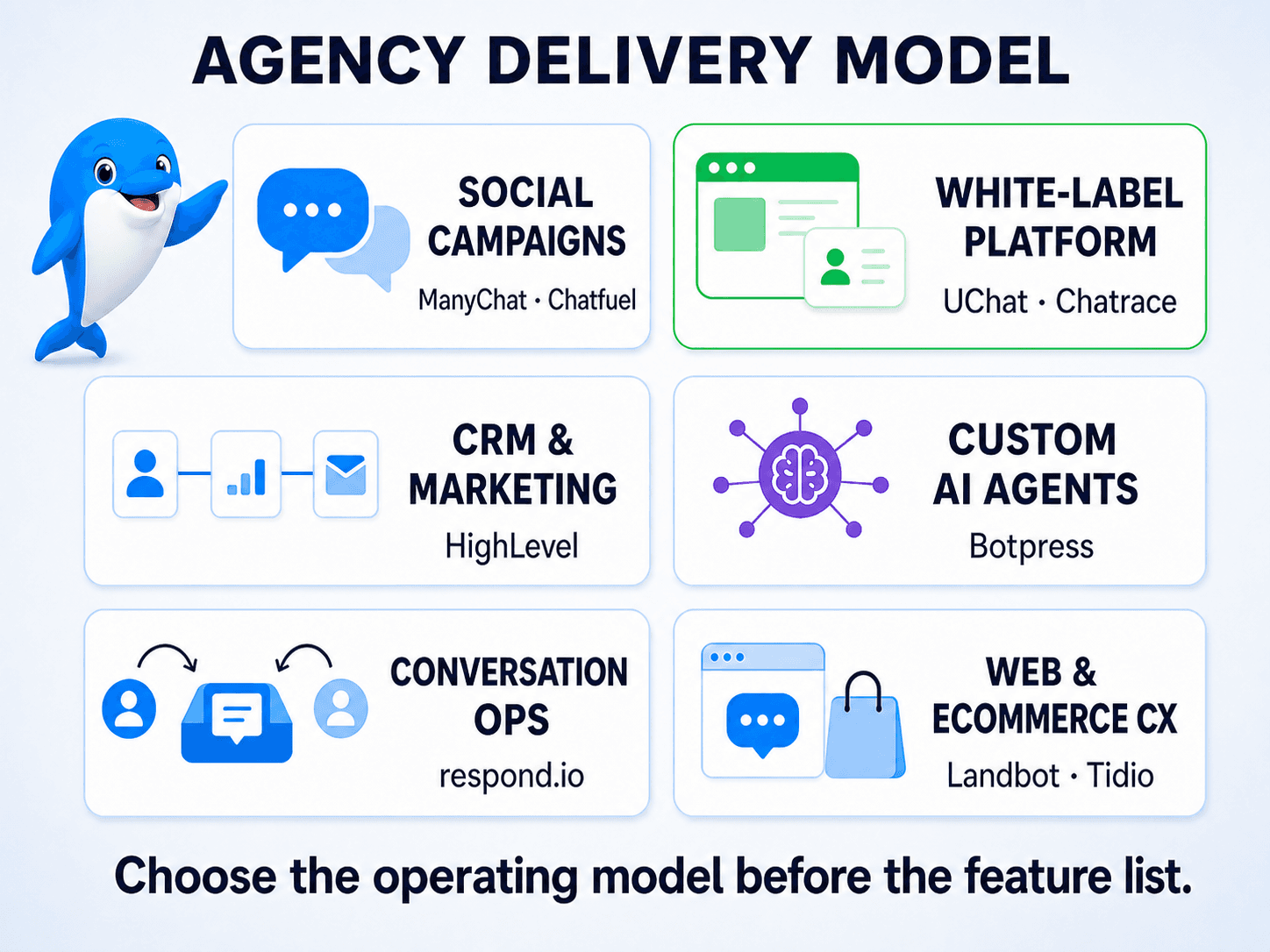
The result is not “UChat wins every category.” It is a map from an agency offer to the platform most likely to support it.
1. UChat — best for a fully white-labeled omnichannel automation platform
UChat is a strong ManyChat alternative when the agency wants to resell a branded automation platform rather than only deliver campaigns inside a vendor account.
The current UChat Partner Program documents:
an agency custom domain and branded login;
white-label platform settings;
client workspace management;
agency-defined plans and selling prices;
Partner API access;
Stripe or external billing workflows;
reusable templates and automated client onboarding;
AI Agents, visual flows, live chat handoff, CRM and tickets across multiple channels.
The official UChat Partner white-label walkthrough shows the domain, branding, client-workspace, plan, billing and Partner API settings in one operating flow.
The commercial difference is important. Clients can pay the agency's price, while UChat charges the partner for the underlying partner subscription and client licenses. That lets the agency package software, implementation and support into its own recurring offer.
UChat also fits when a social trigger is only the start of the workflow. An Instagram comment or WhatsApp message can continue into qualification, an AI Agent, a customer record, an API call, a ticket or a human Live Chat handoff.
The tradeoff is responsibility. A white-label platform gives the agency more control, but the agency must define onboarding, plans, billing, templates, support and client success. It is more infrastructure than a freelancer needs for one comment-to-DM campaign.
At the time of review, UChat's public Partner page lists a $199 monthly partner fee plus client license costs starting from $10 per client workspace per month. Treat those figures as dated, review the live UChat pricing, and model channel or AI provider fees separately.
For a detailed product comparison, read UChat vs ManyChat.
2. Chatrace — best for bundled white-label social automation
Chatrace is the most direct agency-first addition to this shortlist. Its current product page combines Instagram, Messenger, WhatsApp and other messaging channels with AI Agents, a visual flow builder, a shared inbox, human takeover and CRM-style operations.
The agency model is explicit. Chatrace's current white-label pricing documents an agency domain, brand name and logo, central client-account management, agency-controlled client pricing and a bundled allowance for client accounts and contacts.
Choose Chatrace when the agency wants:
a ManyChat-like social and messaging automation surface;
full platform white label rather than only message-brand removal;
a bundled agency plan with client-account controls;
AI, inbox and human takeover in the same platform.
The tradeoff is packaging. Chatrace's displayed white-label offer uses a larger bundled base plan. UChat uses a partner fee plus client-license model and documents Partner API, configurable client plans, workflow depth and broader partner operations. Compare both against the number of clients, support model and technical workflows you actually expect to run.
3. HighLevel — best for CRM-first agency SaaS
HighLevel is the stronger alternative when the core agency offer is a broad marketing and sales operating system.
Its official white-label CRM page combines custom branding and domains with CRM, pipelines, funnels, websites, booking, reputation tools, marketing automation, snapshots and SaaS Mode. The current Unlimited package lists unlimited sub-accounts; verify the live package before building the commercial model around that limit.
That makes HighLevel useful for an agency selling an integrated local-business stack. The chatbot is part of a larger client system rather than the whole product.
Choose HighLevel when the main promise is closer to:
one CRM and marketing system for every client;
funnels, websites, forms and appointment booking;
pipeline and reputation management;
reusable agency snapshots;
a white-labeled SaaS bundle.
The tradeoff is breadth. Teams that need deep channel-specific chatbot logic, a specialized omnichannel bot builder or a lighter partner cost structure may find that they are buying and maintaining more platform than the conversational project requires.
Compare the narrower workflow differences in UChat vs HighLevel.
4. Botpress — best for developer-led custom AI agents
Botpress is a strong alternative when the agency's differentiator is custom AI-agent engineering.
The Botpress pricing and product page lists a visual building studio, AI spend, knowledge capabilities, human handoff, conversation insights, team collaboration and managed implementation options across its plans.
Its white-label boundary is unusually clear. Botpress says agencies can brand the end user's webchat experience and remove the Botpress watermark on applicable plans, but it does not currently white-label the Studio or Dashboard.
That model fits an agency that builds and operates the agent for a client. The customer sees a branded conversational interface, while the technical team works inside Botpress.
Choose Botpress when you need:
developer control over custom AI behavior;
knowledge and integration work around a specific agent;
a branded webchat experience;
technical teams that can monitor AI usage and maintain the solution.
The tradeoff is that this is not the same reseller model as handing clients a fully agency-branded automation platform. Implementation skill and ongoing AI operations are part of the cost.
Read UChat vs Botpress for a deeper no-code-versus-developer-led comparison.
5. respond.io — best for multi-channel conversation operations
respond.io is a good fit when the agency or client needs to operate a high volume of conversations across messaging channels with a team.
Its current pricing and plan comparison emphasizes team and custom inboxes, broadcasts, workflow automation, AI Agents, integrations, developer APIs, webhooks, reporting and multiple workspaces on higher tiers.
This is an operations-first choice. It is useful when the main question is not “Which flow builder sends the first DM?” but “How will sales or support teams route, assign, automate and report on conversations?”
Choose respond.io when:
shared inbox operations are central;
teams need multiple messaging channels;
automation and AI should sit beside human agents;
higher-tier workspaces, APIs and webhooks match the client architecture.
respond.io also has an official reseller partner program for partners that resell plans, manage the client relationship and earn commissions or resale margin. That is materially different from a simple referral link.
The tradeoff is the client-facing platform model. The official pricing and reseller pages reviewed for this guide document plan resale, commissions, team operations and workspaces; they do not document the UChat-style combination of a custom-domain, fully rebranded client platform and partner-controlled provisioning.
See UChat vs respond.io for a direct comparison.
6. Landbot — best for no-code web and WhatsApp experiences
Landbot is a strong alternative for agencies building structured conversational experiences on websites and WhatsApp.
The current Landbot pricing page documents a visual builder, web and Messenger chat, WhatsApp and API options, AI chats, conditional logic, integrations, human takeover and removal of Landbot branding on applicable plans.
It fits agencies that treat the bot as a guided experience: lead qualification, form-like conversations, appointment intake or a support path with clear branches.
Choose Landbot when:
the website chatbot is a primary surface;
WhatsApp is required on an appropriate plan;
a visual no-code builder matters more than a white-label client platform;
integrations and human takeover cover the delivery model.
The tradeoff is plan design. Web chats, AI chats, WhatsApp access, messages, seats and branding can sit in different packages. Compare the exact client workload against the current plan rather than using only the lowest advertised price.
Read UChat vs Landbot for the broader channel and agency considerations.
7. Tidio — best for ecommerce AI support agencies
Tidio is a useful ManyChat alternative for agencies specializing in ecommerce customer experience and support automation.
Its official Agency Partner Program is built around delivering Lyro AI Agent, Help Desk, Live Chat and Flows to ecommerce clients. The program reviewed for this guide uses referral and co-selling economics, certification and partner support; it does not document a full platform-white-label resale model.
Choose Tidio when your agency:
serves Shopify, WordPress or custom ecommerce stores;
sells AI-assisted support and help-desk optimization;
wants live chat, ticket handling and automation together;
prefers partner referrals or co-selling to operating a full reseller platform.
The tradeoff is strategic ownership. Referral revenue and implementation retainers can be attractive, but they are different from setting the software price and running the client portal under the agency's brand.
See UChat vs Tidio for a direct platform comparison.
8. Chatfuel — best for focused social and WhatsApp automation
Chatfuel is the closest option in this list to a focused ManyChat-style automation product.
The current Chatfuel pricing page presents Instagram, Facebook and WhatsApp automation, a shared inbox, automated replies, a flow builder, contact tools and AI sales and support features.
Chatfuel's official agency onboarding material uses a one-client-per-company operating pattern and allows agency-side billing. That can work well for managed delivery, while keeping client companies separate.
Choose Chatfuel when:
the project centers on Instagram, Facebook or WhatsApp;
the client needs a visual automation setup and shared inbox;
AI sales or support is useful but a complete agency-branded platform is not required;
the team wants a narrower product than a CRM or developer platform.
The tradeoff is the same operating-model question that started this guide. A focused automation tool can be excellent for managed client work, but it is not automatically the right base for a white-labeled SaaS offer.
Read UChat vs Chatfuel for the detailed differences.
Which option fits your agency model?
Start with the offer the client is buying.
Keep ManyChat for social campaign delivery
Keep ManyChat when the agency mainly builds Instagram, TikTok, Messenger or WhatsApp campaigns, wants fast social automation, and is comfortable with separate client accounts and billing.
Switching platforms creates migration work. Do not switch only because a generic alternatives list says another tool has more features.
Choose UChat for a white-labeled automation business
Choose UChat when clients should log in on the agency's domain, use the agency's branded platform, buy agency-defined plans and operate inside client workspaces managed through partner infrastructure.
Choose Chatrace for a bundled white-label social platform
Choose Chatrace when the agency wants social and messaging automation plus a full white-label client platform in one larger bundled agency plan.
Choose HighLevel for a CRM and marketing SaaS offer
Choose HighLevel when funnels, websites, pipelines, reputation, booking and CRM are the center of the agency service.
Choose Botpress for custom AI engineering
Choose Botpress when the agency has developers and sells the design, integration and operation of custom AI agents.
Choose respond.io for conversation operations
Choose respond.io when teams, inboxes, routing, workflows and messaging-channel operations matter more than a reseller portal.
Choose Landbot for web and WhatsApp conversation design
Choose Landbot when the project is a guided web or WhatsApp experience built visually and handed over as a managed solution.
Choose Tidio for ecommerce support delivery
Choose Tidio when the agency specializes in ecommerce CX, AI support, help desk and live chat.
Choose Chatfuel for a focused social alternative
Choose Chatfuel when the client needs a narrower Instagram, Facebook or WhatsApp automation product and does not need full agency white label.
How to compare the real agency cost
A starting subscription price is rarely the agency's real cost.
Model the monthly delivery cost as:
Model the full delivery cost: platform or partner fee + client accounts or workspace licenses + contacts or conversations + AI usage + team seats + channel/provider fees + implementation and support time.
Then ask who owns each line item.
Does the client pay the software vendor directly?
Does the agency pay and bundle the cost into a retainer?
Can the agency set the software price and keep the margin?
Does the platform pay referral revenue instead?
Are WhatsApp, SMS, email, telephony or AI provider charges separate?
How much time will onboarding, maintenance and first-line support require?
Two tools with similar starting prices can produce completely different gross margins. A partner platform may have a higher base fee but better resale economics. A low-cost client account may become expensive when every account needs separate seats, contacts or maintenance.
Build the model for five, twenty and one hundred clients before committing to the platform.
Why it matters: Similar starting prices can create very different margins once client accounts, overages, AI, provider fees and first-line support are included.
Migration checklist
Do not move every client at once.
Inventory each client's channels, account ownership, automations, templates, integrations, contacts and team access.
Confirm Meta, WhatsApp and other channel permissions before disconnecting anything.
Document triggers, consent rules, tags, fields, message windows and billing dependencies.
Rebuild one representative workflow in the target platform.
Test every branch, AI knowledge source, API action and human handoff.
Verify what data can be exported and imported legitimately. Do not assume a ManyChat flow can be imported automatically.
Agree on client communication, downtime, billing change and rollback.
Migrate a small client batch, then compare live results and support load.
Preserve the old setup until the new workflow, reporting and ownership are verified.
A successful migration is not “the bot replied.” It is “the client's complete operating path still works, the right people can support it, and billing matches the commercial agreement.”
Frequently asked questions
Which ManyChat alternative is right for agencies?
UChat is a strong fit when the agency needs a fully white-labeled automation platform with its own domain, client workspaces, pricing, Partner API and broader workflow controls. Chatrace is a direct bundled white-label social option; HighLevel fits CRM-first agency SaaS, Botpress custom AI development, respond.io messaging operations, Landbot web and WhatsApp experiences, Tidio ecommerce support, and Chatfuel focused social automation.
Does ManyChat support agency white label?
ManyChat supports agencies managing and building automations for client accounts. Based on the public agency, account, subscription and pricing materials reviewed on August 31, 2026, those materials do not document a fully white-labeled agency platform. Paid plans can remove a customer-facing “Powered by Manychat” message label; that does not white-label the ManyChat domain, login, dashboard, client account model or billing. Confirm current availability directly with ManyChat before purchase.
Can an agency manage multiple ManyChat clients?
Yes. An agency user can access multiple ManyChat accounts. Current ManyChat documentation says that multiple businesses using the same channel type need separate ManyChat accounts, each with its own settings and billing.
What is the difference between removing ManyChat branding and white-labeling a platform?
Removing message branding changes what an end customer sees in an automation. Full platform white label changes what the agency's client sees when they log in and use the software, including the domain, interface, workspace, plans, pricing and support surfaces.
Is there a free ManyChat alternative?
Several products in this guide offer a free plan or trial, but the free tier rarely represents agency delivery cost. Check client limits, channels, branding, AI usage, team seats and support before choosing a platform for commercial work.
Which alternative is best for Instagram automation?
ManyChat may still be the right choice for Instagram-first campaigns. Chatfuel is a focused alternative, while UChat is more relevant when Instagram is the entry point to a broader AI, CRM, API or omnichannel workflow.
Which alternative is best for WhatsApp and omnichannel automation?
UChat is a strong choice for agencies combining WhatsApp with AI Agents, visual workflows, Live Chat and multiple channels under a white-label partner model. Landbot fits visual web-and-WhatsApp experiences, and respond.io fits messaging operations across team inboxes. Verify current WhatsApp provider, message and calling requirements for every platform.
How should an agency compare pricing across client accounts?
Calculate the base platform fee, every client account or workspace, contacts or conversations, AI usage, seats, provider charges and support time. Then compare whether the agency pays the vendor, passes through the cost, earns referral revenue or sets its own client price.
Test the operating model before you sell it
If your agency wants to sell a white-labeled automation platform, test more than a demo bot.
Open the platform on your branded domain. Create a client workspace. Install a reusable template. Define a client plan and selling price. Run a lead through an AI step and human handoff. Test the billing and support path.
Explore the UChat Partner Program and book a partner demo to test that operating model. If your decision is still only UChat or ManyChat, continue with the detailed UChat vs ManyChat comparison.
The right ManyChat alternative depends on what your agency is actually selling. Choose UChat for a branded automation platform with your own domain, client workspaces, pricing model, Partner API and broader workflow stack. Chatrace is a direct white-label social-automation option, HighLevel suits CRM-first agencies, Botpress suits developer-led AI projects, respond.io suits messaging operations, Landbot suits web and WhatsApp experiences, Tidio suits ecommerce support, and Chatfuel suits focused social automation.
ManyChat itself remains a good option for agencies running repeatable Instagram, TikTok, Messenger or WhatsApp campaigns. The reason to change is not that ManyChat cannot serve agencies. It is that a managed social-automation service and a white-labeled software platform are different businesses.
Reviewed August 31, 2026. Competitor plans and features change, so verify the linked official pages before buying. UChat publishes this comparison and is included as one option; every product is evaluated with the same operating-model criteria and first-party sources.
ManyChat alternatives at a glance
Platform | Best for | Client-facing brand model | Client operating model | Main tradeoff |
|---|---|---|---|---|
UChat | Agencies reselling a branded omnichannel automation platform | Full agency-branded domain, login and client platform | Partner-controlled client workspaces, plans and lifecycle | More setup than a single social campaign tool |
Chatrace | Agencies wanting a bundled white-label social and messaging platform | Agency domain, brand name, logo and client-facing platform | Central client-account management with agency pricing controls | Higher bundled base cost and a less modular licensing model |
HighLevel | Agencies selling CRM, funnels and marketing software | White-labeled agency CRM and SaaS experience | Sub-accounts inside a broader agency operating system | Chatbot automation is one part of a much larger stack |
Botpress | Developer-led agencies building custom AI agents | End-user webchat can be branded; Studio and Dashboard remain Botpress | Technical agent projects and workspaces | Requires more AI and integration engineering |
respond.io | Teams operating conversations across messaging channels | Vendor platform plus a reseller partner model | Team inboxes, multiple workspaces on higher plans and plan resale | Reviewed pages do not document a custom-domain, rebranded client platform |
Landbot | No-code web and WhatsApp conversational experiences | Customer-facing bots can remove Landbot branding on applicable plans | Visual bot projects for web, Messenger, WhatsApp and API chat | WhatsApp and higher-volume requirements can change plan economics |
Tidio | Ecommerce AI support and CX retainers | Tidio product delivered through a partner relationship | Referral or co-selling model with client support projects | Partner economics are different from owning a reseller platform |
Chatfuel | Focused Instagram, Facebook and WhatsApp automation | Customer-facing automation with a vendor workspace | Separate business automation projects | Less suitable when the agency needs a full branded client platform |
This table is a starting point, not a universal ranking. A platform that is excellent for a Shopify support retainer may be the wrong foundation for an agency selling branded chatbot software.
Bottom line: Match the platform to the offer, client-access model and support responsibility your agency intends to own.
Why agencies look for a ManyChat alternative
Agencies usually start looking after the service becomes larger than the original social campaign.
The first project may be simple: send a DM after someone comments on an Instagram post, collect an email address and deliver a link. ManyChat is designed for that kind of work and gives agencies a fast way to repeat it.
The operating questions become harder after the fifth or twentieth client:
Will clients log in to ManyChat, or to a platform carrying the agency's brand?
Does every client need a separate account and subscription?
Can the agency define its own software plans and prices?
Can onboarding, workspace creation, upgrades and cancellations be automated?
Does the workflow stop in a social inbox, or continue to web chat, support, CRM, payments and other channels?
Can an AI Agent use approved knowledge, call tools and hand a conversation to a person?
Who provides first-line support when the client cannot find a setting or a workflow fails?
These questions describe the agency's business model. Feature lists matter, but ownership, billing and support determine whether the platform scales as a service or as software.
ManyChat for agencies: what it supports and what white label means
ManyChat's agency page is clear that the platform is used by agencies. It highlights lead capture, appointment booking, sales conversations, reusable flows, messaging channels, integrations and performance tracking.
Agencies can also access separate client workspaces and accounts from one profile. According to ManyChat's current account-management documentation, multiple business accounts of the same channel type require separate ManyChat accounts, each with its own settings and billing.
That is workable for a managed service. The agency can build the flows while the client owns the account and payment relationship, or the agency can operate and pay for separate client accounts.
It is not the same as a fully white-labeled agency platform.
ManyChat's current agency, account, subscription and pricing materials document agency use and separate client accounts, but they do not document a custom-domain, agency-branded reseller platform. A ManyChat Community moderator stated in January 2025 that agencies could sell ManyChat implementation and management as a service, while ManyChat itself could not be white-labeled. Product availability can change, so confirm this boundary directly before purchase.
Capability | Remove customer-facing message branding | White-label the agency platform |
|---|---|---|
“Powered by” label in an automation | Can be removed on applicable paid ManyChat plans | Also removed or replaced |
Agency custom domain | No change | Agency platform runs on the agency's domain |
Branded login and dashboard | No change | Client logs in to the agency-branded interface |
Client workspace and plan controls | Separate vendor accounts | Partner controls client workspace structure and plans |
Agency-defined software pricing | Agency can charge for its service | Agency defines client-facing software plans and margin |
Automated provisioning and billing | Managed outside the message-branding setting | Platform can expose partner billing and workspace lifecycle tools |
The paid plans shown in ManyChat's current pricing model can remove the “Powered by Manychat” message. That improves the customer-facing automation. It does not turn the ManyChat login, dashboard, domain or account structure into the agency's software product.
ManyChat's new-plan rollout uses monthly Active Contacts together with plan-specific channels, users and Inbox seats. Availability can vary by region and account, so use the current subscription guide rather than assuming every client sees the same package.
If your agency sells campaign execution, this may not matter. If your offer promises “our automation platform under our brand,” it matters immediately.
How we selected these alternatives
We did not rank products by the number of boxes they could tick. We evaluated the operating model an agency needs to support.
The seven criteria are:
Client-facing brand: vendor platform, branded widget or complete agency portal.
Client isolation: separate accounts, sub-accounts or managed client workspaces.
Commercial model: vendor subscription, referral/co-sell, managed service or agency resale.
Channel scope: social messaging, web and WhatsApp, or broader omnichannel delivery.
AI and workflow depth: trigger-based automation, support AI or tool-using custom agents.
Human operations: inbox, assignment, handoff, tickets and reporting.
Technical burden: marketer-friendly setup, no-code workflow design or developer-led implementation.
The result is not “UChat wins every category.” It is a map from an agency offer to the platform most likely to support it.
1. UChat — best for a fully white-labeled omnichannel automation platform
UChat is a strong ManyChat alternative when the agency wants to resell a branded automation platform rather than only deliver campaigns inside a vendor account.
The current UChat Partner Program documents:
an agency custom domain and branded login;
white-label platform settings;
client workspace management;
agency-defined plans and selling prices;
Partner API access;
Stripe or external billing workflows;
reusable templates and automated client onboarding;
AI Agents, visual flows, live chat handoff, CRM and tickets across multiple channels.
The official UChat Partner white-label walkthrough shows the domain, branding, client-workspace, plan, billing and Partner API settings in one operating flow.
The commercial difference is important. Clients can pay the agency's price, while UChat charges the partner for the underlying partner subscription and client licenses. That lets the agency package software, implementation and support into its own recurring offer.
UChat also fits when a social trigger is only the start of the workflow. An Instagram comment or WhatsApp message can continue into qualification, an AI Agent, a customer record, an API call, a ticket or a human Live Chat handoff.
The tradeoff is responsibility. A white-label platform gives the agency more control, but the agency must define onboarding, plans, billing, templates, support and client success. It is more infrastructure than a freelancer needs for one comment-to-DM campaign.
At the time of review, UChat's public Partner page lists a $199 monthly partner fee plus client license costs starting from $10 per client workspace per month. Treat those figures as dated, review the live UChat pricing, and model channel or AI provider fees separately.
For a detailed product comparison, read UChat vs ManyChat.
2. Chatrace — best for bundled white-label social automation
Chatrace is the most direct agency-first addition to this shortlist. Its current product page combines Instagram, Messenger, WhatsApp and other messaging channels with AI Agents, a visual flow builder, a shared inbox, human takeover and CRM-style operations.
The agency model is explicit. Chatrace's current white-label pricing documents an agency domain, brand name and logo, central client-account management, agency-controlled client pricing and a bundled allowance for client accounts and contacts.
Choose Chatrace when the agency wants:
a ManyChat-like social and messaging automation surface;
full platform white label rather than only message-brand removal;
a bundled agency plan with client-account controls;
AI, inbox and human takeover in the same platform.
The tradeoff is packaging. Chatrace's displayed white-label offer uses a larger bundled base plan. UChat uses a partner fee plus client-license model and documents Partner API, configurable client plans, workflow depth and broader partner operations. Compare both against the number of clients, support model and technical workflows you actually expect to run.
3. HighLevel — best for CRM-first agency SaaS
HighLevel is the stronger alternative when the core agency offer is a broad marketing and sales operating system.
Its official white-label CRM page combines custom branding and domains with CRM, pipelines, funnels, websites, booking, reputation tools, marketing automation, snapshots and SaaS Mode. The current Unlimited package lists unlimited sub-accounts; verify the live package before building the commercial model around that limit.
That makes HighLevel useful for an agency selling an integrated local-business stack. The chatbot is part of a larger client system rather than the whole product.
Choose HighLevel when the main promise is closer to:
one CRM and marketing system for every client;
funnels, websites, forms and appointment booking;
pipeline and reputation management;
reusable agency snapshots;
a white-labeled SaaS bundle.
The tradeoff is breadth. Teams that need deep channel-specific chatbot logic, a specialized omnichannel bot builder or a lighter partner cost structure may find that they are buying and maintaining more platform than the conversational project requires.
Compare the narrower workflow differences in UChat vs HighLevel.
4. Botpress — best for developer-led custom AI agents
Botpress is a strong alternative when the agency's differentiator is custom AI-agent engineering.
The Botpress pricing and product page lists a visual building studio, AI spend, knowledge capabilities, human handoff, conversation insights, team collaboration and managed implementation options across its plans.
Its white-label boundary is unusually clear. Botpress says agencies can brand the end user's webchat experience and remove the Botpress watermark on applicable plans, but it does not currently white-label the Studio or Dashboard.
That model fits an agency that builds and operates the agent for a client. The customer sees a branded conversational interface, while the technical team works inside Botpress.
Choose Botpress when you need:
developer control over custom AI behavior;
knowledge and integration work around a specific agent;
a branded webchat experience;
technical teams that can monitor AI usage and maintain the solution.
The tradeoff is that this is not the same reseller model as handing clients a fully agency-branded automation platform. Implementation skill and ongoing AI operations are part of the cost.
Read UChat vs Botpress for a deeper no-code-versus-developer-led comparison.
5. respond.io — best for multi-channel conversation operations
respond.io is a good fit when the agency or client needs to operate a high volume of conversations across messaging channels with a team.
Its current pricing and plan comparison emphasizes team and custom inboxes, broadcasts, workflow automation, AI Agents, integrations, developer APIs, webhooks, reporting and multiple workspaces on higher tiers.
This is an operations-first choice. It is useful when the main question is not “Which flow builder sends the first DM?” but “How will sales or support teams route, assign, automate and report on conversations?”
Choose respond.io when:
shared inbox operations are central;
teams need multiple messaging channels;
automation and AI should sit beside human agents;
higher-tier workspaces, APIs and webhooks match the client architecture.
respond.io also has an official reseller partner program for partners that resell plans, manage the client relationship and earn commissions or resale margin. That is materially different from a simple referral link.
The tradeoff is the client-facing platform model. The official pricing and reseller pages reviewed for this guide document plan resale, commissions, team operations and workspaces; they do not document the UChat-style combination of a custom-domain, fully rebranded client platform and partner-controlled provisioning.
See UChat vs respond.io for a direct comparison.
6. Landbot — best for no-code web and WhatsApp experiences
Landbot is a strong alternative for agencies building structured conversational experiences on websites and WhatsApp.
The current Landbot pricing page documents a visual builder, web and Messenger chat, WhatsApp and API options, AI chats, conditional logic, integrations, human takeover and removal of Landbot branding on applicable plans.
It fits agencies that treat the bot as a guided experience: lead qualification, form-like conversations, appointment intake or a support path with clear branches.
Choose Landbot when:
the website chatbot is a primary surface;
WhatsApp is required on an appropriate plan;
a visual no-code builder matters more than a white-label client platform;
integrations and human takeover cover the delivery model.
The tradeoff is plan design. Web chats, AI chats, WhatsApp access, messages, seats and branding can sit in different packages. Compare the exact client workload against the current plan rather than using only the lowest advertised price.
Read UChat vs Landbot for the broader channel and agency considerations.
7. Tidio — best for ecommerce AI support agencies
Tidio is a useful ManyChat alternative for agencies specializing in ecommerce customer experience and support automation.
Its official Agency Partner Program is built around delivering Lyro AI Agent, Help Desk, Live Chat and Flows to ecommerce clients. The program reviewed for this guide uses referral and co-selling economics, certification and partner support; it does not document a full platform-white-label resale model.
Choose Tidio when your agency:
serves Shopify, WordPress or custom ecommerce stores;
sells AI-assisted support and help-desk optimization;
wants live chat, ticket handling and automation together;
prefers partner referrals or co-selling to operating a full reseller platform.
The tradeoff is strategic ownership. Referral revenue and implementation retainers can be attractive, but they are different from setting the software price and running the client portal under the agency's brand.
See UChat vs Tidio for a direct platform comparison.
8. Chatfuel — best for focused social and WhatsApp automation
Chatfuel is the closest option in this list to a focused ManyChat-style automation product.
The current Chatfuel pricing page presents Instagram, Facebook and WhatsApp automation, a shared inbox, automated replies, a flow builder, contact tools and AI sales and support features.
Chatfuel's official agency onboarding material uses a one-client-per-company operating pattern and allows agency-side billing. That can work well for managed delivery, while keeping client companies separate.
Choose Chatfuel when:
the project centers on Instagram, Facebook or WhatsApp;
the client needs a visual automation setup and shared inbox;
AI sales or support is useful but a complete agency-branded platform is not required;
the team wants a narrower product than a CRM or developer platform.
The tradeoff is the same operating-model question that started this guide. A focused automation tool can be excellent for managed client work, but it is not automatically the right base for a white-labeled SaaS offer.
Read UChat vs Chatfuel for the detailed differences.
Which option fits your agency model?
Start with the offer the client is buying.
Keep ManyChat for social campaign delivery
Keep ManyChat when the agency mainly builds Instagram, TikTok, Messenger or WhatsApp campaigns, wants fast social automation, and is comfortable with separate client accounts and billing.
Switching platforms creates migration work. Do not switch only because a generic alternatives list says another tool has more features.
Choose UChat for a white-labeled automation business
Choose UChat when clients should log in on the agency's domain, use the agency's branded platform, buy agency-defined plans and operate inside client workspaces managed through partner infrastructure.
Choose Chatrace for a bundled white-label social platform
Choose Chatrace when the agency wants social and messaging automation plus a full white-label client platform in one larger bundled agency plan.
Choose HighLevel for a CRM and marketing SaaS offer
Choose HighLevel when funnels, websites, pipelines, reputation, booking and CRM are the center of the agency service.
Choose Botpress for custom AI engineering
Choose Botpress when the agency has developers and sells the design, integration and operation of custom AI agents.
Choose respond.io for conversation operations
Choose respond.io when teams, inboxes, routing, workflows and messaging-channel operations matter more than a reseller portal.
Choose Landbot for web and WhatsApp conversation design
Choose Landbot when the project is a guided web or WhatsApp experience built visually and handed over as a managed solution.
Choose Tidio for ecommerce support delivery
Choose Tidio when the agency specializes in ecommerce CX, AI support, help desk and live chat.
Choose Chatfuel for a focused social alternative
Choose Chatfuel when the client needs a narrower Instagram, Facebook or WhatsApp automation product and does not need full agency white label.
How to compare the real agency cost
A starting subscription price is rarely the agency's real cost.
Model the monthly delivery cost as:
Model the full delivery cost: platform or partner fee + client accounts or workspace licenses + contacts or conversations + AI usage + team seats + channel/provider fees + implementation and support time.
Then ask who owns each line item.
Does the client pay the software vendor directly?
Does the agency pay and bundle the cost into a retainer?
Can the agency set the software price and keep the margin?
Does the platform pay referral revenue instead?
Are WhatsApp, SMS, email, telephony or AI provider charges separate?
How much time will onboarding, maintenance and first-line support require?
Two tools with similar starting prices can produce completely different gross margins. A partner platform may have a higher base fee but better resale economics. A low-cost client account may become expensive when every account needs separate seats, contacts or maintenance.
Build the model for five, twenty and one hundred clients before committing to the platform.
Why it matters: Similar starting prices can create very different margins once client accounts, overages, AI, provider fees and first-line support are included.
Migration checklist
Do not move every client at once.
Inventory each client's channels, account ownership, automations, templates, integrations, contacts and team access.
Confirm Meta, WhatsApp and other channel permissions before disconnecting anything.
Document triggers, consent rules, tags, fields, message windows and billing dependencies.
Rebuild one representative workflow in the target platform.
Test every branch, AI knowledge source, API action and human handoff.
Verify what data can be exported and imported legitimately. Do not assume a ManyChat flow can be imported automatically.
Agree on client communication, downtime, billing change and rollback.
Migrate a small client batch, then compare live results and support load.
Preserve the old setup until the new workflow, reporting and ownership are verified.
A successful migration is not “the bot replied.” It is “the client's complete operating path still works, the right people can support it, and billing matches the commercial agreement.”
Frequently asked questions
Which ManyChat alternative is right for agencies?
UChat is a strong fit when the agency needs a fully white-labeled automation platform with its own domain, client workspaces, pricing, Partner API and broader workflow controls. Chatrace is a direct bundled white-label social option; HighLevel fits CRM-first agency SaaS, Botpress custom AI development, respond.io messaging operations, Landbot web and WhatsApp experiences, Tidio ecommerce support, and Chatfuel focused social automation.
Does ManyChat support agency white label?
ManyChat supports agencies managing and building automations for client accounts. Based on the public agency, account, subscription and pricing materials reviewed on August 31, 2026, those materials do not document a fully white-labeled agency platform. Paid plans can remove a customer-facing “Powered by Manychat” message label; that does not white-label the ManyChat domain, login, dashboard, client account model or billing. Confirm current availability directly with ManyChat before purchase.
Can an agency manage multiple ManyChat clients?
Yes. An agency user can access multiple ManyChat accounts. Current ManyChat documentation says that multiple businesses using the same channel type need separate ManyChat accounts, each with its own settings and billing.
What is the difference between removing ManyChat branding and white-labeling a platform?
Removing message branding changes what an end customer sees in an automation. Full platform white label changes what the agency's client sees when they log in and use the software, including the domain, interface, workspace, plans, pricing and support surfaces.
Is there a free ManyChat alternative?
Several products in this guide offer a free plan or trial, but the free tier rarely represents agency delivery cost. Check client limits, channels, branding, AI usage, team seats and support before choosing a platform for commercial work.
Which alternative is best for Instagram automation?
ManyChat may still be the right choice for Instagram-first campaigns. Chatfuel is a focused alternative, while UChat is more relevant when Instagram is the entry point to a broader AI, CRM, API or omnichannel workflow.
Which alternative is best for WhatsApp and omnichannel automation?
UChat is a strong choice for agencies combining WhatsApp with AI Agents, visual workflows, Live Chat and multiple channels under a white-label partner model. Landbot fits visual web-and-WhatsApp experiences, and respond.io fits messaging operations across team inboxes. Verify current WhatsApp provider, message and calling requirements for every platform.
How should an agency compare pricing across client accounts?
Calculate the base platform fee, every client account or workspace, contacts or conversations, AI usage, seats, provider charges and support time. Then compare whether the agency pays the vendor, passes through the cost, earns referral revenue or sets its own client price.
Test the operating model before you sell it
If your agency wants to sell a white-labeled automation platform, test more than a demo bot.
Open the platform on your branded domain. Create a client workspace. Install a reusable template. Define a client plan and selling price. Run a lead through an AI step and human handoff. Test the billing and support path.
Explore the UChat Partner Program and book a partner demo to test that operating model. If your decision is still only UChat or ManyChat, continue with the detailed UChat vs ManyChat comparison.